Nuceiva 50 units powder for injection solution
Spain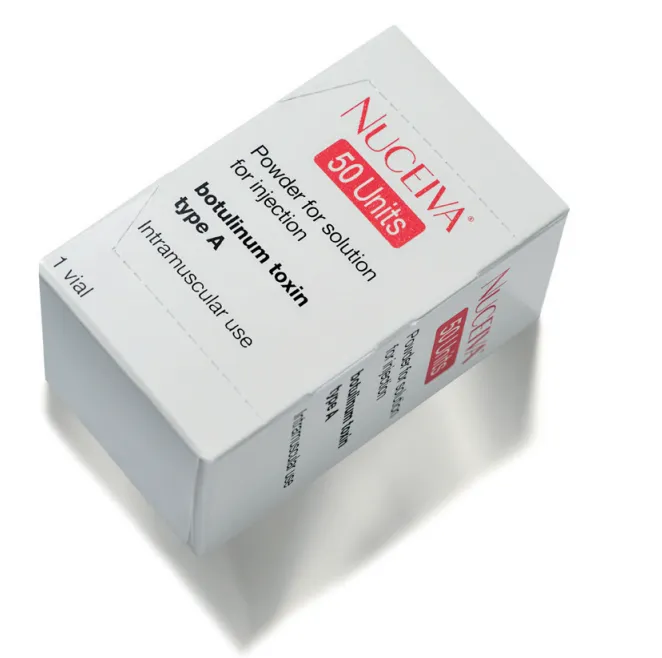
Table of Contents
Package leaflet: Information for the user
Introduction
Package leaflet: information for the user
NUCEIVA 50 Units powder for solution for injection
botulinum toxin type A
Read the entire leaflet carefully before you start using this medicine, because it contains important information for you.
- Keep this leaflet, as you may need to read it again.
- If you have any questions, ask your doctor or pharmacist.
- This medicine has been prescribed for you only, and you should not give it to others, even if they have the same symptoms as you, because it could harm them.
- If you experience any adverse reaction, consult your doctor or pharmacist, even if it is a possible adverse reaction not listed in this leaflet. See section 4.
Leaflet contents
- What NUCEIVA is and what it is used for
- What you need to know before using NUCEIVA
- How to use NUCEIVA
- Possible side effects
- How to store NUCEIVA
- Contents of the pack and other information
1. What NUCEIVA is and what it is used for
NUCEIVA contains the active substance botulinum toxin type A.
It prevents muscle contractions, resulting in temporary paralysis. It works by blocking nerve impulses to the muscles into which it is injected.
NUCEIVA is used to temporarily improve the appearance of vertical frown lines between the eyebrows. It is used in adults under 65 years of age in whom facial lines have a significant psychological impact.
2. What you need to know before using NUCEIVA
Do not use NUCEIVA:
- if you are allergic to botulinum toxin type A or to any of the other components of this medicine (listed in section 6);
- if you have myasthenia gravis or Eaton-Lambert syndrome (chronic diseases affecting the muscles);
- if you have an infection or inflammation at the proposed injection sites between and above the eyebrows (as shown in Figure 1).
Warnings and precautions
Very rarely, adverse effects possibly related to the spread of botulinum toxin from the injection site may occur (e.g., muscle weakness, difficulty swallowing, or aspiration of food or liquids into the airways). Patients receiving the recommended doses may experience excessive muscle weakness.
The injection has been associated with localized pain, inflammation/swelling, abnormal sensation (paresthesia), reduced sensation (hypoesthesia), tenderness on palpation, skin rash (erythema), localized infection, bleeding and/or bruising. Needle-related pain and/or anxiety may lead to vasovagal reactions, such as pallor, nausea, sweating, blurred vision, rapid heartbeat, dizziness and/or a temporary drop in blood pressure causing dizziness or fainting.
Seek immediate medical attention if you experience difficulty swallowing, speaking, or breathing after treatment.
- This medicine is not recommended for patients who have recently or in the past had problems with swallowing (dysphagia) and breathing, as this would prevent safe administration of the medicine in the physician's opinion.
- Excessively frequent or excessive dosing may lead to antibody formation. The development of antibodies may prevent botulinum toxin type A from working, even for other uses.
- Very rarely, an allergic reaction may occur after injection of botulinum toxin.
Symptoms may include skin reactions such as hives, itching, red or pale skin, swelling of the eyes, lips, mouth or throat, weak and rapid pulse, dizziness, wheezing or shortness of breath.
- Eyelid drooping may occur after treatment.
Inform your doctor if:
- you have had problems with previous botulinum toxin injections;
- you do not observe any significant improvement in wrinkles one month after the first treatment cycle;
- you suffer from certain diseases affecting the nervous system (such as amyotrophic lateral sclerosis or motor neuropathy);
- you have inflammation at the proposed injection site;
- the muscles to be injected are weak or damaged;
- you have a bleeding disorder, as the injection may cause bruising.
Children and adolescents
The use of this medicine is not recommended in individuals under 18 years of age.
Other medicines and NUCEIVA
Inform your doctor or pharmacist if you are taking, have recently taken, or might need to take any other medicines.
The use of botulinum toxin together with aminoglycoside antibiotics, spectinomycin, or other medicines affecting nerve impulses to the muscle is not recommended.
Inform your doctor if you have recently received an injection of a medicine containing botulinum toxin (the active substance in NUCEIVA), as this may excessively increase the effect of this medicine.
Pregnancy and breastfeeding
If you are pregnant or breastfeeding, think you may be pregnant, or are planning to become pregnant, consult your doctor before using this medicine.
The use of this medicine is not recommended during pregnancy or in women of childbearing potential who are not using contraceptive methods.
This medicine is not recommended for use during breastfeeding.
Driving and operating machinery
Muscle weakness, dizziness, and visual disturbances have been reported with this medicine, which may make driving or operating machinery hazardous. Do not drive or operate machinery until these effects have resolved.
NUCEIVA contains sodium
This medicine contains less than 1 mmol of sodium (23 mg) per dose; therefore, it is essentially "sodium-free".
3. How to use NUCEIVA
The unit doses of NUCEIVA are not interchangeable with those used for other botulinum toxin preparations.
This medicine should only be administered by physicians with appropriate qualifications and experience in the treatment of glabellar lines with frown lines.
The usual dose of NUCEIVA is 20 Units. You will be injected with the recommended volume of 0.1 milliliters (ml) (4 Units) of this medicine at each of the five injection sites.
Improvement in the depth of wrinkles between the eyebrows usually occurs within a few days after treatment.
The interval between treatments will be determined by your doctor.
How NUCEIVA is injected
This medicine is injected into the muscles (intramuscularly), directly into the affected area between and above the eyebrows.
Once reconstituted, NUCEIVA should only be used to treat a single patient during a single session.
If you have any further questions about the use of this product, ask your doctor or pharmacist.
4. Possible adverse effects
Like all medicines, this medicine can cause adverse effects, although not everyone will experience them.
In general, adverse effects occur during the first few days after the injection and are temporary. Most adverse effects are mild or moderate in intensity.
If you have any difficulty breathing, swallowing, or speaking after receiving this medicine, contact your doctor immediately.
If you develop hives, swelling (including swelling of the face or throat), wheezing, a feeling of weakness, or shortness of breath, contact your doctor immediately, as these may be symptoms of an allergic reaction.
The likelihood of experiencing an adverse effect is described in the following categories:
Common (may affect up to 1 in 10 people) | Headache, muscular imbalance causing raised or asymmetric eyebrows, eyelid drooping, bruising at the injection site |
Uncommon (may affect up to 1 in 100 people) | Sensory disturbances, discomfort in the head, dry eye, eyelid swelling, eye swelling, muscle contractions, injection site: redness, pain, tingling |
Reporting of adverse reactions
If you experience any adverse reactions, consult your doctor or pharmacist, even if they are possible adverse reactions not listed in this leaflet. You can also report them directly through the national reporting system included in Appendix V. By reporting adverse reactions, you can help provide more information on the safety of this medicine.
5. Storage of NUCEIVA
Store in a refrigerator (between 2°C and 8°C).
Keep out of the sight and reach of children.
Unopened vial
Do not use this medicine after the expiry date stated on the vial and the carton after EXP.
6. Contents of the container and other information
Composition of NUCEIVA
- The active substance is: 50 Units of botulinum toxin type A.
- The other components are human albumin and sodium chloride.
Appearance of the product and contents of the container
NUCEIVA is presented as a white powder for injectable solution in a clear glass vial.
Each package contains 1 vial.
Marketing Authorization Holder and Manufacturers
Evolus Pharma B.V.
Apollolaan 151
1077 AR Amsterdam
The Netherlands
Further information on this medicinal product can be obtained by contacting the local representative of the Marketing Authorization Holder.
Date of the most recent review of this leaflet: May 2024.
THIS INFORMATION IS INTENDED FOR MEDICAL OR HEALTHCARE PROFESSIONALS ONLY:
Botulinum toxin units are not interchangeable between products. The recommended doses in units differ from those of other botulinum toxin preparations.
Reconstitution must be performed in accordance with good clinical practices, particularly with regard to aseptic technique. NUCEIVA is reconstituted with sodium chloride 9 mg/ml (0.9%) for injectable solution. Draw up 1.25 ml of sodium chloride 9 mg/ml (0.9%) for injectable solution into a syringe to obtain a reconstituted injectable solution with a concentration of 4 Units/0.1 ml.
Amount of solvent added to the 50-unit vial (sodium chloride 9 mg/ml (0.9%) for injection solution) | Resulting concentration (Units per 0.1 ml) |
1.25 ml | 4.0 U |
The central part of the rubber stopper should be cleaned with alcohol. Slowly inject the diluent into the vial using a needle through the rubber stopper, and gently rotate the vial, avoiding the formation of bubbles. The vial should be discarded if, when creating a vacuum, the diluent does not enter the vial. Once reconstituted, the injectable solution should be visually inspected before use to ensure it is a clear, colorless solution free from particles.
Reconstituted NUCEIVA (50 Units/1.25 mL) is injected using a sterile 30-gauge needle. Administer four units (4 U/0.1 mL) at each of the five injection sites (see Figure 1): two injections in each corrugator muscle (lower inner and upper inner aspects) and one injection in the procerus muscle, resulting in a total dose of 20 Units.
Figure 1 Injection Sites
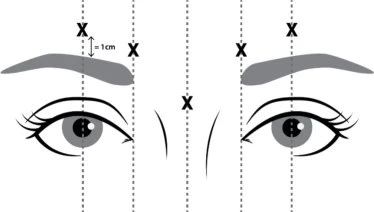
To reduce the risk of eyelid ptosis complications, the following measures should be adopted:
- Avoid injection near the levator palpebrae superioris muscle, especially in patients with large depressor complexes of the eyebrow.
- Injections in the lateral corrugator region should be administered at least 1 cm above the bony supraorbital rim.
- Ensure that the injected volume/dose is accurate and, whenever possible, kept to a minimum.
Procedure for safe disposal of vials, syringes, and used materials:
Immediately after use, any unused reconstituted NUCEIVA injectable solution remaining in the vial or syringe must be inactivated prior to disposal by adding 2 mL of diluted sodium hypochlorite solution (0.5% or 1% available chlorine). After inactivation, dispose of according to local requirements.
Used vials, syringes, and materials must not be emptied and should be discarded in appropriate containers and disposed of in accordance with local regulations.
Recommendations in case of accidents during handling of botulinum toxin:
In the event of an accident while handling the product, whether in the lyophilized or reconstituted form, the following appropriate measures should be applied immediately.
-
The toxin is highly sensitive to heat and certain chemical agents.
-
Spills should be cleaned using an absorbent material soaked in a sodium hypochlorite solution (bleach) for the lyophilized product, or with dry absorbent material if the product has already been reconstituted.
-
Contaminated surfaces should be cleaned with an absorbent material soaked in a sodium hypochlorite solution (bleach), then dried.
-
If a vial breaks, carefully collect the glass fragments and clean up the product as described above, taking care to avoid skin cuts.
-
In case of splashes, wash with a sodium hypochlorite solution and thoroughly rinse with abundant water.
-
If splashed into the eyes, irrigate thoroughly with abundant water or an ocular irrigation solution.
-
If the operator sustains an injury (cut or needlestick), follow the above steps and seek appropriate medical attention depending on the injected dose.
These instructions for use, handling, and disposal must be strictly followed.