Notus Mucus 600 mg effervescent tablets lemon flavour
Spain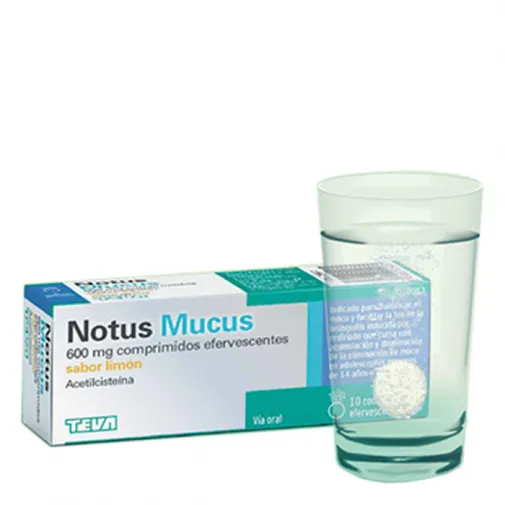
Table of Contents
Package leaflet: Information for the user
Introduction
Package leaflet: information for the patient
Notus Mucus 600 mg effervescent tablets lemon flavour
acetylcysteine
Read all of this leaflet carefully before you start taking this medicine, because it contains important information for you.
Follow exactly the instructions for use of this medicine as described in this leaflet or as directed by your doctor or pharmacist.
-
Keep this leaflet, as you may need to read it again.
-
If you need advice or more information, consult your pharmacist.
-
If you experience any adverse effects, consult your doctor or pharmacist, even if they are adverse effects not listed in this leaflet. See section 4.
-
You should consult a doctor if you get worse or do not improve after 4-5 days.
Contents of the leaflet
- What Notus Mucus is and what it is used for
- What you need to know before taking Notus Mucus
- How to take Notus Mucus
- Possible adverse effects
- How to store Notus Mucus
- Contents of the pack and other information
1. What Notus Mucus is and what it is used for
Notus Mucus contains the active substance acetylcysteine, which is a medication that liquefies mucus accumulated in the respiratory tract.
Notus Mucus is indicated to fluidify mucus and facilitate coughing in cold-induced bronchitis associated with mucus accumulation and reduced mucus clearance in adolescents over 14 years of age and adults.
2. What you need to know before taking Notus Mucus
Do not take Notus Mucus:
- if you are allergic to acetylcysteine or to any of the other ingredients of this medicine (listed in section 6).
Due to the high amount of active substance contained in this medicine, Notus Mucus should not be used in children under 14 years of age. Other medicines with appropriate doses for them are available.
Warnings and precautions
Talk to your doctor or pharmacist before starting to take Notus Mucus if you:
- Experience skin changes. Very rarely, severe skin reactions such as Stevens-Johnson syndrome and Lyell's syndrome have been reported in temporal association with acetylcysteine administration. Therefore, if skin or mucosal changes occur, medical advice should be sought promptly and acetylcysteine should be discontinued.
- Have bronchial asthma.
- Have a history of gastric or duodenal ulcers, especially when used concomitantly with other medicines known to irritate the gastrointestinal mucosa.
- Have histamine intolerance. Long-term treatment should be avoided in these patients, as acetylcysteine affects histamine metabolism and may lead to symptoms of intolerance (e.g., headache, runny nose, itching).
- Are unable to cough up liquefied mucus effectively. The use of acetylcysteine, especially at the beginning of treatment, may liquefy mucus and thus increase the volume of bronchial secretions. If the patient is unable to cough adequately, your doctor will take appropriate measures.
Children and adolescents
Mucolytic medicines may obstruct the airways in children under 2 years of age due to the physiological characteristics of the respiratory tract in this age group. The ability to cough up mucus may be limited. Therefore, mucolytic drugs should not be used in children under 2 years of age.
Taking Notus Mucus with other medicines
Tell your doctor or pharmacist if you are taking, have recently taken, or might need to take any other medicines.
Interaction studies have only been conducted in adults.
You should inform your doctor or pharmacist if you are taking any of the following medicines:
- Medicines for cough (antitussives), as they may cause a dangerous accumulation of secretions due to impaired cough reflex.
- Activated charcoal, used in the treatment of poisoning, may reduce the effect of acetylcysteine.
- Medicines for treating infections (antibiotics) such as tetracyclines, aminoglycosides, penicillins. Clinical studies show that acetylcysteine reduces the effect of antibiotics. Therefore, for safety reasons, antibiotics should be taken separately, with an interval of at least two hours between administration of this medicine and the antibiotic.
This does not apply to medicines containing the active ingredient cefixime or loracarbef. These medicines may be taken at the same time as acetylcysteine.
- Medicines for treating angina attacks; chest, neck, and arm tightness (e.g., nitroglycerin).
Concomitant use of acetylcysteine and nitroglycerin may result in a potentiated vasodilatory effect of glyceryl trinitrate (nitroglycerin), which could be due to a possible anticoagulant effect.
If your doctor considers it necessary to treat you with both nitroglycerin and acetylcysteine, your blood pressure will be monitored, as low blood pressure (hypotension) may occur, which could be severe and cause headaches.
- Medicines for treating epilepsy and nerve pain (carbamazepine).
Concomitant use of acetylcysteine and carbamazepine may reduce the efficacy of carbamazepine due to decreased plasma levels of carbamazepine.
Interference with laboratory test parameters.
Acetylcysteine may interfere with salicylate testing.
In urine tests, acetylcysteine may influence the results of ketone body determination.
It is not recommended to dissolve acetylcysteine with other medicines.
Pregnancy, breastfeeding, and fertility
If you are pregnant or breastfeeding, think you may be pregnant, or are planning to become pregnant, consult your doctor or pharmacist before using this medicine.
Pregnancy
Because there is insufficient experience with the use of acetylcysteine in pregnant women, it should only be used during pregnancy if your doctor considers it absolutely necessary.
Breastfeeding
There is no available information on the excretion of acetylcysteine in breast milk.
For this reason, acetylcysteine should only be used during breastfeeding if your doctor considers it absolutely necessary.
Driving and using machines
There is no evidence of effects on the ability to drive or operate machinery.
Notus Mucus contains sodium
This medicine contains 150 mg of sodium (main component of table/cooking salt) per effervescent tablet. This is equivalent to 7.65% of the maximum daily recommended sodium intake for an adult. This should be particularly considered for patients on a sodium-controlled diet.
Notus Mucus contains aspartame
This medicine contains 20 mg of aspartame per effervescent tablet.
Aspartame contains a source of phenylalanine, which may be harmful in individuals with phenylketonuria (PKU), a rare genetic disorder in which phenylalanine accumulates because the body cannot eliminate it properly.
Notus Mucus contains sucrose and glucose (component of maltodextrin)
If your doctor has diagnosed you with an intolerance to certain sugars, consult with them before taking this medicine.
3. How to take Notus Mucus
Follow exactly the instructions for use provided in this leaflet or those indicated by your doctor or pharmacist. If in doubt, ask your doctor or pharmacist.
The following information applies unless your doctor has prescribed Notus Mucus differently. Follow the instructions for use; otherwise, Notus Mucus may not work properly.
Age | Daily total dose |
Adolescents from 14 years and adults | 1 effervescent tablet once daily |
Form and duration of administration
Dissolve the effervescent tablet in a glass of water and drink the entire contents of the glass.
Take Notus Mucus after meals.
If symptoms worsen or do not improve after 4-5 days, you should consult your doctor.
Talk to your doctor or pharmacist if you think that the effect of Notus Mucus is too strong or too weak.
If you take more Notus Mucus than you should
An overdose may cause gastrointestinal irritation (e.g. abdominal pain, nausea, vomiting, diarrhea).
To date, no serious adverse effects or signs of intoxication have been observed, even after massive overdoses of acetylcysteine tablets. However, in case of overdose or accidental ingestion, contact your doctor or pharmacist immediately or call the Toxicology Information Service at telephone number: 91 562 04 20, indicating the medication and the amount ingested.
If you forget to take Notus Mucus
Do not take a double dose to make up for missed doses. If you miss a dose, wait until the next scheduled dose as described in the instructions for use.
If you have any further questions about the use of this medicine, ask your doctor or pharmacist.
4. Possible adverse effects
Like all medicines, this medicine may cause adverse effects, although not everyone will experience them.
Stop taking Notus Mucus and see a doctor immediately if you experience any of the following very rare adverse effects (may affect up to 1 in 10,000 people):
- Severe skin reactions such as Stevens-Johnson syndrome and Lyell's syndrome with a temporal association with acetylcysteine*. Symptoms may include rash, difficulty swallowing or breathing, swelling of the lips, face, throat or tongue.
*In most reported cases, at least one other pharmaceutical substance was being taken, which may have potentiated the described mucocutaneous effects.
The following adverse effects may occur:
Uncommon (may affect up to 1 in 100 people)
- Hypersensitivity reactions
- Headache
- Ringing in the ears (tinnitus)
- Palpitations
- Vomiting, diarrhoea, inflammation of the mouth mucosa, abdominal pain, nausea
- Allergic reactions: hives, itching, skin rash, skin and mucosal swelling
- Fever
- Low blood pressure
Rare (may affect up to 1 in 1,000 people)
- Dyspnoea, bronchospasm, mainly in patients with hyperreactive bronchial systems such as in bronchial asthma
- Heartburn
Very rare (may affect up to 1 in 10,000 people)
- Hypersensitivity reactions up to shock
- Bleeding
Frequency not known (cannot be estimated from available data)
- Facial fluid retention
You should consult a doctor and stop taking Notus Mucus if new and serious changes in the skin and mucous membranes occur. You must not continue taking Notus Mucus.
Several studies have confirmed a reduction in platelet aggregation (clumping of certain blood components) during administration of acetylcysteine. The clinical significance of this is still unclear.
Countermeasures
Stop taking Notus Mucus at the first signs of a hypersensitivity reaction (see above). In such a case, contact a doctor.
Reporting of adverse effects
If you experience any type of adverse effect, consult your doctor or pharmacist, even if it is a possible adverse effect not listed in this leaflet. You may also report them directly via the Spanish Pharmacovigilance System for Human Medicinal Products website: www.notificaRAM.es. By reporting adverse effects, you can help provide more information on the safety of this medicine.
5. Storage of Notus Mucus
Keep this medicine out of the sight and reach of children.
Do not use this medicine after the expiry date stated on the packaging after CAD or EXP. The expiry date refers to the last day of the month indicated.
Storage conditions
Do not store above 25°C.
Keep the plastic container tightly closed to protect it from moisture.
This medicine should be used within 12 months after first opening the container.
Medicines must not be disposed of via wastewater or household waste. Dispose of unused containers and medicines at the SIGRE Point at your pharmacy. If you are unsure, please consult your pharmacist on how to dispose of unused medicines and their containers. This will help protect the environment.
6. Contents of the pack and other information
Composition of Notus Mucus
-
The active substance is acetylcysteine. Each effervescent tablet contains 600 mg of acetylcysteine.
-
The other components are citric acid, sodium bicarbonate, aspartame (E951), lemon flavour (containing maltodextrin, sucrose, gum arabic (E414), triacetin (E1518), alpha tocopherol (E307), adipic acid, povidone K-25.
Appearance of the product and contents of the container
White to slightly yellowish, round, flat-faced effervescent tablets with a lemon odour.
The effervescent tablets are packed in polypropylene bottles closed with a polyethylene cap, containing a desiccant (60% molecular sieve and 40% silica gel).
Notus Mucus is available in packs of 10 and 20 effervescent tablets.
Only certain pack sizes may be marketed.
Marketing Authorization Holder and Manufacturer
Marketing Authorization Holder
Teva B.V.
Swensweg, 5
2031GA Haarlem, The Netherlands
Manufacturer
Merckle GmbH
Graf-Arco Str. 3
89079 Ulm
Germany
For further information about this medicinal product, please contact the local representative of the Marketing Authorization Holder:
Teva Pharma S.L.U.
C/Anabel Segura 11,
Edificio Albatros B, 1st floor,
28108 Alcobendas, Madrid (Spain)
This medicinal product is authorized in the European Economic Area member states under the following names:
DE: NAC AbZ 600 mg Brausetabletten
ES: Notus Mucus 600 mg effervescent tablets, lemon flavour
FI: Mucoratio 600 mg poretabletti
PL: Acetylocysteinum Flegamina
Date of the most recent review of this leaflet: 03/2024
Detailed and up-to-date information on this medicinal product is available on the website of the Spanish Agency for Medicines and Health Products (AEMPS) http://www.aemps.gob.es/