Normobucal 200 mg/ml solution for oral spray
Spain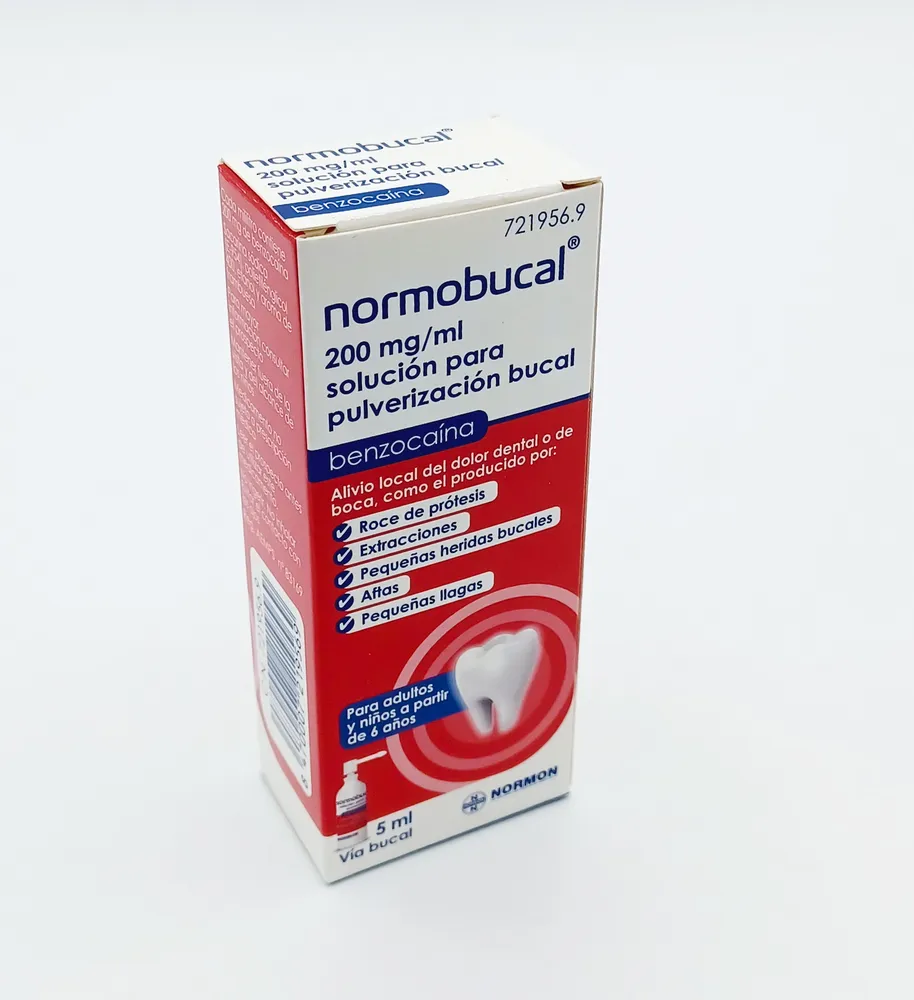
Table of Contents
Patient Information Leaflet
Introduction
Patient Information Leaflet
Normobucal 200 mg/ml oral spray solution
Benzocaine
Read this entire leaflet carefully before you start using this medicine, as it contains important information for you.
Follow exactly the instructions for use provided in this leaflet or as directed by your doctor or pharmacist.
- Keep this leaflet, as you may need to refer to it again.
- If you need advice or further information, consult your pharmacist.
- If you experience any adverse effects, consult your doctor, pharmacist, or nurse, even if they are not listed in this leaflet. See section 4.
- You should consult a doctor if your condition worsens or if you do not improve after 2 days.
Contents of this leaflet
- What Normobucal is and what it is used for
- What you need to know before using Normobucal
- How to use Normobucal
- Possible side effects
- How to store Normobucal
- Contents of the pack and other information
1. What Normobucal is and what it is used for
It is a topical anesthetic that works by suppressing pain when applied externally to the area of the mouth being treated.
It is indicated for local relief of dental or mouth pain, such as that caused by denture irritation, tooth extractions, minor oral wounds, aphthous ulcers, and small sores in adults and children aged 6 years and older.
You should consult a doctor if symptoms worsen or do not improve after 2 days of treatment.
2. What you need to know before using Normobucal
Do not use Normobucal
If you are allergic to benzocaine, to other local anesthetics derived from para-aminobenzoic acid, or to any of the ingredients of this medicine (listed in section 6).
Warnings and precautions
Talk to your doctor or pharmacist before using Normobucal.
- If you are intolerant to other local anesthetics such as para-aminobenzoic acid (PABA), parabens, or paraphenylenediamine (a component of hair dyes).
- If you have a severe or extensive lesion in the mouth.
- Do not exceed the recommended dose indicated in section 3 (How to use Normobucal).
- If you have asthma, bronchitis, or emphysema.
- Stop using the medicine and contact your doctor immediately if you experience: headache, dizziness, shallow breathing, nausea, fatigue, or tachycardia.
- Elderly or debilitated individuals should consult their doctor before using this medicine, as they may be more sensitive to potential adverse reactions.
- Do not swallow or inhale.
- Avoid contact with and/or spraying into the eyes.
- Do not eat or drink while numbness in the mouth persists, due to the risk of biting the tongue or oral mucosa and of choking.
- The risk of developing methemoglobinemia is increased in individuals over 65 years of age and in debilitated patients.
- Young children (especially those under 2 years of age) also have an increased risk of developing methemoglobinemia.
If symptoms worsen or persist beyond 2 days of treatment, consult your doctor.
Children
The use of this medicine is not recommended in children under 6 years of age, as its efficacy and safety have not been established in this age group.
Use of Normobucal with other medicines
Inform your doctor or pharmacist if you are taking, have recently taken, or might need to take any other medicines.
This medicine may interact with:
- Sulfonamides (medicines used to treat infections): should not be used simultaneously with benzocaine, as it may reduce the antibacterial effect of sulfonamides.
- Medicines containing hyaluronidase: should not be used simultaneously with benzocaine, as it may increase the adverse effects of benzocaine.
- Medicines containing cholinesterase, used to treat conditions such as Alzheimer's disease, myasthenia gravis, or glaucoma, because concurrent use may inhibit the metabolism of benzocaine.
- Other local anesthetics. Cross-sensitivity reactions, including anaphylaxis (unusual or exaggerated allergic reaction), may occur between benzocaine and other ester-type local anesthetics, sulfonamides, thiazides, para-amino dyes, glycerol paraminobenzoate (glycerol PABA), paraminobenzoic acid, paraminosalicylic acid, and meprylcaine.
- In individuals sensitive to benzocaine, hair dyes containing paraphenylenediamine may cause severe contact dermatitis.
- Pancreatic function test (diagnostic test): Benzocaine should not be used within 72 hours before undergoing a pancreatic function test with bentiromide, as it may interfere with test results.
Use of Normobucal with food and drinks
Do not use this medicine before meals or before drinking (see section Warnings and precautions).
Pregnancy and breastfeeding
If you are pregnant or breastfeeding, think you may be pregnant, or are planning to become pregnant, consult your doctor or pharmacist before using this medicine.
You should not use benzocaine during pregnancy.
It is unknown whether benzocaine is excreted in breast milk; therefore, women who are breastfeeding should not use this medicine.
Use in people over 65 years of age
Individuals over 65 years of age and debilitated patients may be more sensitive to the adverse effects of benzocaine and should consult their doctor.
Driving and use of machines
Normobucal does not affect the ability to drive or operate machinery.
Normobucal contains ethanol
This medicine contains 47% ethanol (alcohol); this small amount corresponds to 38.8 mg per spray.
3. How to use Normobucal
Follow exactly the administration instructions provided in this leaflet or those indicated by your doctor or pharmacist. If in doubt, consult your doctor or pharmacist.
This medicine is intended for oral use. It must not be swallowed.
Each pump actuation delivers approximately 20 mg of benzocaine.
Recommended dose:
Adults, adolescents, and children aged 6 years and older
Apply one pump actuation to the area to be anesthetized, or soak a cotton swab and hold it in place on the area for several minutes. Apply a maximum of 3 or 4 times daily.
In children (from 6 to under 12 years of age), administration of this medicine should only be performed under adult supervision. The dose is the same as described above.
Elderly and debilitated patients
The dose should be reduced, as elderly and debilitated patients may be more sensitive to the systemic toxicity of benzocaine. Apply to the area to be anesthetized up to 2 or 3 times daily.
Unscrew the bottle cap and attach the applicator cannula to the valve. Press the pump for half a second, directing the applicator cannula toward the area to be anesthetized, or soak a cotton swab with several pump actuations and keep it in contact with the area to be anesthetized for several minutes. Wash your hands after each application.
Do not apply this medicine more than 3 or 4 times daily.
If your condition worsens or if pain persists after 2 days of treatment, consult your doctor.
If you use more Normobucal than you should
There are no known cases of overdose.
Signs of overdose may include: bluish discoloration of the skin, slurred speech, numbness, unsteady gait, blurred or double vision, dizziness, excitement or convulsions, ringing in the ears, and increased sweating. A drop in blood pressure may also occur.
In case of overdose or accidental ingestion, seek immediate medical advice or go to a medical center, or call the Toxicology Information Service (telephone 91 562 04 20), indicating the medicine and the amount ingested.
If you have any further questions about the use of this medicine, consult your doctor or pharmacist.
4. Possible adverse effects
Like all medicines, this medicine can cause adverse effects, although not everyone will experience them.
The following adverse effects have been reported during the period of use of benzocaine, although their frequency cannot be precisely determined:
Urticaria, edema, anaphylactoid reaction (contact dermatitis). Cross-reactions with other ester-type local anesthetics. Photosensitivity, bad taste in the mouth, mucosal dehydration, and difficulty swallowing.
Sensation of oral burning.
Methemoglobinemia, the symptoms of which are: headache, dizziness, shallow breathing, nausea, fatigue, or tachycardia. Methemoglobinemia is mainly due to prolonged use and also occurs in cases of overdose. The risk of developing methemoglobinemia is increased in people with asthma, bronchitis, and emphysema, as well as in individuals over 65 years of age and young children (especially under 2 years), and in people with congenital defects including glucose-6-phosphate dehydrogenase deficiency, hemoglobin-M disease, NADH-methemoglobin reductase deficiency, and pyruvate kinase deficiency.
Prolonged contact of benzocaine with mucous membranes may cause epithelial dehydration and hardening of the mucosa.
Reporting of adverse effects
If you experience any type of adverse effect, consult your doctor, pharmacist, or nurse, even if it involves possible adverse effects not listed in this leaflet. You may also report them directly via the Spanish Pharmacovigilance System for Human Medicines: www.notificaram.es. By reporting adverse effects, you can help provide more information on the safety of this medicine.
5. Storage of Normobucal
This medicine does not require special storage conditions.
Keep this medicine out of the sight and reach of children.
Do not use this medicine after the expiry date stated on the carton after EXP. The expiry date refers to the last day of the month indicated.
Medicines should not be disposed of via wastewater or household waste. Dispose of unused medicines and their containers at a SIGRE collection point at your pharmacy. If you are in doubt, ask your pharmacist how to dispose of medicines and containers you no longer need. This will help protect the environment.
6. Contents of the pack and other information
Composition of Normobucal
- The active substance is benzocaine; each milliliter contains 200 mg of benzocaine.
- The other components (excipients) are: Sodium saccharin (E-954), Polyethylene glycol 400, Ethanol 96º, and Raspberry flavour.
Appearance of the product and contents of the pack
Normobucal is a clear, colourless or pale yellow solution.
It is supplied in aluminium bottles containing 5 ml or 60 ml of solution for oral spray. The pack contains the bottle with cap, a spray applicator nozzle with pump, and a patient leaflet.
Marketing Authorisation Holder and Manufacturer
LABORATORIOS NORMON, S.A.
Ronda de Valdecarrizo, 6 – 28760 Tres Cantos – Madrid (Spain)
Date of the most recent revision of this leaflet: May 2018
Detailed and up-to-date information on this medicinal product is available on the website of the Spanish Agency of Medicines and Health Products (AEMPS) http://www.aemps.gob.es/