Noradrenaline B. Braun 0.5 mg/ml concentrate for solution for infusion
Spain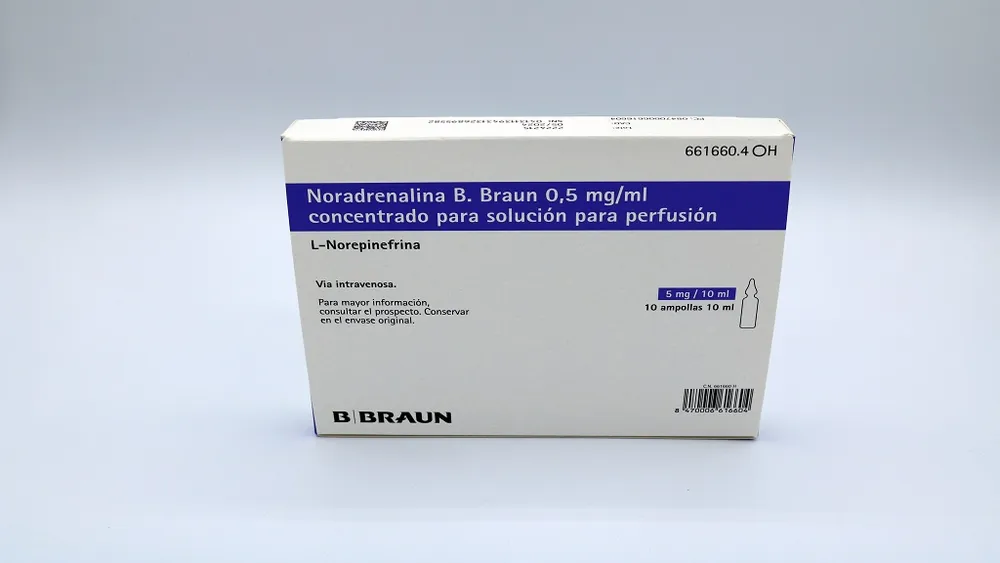
Table of Contents
- Package leaflet: Information for the user
- Introduction
- 1. What Noradrenalina B. Braun is and what it is used for
- 2. What you need to know before starting Noradrenalina B. Braun
- 3. How to use Noradrenalina B. Braun
- 4. Possible adverse effects
- 5. Storage of Noradrenaline B. Braun
- 6. Pack contents and other information
Package leaflet: Information for the user
Introduction
PACKAGE LEAFLET: INFORMATION FOR THE USER
Noradrenaline B. Braun 0.5 mg/ml concentrate for solution for infusion
L-Noradrenaline
Read the entire leaflet carefully before you start using this medicine, as it contains important information for you.
|
Package leaflet:
- What Noradrenalina B. Braun is and what it is used for
- What you need to know before using Noradrenalina B. Braun
- How to use Noradrenalina B. Braun
- Possible side effects
- Storage of Noradrenalina B. Braun
- Contents of the pack and other information
1. What Noradrenalina B. Braun is and what it is used for
Noradrenalina B. Braun belongs to a group of medicines called "adrenergic and dopaminergic agents", which work by increasing blood pressure.
Noradrenalina B. Braun is used for the treatment of acute low blood pressure (acute hypotension).
2. What you need to know before starting Noradrenalina B. Braun
Do not use Noradrenalina B. Braun:
- If you are allergic to bitartrate noradrenaline or to any of the other ingredients of this medicine (listed in section 6).
- As monotherapy if you have low blood pressure (hypotension) due to reduced blood volume (hypovolemia).
- In the lower limbs of elderly patients with occlusive vascular diseases, due to the possibility of reduced blood vessel diameter (vasoconstriction).
- If you are being administered other medications during anesthesia such as halothane or cyclopropane.
- If you have gastrointestinal ulcers or bleeding.
In patients who are sensitive to sulfites
Warnings and precautions:
Talk to your doctor before starting to use Noradrenalina B. Braun.
Inform your doctor of any allergies or medical conditions you have or have had, especially if:
- You have diabetes.
- You have excessive production of thyroid hormones (hyperthyroidism).
- You are suffering from lack of oxygen.
- You have occlusive vascular diseases such as hardening of the arteries (arteriosclerosis) or inflammation of a vein with thrombus formation (Buerger's disease).
- You have had a blood clot inside a blood vessel (thrombosis).
- You have high levels of carbon dioxide in the blood.
- You have low levels of oxygen in the blood.
Use of Noradrenalina with other medicines:
Tell your doctor or pharmacist if you are taking, or have recently taken, any other medicines, including those obtained without a prescription.
Certain medicines may interact with Noradrenalina B. Braun. These should be administered with caution, sometimes requiring dose adjustments (and/or adjustments to the dose of Noradrenalina B. Braun).
It is important that you inform your doctor if you are taking or have recently taken any of the following medicines:
- Organic anesthetics (particularly cyclopropane and halothane)
- Antidepressant medicines: tricyclic antidepressants, monoamine oxidase inhibitors (MAOIs), or maprotiline
- Digitalis glycosides
- Ergoloid mesylates or ergotamine
- Levodopa
- Cocaine
- Hydrochloric chlorpheniramine, hydrochloric tripelennamine, and desipramine
- Medicines for the treatment of allergies: antihistamines
- Amphetamines
- Doxapram
- Mazindol
- Mecamylamine or methyldopa
- Methylphenidate
- Rauwolfia alkaloids
- Other sympathomimetic agents
- Thyroid hormones
- Dihydroergotamine, ergometrine, methylergometrine, or methysergide
- Medicines for blood pressure (such as guanadrel and guanethidine) or for increasing urine elimination (diuretics)
- Desmopressin, lysopressin, or vasopressin
- β-adrenergic blockers
- Lithium
Pregnancy and breastfeeding
Pregnancy:
Consult your doctor or pharmacist before using any medicine. Before Noradrenalina B. Braun is administered, inform your doctor if you are pregnant or trying to become pregnant, as there may be risks to the unborn child.
Breastfeeding:
Consult your doctor or pharmacist before using any medicine. It is unknown whether this medicine is excreted in breast milk, so your doctor will assess the necessity of administration.
Noradrenalina B. Braun contains sodium and sodium metabisulfite (E-223):
10 ml vials:
This medicine contains 34.24 mg of sodium (main component of table/cooking salt) per 10 ml vial. This corresponds to 1.71% of the maximum recommended daily intake of sodium for an adult.
50 ml vial:
This medicine contains 171.2 mg of sodium (main component of table/cooking salt) per 50 ml vial. This corresponds to 8.56% of the maximum recommended daily intake of sodium for an adult.
This medicine may cause severe allergic reactions and bronchospasm (sudden sensation of suffocation) because it contains sodium metabisulfite (E-223).
3. How to use Noradrenalina B. Braun
Noradrenalina B. Braun is administered intravenously.
This medicine will always be administered by healthcare professionals.
Your doctor will decide the dose and frequency at which the medicine will be administered to you.
Follow exactly the administration instructions for this medicine as indicated by your doctor. If in doubt, consult your doctor again.
If you use more Noradrenalina B. Braun than you should:
In case of overdose or accidental ingestion, contact the Toxicology Information Service (telephone: 91.562 04 20) or consult your doctor or pharmacist. Take this leaflet with you.
It is unlikely that this will occur, as your doctor will determine your daily doses. However, if you were to receive more Noradrenalina B. Braun than you should, this could cause you:
A severe increase in blood pressure with intense headache, light sensitivity, acute pain behind the sternum (in the chest), throat pain, marked paleness and intense sweating, and vomiting.
If this occurs, your doctor must immediately stop treatment and, depending on the severity of the situation, administer:
- an appropriate fluid and electrolyte replacement therapy
- a medicine given intravenously to lower blood pressure (antihypertensive), if necessary, to counteract the effects of the elevated blood pressure.
If you have any further questions about the use of this product, ask your doctor or nurse.
4. Possible adverse effects
Like all medicines, Noradrenaline B. Braun may cause adverse effects, although not everyone experiences them.
Leakage of fluid from the vein into surrounding tissues may destroy the tissue around it.
A reduction in heart rate may occur.
Prolonged use may decrease cardiac output.
Prolonged administration of noradrenaline may lead to a reduction in blood volume which, if not corrected, may cause a recurrence of low blood pressure when treatment is discontinued.
Severe narrowing of the blood vessels may occur. This would reduce blood flow and tissue perfusion, resulting in tissue hypoxia, increased blood acidity, and ischemic tissue damage.
The following adverse effects may occur during administration and require medical attention:
Rare (affects between 1 and 10 out of 10,000 patients):
Disorders of the skin and subcutaneous tissue:
Paleness of the skin along the injection vein, formation of skin ulcers (cutaneous eschar), bluish skin discoloration, hot flushes or redness of the skin, skin rash, urticaria or itching (pruritus).
Cardiac disorders:
Irregular heartbeat, decreased heart rate.
Respiratory system disorders:
Wheezing or difficulty breathing.
General disorders and administration site reactions:
Severe dizziness or feeling faint.
Very rare (affects fewer than 1 out of 10,000 patients):
Disorders of the skin and subcutaneous tissue:
Paleness.
Cardiac disorders:
Heart palpitations.
Nervous system disorders:
Anxiety or restlessness, sleep disturbances, tremors, headache.
General disorders and administration site reactions:
Dizziness, neck swelling.
In sensitive individuals, for example those with neurological disorders or hyperthyroidism, the following may occur:
Nervous, thoracic and mediastinal disorders:
Fear, anxiety, pulsating headache, and breathing difficulty.
Cardiac disorders:
Paleness, tachycardia, palpitations, (slight) increase in blood pressure.
If you consider any of the adverse effects you experience to be severe, or if you notice any adverse effects not listed in this leaflet, inform your doctor or nurse.
Reporting of adverse effects
If you experience any type of adverse effect, consult your doctor or nurse, even if it is a possible adverse effect not mentioned in this leaflet. You may also report them directly via the Spanish Pharmacovigilance System for Human Medicines: www.notificaRAM.es. By reporting adverse effects, you can help provide more information on the safety of this medicine.
5. Storage of Noradrenaline B. Braun
Keep out of the sight and reach of children.
No special storage conditions are required.
Store in the original packaging to protect from light.
Do not use this medicine after the expiry date stated on the container (after EXP:). The expiry date refers to the last day of the month indicated.
The contents of the ampoules must be used immediately after opening. Once the container has been opened, discard any unused portion of the solution.
Medicines should not be disposed of via wastewater or household waste. Ask your pharmacist how to dispose of medicines and containers you no longer need. This will help protect the environment.
6. Pack contents and other information
Composition of Noradrenalina B. Braun
The active substance is L-noradrenaline.
Each ml of solution contains 0.5 mg of L-norepinephrine base (equivalent to 1 mg of L-norepinephrine bitartrate).
Each 10 ml ampoule contains 5 mg of L-norepinephrine base (equivalent to 10 mg of L-norepinephrine bitartrate).
Each 50 ml vial contains 25 mg of L-norepinephrine base (equivalent to 50 mg of L-norepinephrine bitartrate).
The other components (excipients) are: sodium chloride, sodium metabisulfite (E-223), hydrochloric acid (for pH adjustment), and water for injections to sufficient quantity.
Appearance of the product and pack contents
Noradrenalina B. Braun is an injectable solution supplied in 10 ml ampoules and 50 ml vials made of colourless glass. It is available in packs containing 10 ampoules of 10 ml and 1 vial of 50 ml.
Marketing Authorization Holder:
- BRAUN MEDICAL, S.A.
Ctra. de Terrassa, 121
Rubí (Barcelona) - 08191 - Spain
Manufacturer:
- BRAUN MEDICAL, S.A.
Ronda de los Olivares, Parcela 11
Polígono Industrial Los Olivares
23009-Jaén (Jaén) - Spain
This summary of product characteristics was approved in June 2021
Detailed information on this medicine is available on the website of the Spanish Agency for Medicines and Health Products (AEMPS):
http://www.aemps.es/
This information is intended exclusively for physicians or healthcare professionals:
Noradrenalina B. Braun must be administered intravenously: the initial dose should be given at a rate of 8 to 12 micrograms (0.008 to 0.012 mg) (base) per minute, adjusting the infusion rate to establish and maintain the desired blood pressure.
For maintenance, adjust the infusion rate to 2 to 4 micrograms (0.002 to 0.004 mg) (base) per minute, titrating the dose according to the patient's response.
In septic shock, doses should be adjusted to approximately 0.5 μg/kg/min (up to a maximum of 1.0 μg/kg/min) to achieve the desired mean arterial pressure. It is recommended to co-administer doses of 2 – 2.5 μg/kg/min of dopamine, which counteract vasoconstriction and ensure adequate renal and splanchnic circulation.
To prepare the noradrenaline intravenous infusion solution, add 4 mg of noradrenaline (base) to 1 litre of 5% glucose solution. The resulting solution will contain 4 micrograms (0.004 mg) of noradrenaline (base) per ml. Note that 1 mg of L-noradrenaline bitartrate is equivalent to 0.5 mg of L-noradrenaline base.
Noradrenalina B. Braun may be used as an emergency measure to maintain perfusion until completion of blood volume replacement therapy.
Duration of treatment
The infusion should be continued until adequate blood pressure and tissue perfusion are maintained without treatment. Noradrenaline infusion should be tapered off gradually, avoiding abrupt discontinuation. In some reported cases of vascular collapse due to acute myocardial infarction, treatment was required for up to six days.
Paediatric dosage
Intravenous infusion: 0.1 microgram (base) per kg per minute, gradually adjusting the infusion rate to achieve the desired blood pressure, up to a maximum of 1 microgram (base) per kg per minute.
When added to local anaesthetics, these solutions contain a noradrenaline concentration of approximately 1:200,000 (5 μg/ml).