Nitoman 25 mg tablets
Spain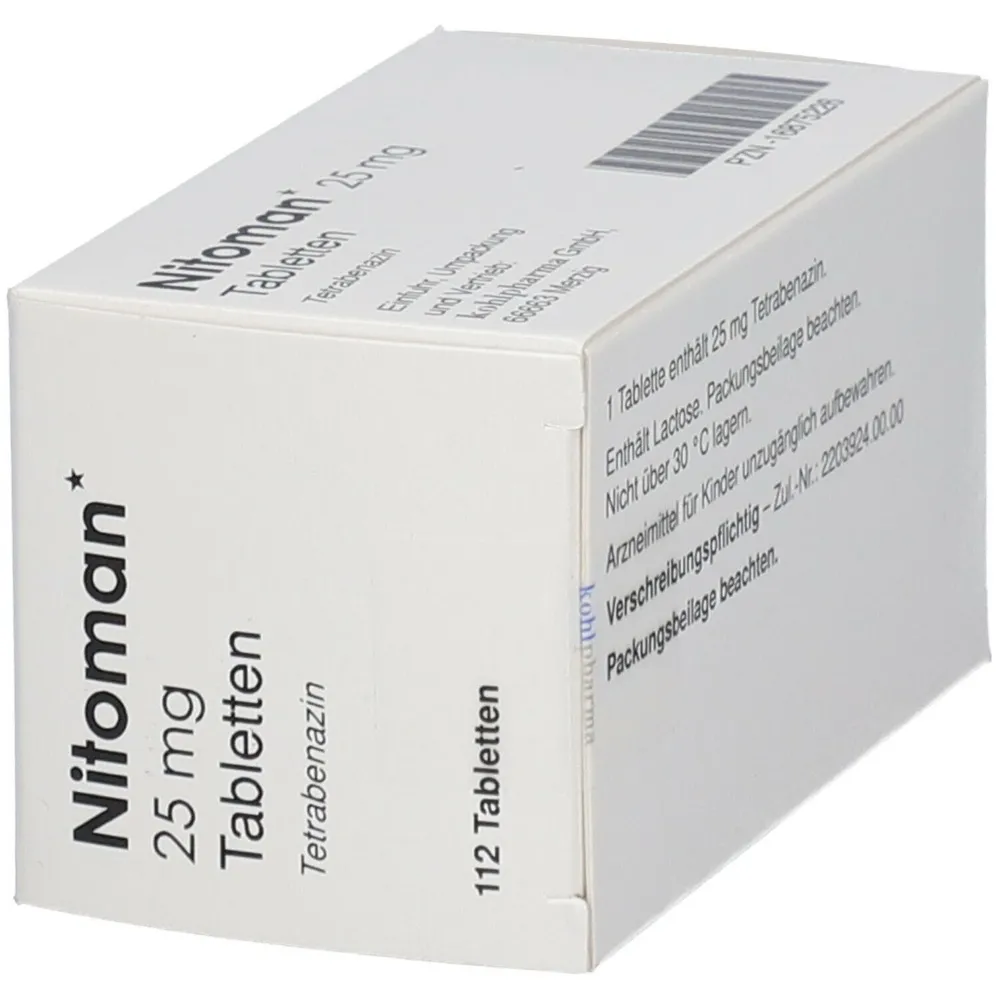
Table of Contents
Package leaflet: Information for the user
Introduction
Package leaflet: information for the user
NITOMAN 25 mg tablets
Tetrabenazine
Read the entire leaflet carefully before you start taking this medicine.
- Keep this leaflet, as you may need to read it again.
- If you have any questions, ask your doctor or pharmacist.
- This medicine has been prescribed for you and should not be given to others, even if they have the same symptoms, as it may harm them.
- If you consider any of the side effects you experience to be severe, or if you notice any side effects not listed in this leaflet, inform your doctor.
Leaflet contents
- What Nitoman is and what it is used for
- Before you take Nitoman
- How to take Nitoman
- Possible side effects
- How to store Nitoman
- Further information
1. What Nitoman is and what it is used for
Nitoman belongs to a group of medicines that act on the nervous system.
This medicine is indicated for the treatment of movement disorders associated with Huntington's chorea (an inherited disorder in which neurons in the brain degenerate, leading to signs of dementia and abnormal movements).
2. BEFORE TAKING NITOMAN
Do not use Nitoman
-
If you are allergic (hypersensitive) to tetrabenazine or any of the components of Nitoman.
-
During pregnancy and breastfeeding.
-
If you have ever been diagnosed with depression or if you have had suicidal thoughts or attempted suicide.
- If you have ever had depression.
- If you have hepatic insufficiency (Child-Pugh score between 5 and 9).
- If you are taking any medication containing reserpine.
- If you have untreated or inadequately treated depression.
- Tetrabenazine must not be administered within two weeks following treatment with monoamine oxidase enzyme inhibitors (MAOIs) (see sections "Special caution with Nitoman", "Use of other medicines", and "Possible side effects").
- If you are taking any medication containing levodopa or dopaminergic drugs (used for the treatment of Parkinson's disease).
- If you have parkinsonism or rigid-akinetic syndrome (parkinsonism).
-
In children.
Special caution with Nitoman
- If you are a poor or intermediate metabolizer of an enzyme called CYP2D6, as you may require a different dose.
- If you have Parkinson's disease, as Nitoman may cause parkinsonism or worsen pre-existing symptoms of the disease.
- If you are being treated with antidepressant medications or have a history of depression, as Nitoman may cause depression or worsen pre-existing depression. Cases of suicidal thoughts and behaviors have been reported in patients taking Nitoman. Consult your doctor before taking this medicine. Irritability and aggressive behaviors may occur or worsen.
- If you have hepatic insufficiency (see section "How to take Nitoman").
- If you have renal insufficiency (see section "How to take Nitoman").
- If you have any heart disease (patients with congenital long QT syndrome, congestive heart failure, or cardiac hypertrophy).
If you have hypotension (low blood pressure).
-
If you have low levels of potassium (hypokalemia) or magnesium (hypomagnesemia).
-
When discontinuing treatment, as a neuroleptic malignant syndrome (NMS) (muscle rigidity, fever, and altered consciousness) may occur. This syndrome may appear immediately after starting treatment, after increasing the dose, or during prolonged treatment.
Nitoman may increase serum prolactin levels (hyperprolactinemia). The clinical significance of this is unknown.
Use of other medicines
Inform your doctor or pharmacist if you are currently using, or have recently used, any other medicines, including those obtained without a prescription.
The following medicines may interact with Nitoman. Inform your doctor if you are taking any of them:
- Levodopa and dopamine agonists (medicines used in the treatment of Parkinson's disease).
- Reserpine (a medicine used to treat hypertension) (see section "Do not use Nitoman").
- Monoamine oxidase enzyme inhibitors (MAOIs) (medicines used in the treatment of depression). After stopping treatment with MAOIs, a two-week interval is recommended before starting treatment with Nitoman. MAO inhibitors (MAOIs) must not be used until at least two weeks after the last dose of tetrabenazine, to avoid potentially serious drug interactions.
- Medicines that inhibit the Central Nervous System (CNS), increasing the sedative effects of tetrabenazine (neuroleptics, hypnotics, and opioids).
- Medicines used in the treatment of epilepsy (such as phenytoin).
- Medicines that prolong the QTc interval (such as tricyclic antidepressants, chlorpromazine, thioridazine), antibiotics (such as gatifloxacin, moxifloxacin), and class I and II antiarrhythmic drugs (such as quinidine, procainamide, amiodarone, sotalol). Antipsychotic medicines (such as haloperidol, chlorpromazine, thioridazine).
- Antihypertensive medicines and beta-blockers, which may increase the risk of orthostatic hypotension (drop in blood pressure upon standing).
Use of Nitoman with food and drinks
No interactions with food are known.
This medicine may enhance the effects of alcohol.
Pregnancy and breastfeeding
Consult your doctor or pharmacist before using any medicine.
You must inform your doctor if you are pregnant, or if you are planning or attempting to become pregnant. Nitoman must not be taken during pregnancy.
You must not breastfeed while taking this medicine.
Driving and use of machines
Do not drive or operate tools or machinery, as Nitoman may cause drowsiness and thereby affect your ability to perform specific tasks.
Important information about some of the components of Nitoman
This medicine contains lactose. If your doctor has informed you that you have an intolerance to certain sugars, consult with him before taking this medicine.
3. How to TAKE NITOMAN
Follow exactly the administration instructions for Nitoman provided by your doctor. Consult your doctor or pharmacist if you have any doubts.
Remember to take your medication.
Your doctor will determine the duration of your treatment with Nitoman.
- Adults:
The usual initial dose in adults is one tablet three times a day (a total of 75 mg). This dose is generally increased by one tablet every three or four days, up to a maximum of eight tablets per day (a total of 200 mg).
- Elderly patients:
Your doctor must decide the appropriate dose.
- Patients with renal impairment:
A slow, gradual increase in the dose of this medicine is recommended. In addition, a lower daily dose may be necessary.
- Patients with hepatic impairment:
A slow, gradual increase in the dose of this medicine is recommended. In addition, a lower daily dose may be necessary.
- Children:
The use of Nitoman is not recommended in children.
The tablets should be swallowed with a sufficient amount of liquid, either water or another non-alcoholic drink.
If you take more Nitoman than you should
In case of overdose or accidental ingestion, contact your doctor or pharmacist immediately, go to the nearest hospital, or call the Toxicology Information Service at telephone number 915 620420.
In case of overdose, the following symptoms may occur: acute dystonia (involuntary muscle contractions affecting the eyes, head, neck, and body), oculogyric crisis (uncontrolled circular eye movements), excessive blinking, nausea, vomiting, diarrhoea, sweating, somnolence, dizziness, hypotension (low blood pressure), and hypothermia (decreased body temperature), confusion, hallucinations, sedation, redness/inflammation, and tremor.
If you forget to take Nitoman
Do not take a double dose to make up for forgotten doses. Continue taking your normal dose at the next scheduled time.
If you stop taking Nitoman
Gradual discontinuation of treatment is recommended. Abruptly stopping treatment could induce neuroleptic malignant syndrome (a serious condition characterized by muscle rigidity, high fever, and somnolence).
4. Possible adverse effects
Like all medicines, Nitoman may cause adverse effects, although not everyone experiences them.
Adverse effects are generally mild and reversible upon discontinuation of treatment.
The following adverse reactions are listed according to MedDRA classification and by frequency:
Very common (may affect more than 1 in 10 people)
- Depression (feeling of sadness), which has been reported in association with suicidal thoughts and behaviors. If you feel down, very sad, or think you may be becoming depressed, you should inform your doctor about this change.
- Parkinsonism (may include symptoms such as muscle rigidity, tremors, and balance or gait disturbances).
Common (may affect up to 1 in 10 people)
- Agitation
- Anxiety (restlessness)
- Confusion
Very rare (may affect up to 1 in 10,000 people)
- Suicidal thoughts
- If you have intentionally tried to harm yourself or started thinking about harming yourself.
- Anger or aggressive behavior
- Neuroleptic malignant syndrome (muscle rigidity, fever, and altered consciousness)
- Pneumonia
- Oculogyric crises (eyes have uncontrolled circular movements)
Frequency not known (cannot be estimated from available data)
- Dizziness and postural hypotension (dizziness or even fainting occurring when standing up quickly from a sitting position)
- Bradycardia (slowing of the heart rate)
- Akathisia (a sensation of physical restlessness without reaching the level of distress)
- Hypertensive crises (critical increase in blood pressure)
Other known adverse effects are:
Very common (may affect more than 1 in 10 people)
- Somnolence
- Tremors
- Excessive salivation
Common (may affect up to 1 in 10 people)
- Insomnia (difficulty sleeping)
Very rare (may affect up to 1 in 10,000 people)
- Leukopenia (decrease in the number of white blood cells)
- Decreased appetite, dehydration (lack of water in the body), weight loss
- Light sensitivity (photophobia)
- Rash, pruritus, or urticaria
- Falls
Frequency not known (cannot be estimated from available data)
- Disorientation, nervousness, malaise, sleep disorders
- Ataxia (lack of coordination in muscle movements), dystonia (involuntary muscle contractions)
- Memory loss
- Difficulty swallowing, nausea, vomiting, stomach pain, diarrhea, constipation, dry mouth
- Increased appetite, weight gain
- Excessive sweating (hyperhidrosis)
- Irregular menstrual cycle
- Fatigue, weakness, hypothermia (reduction in body temperature)
Reporting of adverse effects:
If you experience any type of adverse effect, consult your doctor or pharmacist, even if it is a possible adverse effect not listed in this leaflet. You may also report them directly via the Spanish Pharmacovigilance System for Human Medicines: https://www.notificaram.es.
By reporting adverse effects, you can help provide more information on the safety of this medicine.
5. Storage of NITOMAN
Keep out of the reach and sight of children.
Do not store above 30°C.
Do not use Nitoman after the expiry date stated on the packaging after EXP.
The expiry date refers to the last day of the month indicated.
Medicines should not be disposed of via wastewater or household waste. Dispose of unused containers and medicines at the SIGRE collection point at your pharmacy. If in doubt, ask your pharmacist how to dispose of unused containers and medicines.
This way, you will help protect the environment.
6. ADDITIONAL INFORMATION
Composition of Nitoman 25 mg tablets
The active substance is tetrabenazine.
The other components are: monohydrate lactose, corn starch, talc, magnesium stearate and yellow iron oxide (E172).
Appearance of the product and contents of the container
Beige-yellowish, cylindrical, biconvex tablets with beveled edges, scored, and bearing the mark “CL25”.
Bottle and child-resistant cap made of white high-density polyethylene containing 112 tablets.
Marketing Authorization Holder and Manufacturer
Marketing Authorization Holder:
Bausch Health Ireland Limited
3013 Lake Drive
Citywest Business Campus
Dublin 24, D24PPT3, Ireland.
Manufacturer:
Astrea Fontaine
Rue des Pres Potes – 21121
Fontaine Les Dijon - (France)
For further information about this medicinal product, please contact the local representative of the Marketing Authorization Holder:
Zentiva Spain S.L.U.
Paseo Club Deportivo 1, Edif 4.
Pozuelo de Alarcón 28223 – Madrid, Spain
Detailed and up-to-date information on this medicinal product is available on the website of the Spanish Agency for Medicines and Health Products (AEMPS): http://www.aemps.gob.es/
This leaflet was approved in August 2022