Niquitin Clear 21 mg/24 hours transdermal patch
Spain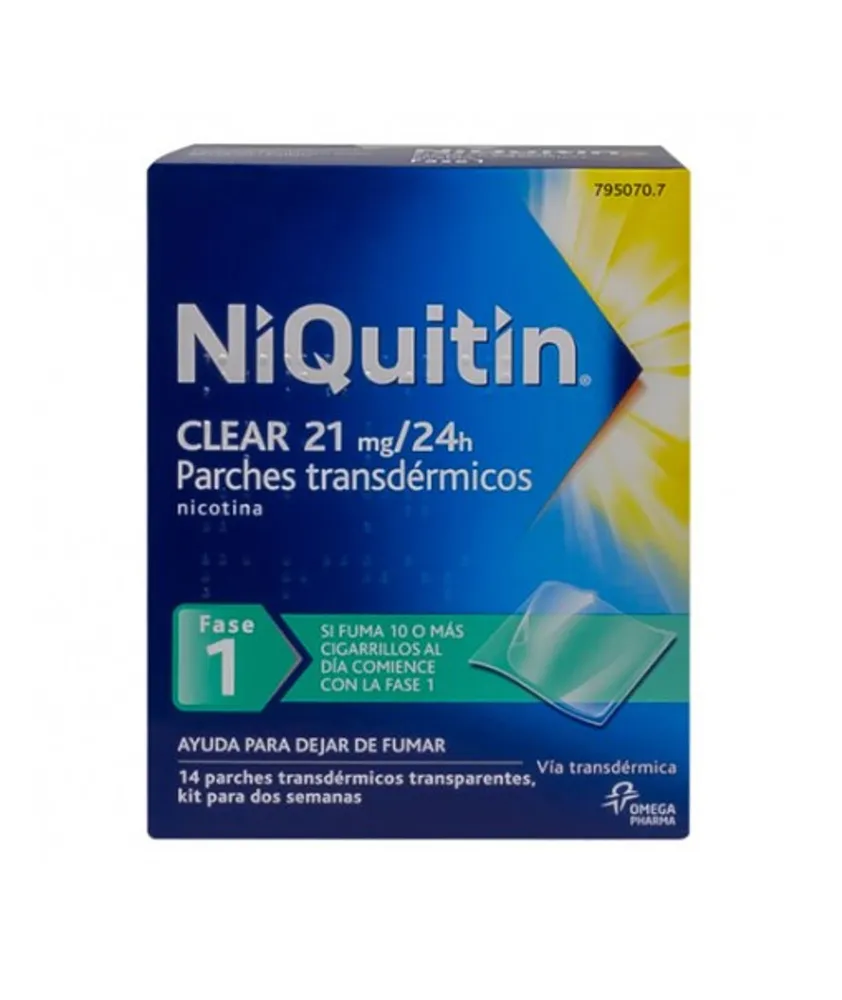
Table of Contents
Patient Information Leaflet
Introduction
Patient Information Leaflet
NiQuitin Clear 21mg/24h Transdermal Patches
Nicotine
Read all of this leaflet carefully before you start using this medicine as it contains important information for you.Always follow the instructions for taking this medicine exactly as described in this leaflet or as advised by your healthcare professional.
|
Package leaflet
- What NiQuitin Clear is and what it is used for
- What you need to know before using NiQuitin Clear
- How to use NiQuitin Clear
- Possible side effects
- How to store NiQuitin Clear
- Contents of the pack and other information
1. What NiQuitin Clear is and what it is used for
NiQuitin Clear are nicotine patches that release nicotine to help people stop smoking. This type of treatment is called Nicotine Replacement Therapy (NRT).
NiQuitin Clear patches are available in 3 doses: 21 mg, 14 mg, and 7 mg/24 h. People who wish to stop smoking should start with the highest dose patch and gradually switch to lower doses (see section 3: How to use NiQuitin Clear). Each dose is supplied in its own packaging.
Nicotine from cigarettes is what makes them addictive. NiQuitin Clear helps you stop smoking by replacing some of the nicotine you normally get from cigarettes. Each patch slowly releases nicotine into the body. This helps relieve some of the unpleasant effects that smokers may experience when trying to quit. It reduces cigarette cravings and helps you resist the urge to smoke.
NiQuitin Clear patches may be used together with any NiQuitin oral product (lozenges or chewing gum) if you have relapsed after trying to quit smoking with NRT, or when a single NiQuitin product is not sufficient to control your cravings, or if you are a heavy smoker (for example, if you smoke more than 10 cigarettes a day) (see section 3: How to use NiQuitin Clear).
NRT does not carry the health risks of tobacco because it does not contain tar, carbon monoxide, or other toxins found in cigarette smoke. Some people are concerned that they might become dependent on nicotine from NRT. This is very rare, but if it were to happen, it would be less harmful than continuing to smoke. In addition, it is easier to break this habit.
Your chances of success improve if you take part in a support programme. If you would like information about such programmes, please consult a healthcare professional.
Smoking has no health benefits. It is always better to stop smoking. Using Nicotine Replacement Therapy (NRT) such as NiQuitin Clear can help. In general, any side effects associated with NRT are greatly outweighed by the dangers of smoking.
2. What you need to know before using NiQuitin Clear
Do not use NiQuitin Clear
- If you are allergic to nicotine or to any of the other ingredients of this medicine (listed in section 6).
- If you are a non-smoker, an occasional smoker, or are under 12 years of age.
Warnings and precautions
Consult your healthcare professional before starting to use NiQuitin Clear:
-
if you are in the hospital due to a heart attack, serious heart rhythm problems, or stroke. You should try to quit smoking without using nicotine replacement therapy (NRT), unless your doctor advises you to use it. Once you leave the hospital, you may use NRT normally.
-
if you have diabetes. You should monitor your blood sugar levels more often than usual when you start using NiQuitin Clear. Your insulin or medication needs may change.
-
if you have had allergic reactions involving swelling of the lips, face, and throat, or itchy skin rash. Using NRT may sometimes trigger this type of reaction.
-
if you have had allergic eczema or dermatitis. You may experience a reaction to the patches.
-
if you have stomach or duodenal ulcers or inflammation of the oesophagus or throat (the passage between the mouth and stomach). NRT may worsen your symptoms.
-
if you have a history of epilepsy (seizures).
-
if you have a history of cardiovascular disease (such as heart disease, angina, or high blood pressure) and wish to use NiQuitin Clear patches in combination with NiQuitin tablets or chewing gum.
-
if you have severe liver or kidney problems. You may be more susceptible to adverse effects.
-
if you have uncontrolled hyperthyroidism or phaeochromocytoma (a tumour of the adrenal gland that can affect blood pressure). Nicotine may worsen your symptoms.
-
if you have any concerns about becoming dependent on this product or if you believe you are already dependent on it.
Consult a healthcare professional before using NiQuitin Clear if any of the above apply to you.
Children (under 12 years of age)
Nicotine levels in NRT are not suitable for children under 12 years of age. Nicotine affects children more than adults and could cause severe poisoning, which may be fatal.
Using NiQuitin Clear with other medicines
Inform your healthcare professional if you are taking, have recently taken, or might need to take any other medicines.
Stopping smoking may alter the effects of other medicines you are taking. If you have any questions or concerns about this, speak with a healthcare professional.
Pregnancy and breastfeeding
Smoking during pregnancy poses risks to the baby, including low birth weight, premature delivery, and miscarriage. Quitting smoking is the best way to improve both your health and your baby's. The earlier you stop smoking, the better.
Ideally, if you are pregnant, you should stop smoking without using NRT. However, if you have tried this and it has not worked, nicotine replacement therapy may be recommended by a healthcare professional, as it is better for your baby than continuing to smoke. You should use NRT as early as possible during pregnancy and ideally only for 2–3 months. Remember, the most important thing is to stop smoking. Oral NRT, such as lozenges, may be preferable to nicotine patches because you do not receive nicotine continuously. However, patches may be better if you experience nausea or vomiting.
If you are breastfeeding, tobacco smoke can cause breathing difficulties and other problems in babies and children. You should try to stop smoking without using NRT first. If you need NRT, the amount of nicotine your baby might receive is small but present. It is much less harmful to the baby than exposure to tobacco smoke. Products such as lozenges are better than patches because you do not receive nicotine continuously.
It is also advisable to breastfeed just before using NRT so that your baby receives the smallest possible amount of nicotine.
Do not use NiQuitin patches in combination with NiQuitin tablets or chewing gum if you are pregnant or breastfeeding, except if considered necessary by a healthcare professional. This is because this combination has not been tested in pregnant or breastfeeding women.
Driving and using machines
There are no known effects of NiQuitin Clear on your ability to drive or operate machinery. However, quitting smoking may cause behavioural changes that could affect your ability in these areas.
3. How to use NiQuitin Clear
Follow exactly the instructions for administering this medicine as described in this leaflet or as directed by your healthcare professional. If in doubt, consult your healthcare professional.
As your body adjusts to not smoking, gradually reduce the dose of patches used until you no longer need them. This step-down program allows you to gradually overcome your body's nicotine dependence.
To maximize your chances of success, it is important to complete the full step-down program.
Apply one new patch each day. Each patch should be used only once and worn for 24 hours. Do not exceed the recommended dose.
Patches for adults (18 years and over)
Table 1: Heavy smokers (more than 10 cigarettes per day)
For 6 weeks | Phase 1, NiQuitin Clear 21 mg/24 h, 1 patch per day |
Weeks 7 and 8 | Phase 2, NiQuitin Clear 14 mg/24 h, 1 patch per day |
Weeks 9 and 10 | Phase 3, NiQuitin Clear 7 mg/24 h, 1 patch per day |
After 10 weeks | Patches can be continued if necessary* |
Table 2: Lightly dependent smokers (fewer than 10 cigarettes per day)
For 6 weeks | Phase 2, NiQuitin Clear 14 mg/24 h, 1 patch per day |
Weeks 7 and 8 | Phase 3, NiQuitin Clear 7 mg/24 h, 1 patch per day |
After 8 weeks | Patches may be continued if necessary* |
*The patches may be continued beyond the recommended 8 or 10 weeks if you need them to remain smoke-free. However, if you are still using them after 9 months, consult a healthcare professional.
Talk to a healthcare professional if you:
- are concerned that you might start smoking again
- are finding it difficult to stop using the patches completely.
If you start smoking again, they can advise you on how to get the best results from further courses of NRT.
Use in children and adolescents
Adolescents (12–17 years inclusive) should follow the instructions in Tables 1 and 2, but should only use the patches for a total of 12 weeks. If you feel you need to use Niquitin Clear for longer than 12 weeks, consult a healthcare professional. NiQuitin patches must not be used in combination with NiQuitin tablets or chewing gum. Do not exceed the recommended dose.
Children under 12 years of age must not use Niquitin Clear
Combining NiQuitin Clear patches with oral NiQuitin products (tablets or chewing gum)
NiQuitin Clear patches alone are not always sufficient. Using oral forms of NiQuitin at the same time as the patches may help control sudden cravings and increase your chances of quitting smoking compared to using patches alone. Oral forms of NiQuitin are available as tablets or chewing gum.
Combining patches with oral NiQuitin may help:
- if you have relapsed after trying to quit smoking with NRT
- if one NiQuitin product alone is not enough to control your cravings
- if you are a heavy smoker (for example, you smoke 10 or more cigarettes per day)
- only if you are 18 years of age or older and any of the above situations apply to you.
Follow the same step-down process with the patches, but take oral NiQuitin when you experience a sudden craving; around 5–6 tablets or chewing gums per day are recommended. See Tables 3 and 4 on the reverse of this leaflet for further details.
When using NiQuitin Clear patches and oral NiQuitin together:
- do not take more than 15 units of 1.5 mg or 2 mg oral NiQuitin in 24 hours
- do not take more than 10 units of 4 mg oral NiQuitin in 24 hours
For more information, read the leaflet provided with the oral NiQuitin product.
Table 3: Combination therapy for highly dependent smokers (10 or more cigarettes per day)
NiQuitin oral form (tablets or chewing gum) | ||
For 6 weeks | Phase 1, NiQuitin Clear 21 mg/24 h, 1 patch per day | 5-6 units of NiQuitin oral form per day. Start with 4 mg of NiQuitin oral form if you smoke more than 20 cigarettes per day. |
Weeks 7 and 8 | Phase 2, NiQuitin Clear 14 mg/24 h, 1 patch per day | Reduce to a lower dose of NiQuitin oral form and continue using it as needed. |
Weeks 9 and 10 | Phase 3, NiQuitin Clear 7 mg/24 h, 1 patch per day | |
After 10 weeks | Stop using patches as soon as possible. | Gradually reduce the amount of NiQuitin oral form. When reduced to 1-2 units per day, discontinue treatment. |
Table 4: Combination therapy for low-dependence smokers (fewer than 10 cigarettes per day)
NiQuitin in oral form (tablets or chewing gum) | ||
For 6 weeks | Phase 2, NiQuitin Clear 14 mg/24 h, 1 patch per day | 5-6 units of NiQuitin in oral form per day, either 2 mg or 1.5 mg. |
Weeks 7 and 8 | Phase 3, NiQuitin Clear 7 mg/24 h, 1 patch per day | Continue using NiQuitin in oral form as needed. |
After 8 weeks | Stop using patches as soon as you can. | Gradually reduce the amount of NiQuitin in oral form. |
How to apply the patches
Choose a clean, dry, and hairless area of skin to apply the patch, to ensure proper adhesion. Avoid cracked skin (such as over a joint) or areas that fold when you move. Also avoid red, damaged, or irritated skin.
-
Do not remove the patch from its pouch until you are ready to use it. Do not use if the pouch is damaged.
-
Cut along the dotted line with scissors, taking care not to damage the patch inside.
-
Carefully remove the patch. A transparent protective layer covers the adhesive side of the patch, which is the side placed on the skin.
-
Remove the patch from its pouch and peel off the transparent protective layers by folding them back, taking care not to touch the adhesive surface.
-
With the adhesive side facing you, remove half of the protective layer starting from the middle. Hold the patch by the outer edge (touching the adhesive surface as little as possible), and then remove the other half of the protective layer.
-
Immediately apply the adhesive side of the patch to your skin. Press firmly with the palm of your hand for at least 10 seconds. Make sure it adheres well, especially around the edges.
-
When applying the patch, avoid touching your eyes or nose. After application, always wash your hands with water only. Do not use soap, as it may increase nicotine absorption.
Water will not damage the patch if it has been applied correctly. You may bathe, swim, or shower for short periods while wearing the patch.
NiQuitin Clear generally adheres well to the skin of most people. However, occasionally a patch may come loose. If the patch falls off, apply a new patch immediately, making sure to choose a different area of skin. Then continue changing patches at your usual time.
How to change the patches
A new patch should be applied once daily, at approximately the same time each day, preferably shortly after waking up. Leave the patch in place for 24 hours, and always choose a different area of skin for each new patch. Do not reuse the same area of skin for at least 7 days.
Disposal of patches
When removing a patch, fold it in half with the adhesive side facing inward and place it back into the pouch from which you just removed your new patch, or wrap it in aluminum foil. Dispose of it carefully, ensuring it is out of reach of children and pets.
If desired, you may remove the patch before going to bed (after approximately 16 hours) and apply a new one in the morning. However, removing the patch before bedtime may reduce its effectiveness in relieving morning cravings.
If you use more NiQuitin Clear than you should:
If you use too many patches at the same time, you may begin to feel nausea, dizziness, and discomfort. Remove all patches and wash and dry your skin with water only (without soap). In case of overdose or accidental ingestion, contact your doctor, pharmacist, go to the nearest hospital, or call the Toxicology Information Service (telephone 91 562 04 20), indicating the product name and amount used.
These patches are not suitable for children under 12 years of age or for non-smokers. If used by children or non-smokers, symptoms of nicotine overdose may occur, including headache, nausea, stomach pain, or diarrhea.
If a child has applied or ingested a patch, remove any patch from the skin and wash the area with water only (without soap), then dry the area. Contact your doctor or nearest hospital immediately. If possible, show them the packaging or this leaflet.
If you forget to use NiQuitin Clear:
As soon as you remember, apply a patch immediately. You may continue changing patches at your usual time.
If you stop treatment with NiQuitin Clear prematurely:
If you stop using this medicine before the recommended time, you may feel the urge to smoke again.
If you have any further questions about the use of this medicine, consult your healthcare professional.
4. Possible adverse effects
Like all medicines, NiQuitin Clear may cause adverse effects, although not everyone experiences them. At the recommended doses, NiQuitin Clear has not been found to cause any serious adverse effects.
The process of quitting smoking itself may produce certain symptoms such as weakness, dizziness, headache, cough, and flu-like symptoms.
Other symptoms that may also be related to withdrawal symptoms associated with quitting smoking include mood changes, insomnia, sleep disturbances, difficulty concentrating, feelings of depression, irritability, anxiety, drowsiness, restlessness, or nervousness.
Very common (may affect more than 1 in 10 people):
- Skin reactions at the site where the patch is applied
- Sleep disturbances, including insomnia and abnormal dreams
- Nausea, vomiting
- Headache
- Dizziness
Common (may affect up to 1 in 10 people):
- Nervousness
- Tremor
- Difficulty breathing
- Sore throat or throat inflammation
- Cough
- Indigestion, stomach pain, diarrhoea, constipation, dry mouth
- Sweating
- Joint pain, muscle pain, chest pain, limb pain
- Weakness or fatigue
Uncommon (may affect up to 1 in 100 people):
- Allergic reaction
- Increased heart rate
- Flu-like symptoms
Rare (may affect up to 1 in 1,000 people):
- Skin reactions, skin sensitivity to sunlight
- Severe symptoms of allergic reactions, which may include wheezing (whistling sounds) or tightness in the chest, rash, and feeling faint
Not known (frequency cannot be estimated from the available data):
- Seizures (fits)
You may experience mild redness, itching, burning, or tingling on the skin where the patch has been applied. This usually disappears quickly after removing the patch. Rarely, a more severe reaction may occur at the application site, including redness, swelling, or rash that does not disappear after 4 days, or a generalized skin reaction. This is more likely if you have a history of dermatitis. If this occurs, stop using the patch and inform your doctor.
Reporting of adverse effects
If you experience any adverse effect, consult your doctor or pharmacist, even if it is a possible adverse effect not listed in this leaflet. You can also report them directly via the Spanish Pharmacovigilance System for Human Medicines: www.notificaram.es.
By reporting adverse effects, you can help provide more information on the safety of this medicine.
5. Storage of NiQuitin Clear
- Keep this medicine out of the sight and reach of children.
- Do not use this medicine after the expiry date stated on the packaging. The expiry date refers to the last day of the month indicated.
- Store below 30 ºC. Keep all patches in the box, inside their protective pouches until ready to use.
- Do not use NiQuitin Clear patches if the pouch is open or damaged.
Dispose of the container responsibly. Medicines should not be disposed of via wastewater or household waste. Return unused medicines and their containers to the SIGRE collection point at your pharmacy. If you have any doubts, ask your pharmacist how to properly dispose of unused medicines and their packaging. This helps protect the environment.
6. Contents of the pack and other information
Composition of NiQuitin Clear patches.
The active substance is nicotine.
The other ingredients are: Ethylene Vinyl Acetate copolymer, Polyethylene Terephthalate, polyethylene film, polyisobutylene and printing ink.
Appearance and contents of the NiQuitin Clear pack
NiQuitin Clear are transparent, colourless rectangular patches for skin application.
Each stage (dose) comes in its own pack and each pack contains 7, 14, 21, 28, or 42 patches. Not all pack sizes may be marketed.
Marketing Authorisation Holder and Manufacturer.
The Marketing Authorisation Holder is:
Perrigo España, S.A.
Pza. Xavier Cugat, 2 - Edif. D, Pl. 1ª
08174 Sant Cugat del Vallès (Barcelona)
Spain.
The manufacturer is:
LTS Lohmann Therapie-Systeme AG
Lohmannstrasse 2
56626 Andernach
Germany
This medicinal product is authorised in certain European Economic Area Member States under the following names:
Germany: Niquitin Clear 14mg/24 Stunden transdermales Pflaster
Austria: Niquitin Clear 14mg/24 Stunden transdermales Pflaster
Spain: Niquitin 14 mg/24 h parches transdérmicos
Ireland: Niquitin Clear 14mg/24 hrs Transdermal Patch
Italy: Niquitin 14mg/24 ore cerotti transdermici trasparenti (nicotina)
Portugal: Niquitin Clear 14mg/24 h sistemas Transdermicos
United Kingdom: Nicabate Clear 14mg/24 hrs transdermal patches.
Date of the most recent review of this leaflet: May 2021
Detailed information on this medicinal product is available on the website of the Spanish Agency for Medicines and Health Products (AEMPS): http://www.aemps.gob.es