Niquitin 4 mg menthol-flavoured tablets for sucking
Spain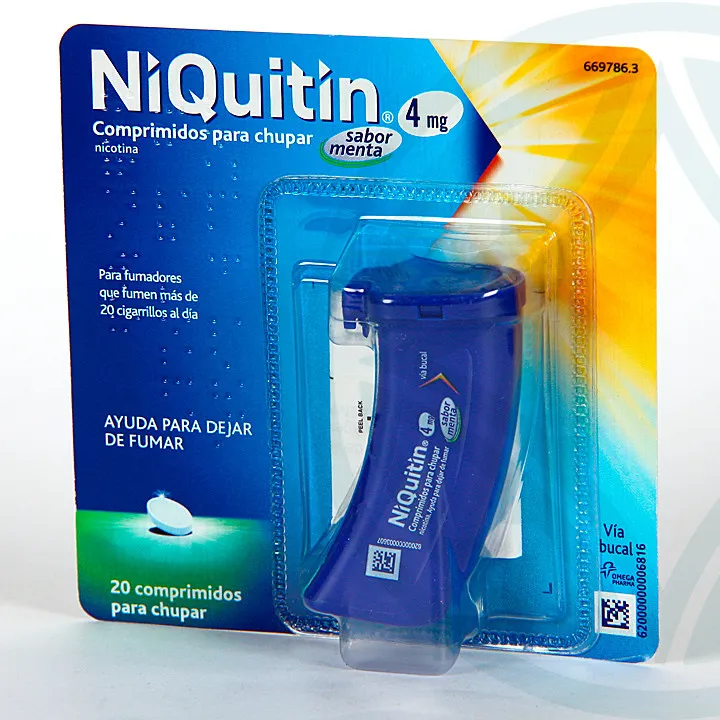
Table of Contents
Patient Information Leaflet
Introduction
Patient Information Leaflet
NiQuitin 4 mg Mint-Flavoured Lozenges
Nicotine
Read the entire leaflet carefully before you start taking this medicine, as it contains important information for you. Always take this medicine exactly as described in this leaflet or as your doctor or pharmacist has told you.
|
Package leaflet contents
- What NiQuitin is and what it is used for
- What you need to know before using NiQuitin
- How to use NiQuitin
- Possible side effects
- How to store NiQuitin
- Contents of the pack and other information
1. What NiQuitin is and what it is used for
NiQuitin is used to help stop smoking. This type of treatment is called Nicotine Replacement Therapy (NRT). NiQuitin 4 mg nicotine tablets for sucking with mint flavour are suitable for smokers who smoke more than 20 cigarettes per day.
The nicotine in cigarettes is what can make you physically addicted to them.
- NiQuitin helps you quit smoking by replacing part of the nicotine provided by cigarettes.
- This nicotine relieves some of the unpleasant symptoms smokers may experience when trying to quit, such as feeling unwell or irritable.
- Nicotine can also reduce cigarette cravings and help you resist the urge to smoke.
NiQuitin does not carry the same health risks as tobacco. This is because it does not contain tar, carbon monoxide, or other toxins found in cigarette smoke. Some people are concerned that after quitting smoking, they might become dependent on nicotine replacement tablets. This is very rare, and if it does occur, it is less harmful than continuing to smoke. In any case, it is an easier habit to break.
Your chances of successfully quitting smoking will improve if you take part in a support programme. These "quit-smoking programmes" are known as behavioural support. For information about such programmes, please consult a healthcare professional.
Smoking has no health benefits. It is always better to quit. Using Nicotine Replacement Therapy (NRT), such as NiQuitin, can help you stop smoking. In general, any possible side effects associated with NRT are outweighed by the well-known dangers of continuing to smoke.
2. BEFORE TAKING NIQUITIN
Do not take NiQuitin:
- If you are allergic (hypersensitive) to nicotine or any of the components of this medicine (see section 6).
- If you are a non-smoker or under 12 years of age.
Warnings and precautions
Consult your doctor or pharmacist before starting to use NiQuitin:
- if you have recently had a heart attack or stroke, or you suffer from serious heart rhythm problems, unstable angina or worsening angina pectoris (chest pain) or angina at rest – you should try to stop smoking without using any nicotine replacement therapy (NRT) unless your doctor advises you to use it.
- if you have diabetes – you should monitor your blood sugar levels more frequently than usual when starting to use NiQuitin. The amount of insulin or medication you require may change.
- if you have a history of epilepsy (seizures).
- if you have ever had allergic reactions including swelling of the lips, face and throat (angioedema) or itching of the skin (urticaria). The use of NRT may sometimes trigger these types of reactions.
Do not switch between using NiQuitin lozenges and nicotine chewing gum during your attempt to quit smoking.
Seek help and advice from a healthcare professional if you have:
- severe or moderate liver problems or severe kidney problems – because you may be more likely to experience side effects.
- uncontrolled hyperactivity of the thyroid gland or phaeochromocytoma (a tumour of the adrenal gland that can affect blood pressure) – your doctor will have told you that nicotine may worsen symptoms of your condition.
- a stomach or duodenal ulcer or inflammation of the oesophagus or glottis (the passage between the mouth and stomach) – the swallowed nicotine may worsen your symptoms. This treatment may also cause mouth ulcers. If your symptoms worsen, consult your doctor. You may wish to use a non-oral form of NRT, such as patches.
- any concerns about becoming dependent on this product, or if you believe you are already dependent on it.
Children and adolescents
This medicine must not be used by children under 12 years of age. A normal dose for an adult smoker could seriously poison or even cause death in a child. It is therefore essential to keep NiQuitin out of sight and reach of children at all times.
Other medicines and NiQuitin
Inform your doctor or pharmacist if you are taking or have recently taken any other medicines, including those obtained without a prescription.
Stopping smoking may alter the effects of other medicines you are taking. If you have any questions or concerns about this, speak to a healthcare professional.
Pregnancy and breastfeeding
If you are pregnant or breastfeeding, think you may be pregnant or are planning to become pregnant, consult your doctor or pharmacist before using this medicine.
Smoking during pregnancy poses risks to the baby, including fetal growth retardation, premature birth or fetal death. Stopping smoking is the best way to improve both your health and that of your baby. The earlier you stop smoking, the better. Ideally, if you are pregnant, you should stop smoking without using nicotine replacement therapy (NRT). However, if you have tried and failed, NRT may be recommended by a healthcare professional to help you quit, as it is better for your baby's development than continuing to smoke. The decision to use NRT should be made as early as possible in pregnancy. You should only use the product for 2–3 months. Remember, the most important thing is to stop smoking. Products such as lozenges may be preferable to nicotine patches, because with lozenges the nicotine delivery is not continuous. However, if you experience nausea or dizziness, patches may be preferable.
If you are breastfeeding, tobacco smoke causes breathing difficulties and other problems in babies and children. Ideally, you should stop smoking without using nicotine replacement therapy (NRT). However, if you have already tried and failed, NRT may be recommended by a healthcare professional. If you need to use NRT to stop smoking, the amount of nicotine that passes to your baby is small. This is much less harmful than exposing your baby to tobacco smoke. It is better to use NRT products that are taken at specific times of day (such as chewing gum or lozenges) rather than patches. It is also advisable to breastfeed just before taking the medicine, which helps ensure your baby receives the smallest possible amount of nicotine.
Driving and using machines
There are no known effects of NiQuitin on your ability to drive or operate machinery. However, you should be aware that quitting smoking may cause behavioural changes that could affect your ability in this regard.
NiQuitin lozenges contain:
Sodium: This medicine contains less than 1 mmol (23 mg) per lozenge, i.e., essentially "sodium-free".
3. HOW TO TAKE NIQUITIN
Always use NiQuitin exactly as described in this leaflet. You should consult a healthcare professional if you are unsure about how to use it.
Place a lozenge in your mouth and occasionally move it from side to side in the mouth until it dissolves completely. This may take about 10 minutes. Do not chew the lozenge or swallow it whole.
Do not use more than 15 lozenges per day.
If you require treatment with this medicine for more than 9 consecutive months, you should consult a healthcare professional.
Adults (over 18 years of age)
- Begin by using 1 lozenge whenever you feel the urge to smoke, up to 8 to 12 lozenges per day.
- Continue in this way for up to 6 weeks, then gradually reduce the number of lozenges you use each day.
- When you are using only 1 or 2 lozenges per day, stop using them.
After successfully quitting smoking, you may suddenly feel the desire to smoke again. If this happens, you may use 1 lozenge.
Use in children and adolescents
Adolescents (12 to 17 years inclusive)
NiQuitin may only be used under the advice of a healthcare professional.
Do not exceed the recommended dose. Follow the instructions carefully and do not take more than
15 tablets per day (24 hours).
Children under 12 years of age must not use NiQuitin.
This medicine is for oral use. This means that the nicotine in the lozenges is slowly released in the mouth, where it is absorbed and enters the body.
If you are tempted to smoke again
If you are concerned about relapsing or have difficulties completely stopping the use of the lozenges, you should consult a healthcare professional.
If you start smoking again, they can advise you on how to achieve better results with future NRT (nicotine replacement therapy) treatments.
If you take more NiQuitin than you should:
If you take more NiQuitin than recommended, you may begin to feel unwell, dizzy, or nauseous. Stop using the lozenges immediately and consult a doctor or go to a hospital emergency department straight away. If possible, take the medicine pack or this leaflet with you.
The lozenges are not suitable for children under 12 years of age or for non-smokers. If children or non-smokers use the lozenges, they may show signs of nicotine overdose. These include headache, nausea, stomach pain, and diarrhoea. If a child has used or swallowed any lozenges, consult your doctor immediately or go to the nearest hospital emergency department. If possible, show them the medicine or this leaflet.
If you have any questions about using this medicine, ask your healthcare professional.
4. Possible adverse effects
Like all medicines, NiQuitin can have adverse effects, although not everyone experiences them. At the recommended doses, NiQuitin has not been found to cause any serious adverse effects.
Stopping smoking may cause symptoms such as dizziness, headache, sleep disturbances, cough, cold-like symptoms. Symptoms such as depression, irritability, anxiety, restlessness, increased appetite, and insomnia may also be related to withdrawal symptoms associated with quitting smoking.
Other adverse effects listed below are grouped according to how frequently they may occur:
Very common (may affect more than 1 in 10 people):
- May cause pain or irritation in the mouth or on the tongue. You may also feel sick.
Common (may affect up to 1 in 10 people):
- Sore throat
- Feeling sick
- Gastrointestinal discomfort
- Diarrhea
- Indigestion/heartburn
- Flatulence
- Hiccups
- Pharyngitis
Uncommon (may affect up to 1 in 100 people):
- Nervousness
- Depression
- Palpitations (awareness of heartbeat)
- Increased heart rate
- Chest pain
- Skin rash
- Tiredness and general malaise
Very rare (may affect up to 1 in 10,000 people):
- Severe allergic reaction symptoms including sudden wheezing or chest tightness (whistling or difficulty breathing), skin rash, and feeling faint.
Frequency not known (frequency cannot be estimated from the available data):
- Seizures (fits)
- Dysphagia (difficulty swallowing)
- Belching (a reflex that expels gas from the stomach through the mouth with noise)
- Increased salivation
- Influenza-like illness (flu-like symptoms)
- Hypersensitivity
- Tremor, dysgeusia (altered taste), oral paresthesia (numbness or tingling in the mouth)
- Dyspnea (difficulty breathing)
- Itching or skin rash, swelling of the skin or mucous membranes, skin redness, increased sweating.
- Rapid and irregular heartbeat (atrial fibrillation).
Reporting of adverse reactions
If you experience any type of adverse reaction, consult your doctor or pharmacist, even if it is a possible adverse reaction not listed in this leaflet. You may also report them directly via the Spanish Pharmacovigilance System for Human Medicinal Products: www.notificaram.es.
By reporting adverse reactions, you can help provide more information on the safety of this medicine.
If any of the adverse reactions you experience are severe or if you notice any adverse reaction not mentioned in this leaflet, inform a healthcare professional.
5. Storage of NIQUITIN
-
Keep this medicine out of the sight and reach of children.
-
Do not use the lozenges after the expiry date stated on the
packaging and the box. The expiry date refers to the last day of the month indicated.
-
Store in the original container to protect it from moisture.
-
Do not store above 25°C.
-
Do not reuse the container due to the possibility that it may contain residual tablet powder.
-
Dispose of the container responsibly. Medicines should not be disposed of via wastewater or household waste. Return unused containers and unwanted medicines to the SIGRE collection point at your pharmacy. If in doubt, ask your pharmacist how to properly dispose of containers and unused medicines. This will help protect the environment.
6. ADDITIONAL INFORMATION
Composition of NiQuitin
The active substance is nicotine. Each lozenge contains 4 mg (in the form of a resin complex called nicotine polacrilex).
The other components are: mannitol (E421), sodium alginate (E401), xanthan gum (E415), potassium bicarbonate (E501), polycarbophil calcium, anhydrous sodium carbonate (E500), potassium acesulfame (E950), powdered mint flavoring, sucralose (E955), magnesium stearate (E470b).
Appearance of NiQuitin and contents of the pack
White oval-shaped lozenges with convex surfaces.
The 4 mg lozenges are marked with "NIC4" on one side.
Each pack contains 20 lozenges, and each presentation may contain 1, 3, or 5 packs of lozenges.
Only certain pack sizes may be commercially available.
Marketing Authorization Holder and Manufacturer
Marketing Authorization Holder
Perrigo España, S.A.
Pza. Xavier Cugat, 2 Edif. D Pl. 1ª
08174 Sant Cugat del Vallès (Barcelona)
Manufacturer:
Perrigo Supply Chain International DAC
The Sharp Building
Hogan Place
Dublin 2
Dublin, D02 TY74 Ireland
This medicine is authorized in certain European Economic Area member states under the following names:
Belgium: NiQuitin Minilozenge 4 mg, zuigtabletten, NiQuitin Minilozenge 4 mg, comprimés à sucer
Netherlands: Niquitin Mini 4 mg Zuigtabletten
Italy: Niquitin 4 mg pastiglie
Luxembourg: NiQuitin Minilozenge 4 mg, Zuigtabletten, NiQuitin Minilozenge 4 mg, comprimés à sucer
Poland: Niquitin Mini, 4 mg, tabletki do ssania
Portugal: Niquitin Menta 4 mg comprimidos para chupar
Sweden: Niquitin 4 mg Komprimerad sugtablett
This leaflet has been reviewed in November 2025.
Detailed and up-to-date information on this medicine is available on the website of the Spanish Agency of Medicines and Health Products (AEMPS) http://www.aemps.gob.es/