Nipent 10 mg powder for solution for injection and for infusion
Spain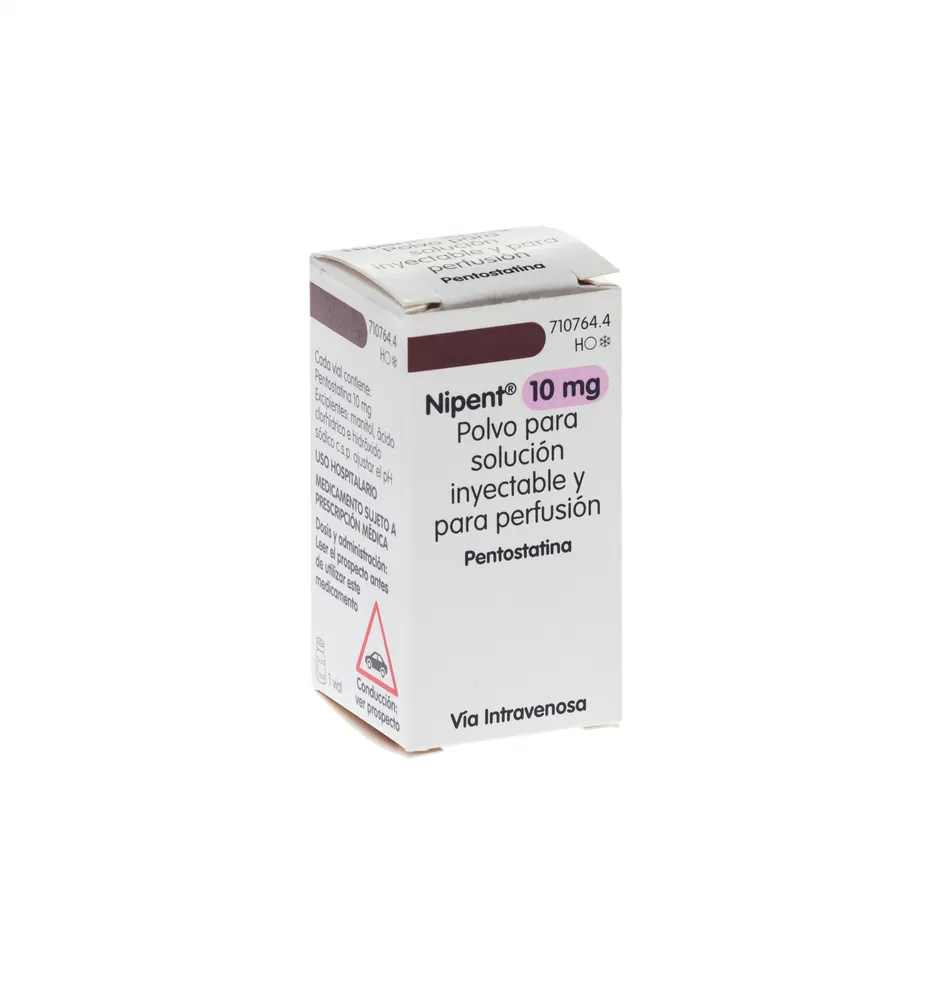
Instructions for Use
Package leaflet: Information for the user
Introduction
Package leaflet: information for the user
NIPENT® 10 mg
Powder for solution for injection and infusion
Pentostatin
Read all of this leaflet carefully before you start using this medicine, because it contains important information for you.
- Keep this leaflet. You may need to read it again.
- If you have any questions, ask your doctor or pharmacist.
- If you get any side effects, talk to your doctor or pharmacist. This includes any possible side effects not listed in this leaflet. See section 4.
Contents of this leaflet
- What Nipent is and what it is used for
- What you need to know before you use Nipent
- How to use Nipent
- Possible side effects
- How to store Nipent
- Contents of the pack and other information
1. What Nipent is and what it is used for
Nipent is an anticancer medicine used to treat adults with hairy cell leukemia, a type of cancer affecting lymphocytes (white blood cells that fight viruses and bacteria).
2. What you need to know before using Nipent
Do not use Nipent:
- If you have had an allergic reaction to Nipent (pentostatin) or to mannitol
- If you have kidney problems (creatinine clearance <60 ml/min)
- If you have an infection (high temperature or fever, chills, or feeling unwell)
Tell your doctor if any of the above conditions apply to you.
Nipent is not recommended for use in children.
Take special care with Nipent:
- If you have liver problems
Inform your doctor if any of the above conditions apply to you.
Tests
Before receiving Nipent for the first time, your kidneys should be evaluated to ensure they are functioning normally. You will also have a blood test, which will be repeated regularly throughout your treatment with Nipent.
Talk to your doctor if, after receiving Nipent, you experience any of the following: confusion, dizziness, sleep disturbances, tingling and prickling sensations, memory loss, unsteadiness when walking, tremors, agitation, fainting, headaches, seizures, or other central nervous system conditions.
Other medicines and Nipent
Inform your doctor or pharmacist if you are taking, have recently taken, or might need to take any other medicines, including those obtained without a prescription.
Nipent should not be used with:
- fludarabine (another cancer medicine)
Tell your doctor if you are taking the following medicines:
- vidarabine (an antiviral medicine)
- cyclophosphamide, etoposide, carmustine (other anticancer medicines)
- allopurinol (a medicine used for gout, high levels of uric acid in the body caused by certain cancer treatments, and kidney stones)
Pregnancy, breastfeeding, and fertility
Pregnancy
Nipent is not recommended during pregnancy. It is very important that you inform your doctor if you are pregnant, trying to become pregnant, or breastfeeding.
Breastfeeding
You must not breastfeed during treatment with Nipent and for 1 week after the last dose.
Fertility
If you wish to have children after treatment with Nipent, you should discuss fertility preservation options with your doctor before starting treatment.
Contraception in men and women
If you are of childbearing potential, you must use effective contraception during treatment with Nipent and for at least 6 months after the last dose. If you become pregnant during treatment, you must inform your doctor immediately.
Men treated with Nipent must use an effective contraceptive method during treatment and for at least 3 months after the last dose.
Driving and use of machines
After receiving this medicine, you may feel unwell or experience dizziness and vision problems. You should not drive or operate machinery if you experience these adverse effects.
Nipent contains sodium
This medicine contains less than 1 mmol of sodium (23 mg) per vial; that is, essentially “sodium-free”.
3. How to use Nipent
Nipent will be administered to you under the supervision of a specialist doctor experienced in this type of treatment.
Dosage
Your doctor will determine the exact dose you need based on your height, weight, and overall health condition. The usual dose for adults, including elderly patients, is 4 mg/m² of body surface area, given once every two weeks. This medicine will be administered as a short injection or as a prolonged intravenous infusion (drip) into a vein over 20 to 30 minutes.
Before and after administration of Nipent, you will receive an intravenous infusion of a solution (glucose or glucose-saline) to ensure adequate hydration. This will help the medicine reach its intended site of action and reduce the risk of side effects.
Duration of treatment
You will continue to receive Nipent treatment until the cancerous cells have been destroyed. Your doctor will review your response to Nipent 6–12 months after starting treatment to assess its effectiveness.
If you use more Nipent than you should
If you receive a dose of Nipent higher than recommended, vital organs (brain, liver, kidney, lung) may be affected, potentially leading to a serious medical condition. If you experience any of the symptoms listed below, contact your doctor immediately, as this may be an acute medical emergency and possibly life-threatening: confusion; drowsiness; seizures; loss of consciousness for a period of time; pain, burning, numbness, or tingling in the hands or feet; weakness in the arms or legs, loss of ability to move arms or legs, or visual and auditory disturbances (difficulty concentrating and tinnitus).
You may also notice: yellowing of the skin and whites of the eyes (jaundice); itching; pain in the upper right part of the abdomen; rash; unexplained fatigue and weakness; or loss of appetite. Other symptoms may include: frequent need to urinate, especially at night (nocturia); swelling of the legs and swelling around the eyes (fluid retention); difficulty breathing, dry cough, discomfort when breathing, or worsening of symptoms when lying on your back.
4. Possible adverse effects
Like all medicines, Nipent can cause adverse effects, although not everyone will experience them.
Nipent works by destroying cancer cells, but sometimes it may also destroy normal blood cells, which can increase the risk of developing an infection. It may also reduce the number of platelets (needed for blood clotting). Your doctor will monitor your condition and inform you if this occurs. There are certain precautions you should take to reduce the risk of infection or bleeding. If possible, avoid contact with people who have infections.
- Contact your doctor immediately if you think you have an infection or if you have fever, sweating, chills, cough, hoarseness, difficulty breathing, mouth or lip sores, swollen and runny nose, sinus pain, lower back or flank pain, difficulty or inability to urinate (passing water), headache with confusion (encephalitis).
- Contact your doctor immediately if you experience any abnormal bleeding, nosebleeds or bruising, black stools, blood in the urine or faeces, red spots on the skin, throat sores, jaundice (yellowing of eyes and skin, pale stools or dark urine), allergic reactions (e.g. severe rash, difficulty breathing, runny nose, facial swelling, painful mouth sores), tremor, spasms, severe chest pain that may also affect your arm and neck (heart attack).
Consult your doctor or nurse as soon as possible if you experience any of the following effects:
Very common (may affect more than 1 in 10 patients)
- stomach pain or feeling unwell
- loss of appetite
- diarrhoea or blood in the stools
- headache
- cough, runny nose, cold, hoarseness or breathing problems
- rash, skin problems or itching
- muscle pain, bone or joint problems
- fatigue, weakness or pain
- fever, sweating or chills
- jaundice
Common (may affect up to 1 in 10 patients)
- abdominal pain, indigestion, bloating or gas, constipation, weight changes
- gum inflammation (gingivitis), mouth or lip inflammation, or throat inflammation
- dental problems, taste changes, dry mouth
- dehydration
- mood changes, aggression, anxiety, nervousness, depression, strange dreams, unusual thoughts, hallucinations, neurosis
- confusion, memory loss
- dizziness, body or limb tremors, shaking, seizures, fainting
- sleep problems or drowsiness
- unsteady gait, speech difficulties, paralysis, inflammation of the membranes covering the brain, nerve damage
- rash, skin peeling, inflammation, redness, skin infection or itching
- dry skin, acne, oily skin, skin discoloration, skin sensitivity to light
- hair loss
- dry eyes or altered tear production, eye pain, eye infections, light sensitivity, vision changes, and damage to the back of the eye (retina)
- ringing in the ears, ear pain, deafness, balance problems, vertigo
- shortness of breath, asthma, blood clots or fluid in the lungs, nosebleeds
- irregular, slow or rapid heartbeat, changes in ECG, high or low blood pressure, shock
- chest pain, angina, fluid around the heart, heart failure, cardiac arrest
- blood clots and vein inflammation, bleeding
- infections such as sinusitis, pneumonia or bronchitis, abscesses, bone, skin, kidney or urinary tract infections, fungal infections (e.g. in the mouth), herpes
- skin cancer or other types of cancer, leukaemia
- problems after transplantation
- enlarged spleen, bruising, enlarged lymph nodes
- gout, changes in blood electrolytes (e.g. sodium, potassium and calcium)
- arthritis, joint problems
- kidney problems, difficulty or pain when urinating, kidney failure, kidney stones, inability to empty the bladder
- missed periods, breast lumps, impotence
Uncommon (may affect up to 1 in 100 patients)
- gastroenteritis, Clostridium difficile gallbladder infection
- bladder infections (cystitis), CMV (Cytomegalovirus), fungal lung infection
- tumour lysis syndrome (includes breakdown products from dying cancer cells)
- specific problems with red blood cells (pure red cell aplasia and certain types of anaemia), red or purple skin spots due to low platelet count
- transplant failure
- heart attack, heart muscle problems, low blood oxygen levels
- organ failure
- severe breathing problems
Rare (may affect up to 1 in 1,000 patients)
- Alzheimer's disease (memory loss, problems with thinking and speaking)
- epileptic seizures
- migraine
- Parkinson's disease (loss of coordination, body and limb tremors)
- eyelid inflammation
- inflammation of the heart lining, reduced heart function
- fungal infection of the oesophagus
Very rare (may affect up to 1 in 10,000 patients):
- severe eye pain with vision loss
This medicine may also cause the following side effects which your doctor should monitor:
Very common (may affect more than 1 in 10 patients)
- blood disorders affecting red blood cells, white blood cells, and platelets (clotting factors)
- changes in blood test results due to liver or kidney function
Common (may affect up to 1 in 10 patients)
- kidney stones
- gland inflammation
- heart and circulation problems
- enlarged spleen
Sometimes the effects of Nipent may not occur until months or years after taking the medicine, and in rare cases, adverse effects have been serious and life-threatening.
These delayed effects may include the development of certain types of cancer (e.g. skin cancer and acute leukaemia). Discuss these possible effects with your doctor.
Reporting of adverse effects
If you experience any type of adverse effect, consult your doctor or pharmacist, even if they are possible adverse effects not listed in this leaflet. You can also report them directly via the Spanish Pharmacovigilance System for Human Medicinal Products: www.notificaRAM.es. By reporting adverse effects, you can help provide more information on the safety of this medicine.
5. Storage of Nipent
Keep this medicine out of the sight and reach of children.
Do not use this medicine after the expiry date stated on the container after "EXP:". The expiry date refers to the last day of the month indicated.
Store in a refrigerator (between 2°C and 8°C).
Reconstituted injections or infusions should be used immediately; however, if this is not possible, they may be stored for up to 8 hours at a temperature below 25°C.
Medicines must not be disposed of via wastewater or household waste. Dispose of unused medicines and their containers at the SIGRE collection point at your pharmacy. If you have any doubts, ask your pharmacist how to dispose of medicines and containers you no longer need. This will help protect the environment.
6. Contents of the container and other information
Composition of Nipent:
The active substance is pentostatin. Each glass vial contains 10 mg of the active substance.
The other components (excipients) are: mannitol, sodium hydroxide or hydrochloric acid.
Appearance of the product and contents of the pack
Nipent is a white powder that is converted into a solution by adding sterile water before administration as an injection or infusion.
Nipent is supplied in single-dose vials, 10 mg vials packed in individual cardboard boxes (packs of 1 vial).
Marketing Authorization Holder:
Pfizer, S.L.
Avenida de Europa 20B
Parque Empresarial La Moraleja
28108 Alcobendas (Madrid)
Spain
Manufacturer:
Pfizer Service Company BV
Hermeslaan 11
1932 Zaventem
Belgium
Date of the most recent revision of this leaflet: 12/2020
Detailed and up-to-date information on this medicine is available on the website of the Spanish Agency of Medicines and Health Products (AEMPS) http://www.aemps.gob.es/
NIPENT 10 mg powder for injectable solution and for infusion
The following information is intended for healthcare professionals only:
For intravenous bolus injection or intravenous infusion administration only. Do not administer by any other route.
Instructions for preparation and dilution
Any unused product or waste material must be disposed of in accordance with local regulations.
Healthcare professionals should refer to recognized national guidelines for handling cytotoxic agents.
Appropriate procedures must be followed for the handling and disposal of anticancer drugs:
- Reconstitution of Nipent must be performed only by trained personnel in a designated area for cytotoxic agents.
- Appropriate protective gloves must be used.
- Pregnant healthcare personnel should not handle the preparation of cytotoxic agents.
- Adequate care and precautions must be taken for the disposal of syringes, needles, and other materials used in reconstituting cytotoxic drugs.
- Contaminated surfaces must be washed thoroughly with abundant water.
- Any remaining solution must be discarded.
Transfer 5 ml of Sterile Water for Injection into the vial containing Nipent and mix well until complete dissolution. The resulting solution should be colorless or pale yellow and contain 2 mg/ml of pentostatin. Parenteral medicinal products should be inspected visually for particulate matter and discoloration prior to administration.
Nipent may be administered intravenously either as a bolus injection or diluted in a larger volume (25 to 50 ml) with 5% dextrose for injection (5% dextrose solution) or 0.9% sodium chloride for injection (0.9% saline solution). Diluting the entire contents of the reconstituted vial with 25 ml or 50 ml results in a pentostatin concentration of 0.33 mg/ml or 0.18 mg/ml, respectively, in the diluted solutions.
The solution of Nipent, when diluted for infusion with 5% dextrose for injection (5% dextrose solution) or 0.9% sodium chloride for injection (0.9% saline solution), does not interact with PVC infusion containers or administration sets at concentrations between 0.18 mg/ml and 0.33 mg/ml.
Acidic solutions should be avoided (the pH of the reconstituted powder is 7.0 to 8.2).
Storage and shelf life:
The reconstituted solution for injection, after further dilution for infusion, should be used within 8 hours and must be stored at temperatures below 25°C. Immediate administration after reconstitution is recommended.
This page has been machine-translated and may contain inaccuracies. The original data is available in the manufacturing country's language.
Last data check: May 18, 2026 · Data source: CIMA — AEMPS