Nilemdo 180 mg film-coated tablets
Spain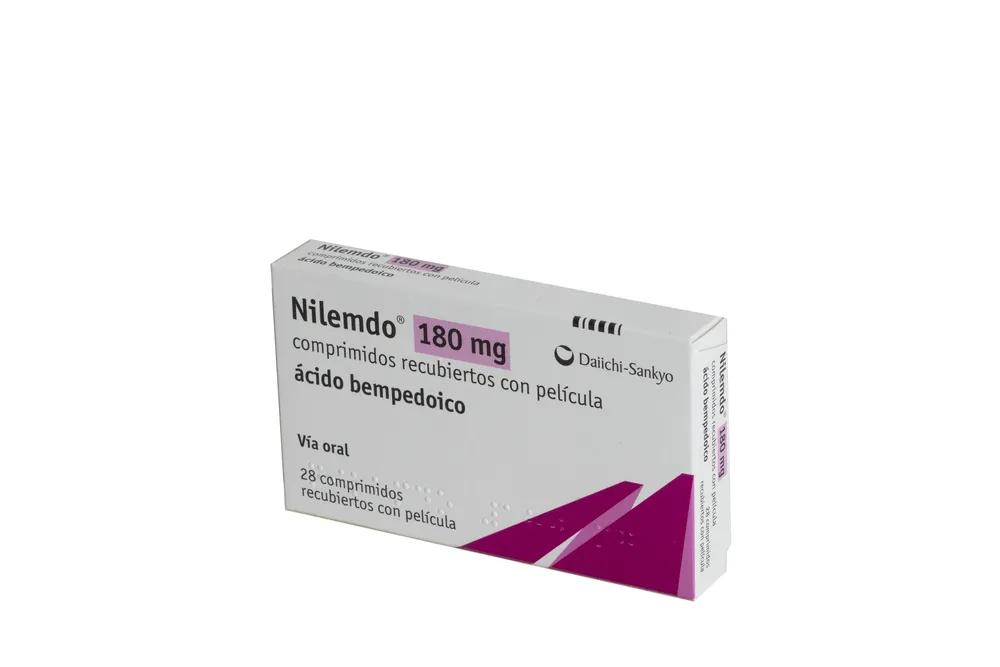
Table of Contents
Patient Information Leaflet
Introduction
Patient Information Leaflet
Nilemdo 180 mg film-coated tablets
bempedoic acid
Read all of this leaflet carefully before you start taking this medicine, as it contains important information for you.
-
Keep this leaflet as you may need to read it again.
-
If you have any questions, ask your doctor or pharmacist.
-
This medicine has been prescribed for you only, and you should not give it to other people, even if they have the same symptoms as you. It may harm them.
-
If you experience any side effects, talk to your doctor or pharmacist, even if the side effects are not listed in this leaflet. See section 4.
Contents of the leaflet
-
What Nilemdo is and what it is used for
-
What you need to know before taking Nilemdo
-
How to take Nilemdo
-
Possible side effects
-
How to store Nilemdo
-
Contents of the pack and other information
1. What Nilemdo is and what it is used for
What Nilemdo is and how it works
Nilemdo is a medicine that lowers levels of "bad" cholesterol (also known as "LDL cholesterol"), a type of fat, in the blood. Nilemdo may also help reduce cardiovascular risk by lowering levels of bad cholesterol.
Nilemdo contains the active substance bempedoic acid, which remains inactive until it enters the liver, where it is converted into its active form. Bempedoic acid reduces cholesterol production in the liver and increases the removal of LDL cholesterol from the blood by blocking an enzyme (ATP-citrate lyase) required for cholesterol production.
What Nilemdo is used for
- Adults with primary hypercholesterolemia or mixed dyslipidemia, conditions that cause elevated cholesterol levels in the blood. It is given in addition to a cholesterol-lowering diet.
- Adults with high blood cholesterol levels who already have cardiovascular disease or have other conditions that increase their risk of cardiovascular events.
Nilemdo is administered:
- if you have been taking a statin (such as simvastatin, a medicine commonly used to treat high cholesterol) and your LDL cholesterol has not been sufficiently reduced;
- alone or with other cholesterol-lowering medicines when statins are not tolerated or cannot be used.
2. What you need to know before taking Nilemdo
Do not take Nilemdo
-
if you are allergic to bempedoic acid or to any of the other ingredients of this medicine (listed in section 6);
-
if you are pregnant;
-
if you are taking more than 40 mg of simvastatin per day (another medicine used to lower cholesterol).
Warnings and precautions
Talk to your doctor or pharmacist before starting to take Nilemdo:
- if you have ever had gout;
- if you have severe kidney problems;
- if you have severe liver problems.
Your doctor may perform a blood test before you start taking Nilemdo. This is done to check how well your liver is functioning.
If you are taking other medicines called statins (medicines used to lower cholesterol), contact your doctor immediately if you experience unexplained muscle pain, tenderness, or weakness (see Other medicines and Nilemdo).
When fibrates are administered concomitantly with Nilemdo, your doctor should perform a blood test four weeks after starting Nilemdo and periodically thereafter to monitor:
- a type of fat (also called triglycerides) and
- "good" cholesterol (also called "HDL cholesterol").
If you are planning to become pregnant, consult your doctor first. Your doctor will advise you on how to stop taking Nilemdo before discontinuing any contraceptive method.
Children and adolescents
Do not give Nilemdo to children and adolescents under 18 years of age. The use of Nilemdo has not been studied in this age group.
Other medicines and Nilemdo
Tell your doctor or pharmacist if you are taking, have recently taken, or might need to take any other medicines. In particular, inform your doctor if you are taking medicines containing any of the following active substances:
- Atorvastatin, fluvastatin, pitavastatin, pravastatin, rosuvastatin, simvastatin (used to lower cholesterol and known as statins).
- The risk of muscle disease may increase when taking a statin together with Nilemdo. Inform your doctor immediately of any unexplained muscle pain, tenderness, or weakness.
- Bosentan (used to treat a disease called pulmonary arterial hypertension).
- Fimasartan (used to treat high blood pressure and heart failure).
- Asunaprevir, glecaprevir, grazoprevir, voxilaprevir (used to treat hepatitis C).
- Fenofibrate or other fibrates (used to lower cholesterol).
Pregnancy and breastfeeding
Do not take this medicine if you are pregnant, planning to become pregnant, or think you might be pregnant, as there is a possibility it could harm the fetus. If you become pregnant while taking this medicine, contact your doctor immediately and stop taking Nilemdo.
- Pregnancy
Before starting treatment, you must confirm that you are not pregnant and that you are using an effective contraceptive method, as advised by your doctor. If you are taking oral contraceptives and experience an episode of diarrhea or vomiting lasting more than 2 days, you should use an alternative contraceptive method (e.g., condoms, diaphragm) for 7 days after symptoms resolve.
If, after starting treatment with Nilemdo, you decide you would like to become pregnant, inform your doctor, as your treatment will need to be changed.
- Breastfeeding
If you are breastfeeding, consult your doctor before taking this medicine, as Nilemdo may pass into breast milk.
Driving and using machines
The influence of Nilemdo on the ability to drive and use machines is negligible or minor.
Nilemdo contains lactose and sodium
If your doctor has informed you that you have an intolerance to certain sugars, consult with him before taking this medicine.
This medicine contains less than 1 mmol of sodium (23 mg) per tablet; this is essentially "sodium-free".
3. How to take Nilemdo
Follow exactly the instructions for administering this medicine as given by your doctor or pharmacist. If in doubt, consult your doctor or pharmacist again.
The recommended dose is one tablet daily.
Swallow the tablet whole with food or between meals.
If you take more Nilemdo than you should
Contact your doctor or pharmacist immediately.
If you forget to take Nilemdo
If you realize:
- you missed a dose later the same day, take the missed dose and take the next dose at the usual time the following day.
- you missed the dose from the previous day, take your tablet at the usual time and do not take a double dose to make up for the missed dose.
If you stop taking Nilemdo
Do not stop taking Nilemdo without permission from your doctor, as your cholesterol may rise again.
If you have any further questions about the use of this medicine, ask your doctor or pharmacist.
4. Possible adverse effects
Like all medicines, this medicine can cause adverse effects, although not everyone will experience them.
Adverse effects may occur with the following frequencies:
Frequent (may affect up to 1 in 10 people)
- decrease in the number of red blood cells (anaemia)
- increased levels of uric acid in the blood, gout
- pain in shoulders, legs or arms
- blood tests indicating liver abnormalities
- decrease in glomerular filtration rate (a measure of kidney function)
Uncommon (may affect up to 1 in 100 people)
- decrease in haemoglobin (the oxygen-carrying protein in red blood cells)
- increased creatinine and blood urea nitrogen levels (laboratory tests of kidney function)
- weight loss
Reporting of adverse effects
If you experience any adverse effect, please consult your doctor or pharmacist, even if it is a possible adverse effect not listed in this leaflet. You may also report them directly through the national reporting system detailed in Appendix V. By reporting adverse effects, you can help provide more information on the safety of this medicine.
5. Conservation of Nilemdo
Keep this medicine out of the sight and reach of children.
Do not use this medicine after the expiry date stated on the blister and on the carton following EXP/CAD. The expiry date refers to the last day of the month indicated.
This medicine does not require any special storage conditions.
Medicines must not be disposed of via wastewater or household waste. Ask your pharmacist how to dispose of medicines and packaging no longer required. This will help protect the environment.
6. Contents of the pack and other information
Composition of Nilemdo
-
The active substance is bempedoic acid. Each film-coated tablet contains 180 mg of bempedoic acid.
-
The other components are:
-
monohydrate lactose (see end of section 2 “Nilemdo contains lactose and sodium”)
-
microcrystalline cellulose (E 460)
-
sodium carboxymethyl starch (type A grade) (see end of section 2 “Nilemdo contains lactose and sodium”)
-
hydroxypropyl cellulose (E 463)
-
magnesium stearate (E 470b)
-
colloidal anhydrous silica (E 551)
-
partially hydrolysed (poly)vinyl alcohol (E 1203), talc (E 553b), titanium dioxide (E 171), macrogol/PEG (E 1521)
Appearance of the product and contents of the pack
The film-coated tablets are white or almost white, oval-shaped, with the imprint “180” on one side and “ESP” on the other side. Tablet size: 13.97 mm × 6.60 mm × 4.80 mm.
Nilemdo is available in plastic/aluminum blisters in packs of 10, 14, 28, 30, 84, 90, 98 or 100 film-coated tablets, or in unit-dose blisters in packs of 10 x 1, 50 x 1 or 100 x 1 film-coated tablet.
In your country, only certain pack sizes may be marketed.
Marketing Authorization Holder
Daiichi Sankyo Europe GmbH
Zielstattstrasse 48
81379 Munich
Germany
Manufacturer
Daiichi Sankyo Europe GmbH
Luitpoldstrasse 1
85276 Pfaffenhofen
Germany
For more information about this medicinal product, you may contact the local representative of the Marketing Authorization Holder.
Belgium/Belgium/Belgium Daiichi Sankyo Belgium N.V.-S.A Tel/Tel: +32-(0) 2 227 18 80 | Lithuania Zentiva, k.s. Tel: +370 52152025 |
| Luxembourg/Luxembourg Daiichi Sankyo Belgium N.V.-S.A Tel/Tel: +32-(0) 2 227 18 80 |
Czech Republic Zentiva, k.s. Tel: +420 267 241 111 | Hungary Daiichi Sankyo Europe GmbH Tel.: +49-(0) 89 7808 0 |
Denmark Organon Denmark ApS Tlf: +45 4484 6800 | Malta Daiichi Sankyo Europe GmbH Tel: +49-(0) 89 7808 0 |
Germany Daiichi Sankyo Deutschland GmbH Tel: +49-(0) 89 7808 0 | Netherlands Daiichi Sankyo Nederland B.V. Tel: +31-(0) 20 4 07 20 72 |
Estonia Zentiva, k.s. Tel: +372 52 70308 | Norway Organon Norway AS Tlf: +47 24 14 56 60 |
Greece Daiichi Sankyo Europe GmbH Tel: +49-(0) 89 7808 0 | Austria Daiichi Sankyo Austria GmbH Tel: +43 (0) 1 485 86 42 0 |
Spain Daiichi Sankyo España, S.A. Tel: +34 91 539 99 11 | Poland Daiichi Sankyo Europe GmbH Tel.: +49-(0) 89 7808 0 |
France Organon France Tél: +33 (0) 1 57 77 32 00 | Portugal Daiichi Sankyo Portugal, Unip. LDA Tel: +351 21 4232010 |
Croatia Zentiva d.o.o. Tel: +385 1 6641 830 | Romania Daiichi Sankyo Europe GmbH Tel: +49-(0) 89 7808 0 |
Ireland Daiichi Sankyo Ireland Ltd Tel: +353-(0) 1 489 3000 | Slovenia Daiichi Sankyo Europe GmbH Tel: +49-(0) 89 7808 0 |
Iceland Vistor hf. Sími: +354 535 7000 | Slovakia Zentiva, a.s. Tel: +421 2 3918 3010 |
Italy Daiichi Sankyo Italia S.p.A. Tel: +39-06 85 2551 | Finland/Finland Organon Finland Oy Puh/Tel: +358 (0) 29 170 3520 |
Cyprus Daiichi Sankyo Europe GmbH Tel: +49-(0) 89 7808 0 | Sweden Organon Sweden AB Tel: +46 8 502 597 00 |
Latvia Zentiva, k.s. Tel: +371 67893939 |
Date of the most recent review of this leaflet:
Other sources of information
Detailed information on this medicine is available on the website of the European Medicines Agency: https://www.ema.europa.eu.