Nicotinell Mint 1 mg lozenges
Spain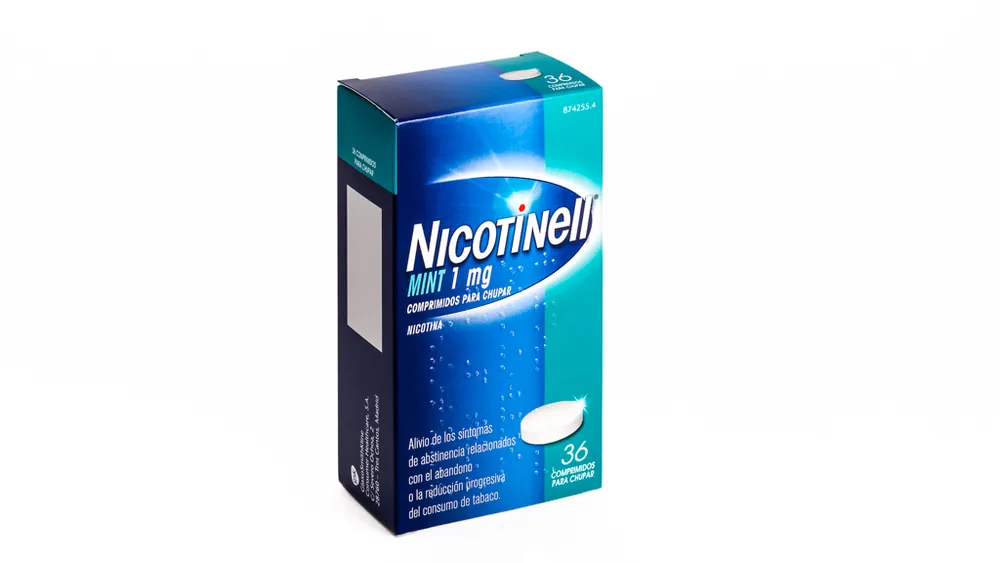
Table of Contents
- Package leaflet: Information for the user
- Introduction
- 1. What Nicotinell Mint is and what it is used for
- 2. What you need to know before starting to take Nicotinell Mint
- 3. How to take Nicotinell Mint
- 4. Possible adverse effects
- 5. Storage of Nicotinell Mint Sucking Tablets
- 6. Contents of the pack and other information
Package leaflet: Information for the user
Introduction
Package leaflet: information for the user
Nicotinell Mint 1 mg medicated chewing tablets
nicotine
Read the entire leaflet carefully before you start taking this medicine, because it contains important information for you.
Follow exactly the instructions for use provided in this leaflet or as advised by your pharmacist.
- Keep this leaflet, as you may need to read it again.
- If you need advice or further information, consult your pharmacist.
- If you experience any adverse effects, consult your doctor or pharmacist, even if they are effects not listed in this leaflet. See section 4.
- If symptoms worsen or persist after 6 months, you must consult your doctor.
Contents of the leaflet
- What Nicotinell Mint is and what it is used for
- What you need to know before taking Nicotinell Mint
- How to take Nicotinell Mint
- Possible side effects
- How to store Nicotinell Mint
- Contents of the pack and other information
1. What Nicotinell Mint is and what it is used for
Nicotinell Mint belongs to a group of medicines used as an aid to stop smoking. Nicotinell Mint lozenges contain the active substance nicotine.
When sucking the lozenges, nicotine is slowly released and absorbed through the mucous membrane of the mouth.
This medicine is used to help people quit smoking. The nicotine contained in Nicotinell Mint lozenges relieves nicotine withdrawal symptoms and the anxiety that occur when stopping smoking or gradually reducing tobacco consumption, thereby facilitating the smoking cessation process. By relieving nicotine withdrawal symptoms and anxiety, Nicotinell Mint lozenges help prevent relapses in smokers who are motivated to quit.
Counselling and patient support normally improve the chances of success.
Nicotinell Mint lozenges are indicated for smokers aged 18 years and over.
2. What you need to know before starting to take Nicotinell Mint
Do not take Nicotinell Mint lozenges
-
If you are allergic to nicotine or to any of the other ingredients of
this medicine (listed in section 6). -
If you are not a smoker.
Warnings and precautions
Consult your doctor or pharmacist before taking Nicotinell Mint lozenges if you have:
- Any heart problems, such as having recently had a heart attack, having irregular heart rhythms, heart failure, or chest pain (angina, including Prinzmetal's angina). While using this medicine, if you experience worsening heart problems, you should reduce or stop using this medicine.
- Stroke (cerebral apoplexy).
- High blood pressure.
- Circulatory problems.
- Diabetes. You should monitor your blood sugar levels more frequently than usual when starting to use nicotine lozenges. Your insulin or medication requirements may change.
- Hyperthyroidism.
- Overactive adrenal glands (pheochromocytoma).
- Kidney or liver impairment.
- Oesophagitis, inflammation of the mouth or throat, gastritis, or peptic ulcer.
- History of epilepsy (seizures).
Children and adolescents
Nicotinell must not be used by adolescents aged 12 to 17 without a prescription from a healthcare professional.
The correct dose for adults could cause severe poisoning or even be fatal in young children. Therefore, it is essential to keep Nicotinell Mint lozenges out of sight and reach of children at all times. Nicotinell Mint must not be used in children under 12 years of age.
Use of Nicotinell Mint with other medicines
Inform your doctor or pharmacist if you are taking, have recently taken, or might need to take any other medicines. If you are trying to quit smoking and are taking other medications, your doctor may need to adjust their dosage.
There is no information available regarding interactions between Nicotinell Mint lozenges and
other medicines. However, apart from nicotine, other substances in cigarettes may affect certain treatments.
Stopping smoking may alter the effect of medicines such as:
- Theophylline (used in the treatment of bronchial asthma)
- Tacrine (used in the treatment of Alzheimer's disease)
- Olanzapine and Clozapine (for the treatment of schizophrenia)
- Insulin (used in the treatment of diabetes), whose dose may need to be readjusted
Use of Nicotinell Mint with food and drink
Consumption of coffee, acidic drinks (based on lemon, orange, etc.) or soft drinks may reduce the absorption of nicotine and should therefore be avoided during the 15 minutes before taking the lozenge. Do not eat or drink while you have a lozenge in your mouth.
Pregnancy, breastfeeding, and fertility
Pregnancy
It is very important to stop smoking during pregnancy because it can be harmful to
fetal development. It may lead to premature births or even stillbirths. Ideally, you should stop smoking without using nicotine-containing medicines. If you are unable to stop smoking without
medication, Nicotinell should only be used after consulting a healthcare professional.
Breastfeeding
Treatment with Nicotinell Mint should be avoided during breastfeeding because nicotine passes into breast milk and may affect your baby. If a healthcare professional advises continuing treatment
during breastfeeding, you should take the lozenge immediately after breastfeeding, and
never when less than 2 hours remain before the next breastfeeding session.
Fertility
Smoking increases the risk of infertility in both women and men. The effects of nicotine on fertility are unknown.
Driving and use of machines
Although no effects on the ability to drive or operate machinery are known at the recommended doses, it should be noted that quitting smoking may cause behavioral changes.
Nicotinell Mint contains aspartame, mannitol, and sodium
This medicine contains 10 mg of aspartame per lozenge. Aspartame is a source of phenylalanine, which may be harmful if you have phenylketonuria (PKU), a rare genetic disorder in which phenylalanine accumulates because the body cannot eliminate it properly.
This medicine contains maltitol (E965). If your doctor has diagnosed you with intolerance to
certain sugars, consult with him before taking this medicine. It may have a mild laxative effect.
The caloric value is 2.3 kcal/g of maltitol. The components of Nicotinell Mint lozenges
are suitable for diabetics.
This medicine contains less than 23 mg of sodium (1 mmol) per lozenge; hence, it is essentially “sodium-free”.
3. How to take Nicotinell Mint
Follow exactly the instructions for use provided in this leaflet or those given by your doctor or pharmacist. If in doubt, consult your doctor or pharmacist.
Nicotinell Mint lozenges are available in two strengths: 1 mg and 2 mg.
Nicotinell Mint 1 mg lozenges may be used alone (a) or in combination with
Nicotinell patches (b).
Adults over 18 years of age
(a) Nicotinell Mint lozenges-only treatment
Nicotinell Mint 1 mg lozenges are recommended for smokers with low to moderate nicotine dependence. They are not recommended for smokers with high to very high nicotine dependence.
Select the appropriate dose for you from the following table:
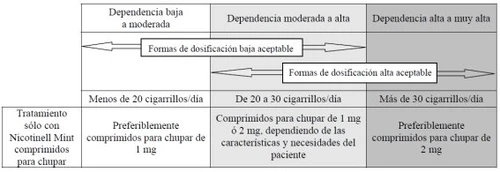
If any adverse events occur when starting treatment with a higher dosage form (2 mg lozenges), switch to a lower strength (1 mg lozenges).
Dosage for adults over 18 years of age
Take one lozenge when you start to feel the urge to smoke. Generally, one lozenge should be taken every 1–2 hours. In most cases, 8–12 lozenges per day are sufficient. If you still feel the urge to smoke, you may take additional lozenges. Do not take more than 24 of the 1 mg lozenges per day (both for smoking cessation and for gradual smoking reduction). Do not take more than one lozenge per hour.
The primary goal of using Nicotinell lozenges should be to stop smoking completely.
Smoking cessation:
To maximize your chances of success, you must not smoke at all when starting treatment with lozenges or during the entire course of treatment.
The duration of treatment is individual. Normally, treatment should continue for at least 3 months. After 3 months, gradually reduce the number of daily lozenges. Treatment should end when your intake has been reduced to 1 or 2 lozenges per day.
It is not recommended to use Nicotinell Mint lozenges for longer than 6 months. However, some former smokers may require longer treatment with lozenges to prevent relapse.
If you are still using lozenges after 6 months, consult your doctor or pharmacist.
Counselling and patient support generally improve the chances of success.
Gradual smoking reduction:
Use Nicotinell lozenges to extend the periods during which you do not smoke and to progressively reduce your tobacco consumption as much as possible. Gradually replace cigarettes with Nicotinell lozenges. If after 6 weeks you have not reduced your daily cigarette consumption by at least half, seek professional advice. Try to quit smoking as soon as you feel ready, but in any case within the first 4 months of starting Nicotinell lozenges. Then gradually reduce the number of lozenges—for example, by removing one lozenge every 2–5 days.
If a serious attempt to quit smoking has not been made within 6 months, seek professional help. Regular use of Nicotinell lozenges for longer than 6 months is not recommended. Some ex-smokers may require longer treatment to avoid relapse.
Counselling can increase your chances of quitting smoking.
Instructions for use:
Lozenges must not be swallowed.
- Suck the lozenge until the taste becomes strong.
- Place the lozenge between your cheek and gum.
- When the taste fades, resume sucking.
- Repeat this process until the lozenge has completely dissolved (approximately 30 minutes).
Avoid coffee, acidic or carbonated drinks for 15 minutes before taking a lozenge, as they may reduce nicotine absorption. Do not eat or drink while a lozenge is in your mouth.
(b) Combined therapy with Nicotinell Mint 1 mg lozenges and Nicotinell transdermal patches
Smoking cessation:
If treatment with Nicotinell lozenges alone has failed, you may use Nicotinell patches together with Nicotinell 1 mg lozenges.
NOTE: Read the Nicotinell patch leaflet before use.
You must stop smoking completely when starting treatment with lozenges in combination with Nicotinell patches, and throughout the entire treatment period.
The use of Nicotinell patches together with Nicotinell 1 mg lozenges is recommended for smokers with moderate to very strong dependence, i.e., more than 20 cigarettes per day. It is strongly recommended that combined therapy be carried out with the advice and support of a healthcare professional.
Combined therapy may only be used for smoking cessation.
Initial combination therapy:
Begin treatment with a 21 mg/24 h patch in combination with Nicotinell 1 mg lozenges. Use at least 4 lozenges (1 mg) per day. In most cases, 5–6 lozenges are sufficient. Do not use more than 15 lozenges per day. In typical cases, treatment may last 6 to 12 weeks. After this, the nicotine dose should be gradually reduced.
Apply the patch to an intact, clean, dry, and hair-free area of skin on the trunk, arms, or hips, and press it with your hand against the skin for 10 to 20 seconds.
Alternate between different application sites to minimize the risk of local irritation when applying Nicotinell patches.
Wash your hands thoroughly after applying the transdermal patches to avoid eye irritation from nicotine on your fingers.
Reducing the nicotine dose after the first 6–12 weeks:
This can be done in two ways.
Alternative 1:
Switch to a lower-dose patch, i.e., 14 mg/24 hours for 3–6 weeks, followed by 7 mg/24 hours for another 3–6 weeks, while continuing with the initial dose of Nicotinell 1 mg lozenges. After that, gradually reduce the number of lozenges. Generally, use of Nicotinell Mint lozenges is not recommended for longer than 6 months. However, some ex-smokers may require treatment for a longer period to prevent relapse, but not beyond 9 months.
Alternative 2:
Discontinue the patch and gradually reduce the number of 1 mg lozenges. Generally, use of Nicotinell Mint lozenges is not recommended for longer than 6 months. However, some ex-smokers may require treatment for a longer period to prevent relapse, but not beyond 9 months.
Recommended dosage:
Period | Patches | 1 mg Sucking Tablets |
Initial treatment (followed by option 1 or 2 below) | ||
First 6-12 weeks | 1 patch 21 mg/24 hours | As needed, 5-6 sucking tablets per day are recommended |
Nicotine dose reduction – option 1 | ||
Next 3-6 weeks | 1 patch 14 mg/24 hours | Continue using sucking tablets as needed |
Next 3-6 weeks | 1 patch 7 mg/24 hours | Continue using sucking tablets as needed |
Up to 9 months in total | --- | Gradually reduce the number of sucking tablets |
Nicotine dose reduction – option 2 | ||
Up to 9 months in total | --- | Continue gradually reducing the number of sucking tablets |
If you are still using the lozenges after 6 months, you should consult your doctor or pharmacist.
If you take more Nicotinell Mint than you should
You may experience symptoms similar to those caused by smoking a large amount of tobacco. Symptoms of nicotine overdose include: weakness, pale skin, sweating, increased salivation, throat burning, nausea, vomiting, diarrhea, abdominal pain, disturbances in vision and hearing, headache, increased heart rate or any other heart rhythm disturbances, shortness of breath, dizziness, tremor, and confusion.
With large overdoses, these symptoms may be followed by exhaustion, low blood pressure, circulatory collapse, coma, breathing difficulties, and seizures.
Stop taking the lozenges and contact a doctor immediately to assess the risk and receive advice if you have taken more medicine than intended, or if a child has accidentally taken the medicine.
If nicotine poisoning is suspected in a child, a doctor must be consulted immediately. Even small amounts of nicotine are dangerous and potentially fatal for children, and may lead to severe poisoning symptoms, which could be fatal.
If you forget to take Nicotinell
Do not take a double dose to make up for missed doses.
If you have any further questions about the use of this medicine, ask your doctor or pharmacist.
4. Possible adverse effects
Like all medicines, this medicine can cause adverse effects, although not everyone will experience them.
Some of the effects you may notice during the first few days are dizziness, headache, and sleep disturbances, which may be attributed to the symptoms associated with quitting smoking itself. Occasionally, these may also be due to insufficient nicotine administration.
Other possible withdrawal symptoms related to stopping smoking may include insomnia, cough, weakness, fatigue, malaise, and flu-like symptoms.
Stop taking Nicotinell Mint and contact a doctor immediately if you experience any of the following signs of a severe allergic reaction (angioedema or anaphylactic reaction):
- Swelling of the face, tongue, or throat; difficulty swallowing; hives; and breathing difficulties. These side effects are rare.
Other possible adverse effects:
Very common (may affect more than 1 in 10 people):
- Feeling sick (nausea).
Common (may affect up to 1 in 10 people):
- Inflammation of the mouth mucosa, oral discomfort.
- Sore throat.
- Vomiting.
- Stomach discomfort, stomach pain.
- Diarrhea.
- Indigestion / heartburn. Sucking the tablet more slowly usually resolves these problems.
- Flatulence.
- Hiccups.
- Constipation.
- Headache and dizziness.
- Cough.
- Dry mouth.
Uncommon (may affect up to 1 in 100 people):
- Palpitations.
Rare (may affect up to 1 in 1,000 people):
- Heart rhythm disturbances and allergic reactions.
- Hypersensitivity reactions.
Frequency not known (cannot be estimated from available data):
- Urticaria.
- Ulcerative stomatitis.
- Tremor.
- Shortness of breath.
- Difficulty swallowing.
- Belching.
- Increased salivation.
- Weakness.
- Fatigue.
- Malaise and flu-like symptoms.
- Fast and irregular heartbeat (Atrial fibrillation).
Mouth ulcers may occur when trying to quit smoking, but the relationship with nicotine treatment is not clear.
Reporting of adverse effects
If you experience any type of adverse effect, consult your doctor or pharmacist, even if it is a possible adverse effect not listed in this leaflet. You can also report them directly via the Spanish Pharmacovigilance System for Human Medicinal Products. Website: www.notificaRAM.es. By reporting adverse effects, you can help provide more information on the safety of this medicine.
5. Storage of Nicotinell Mint Sucking Tablets
Keep this medicine out of the sight and reach of children.
Do not use this medicine after the expiry date stated on the packaging and blister after EXP. The expiry date refers to the last day of the month indicated.
Do not store above 25°C.
Keep in the original packaging.
Medicines must not be disposed of via wastewater or household waste. Ask your pharmacist how to dispose of any unused medicines and their packaging. This will help protect the environment.
6. Contents of the pack and other information
Composition of Nicotinell Mint
- The active substance is nicotine. Each lozenge contains 1 mg (corresponding to 3.072 mg of nicotine bitartrate dihydrate).
- The other components are: maltitol (E965), anhydrous sodium carbonate, sodium hydrogen carbonate, polyacrylate, xanthan gum, colloidal anhydrous silica, levomenthol, peppermint essential oil, aspartame (E951) and magnesium stearate.
Nature of the product and contents of the pack
Nicotinell Mint lozenges are white, round, biconvex tablets with a mint flavour.
Nicotinell Mint lozenges are available in two strengths (1 mg and 2 mg). This leaflet is for Nicotinell Mint 1 mg lozenges.
Nicotinell Mint is available in packs of 12, 36, 72, 96, 144, 192 or 204 lozenges in blisters. Not all pack sizes may be marketed.
Marketing Authorisation Holder
Dr. Reddy’s Netherlands B.V.
Claude Debussylaan 10
1082 MD Amsterdam
The Netherlands
Manufacturer
GlaxoSmithKline Consumer Healthcare (UK) Trading Limited
980 Great West Road, Brentford
Middlesex TW8 9GS
United Kingdom
or
Haleon Belgium NV
Da Vincilaan 5,
1930 Zaventem,
Belgium
or
Haleon Denmark ApS
Delta Park 37, 2665 Vallensbæk Strand (Denmark)
or
Haleon Germany GmbH
Barthstrasse, 4 - 80339
Munich (Germany)
or
Haleon-Gebro Consumer Health GmbH
Bahnhofbichl 13, 6391 Fieberbrunn, Austria
or
Dr. Reddy’s Netherlands B.V.
Claude Debussylaan 10
Amsterdam 1082 MD
The Netherlands
or
Dr. Reddy’s Denmark ApS
Delta Park 45 DK-2665
Vallensbaek Strand
Denmark
For further information about this medicine, please contact the local representative of the Marketing Authorisation Holder:
Vemedia Pharma Hispania, S.A.
C/ Aragón, 182, 5th floor
08011 - Barcelona (Spain)
This medicinal product has been authorised in the following EEA Member States under the following names:
Germany Nicotinell Lutschtabletten 1 mg Mint
Austria Nicotinell Mint 1 mg Lutschtabletten
Denmark Nicotinell Mint 1 mg Sugetablet
Spain Nicotinell Mint 1 mg comprimidos para chupar
Finland Nicotinell Mint 1 mg Imeskelytabletti
France Nicotinell Menthe 1 mg, comprimé à sucer
Ireland Nicotinell Mint 1 mg compressed Lozenge
Luxembourg Nicotinell Mint 1 mg, comprimé à sucer
The Netherlands Nicotinell Mint 1 mg Zuigtablet
Portugal Nicotinell Mint 1 mg Pastilhas
United Kingdom Nicotinell Mint 1 mg lozenge
Sweden Nicotinell Mint 1 mg sugtablett
Date of the most recent review of this leaflet: December 2025
Detailed and up-to-date information on this medicine is available on the website of the Spanish Agency for Medicines and Health Products (AEMPS): http://www.aemps.gob.es/