Nicorette Ice Mint 2 mg medicated chewing gum
Spain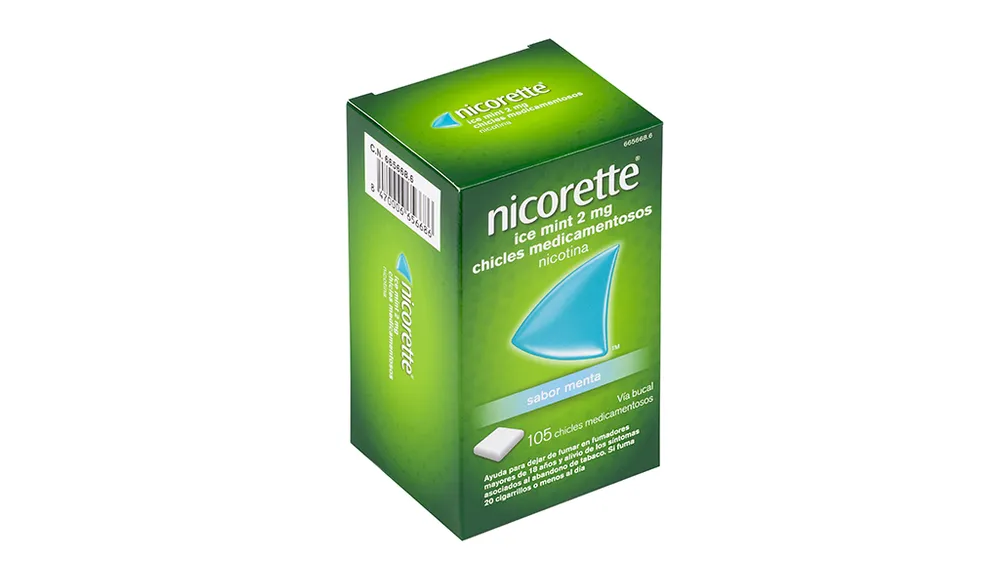
Table of Contents
- Patient Information Leaflet
- Introduction
- **Read the entire leaflet carefully before starting to take this medicine, as it contains important information for you.**
- 1. What Nicorette Ice Mint 2 mg medicated chewing gum is and what it is used for
- 2. What you need to know before using Nicorette Ice Mint 2 mg medicated chewing gum
- 3. How to take Nicorette Ice Mint 2 mg medicated chewing gum
- ***Use in children and adolescents***
- 4. Possible adverse effects
- 5. Storage of Nicorette Ice Mint 2 mg medicated chewing gum
- 6. Contents of the pack and other information
Patient Information Leaflet
Introduction
PATIENT INFORMATION LEAFLET
NICORETTE ICE MINT 2 mg CHEWING GUM
Nicotine
Read the entire leaflet carefully before starting to take this medicine, as it contains important information for you.
Follow exactly the instructions for use provided in this leaflet or those indicated by your doctor or pharmacist.
- Keep this leaflet, as you may need to read it again.
- If you need advice or more information, consult your pharmacist.
- If you experience adverse effects, consult your doctor or pharmacist, even if they are adverse effects not listed in this leaflet. See section 4.
- You should consult a doctor if you worsen or do not improve after 6 months.
Leaflet contents
- What Nicorette Ice Mint 2 mg medicated chewing gum is and what it is used for.
- What you need to know before taking Nicorette Ice Mint 2 mg medicated chewing gum
- How to take Nicorette Ice Mint 2 mg medicated chewing gum
- Possible adverse effects.
- Storage of Nicorette Ice Mint 2 mg medicated chewing gum
- Contents of the pack and additional information
1. What Nicorette Ice Mint 2 mg medicated chewing gum is and what it is used for
It is indicated as an aid for smokers over 18 years of age who smoke fewer than 20 cigarettes per day and who, although determined to quit smoking, may experience the unpleasant effects associated with withdrawal from this addiction: irritability, anxiety, tobacco craving, insomnia, or constipation, primarily.
Due to its nicotine content, it reduces the unpleasant withdrawal symptoms commonly experienced when quitting smoking, but it does not provide the same satisfaction as a cigarette. Therefore, to successfully quit smoking, you must rely on your own conviction, determination, and willpower.
Consult a doctor if your condition worsens or does not improve after 6 months.
2. What you need to know before using Nicorette Ice Mint 2 mg medicated chewing gum
It is very important that during treatment to stop smoking with Nicorette Ice Mint 2 mg medicated chewing gum you do not use any other nicotine-containing medicine.
Do not take Nicorette Ice Mint 2 mg medicated chewing gum:
- If you are allergic to nicotine or to any of the other components of this medicine (listed in section 6).
- If you are not a smoker.
- If you have disorders of the jaw joint.
Warnings and precautions
Talk to your doctor or pharmacist before starting to use Nicorette Ice Mint 2 mg medicated chewing gum.
Smokers with dentures may have difficulty chewing Nicorette Ice Mint 2 mg medicated chewing gum. The gum may stick, and in rare cases may damage the dentures.
If you have or have had any of the following conditions, you should try to stop smoking without using any medication. If you are unable to do so, consult your doctor for advice on the appropriate treatment.
- If you have recently suffered (within the last 3 months) a heart attack or myocardial infarction.
- If you suffer from chest pain (angina pectoris) or resting angina.
- If you have a heart disease affecting heart rhythm or rate.
- If you have uncontrolled high blood pressure (hypertension) despite medication.
- If you have ever had an allergic reaction with swelling of the lips, face, and throat (angioedema) or skin irritation (urticaria). Nicotine replacement therapy may occasionally cause such reactions.
- If you have severe or moderate liver disease.
- If you have severe kidney disease.
- If you have diabetes.
- If you have hyperactivity of the thyroid gland.
- If you have a tumor of the adrenal medulla (pheochromocytoma).
- If you have a stomach or duodenal ulcer.
- If you have oesophagitis.
- If you have a history of epilepsy or seizures.
Other medicines and Nicorette Ice Mint 2 mg medicated chewing gum
Inform your doctor or pharmacist if you are taking, have recently taken, or might need to take any other medicines.
Smoking can affect how your body responds to certain medicines. Therefore, when you stop smoking (with or without nicotine replacement therapy), the doses of your current medicines may need to be adjusted.
If you are taking any of the following medicines, dose adjustments may be necessary:
- Medicines containing alcohol or caffeine.
- Medicines acting on the central nervous system such as tranquilizers, antidepressants, sleeping medicines (benzodiazepines, clozapine, olanzapine, fluvoxamine, imipramine, clomipramine).
- Medicines for Parkinson's disease, such as ropinirole.
- Medicines for high blood pressure (hypertension), such as beta-blockers or furosemide.
- Painkillers such as paracetamol or stronger ones like morphine or its derivatives (dextropropoxyphene, pentazocine).
- Oral contraceptives such as estradiol.
- Anticoagulant medicines such as warfarin or heparin.
- Medicines for Alzheimer's disease such as tacrine.
- Medicines for asthma or bronchodilators such as theophylline.
- Medicines for heart rhythm disorders such as mexiletine and flecainide.
- Medicines for diabetes such as insulin.
- Vitamin B12 (cyanocobalamin).
- Local anesthetics such as lidocaine used in the mouth or throat.
Taking Nicorette Ice Mint 2 mg medicated chewing gum with food and drinks
Simultaneous consumption of Nicorette Ice Mint 2 mg medicated chewing gum and coffee, acidic drinks (lemon-based, orange-based, etc.) or soft drinks may reduce the absorption of nicotine in the oral cavity. These drinks should be avoided during the 15 minutes before chewing the gum.
Pregnancy and breastfeeding
If you are pregnant or breastfeeding, think you may be pregnant, or are planning to become pregnant, consult your doctor or pharmacist before using this medicine.
Pregnancy
Consult your doctor or pharmacist before using any medicine.
Nicotine poses a risk to the fetus, as it affects fetal respiratory movements and the circulatory system, and may even cause premature delivery or fetal death. For this reason, pregnant smokers are advised to stop smoking completely without using any medication. However, continuing to smoke during pregnancy may pose a greater risk to the fetus than using nicotine-containing medicines within a controlled smoking cessation program.
Nevertheless, a pregnant smoker should only take this medicine if recommended by a doctor.
Breastfeeding
Consult your doctor or pharmacist before using any medicine.
Nicotine passes into breast milk in amounts that may affect the baby. Therefore, women who are breastfeeding should avoid both smoking and using nicotine-containing medicines. In any case, women undergoing treatment with nicotine-containing medicines to stop smoking should consult their doctor about the advisability of switching from breastfeeding to artificial feeding.
If your doctor recommends continuing treatment during breastfeeding, you should chew the gum immediately after breastfeeding and in no case if less than 2 hours remain before the next feeding.
Driving and using machines
No effects on the ability to drive or use machines have been observed, although it should be noted that quitting smoking may cause behavioral changes.
Nicorette Ice Mint 2 mg medicated chewing gum may cause a mild laxative effect because it contains 0.59 g of xylitol (E-967) in each medicated chewing gum. Energy value: 2.4 kcal/g xylitol.
This medicine may cause local skin reactions (such as contact dermatitis) or irritation of the eyes and mucous membranes because it contains butylated hydroxytoluene (E-321).
Patients with renal impairment or those on low-potassium diets should be aware that this medicine contains 0.39 mg (0.009 mmol) of potassium per medicated chewing gum.
Patients on low-sodium diets should be aware that this medicine contains 11.3 mg (0.491 mmol) of sodium per chewing gum.
3. How to take Nicorette Ice Mint 2 mg medicated chewing gum
Follow exactly the dosage instructions provided in this leaflet or those given by your doctor or pharmacist. If in doubt, consult your doctor or pharmacist.
For adults aged 18 years and over:
Tobacco cessation with abrupt quitting.
Use only one piece of gum at a time, and do not use another piece until 1 to 2 hours have passed. Generally, 8 to 12 pieces are used per day. Do not exceed 24 chewing gums per day.
The duration of treatment depends on the individual needs of each smoker. Abrupt discontinuation of treatment is not recommended, as this could increase the risk of relapse into tobacco addiction. It is preferable to gradually reduce the dose. For example: every 4 or 5 days, reduce daily use by one or two chewing gums until only 1 or 2 pieces per day are needed. This may be achieved within 2 to 3 months. Do not stop treatment completely until the dose has stabilized at 1 or 2 chewing gums per day.
Regular use of the chewing gum is not recommended for longer than 6 months.
If you have not been able to stop treatment completely after 6 months, you should consult your doctor. Your doctor may advise you, based on your individual situation, to use the gum occasionally in case of sudden urges to smoke.
Gradual tobacco reduction:
If you choose to gradually reduce your tobacco consumption, replace cigarettes with Nicorette Ice Mint as much as possible, aiming to extend the periods during which no cigarettes are smoked, thereby reducing overall tobacco use.
The number of chewing gums used per day varies and depends on individual needs. Do not exceed 24 chewing gums per day.
By 6 weeks of treatment, the smoker should have reduced cigarette consumption by at least half. If this has not been achieved, consult your doctor.
A serious attempt to quit smoking completely should be made within 4 months; if unsuccessful, consult your doctor.
From the fourth month of treatment until the sixth month, gradually reduce the number of chewing gums used.
Guideline for substituting daily number of cigarettes with chewing gums.
Number of cigarettes/day | At 6 weeks: substitute at least 50% of the number of cigarettes with gum | At 4 months: completely replace the number of cigarettes, up to a maximum number (of gum pieces) | Guideline for discontinuing use of the gum |
10 | 5 cigarettes + 5 gums | 10 gums | Reduce by 1 gum every 5 days |
20 | 10 cigarettes + 10 gums | 20 gums | Reduce by 1 gum every 3 days |
30 or more | 50% cigarettes + up to a maximum of 24 gums | Maximum 24 gums | Reduce by 1 gum every 2 or 3 days |
Regular use of the gum is not recommended for longer than 6 months.
If you have not been able to permanently stop treatment after 6 months, you should consult your doctor. Your doctor may advise you, depending on your situation, to use the gum occasionally in case of sudden urges to smoke.
If you find the effect of Nicorette Ice Mint too strong or too weak, inform your doctor or pharmacist.
Use in children and adolescents
Must not be used in individuals under 18 years of age without medical recommendation, as even small amounts of nicotine are dangerous for children and may cause severe symptoms of poisoning, which may be fatal (see section If you take more Nicorette Ice Mint 2 mg chewing gum than you should).
How to chew Nicorette Ice Mint
When you feel the urge to smoke, place a chewing gum into your mouth and chew it slowly until you notice a strong taste. Then place it between your cheek and gum. When the taste fades, chew the gum slowly again and repeat this process for 30 minutes to allow the nicotine to be gradually released.
The gum must be chewed as indicated to release the nicotine, and then left to rest so that the nicotine can be absorbed through the mouth lining. Swallowed nicotine is not beneficial and, in excess, may irritate the throat or cause stomach discomfort, such as hiccups. To avoid this, chewing should be slow.
Do not exceed the recommended dose.
If you take more Nicorette Ice Mint than you should
Excessive use of nicotine from nicotine replacement therapy and/or continued smoking may cause symptoms of overdose. The risk of poisoning due to swallowing the gum is very low, as absorption without chewing is slow and incomplete.
Symptoms of overdose are those of acute nicotine poisoning and include nausea, vomiting, increased salivation, abdominal pain, diarrhea, sweating, headache, dizziness, increased blood pressure, disturbances in hearing, and marked weakness. These symptoms may be followed by decreased blood pressure, heart rhythm disturbances, weakness, irregular pulse, breathing difficulties, prostration, circulatory collapse, generalized seizures, and coma.
If you have used too many chewing gums, contact your doctor or pharmacist immediately, or call the Toxicology Information Service (telephone 91 562 04 20), stating the name of the product and the amount used. It is recommended to bring the package leaflet and the medicine container to the healthcare professional.
Even small amounts of nicotine are dangerous for children and may cause severe symptoms of poisoning, which may be fatal. If nicotine poisoning in a child is suspected, seek immediate medical attention.
If you forget to take Nicorette Ice Mint
Do not take a double dose to make up for forgotten doses.
If you stop treatment with Nicorette Ice Mint
If you have any further questions about the use of this medicine, ask your doctor or pharmacist.
4. Possible adverse effects
Like all medicines, this medicine can cause adverse effects, although not everyone will experience them.
Nicorette Ice Mint 2 mg medicated chewing gum may cause adverse effects similar to those associated with tobacco nicotine and are usually dependent on the number of chewing gums used.
The chewing gums may stick and, in rare cases, may damage dental work.
Effects related to quitting smoking (nicotine withdrawal)
Some of the unwanted effects experienced when quitting smoking may be withdrawal symptoms due to reduced nicotine intake. Mouth ulcers may develop when quitting smoking. The reason for this is unknown.
These effects include:
- Irritability, aggression, impatience, or frustration.
- Feelings of anxiety, restlessness, or difficulty concentrating.
- Sleep disturbances.
- Increased appetite or weight gain.
- Lethargy.
- Craving for cigarettes.
- Slowing of heart rate.
- Bleeding gums.
- Dizziness or mild disorientation.
- Cough, sore throat, nasal congestion, or mucus production.
If you experience palpitations, chest pain, leg pain, or indigestion, stop taking the medicine, do not smoke, and consult your doctor as soon as possible.
Most adverse effects occur during the first weeks of starting treatment.
Adverse reactions of unknown frequency (cannot be estimated from available data):
- Blurred vision and increased lacrimation.
- Dry throat, lip discomfort, and gastrointestinal disturbances.
- Allergic reactions (including symptoms of anaphylaxis).
- Muscle stiffness.
- Angioedema and erythema.
- Seizures.
- Rapid and irregular heartbeat (atrial fibrillation).
Rare adverse reactions (may affect up to 1 in 1,000 patients):
- Difficulty swallowing, loss of oral sensitivity, and retching.
Uncommon adverse reactions (may affect up to 1 in 100 patients):
- Palpitations and tachycardia.
- Belching, oral mucosal burning and peeling, tongue inflammation, oral tingling.
- Asthenia, chest pain and discomfort, and general malaise.
- Jaw pain.
- Sleep disorders.
- Nasal congestion, sneezing, oropharyngeal pain, throat tightness, dysphonia, dyspnea, bronchospasm.
- Hyperhidrosis, pruritus, urticaria, rash.
- Hot flushes and hypertension.
Frequent adverse reactions (may affect up to 1 in 10 patients):
- Abdominal pain, dry mouth, diarrhoea, dyspepsia, flatulence, hypersalivation, stomatitis, vomiting, burning sensation, fatigue.
- Hypersensitivity.
- Taste disturbances, paraesthesia.
Very frequent adverse reactions:
- Nausea.
- Headache.
- Cough, hiccups, and throat irritation.
Reporting of adverse effects
If you experience any type of adverse effect, consult your doctor or pharmacist, even if it is a possible adverse effect not listed in this leaflet. You may also report them directly via the Spanish Pharmacovigilance System for Human Medicines: www.notificaRAM.es.
By reporting adverse effects, you can help provide more information on the safety of this medicine.
5. Storage of Nicorette Ice Mint 2 mg medicated chewing gum
Keep this medicine out of the sight and reach of children.
Do not store above 25°C.
Do not use this medicine after the expiry date stated on the packaging after EXP. The expiry date refers to the last day of the month indicated.
Medicines should not be disposed of via wastewater drains or household waste. Dispose of empty containers and unused medicines at the SIGRE collection point at your pharmacy. If in doubt, ask your pharmacist how to properly dispose of containers and medicines you no longer need. This will help protect the environment.
6. Contents of the pack and other information
Composition of Nicorette Ice Mint 2 mg medicated chewing gum
The active substance is nicotine (2 mg, equivalent to 10 mg of 20% resin complex).
The other components are: chewing gum base (containing butylated hydroxytoluene E-321), xylitol (E-967), peppermint oil, anhydrous sodium carbonate, sodium hydrogen carbonate, potassium acesulfame (E-950), levomenthol, light magnesium oxide, mint flavouring, hypromellose, sucralose, polysorbate 80, pregelatinized corn starch, titanium dioxide (E-171), carnauba wax (E-903) and talc.
Appearance of the product and contents of the pack
Medicated white rectangular chewing gums presented in cartons containing 30, 105 and 210 chewing gums.
Marketing Authorization Holder:
JNTL Consumer Health (Spain), S.L.
C/ Vía de los Poblados 1, Edificio E, planta 3
28033-Madrid
Spain
Manufacturer:
McNEIL AB
Norrboplatsen, 2
Helsingborg (SWEDEN)
Date of the most recent revision of this leaflet: September 2025
Detailed and up-to-date information on this medicinal product is available on the website of the Spanish Agency of Medicines and Health Products (AEMPS) http://www.aemps.gob.es