Nexviadyme 100 mg powder for concentrate for solution for infusion
Spain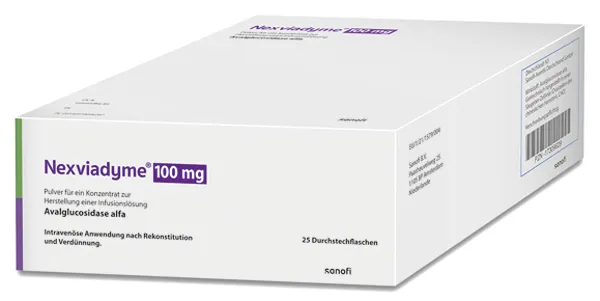
Table of Contents
Package leaflet: Information for the user
Introduction
Package leaflet: information for the user
Nexviadyme 100 mg powder for concentrate for solution for infusion
avalglucosidase alfa
This medicinal product is subject to additional monitoring, which will allow rapid detection of new information on its safety. You can help by reporting any side effects you may experience. Information on how to report side effects is included at the end of section 4.
Read this entire leaflet carefully before starting to use this medicine, as it contains important information for you.
- Keep this leaflet, as you may need to read it again.
- If you have any questions, consult your doctor, pharmacist, or nurse.
- If you experience any side effects, consult your doctor, pharmacist, or nurse, even if they are side effects not listed in this leaflet. See section 4.
Leaflet contents
- What Nexviadyme is and what it is used for
- What you need to know before being administered Nexviadyme
- How Nexviadyme is administered
- Possible side effects
- Storage of Nexviadyme
- Contents of the pack and other information
1. What Nexviadyme is and what it is used for
What Nexviadyme is
Nexviadyme contains an enzyme called avalglucosidase alfa; it is a copy of the natural enzyme called acid alpha-glucosidase (GAA) that is missing in people with Pompe disease.
What Nexviadyme is used for
Nexviadyme is used to treat people of all ages who have Pompe disease.
People with Pompe disease have low levels of the enzyme acid alpha-glucosidase (GAA). This enzyme helps regulate levels of glycogen (a type of carbohydrate) in the body. Glycogen provides energy to the body, but in Pompe disease, high levels of glycogen accumulate in various muscles and cause damage. The medicine replaces the missing enzyme so that the body can reduce glycogen accumulation.
2. What you need to know before Nexviadyme is administered to you
Do not use Nexviadyme
If you have had potentially life-threatening allergic reactions (hypersensitivity) to avalglucosidase alfa or to any of the other components of this medicine (listed in section 6), and these reactions recurred after interruption and reinitiation of the medication.
Warnings and precautions
Talk to your doctor, pharmacist, or nurse before starting to use Nexviadyme.
Contact your doctor immediately if treatment with Nexviadyme causes:
- allergic reactions, including anaphylaxis (a severe allergic reaction) – see section “Possible side effects” below for symptoms
- infusion-associated reactions while receiving the medicine or within a few hours afterwards – see section “Possible side effects” below for symptoms
Also inform your doctor if you have swelling in your legs or generalized swelling of your body. Your doctor will decide whether to interrupt the Nexviadyme infusion and will provide appropriate medical treatment. Your doctor will also determine whether you can continue receiving avalglucosidase alfa.
Other medicines and Nexviadyme
Tell your doctor or pharmacist if you are taking, have recently taken, or might need to take any other medicines.
Pregnancy, breastfeeding, and fertility
If you are pregnant or breastfeeding, think you may be pregnant, or plan to become pregnant, consult your doctor or pharmacist before using this medicine. There is no information available on the use of Nexviadyme in pregnant women. You should not receive Nexviadyme during pregnancy unless specifically recommended by your doctor. You and your doctor should decide whether you can use Nexviadyme if you are breastfeeding.
Driving and using machines
Nexviadyme may have a minor effect on the ability to drive and use machines. Since dizziness, low blood pressure, and somnolence may occur as infusion-associated reactions, this could affect your ability to drive and use machines on the day of the infusion.
3. How Nexviadyme is administered
Nexviadyme will be administered under the supervision of a healthcare professional experienced in the treatment of Pompe disease.
You may be given other medications before receiving Nexviadyme to reduce certain adverse effects. These medications include an antihistamine, a corticosteroid, and a medicine (such as paracetamol) to reduce fever.
The dose of Nexviadyme is based on your body weight and will be administered once every 2 weeks.
- The recommended dose of Nexviadyme is 20 mg/kg body weight.
Home infusion
Your doctor may consider that you can receive home infusion of Nexviadyme if it is safe and appropriate to do so. If you experience any adverse reaction during a Nexviadyme infusion, the person administering the home infusion may stop the infusion and begin appropriate medical treatment.
Instructions for proper use
Nexviadyme is administered as an intravenous drip (intravenous infusion). It is supplied to the healthcare professional as a powder to be mixed with sterile water and then diluted with glucose prior to infusion.
If you receive more Nexviadyme than you should
An excessively rapid infusion rate of Nexviadyme may cause flushing.
If you miss your dose of Nexviadyme
If you have missed an infusion, contact your doctor. If you have any further questions about the use of this medicine, ask your doctor, pharmacist, or nurse.
If you stop treatment with Nexviadyme
Consult your doctor if you wish to discontinue treatment with Nexviadyme. Your disease symptoms may worsen if you stop treatment.
4. Possible adverse effects
Adverse effects occur mainly while patients are receiving the Nexviadyme infusion or shortly after. You should inform your doctor immediately if you experience an infusion-related reaction or an allergic reaction. Your doctor may give you medications before your infusion to prevent these reactions.
Infusion-related reactions
Most infusion-related reactions are mild or moderate. Symptoms of an infusion-related reaction include chest discomfort, increased blood pressure, increased heart rate, chills, cough, diarrhea, fatigue, headache, flu-like illness, nausea, vomiting, red eyes, pain in arms and legs, skin redness, skin itching, rash, and hives.
Allergic reactions
Allergic reactions may include symptoms such as difficulty breathing, chest tightness, flushing, cough, dizziness, nausea, redness of palms and soles, itching of palms and soles, swelling of the lower lip and tongue, low blood oxygen levels, and skin rash.
Very common (may affect more than 1 in 10 people)
- Hypersensitivity
- Headache
- Nausea
- Skin itching
- Skin rash
Common (may affect up to 1 in 10 people)
- Anaphylaxis (severe allergic reaction)
- Dizziness
- Somnolence
- Tremor (shaking)
- Burning sensation
- Red eyes
- Itchy eyes
- Eyelid swelling
- Palpitations
- Flushing
- Increased blood pressure
- Low blood pressure
- Skin and lips turning blue
- Hot flushes
- Pale skin
- Cough
- Difficulty breathing
- Throat irritation
- Mouth and throat pain
- Diarrhea
- Vomiting
- Swollen lips
- Swollen tongue
- Abdominal pain
- Upper abdominal pain
- Indigestion
- Hives
- Redness of hands
- Skin redness
- Red skin rash
- Excessive sweating
- Itchy rash
- Skin plaque
- Muscle spasms
- Muscle pain
- Pain in arms or legs
- Flank pain
- Fatigue
- Chills
- Fever
- Chest discomfort
- Pain
- Flu-like illness
- Infusion site pain
- Low blood oxygen levels
- Weakness
- Facial swelling
- Feeling cold or hot
Uncommon (may affect up to 1 in 100 people)
- Eye inflammation
- Numbness or tingling
- Tearing
- Extra heartbeats
- Rapid breathing
- Throat swelling
- Numbness in mouth, tongue, or lips
- Tingling in mouth, tongue, or lips
- Difficulty swallowing
- Skin swelling
- Skin discoloration
- Facial pain
- Increased body temperature
- Extravasation at infusion site
- Joint pain at infusion site
- Skin rash at infusion site
- Reaction at infusion site
- Itching at infusion site
- Localized edema
- Swelling in arms and legs
- Abnormal breathing sounds (wheezing)
- Blood test indicating inflammation
- Reduced sensation to touch, pain, and temperature
- Oral discomfort (including burning sensation in lips)
Adverse effects reported in children and adolescents were similar to those observed in adults.
Reporting of adverse effects
If you experience any adverse effects, consult your doctor, pharmacist, or nurse, even if they are possible adverse effects not listed in this leaflet. You may also report them directly through the national reporting system included in Appendix V. By reporting adverse effects, you can help provide more information on the safety of this medicine.
5. Storage of Nexviadyme
Keep this medicine out of the sight and reach of children.
Do not use this medicine after the expiry date stated on the label after EXP. The expiry date refers to the last day of the month indicated.
Unopened vials:
Store in a refrigerator (between 2 ºC and 8 ºC).
Reconstituted solution:
After reconstitution, immediate dilution is recommended. The reconstituted solution can be stored for up to 24 hours when kept refrigerated between 2 ºC and 8 °C.
Diluted solution:
After dilution, immediate use is recommended. The diluted solution can be stored for 24 hours at a temperature between 2 ºC and 8 ºC, followed by up to 9 hours at room temperature (up to 25 ºC).
Medicines must not be disposed of via wastewater or household waste. Ask your doctor, pharmacist, or nurse how to dispose of medicines and containers you no longer need. This will help protect the environment.
6. Contents of the pack and other information
Composition of Nexviadyme
The active substance is avalglucosidase alfa. One vial contains 100 mg of avalglucosidase alfa. After reconstitution, the solution contains 10 mg of avalglucosidase alfa per ml, and after dilution, the concentration ranges from 0.5 mg/ml to 4 mg/ml.
The other components are:
- Histidine
- Monohydrate histidine hydrochloride
- Glycine
- Mannitol
- Polysorbate 80
Appearance of the product and contents of the container
Avalglucosidase alfa is a powder for concentrate for solution for infusion in a vial (100 mg/vial). Each pack contains 1, 5, 10 or 25 vials. Only certain pack sizes may be marketed.
The powder is white to pale yellow in color. After reconstitution, it forms a clear, colorless to pale yellow solution. The reconstituted solution must be further diluted before use.
Marketing Authorization Holder
Sanofi B.V.
Paasheuvelweg 25
1105 BP Amsterdam
The Netherlands
Manufacturer
Genzyme Ireland Limited, IDA Industrial Park, Old Kilmeaden Road, Waterford, Ireland
For more information about this medicine, please contact the local representative of the Marketing Authorization Holder:
Belgium/Belgium/Belgium Sanofi Belgium Tel/Tel: + 32 2 710 54 00 | Lithuania Swixx Biopharma UAB Tel: +370 5 236 91 40 |
| Luxembourg/Luxembourg Sanofi Belgium Tél/Tel: + 32 2 710 54 00 (Belgium/Belgium) |
Czech Republic Sanofi s.r.o. Tel: +420 233086 111 | Hungary SANOFI-AVENTIS Zrt. Tel: +36 1 505 0050 |
Denmark Sanofi A/S Tlf: +45 45 16 70 00 | Malta Sanofi S.r.l. Tel: +39 02 39394275 |
Germany Sanofi-Aventis Deutschland GmbH Tel.: 0800 04 36 996 Tel. from abroad: +49 69 305 70 13 | Netherlands Sanofi B.V. Tel: +31 20 245 4000 |
Estonia Swixx Biopharma OÜ Tel: +372 640 10 30 | Norway sanofi-aventis Norge AS Tlf: + 47 67 10 71 00 |
Greece Sanofi-Aventis Μονοπρόσωπη ΕΠΕ Τηλ: +30 210 900 1600 | Austria sanofi-aventis GmbH Tel: + 43 1 80 185 – 0 |
Spain sanofi-aventis, S.A. Tel: +34 93 485 94 00 | Poland sanofi-aventis Sp. z o.o. Tel.: +48 22 280 00 00 |
France Sanofi Winthrop Industrie Tél: 0 800 222 555 Call from abroad: +33 1 57 63 23 23 | Portugal Sanofi – Produtos Farmacêuticos, Lda. Tel: +351 21 35 89 400 |
Croatia Swixx Biopharma d.o.o. Tel: +385 1 2078 500 Ireland Sanofi-aventis Ireland Ltd. T/A SANOFI Tel: +353 (0) 1 403 56 00 | Romania Sanofi Romania SRL Tel: +40 (0) 21 317 31 36 Slovenia Swixx Biopharma d.o.o. Tel: +386 1 235 51 00 |
Iceland Vistor hf. Sími: +354 535 7000 | Slovak Republic Swixx Biopharma s.r.o. Tel: +421 2 208 33 600 |
Italy Sanofi S.r.l. Tel: 800536389 | Finland Sanofi Oy Puh/Tel: + 358 201 200 300 |
Cyprus C.A. Papaellinas Ltd. Τηλ: +357 22 741741 | Sweden Sanofi AB Tel: +46 (0)8 634 50 00 |
Latvia Swixx Biopharma SIA Tel: +371 6 616 47 50 | United Kingdom (Northern Ireland) sanofi-aventis Ireland Ltd. T/A SANOFI Tel +44 (0) 800 035 2525 |
Date of the most recent review of this summary:
Detailed information on this medicine is available on the European Medicines Agency website: http://www.ema.europa.eu. Links to other websites on rare diseases and orphan medicinal products are also available.
<------------------------------------------------------------------------------------------------------------------>
This information is intended for healthcare professionals only:
Reconstitution:
Use aseptic technique during reconstitution.
- Calculate the number of vials required for reconstitution based on the individual patient's weight and the recommended dose of 20 mg/kg or 40 mg/kg.
Patient weight (kg) × dose (mg/kg) = patient dose (in mg). Patient dose (in mg) divided by 100 mg/vial = number of vials to reconstitute. If the number of vials includes a fraction, round up to the next whole number.
Example: patient weight (16 kg) × dose (20 mg/kg) = patient dose (320 mg). 320 mg divided by 100 mg/vial = 3.2 vials; therefore, 4 vials should be reconstituted.
Example: patient weight (16 kg) × dose (40 mg/kg) = patient dose (640 mg).
640 mg divided by 100 mg/vial = 6.4 vials; therefore, 7 vials should be reconstituted.
- Remove the required number of vials needed for infusion from the refrigerator and allow them to reach room temperature for approximately 30 minutes.
- Reconstitute each vial by slowly injecting 10.0 ml of water for injection (WFI) into each vial. Each vial will yield 100 mg/10 ml (10 mg/ml). Avoid forcefully impacting the WFI onto the powder and the formation of foam. This can be achieved by slowly adding the water for injection by dripping it down the inner wall of the vial, not directly onto the lyophilized powder. Gently tilt and rotate each vial. Do not invert, flip, or shake.
- Immediately perform a visual inspection of the reconstituted vials to confirm that the solution is free from particles and has not changed in color. If particles are observed or discoloration is present during immediate inspection, do not use. Allow the solution to dissolve.
Dilution
- The reconstituted solution must be diluted in 5% glucose in water to a final concentration of 0.5 mg/ml to 4 mg/ml. Refer to Table 1 for the recommended total infusion volume based on patient weight.
- Slowly withdraw the volume of reconstituted solution from each vial (calculated according to patient weight).
- Slowly and directly add the reconstituted solution to the 5% glucose solution. Avoid the formation of foam or agitation of the infusion bag. Avoid introducing air into the infusion bag.
- Carefully invert or massage the infusion bag to mix. Do not shake.
- To avoid administering particles inadvertently introduced during IV dose preparation, it is recommended to use a low plasma protein-binding 0.2 μm in-line filter when administering Nexviadyme. After completion of the infusion, flush the intravenous line with 5% glucose in water.
- Do not administer Nexviadyme in the same intravenous line with other medicinal products.
Table 1: Estimated intravenous infusion volumes for administration of Nexviadyme by patient weight at doses of 20 mg/kg and 40 mg/kg
Patient weight range (kg) | Total infusion volume (ml) for 20 mg/kg | Total infusion volume (ml) for 40 mg/kg |
1.25 to 5 | 50 | 50 |
5.1 to 10 | 50 | 100 |
10.1 to 20 | 100 | 200 |
20.1 to 30 | 150 | 300 |
30.1 to 35 | 200 | 400 |
35.1 to 50 | 250 | 500 |
50.1 to 60 | 300 | 600 |
60.1 to 100 | 500 | 1 000 |
100.1 to 120 | 600 | 1 200 |
120.1 to 140 | 700 | 1 400 |
140.1 to 160 | 800 | 1 600 |
160.1 to 180 | 900 | 1 800 |
180.1 to 200 | 1 000 | 2 000 |
Disposal of unused medicinal product and all materials that have come into contact with it must be carried out in accordance with local regulations.
Home infusion
Home infusion of Nexviadyme should be considered for patients with good tolerance to infusions and no history of moderate or severe RAPs over several months. The decision to transition a patient to home infusion must be made following evaluation and recommendation by the treating physician. A patient's underlying comorbidities and ability to comply with home infusion requirements must be taken into account when assessing eligibility for home infusion. The following criteria should be considered:
- The patient must not have an ongoing concurrent condition that, in the physician’s opinion, could affect the patient’s ability to tolerate the infusion.
- The patient is considered medically stable. A detailed assessment must be completed prior to initiating home infusion.
- The patient must have received Nexviadyme infusions supervised by a physician experienced in treating Pompe disease patients for several months, which may have occurred either in a hospital or another appropriate outpatient setting. Documentation of a pattern of well-tolerated infusions without RAPs, or with only mild RAPs controlled by premedication, is a prerequisite for initiating home infusion.
- The patient must be willing and able to comply with home infusion procedures.
- Infrastructure, resources, and procedures for home infusion, including training, must be established and available to the healthcare professional. The healthcare professional must be available at all times during the home infusion and for a defined period after the infusion, based on the patient’s prior tolerance, before initiating home infusion.
If the patient experiences adverse reactions during home infusion, the infusion process must be stopped immediately and appropriate medical treatment initiated. Subsequent infusions may need to be administered in a hospital or another appropriate outpatient setting until no such adverse reaction occurs. The dose and infusion rate must not be changed without consulting the patient’s treating physician.