Neuraceq 300 MBq/ml solution for injection
Spain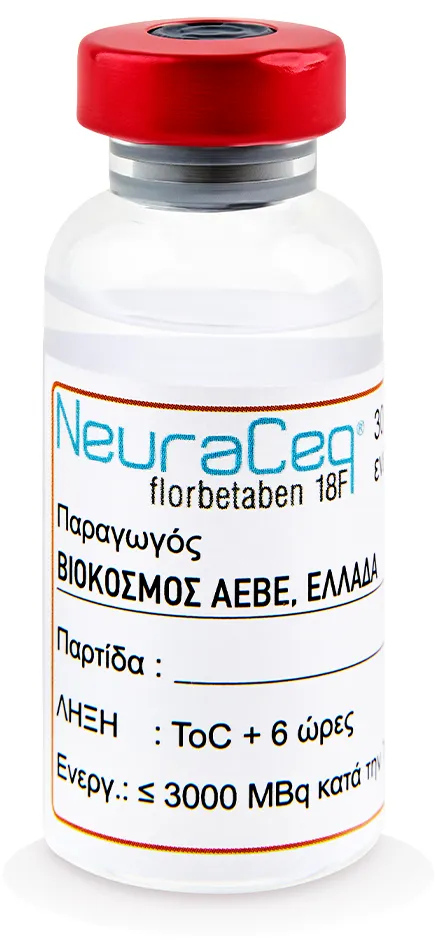
Table of Contents
Patient Information Leaflet
Introduction
Package Leaflet: Information for the Patient
Neuraceq 300 MBq/ml solution for injection
florbetaben (18F)
Read all of this leaflet carefully before you start using this medicine, because it contains important information for you.
- Keep this leaflet. You may need to read it again.
- If you have any questions, ask the nuclear medicine physician who will supervise the procedure.
- If you experience any side effects, talk to the nuclear medicine physician, even if it is a side effect not listed in this leaflet. See section 4.
Contents of this leaflet
- What Neuraceq is and what it is used for
- What you need to know before Neuraceq is administered
- How Neuraceq is used
- Possible side effects
- How Neuraceq is stored
- Contents of the pack and other information
1. What Neuraceq is and what it is used for
This medicine is a radiopharmaceutical for diagnostic use only.
Neuraceq contains the active substance florbetaben (18F).
Neuraceq is given to people with memory problems so that doctors can perform a type of brain scan called a PET study. A PET scan with Neuraceq, together with other tests of brain function, can help your doctor determine whether you have β-amyloid plaques in the brain. This medicine should only be administered to adults.
You may discuss the test results with the doctor who requested the scan.
The use of Neuraceq involves exposure to small amounts of radioactivity. Your doctor and the nuclear medicine physician have determined that the clinical benefit of this procedure with the radiopharmaceutical outweighs the risk of radiation exposure.
2. What you need to know before using Neuraceq
Do not use Neuraceq
- if you are allergic to florbetaben (18F) or to any of the other ingredients of this medicine (listed in section 6).
Warnings and precautions
Consult the nuclear medicine physician before using Neuraceq if:
- You have kidney problems.
- You have liver problems.
- You are pregnant or think you may be pregnant.
- You are breastfeeding.
Children and adolescents
Neuraceq must not be used in children and adolescents under 18 years of age.
Other medicines and Neuraceq
Inform your nuclear medicine physician if you are taking, have recently taken, or might need to take any other medicines, as they could interfere with the interpretation of PET images.
Pregnancy and breastfeeding
If you are pregnant or breastfeeding, think you may be pregnant, or plan to become pregnant, consult your nuclear medicine physician before using this medicine.
You must inform the nuclear medicine physician before administration of Neuraceq if there is any possibility you are pregnant, if you have missed a menstrual period, or if you are breastfeeding. If in doubt, it is important to ask the nuclear medicine physician who will supervise the procedure.
Pregnancy
The nuclear medicine physician will only administer this medicine during pregnancy if the expected benefit outweighs the potential risks.
Breastfeeding
You must interrupt breastfeeding for 24 hours after the injection. Express milk during this period and discard it. Resumption of breastfeeding should be discussed with the nuclear medicine physician supervising the procedure.
Driving and using machines
Neuraceq has no influence on the ability to drive and use machines.
Neuraceq contains ethanol and sodium ascorbate
- This medicine contains up to 1200 mg of alcohol (ethanol) per dose, equivalent to 17 mg/kg. The amount per dose of this medicine is equivalent to less than 30 ml of beer or 12.5 ml of wine.
It is unlikely that the amount of alcohol contained in this medicine will have any noticeable effect in adults or adolescents. However, it could have some effects in young children, such as drowsiness.
The amount of alcohol contained in this medicine may alter the effect of other medicines. Consult your doctor or pharmacist if you are taking other medicines.
If you are pregnant or breastfeeding, consult your doctor or pharmacist before taking this medicine.
- This medicine contains 33 mg of sodium (a main component of table/cooking salt) per dose. This corresponds to 1.6% of the maximum daily recommended sodium intake for an adult.
3. How to use Neuraceq
There are strict regulations regarding the use, handling, and disposal of radiopharmaceuticals. Neuraceq should only be used in specially controlled facilities. This medicine will only be handled and administered by trained and qualified personnel who are experienced in its safe use. These individuals will take special care in the safe handling of this medicine and will inform you of their actions.
Dosage
The nuclear medicine physician supervising the procedure will determine the amount of Neuraceq to be used in your case, which will be the minimum necessary to obtain the required information.
The recommended administered activity for an adult is 300 MBq (megabecquerel, the unit used to express radioactivity).
Administration of Neuraceq and performance of the procedure
Neuraceq is administered by intravenous injection followed by a flush with sodium chloride solution to ensure that the entire dose is delivered. A single injection is sufficient to perform the scan required by your physician.
Duration of the procedure
Approximately 90 minutes after the administration of Neuraceq, a brain scan is usually performed.
Your nuclear medicine physician will inform you about the typical duration of the procedure.
After administration of Neuraceq, you should
Avoid close contact with young children and pregnant women during the 24 hours following the injection.
The nuclear medicine physician will inform you if you need to take any special precautions after receiving this medicine. If in doubt, please consult your nuclear medicine physician.
If you have been given more Neuraceq than you should
It is unlikely that an overdose will occur, as you will only receive a precisely calculated dose of Neuraceq determined by the nuclear medicine physician supervising the procedure.
However, in the event of an overdose, appropriate treatment will be provided. Specifically, the physician in charge of the procedure may recommend measures to increase diuresis and defecation to help eliminate radioactivity from the body.
If you have any further questions about the use of this medicine, please consult the nuclear medicine physician supervising the procedure.
4. Possible adverse effects
Like all medicines, this medicine can cause adverse effects, although not everyone will experience them.
Possible adverse effects include:
Frequent (may affect up to 1 in 10 people):
- Reactions at the injection site: pain at the injection site, redness of the skin at the injection site (erythema at injection/application site)
Uncommon (may affect up to 1 in 100 people):
- Burning sensation, headache, neuralgia (intense and typically intermittent pain along the course of a nerve), tremor (involuntary shaking movement)
- Blood vessels: flushing (sudden redness of the face and/or neck), hematoma (bruising, a black or blue mark), hypotension (low blood pressure)
- Stomach: diarrhoea, nausea (feeling unwell)
- Liver: abnormal liver function
- Skin: hyperhidrosis (excessive sweating), rash, toxic skin eruption (acute skin disorders with morbilliform erythema possibly including blisters and ulcers)
- Muscles and bones: limb discomfort, limb pain
- Injection site disorders: irritation at injection site, pain and discomfort in the area adjacent to the injection site, hematoma at injection site (bruising, a black or blue mark at injection site), warmth at injection site, pain at vascular puncture site, fatigue, sensation of warmth and pyrexia (increased body temperature, fever)
- Abnormal blood test results: increased serum creatinine concentrations (reduced kidney function)
This radiopharmaceutical will emit low levels of ionising radiation, which is associated with a minimal risk of cancer and the possibility of causing hereditary abnormalities.
Reporting of adverse effects
If you experience any adverse effect, consult your nuclear medicine physician, even if it is an adverse effect not listed in this leaflet. You may also report them directly through the national reporting system included in Appendix V. By reporting adverse effects, you can help provide more information on the safety of this medicine.
5. Storage of Neuraceq
You will not be required to store this medicine. This medicine will be stored by the specialist under appropriate conditions and under their responsibility. Storage of radiopharmaceuticals will comply with national regulations regarding radioactive materials.
This information is intended for healthcare professionals only:
- Keep this medicine out of the sight and reach of children.
- Do not use this medicine after the expiry date stated on the carton, the shield label, or the vial label after EXP.
- No special storage conditions are required.
- Disposal of unused medicine and of all materials that have come into contact with it must be carried out in accordance with local regulations.
6. Package contents and other information
Composition of Neuraceq
- The active substance is florbetaben (18F). Each millilitre of injectable solution contains 300 MBq of florbetaben (18F) at the date and time of calibration. The activity per vial ranges between 300 MBq and 3,000 MBq at the date and time of calibration.
- The other excipients are ascorbic acid, anhydrous ethanol, macrogol 400, sodium ascorbate and water for injections (see section 2, "Neuraceq contains ethanol and sodium ascorbate").
Appearance of the product and contents of the pack
Neuraceq is a clear, colourless injectable solution. It is supplied in a 15 ml colourless glass vial, closed with a rubber stopper and an aluminium seal.
Each multidose vial contains 1 to 10 ml of solution, corresponding to an activity of 300 to 3,000 MBq of florbetaben (18F) at the date and time of calibration.
Pack containing one vial.
Marketing Authorisation Holder
Life Molecular Imaging GmbH
Tegeler Strasse 6-7
Wedding
Berlin
13353
Germany
Email: [email protected]
Manufacturer
Curium PET France
CHU de Brabois
4 rue du Morvan
54500 Vandoeuvre les Nancy
France
Curium PET France
Parc scientifique Georges Besse
180 Allée Von Neumann
30000 Nimes
France
Curium PET France
14, rue de la Grange aux Belles
75010 Paris
France
Curium PET France
avenue de la Bataille Flandres Dunkerque, CS 44229
35000 Rennes
France
Curium PET France
CHU Xavier Arnozan
avenue du Haut-Lévèque
33604 Pessac
France
Alliance Medical RP Berlin GmbH
Max-Planck-Strasse 4
Adlershof
Berlin
12489
Germany
Alliance Medical sp. z o.o.
ul. Szeligowska 3
05-850 Szeligi
Poland
Alliance Medical RP GmbH
Spessartstr. 9
53119 Bonn
Germany
Curium Italy S.R.L.
via Pergolesi, 33
20900 Monza
Italy
Curium Italy S.R.L.
Viale Oxford 81 (loc. Tor Vergata)
00133 Rome
Italy
Curium Italy S.R.L.
Piazzale Santa Maria della Misericordia, 15
33100 Udine
Italy
ITEL Telecomunicazioni S.R.L.
Via Antonio Labriola Zona Industriale SNC
70037 Ruvo di Puglia (BA)
Italy
Curium Pharma Ireland Limited
Blackrock Clinic
Blackrock
Co. Dublin, A94 E4X7
Ireland
Curium Pharma Spain, S.A.
Thomas Alba Edison, s/n
41092 Seville
Spain
Curium Pharma Spain, S.A.
Pol. Ind. Conpisa,
C/Veguillas – 2 Nave 16,
Ajalvir 28864 (Madrid)
Spain
Seibersdorf Labor GmbH
Grundstueck Nr. 482/2 EZ 98 KG
2444 Seibersdorf
Austria
BetaPlus Pharma SA
Avenue Hippocrate 10 bte 1527
1200 Brussels
Belgium
Institut Radiofarmacia Aplicada Barcelona-IRAB
c/Doctor Aiguader 88, planta -1
08003 Barcelona
Spain
Biokosmos S.A.
Lakkoma Industrial Area
Νea Propontida
Halkidiki
630 80
Greece
Biokosmos S.A.
Thesi Panormos
Lavrio
Athens
195 00
Greece
Radboud Translational Medicine B.V.
Geert Grooteplein Noord 21
Route 142
Nijmegen
Gelderland
6525 EZ
Netherlands
Karolinska University Hospital
Akademiska Straket 1
Solna
Stockholms Lan
171 64
Sweden
You can request further information about this medicine by contacting the local representative of the Marketing Authorisation Holder:
Date of the latest review of this leaflet: {month YYYY}
Detailed information on this medicine is available on the European Medicines Agency website: http://www.ema.europa.eu.
_____________________________________________________________________________
This information is intended for healthcare professionals only:
The full summary of product characteristics for Neuraceq is included as a separate document in the product packaging, to provide healthcare professionals with additional scientific and practical information on the administration and use of this radiopharmaceutical.