Nephroprotect solution for infusion
Spain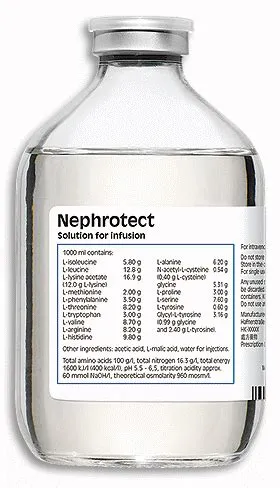
Table of Contents
- Package leaflet: Information for the user
- Introduction
- 1. What Nephrotect is and what it is used for
- 2. What you need to know before Nephrotect is administered to you
- 3. How Nephrotect is to be administered to you
- 4. Possible adverse effects
- 5. Storage of Nephrotect
- 6. Contents of the package and other information
Package leaflet: Information for the user
Introduction
Package leaflet: information for the user
Nephrotect infusion solution
Amino acid solution
Read all of this leaflet carefully before you start using this medicine, because it contains important information for you.
-
Keep this leaflet, as you may need to read it again.
-
If you have any questions, ask your doctor or nurse.
-
If you experience any side effects, talk to your doctor, pharmacist, or nurse, even if it is a side effect not listed in this leaflet. See section 4.
Contents of this leaflet:
- What Nephrotect is and what it is used for
- What you need to know before Nephrotect is administered to you
- How Nephrotect is administered
- Possible side effects
- How to store Nephrotect
- Contents of the pack and other information
1. What Nephrotect is and what it is used for
Nephrotect is a solution providing amino acids as part of parenteral nutrition in patients with renal failure when other forms of nutrition are not suitable. The solution can be used in patients with acute or chronic renal failure, including patients receiving dialysis treatment.
2. What you need to know before Nephrotect is administered to you
Do not administer Nephrotect:
- if you are allergic (hypersensitive) to the active substances or to any of the other components of this medicine (listed in section 6)
- if your body has problems using amino acids
- if you have severe kidney disease without possibility of undergoing dialysis
- if you are suffering from acute shock
- if you have too much fluid in your body (hyperhydration)
- if you have fluid in the lungs (pulmonary edema)
- if you have untreated heart failure
- if you do not have enough body fluid (hypotonic dehydration)
- if you have severe liver disease
Warnings and precautions
Talk to your doctor before Nephrotect is administered to you:
- if you have abnormally low sodium levels in your blood (hyponatremia)
- if you have high blood levels of the following components: sodium, chloride, bicarbonate, proteins, and sugar (glucose). Your doctor will monitor these levels during treatment with Nephrotect.
Typically, a blood or urine test will be used to check these levels.
Children
The use of Nephrotect is not recommended in children.
Use of Nephrotect with other medicines
Inform your doctor or pharmacist if you are taking, have recently taken, or might need to take any other medicines.
Pregnancy and breastfeeding
There is insufficient experience regarding the use of Nephrotect during pregnancy and breastfeeding. Your doctor will assess the need to use this medicine.
If you are pregnant or breastfeeding, think you may be pregnant, or plan to become pregnant, consult your doctor before using this medicine. Your doctor will decide whether Nephrotect should be administered to you.
Driving and using machines
Not applicable, as this product is administered in a hospital setting.
3. How Nephrotect is to be administered to you
Your doctor will determine the dose to be administered based on your body weight and kidney function.
Nephrotect will be administered to you by a healthcare professional.
If you are given more Nephrotect than you should
It is unlikely that you will receive too much Nephrotect, as this product is administered by healthcare professionals.
The basic symptoms of an overdose or of too rapid infusion of the solution may include:
- nausea
- vomiting
- fever
- chills
- flushing
If any of these symptoms occur, or if you think you have been given too much Nephrotect, you must inform your doctor immediately. The doctor will then stop the infusion and take appropriate measures.
If you have any further questions about the use of this medicine, ask your doctor or nurse.
4. Possible adverse effects
Like all medicines, this medicine can cause adverse effects, although not everybody will experience them.
Reporting of adverse effects
If you experience any type of adverse effect, consult your doctor, pharmacist, or nurse, even if it is a possible adverse effect not listed in this leaflet. You can also report them directly through the Spanish Pharmacovigilance System for Human Medicinal Products: https://www.notificaram.es. By reporting adverse effects, you can help provide more information on the safety of this medicine.
5. Storage of Nephrotect
Keep this medicine out of the sight and reach of children.
- Store the container in the outer packaging.
- Do not store above 25°C.
- Do not use Nephrotect after the expiry date stated on the container after EXP. The expiry date refers to the last day of the month indicated.
- Use only clear solutions and undamaged containers.
- Medicines should not be disposed of via wastewater or household waste. Ask your pharmacist how to dispose of unused medicines and their packaging. This will help protect the environment.
6. Contents of the package and other information
Composition of Nephrotect
The active substances are:
1 liter contains:
L-isoleucine | 5.80 g |
L-leucine | 12.80 g |
L-lysine acetate | 16.9 g |
= 12 g L-lysine | |
L-methionine | 2.00 g |
L-phenylalanine | 3.50 g |
L-threonine | 8.20 g |
L-tryptophan | 3.00 g |
L-valine | 8.70 g |
Arginine | 8.20 g |
L-histidine | 9.80 g |
L-alanine | 6.20 g |
Acetylcysteine | 0.54 g |
= 0.40 g L-cysteine glycine | 5.31 g |
L-proline | 3.00 g |
L-serine | 7.60 g |
L-tyrosine | 0.60 g |
N-glycyl-L-tyrosine | 3.16 g |
= 0.994 g glycine
= 2.40 g tyrosine
The other components are: acetic acid, L-malic acid and water for injections.
Total amino acids 100 g/l
Total nitrogen 16.3 g/l
Total energy content 400 kcal/l
pH 5.5–6.5
Acidity titration approx. 60 mmol NaOH/l
Theoretical osmolarity 960 mosm/l
Appearance of the product and contents of the pack
Clear solution, colourless to slightly yellowish, presented in glass bottles of 250 ml and 500 ml with rubber stopper and aluminium seal.
Pack sizes:
1 × 250 ml, 10 × 250 ml
1 × 500 ml, 10 × 500 ml
Only some pack sizes may be commercially available.
Marketing Authorization Holder and Manufacturer
Marketing Authorization Holder
Fresenius Kabi Deutschland GmbH
61346 Bad Homburg, Germany
Manufacturer
Fresenius Kabi Austria GmbH, 8055 Graz, Austria
Local Representative
Fresenius Kabi España, S.A.U
Marina, 16-18
08005 Barcelona
Date of latest revision of this leaflet: January 2015
Detailed and up-to-date information on this medicinal product is available on the website of the Spanish Agency of Medicines and Health Products (AEMPS) http://www.aemps.gob.es/
This information is intended for healthcare professionals only:
Contraindications
- Congenital disorders of amino acid metabolism
- Severe renal failure without possibility of hemofiltration or dialysis
- Acute shock
- General contraindications to infusion therapy: acute pulmonary edema, hyperhydration, decompensated heart failure and hypotonic dehydration
- Severe hepatic insufficiency
Warnings and precautions
Exercise particular caution in patients with hyponatremia or elevated serum osmolarity.
During treatment, it is necessary to monitor fluid balance, serum electrolyte levels, acid-base balance, serum urea and blood ammonia levels. Laboratory monitoring should also include blood glucose, serum protein, creatinine and liver function tests.
There is currently no clinical experience with the use of Nephrotect in children.
Dosage and administration
For administration as continuous intravenous infusion.
Your doctor will adjust the dose according to your individual needs.
Unless otherwise indicated, in patients with acute and chronic renal failure:
– Patients not undergoing dialysis:
0.6 – 0.8 g AAs/kg body weight/day
= 6 – 8 ml/kg body weight/day
– Patients undergoing dialysis:
0.8 – 1.2 g AAs/kg body weight/day
= 8 – 12 ml/kg body weight/day
– For intradialytic nutrition in patients undergoing long-term hemodialysis:
0.5 – 0.8 g AAs/kg body weight/dialysis
= 5 – 8 ml/kg body weight/dialysis
Maximum recommended daily dose:
0.8 – 1.2 g AAs/kg body weight
= 8 – 12 ml/kg body weight, or 560 – 840 ml in a 70 kg patient
Recommended maximum infusion rates:
Parenteral nutrition:
0.1 g AAs/kg body weight/hour
Intradialytic nutrition:
0.2 g AAs/kg body weight/hour
In general, amino acids should be administered in combination with infusion solutions providing the patient's energy requirements during parenteral nutrition.
Nephrotect may be used for total parenteral nutrition if administered in combination with energy sources, electrolytes, vitamins and trace elements.
For central or peripheral venous infusion; may be mixed with other nutrients if appropriate.
Nephrotect may be administered using separate infusion lines together with other nutritional substrates (multi-bottle/bag system), or may be mixed in one container with other solutions to provide a total nutrient solution containing all components.
If Nephrotect is used for intradialytic nutrition, it may be injected directly into the venous drip chamber of the dialysis apparatus.
Amino acid solutions, including Nephrotect, are generally administered in combination with carbohydrates and lipids to ensure anabolic utilization of amino acids. An exception is the use of amino acid supplements in intradialytic nutrition, during which a glucose-containing dialysate may be used.
The duration of treatment depends on the patient's clinical condition.
If serum creatinine falls below 300 µmol/l, a conventional amino acid solution may be used.
There is currently no clinical experience with the use of Nephrotect in children.
Compatibility
Only those medicinal products necessary for parenteral nutrition, such as energy sources, electrolytes, trace elements and vitamins, with which compatibility has been studied, may be mixed with Nephrotect.
The combination must be properly mixed.
Stability
Shelf life of the packaged medicinal product for sale:
24 months. Keep the container in the outer packaging.
Do not store above 25°C.
Shelf life after first opening of the container:
The solution should be used immediately.
Any unused solution must be discarded after infusion.
Shelf life after addition of other nutritional components
Nephrotect may be mixed with other nutritional solutions such as lipid emulsions, carbohydrates, electrolyte solutions, trace elements and vitamins. Compatibility data are available upon request.
From a microbiological standpoint, the product should be used immediately after additions. If immediate use is not possible, the user is responsible for storage conditions and duration of storage prior to use. Normally, the mixture should not be stored for more than 24 hours at 2–8°C, unless the mixture has been prepared under controlled and validated aseptic conditions. If storage cannot be avoided and it is ensured that the mixture was prepared under controlled and validated aseptic conditions, storage for longer than 24 hours at 2–8°C may be acceptable, provided compatibility has been demonstrated. After removal from storage at 2–8°C, the mixture must be infused within 24 hours.
Any unused portion of the mixture must be discarded after infusion.
Handling and disposal
Nephrotect should be used with a sterile transfer set immediately after opening. Any unused portion of solution must be discarded.
Nephrotect is generally administered via a central venous access (preferably as a continuous 24-hour infusion).
When used for intradialytic nutrition, Nephrotect may be infused into the venous side of the dialyzer, thus avoiding the need for a separate venous line.
Chemical and physical stability data for various mixtures are available from the manufacturer upon request.
Additions must be made aseptically.
Use only clear solutions and intact containers.
Do not use multiple doses from a single vial.