Neocare 4 mg/g cream
Spain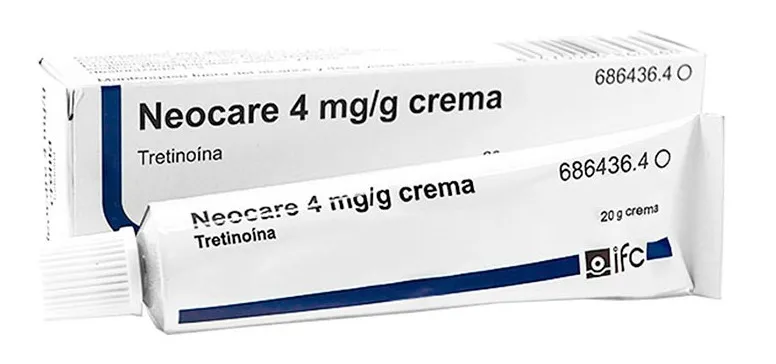
Table of Contents
Package leaflet: Information for the user
Introduction
Package leaflet: information for the user
Neocare 4 mg/g cream
Tretinoin
Read the entire leaflet carefully before you start using this medicine, because it contains important information for you.
-
Keep this leaflet, as you may need to read it again.
-
If you have any questions, ask your doctor or pharmacist.
-
This medicine has been prescribed for you only and must not be given to other people, even if they have the same symptoms as you, because it could harm them.
-
If you experience any adverse effects, consult your doctor or pharmacist, even if they are adverse effects not listed in this leaflet.
Contents of the leaflet
- What Neocare cream is and what it is used for
- What you need to know before using Neocare cream
- How to use Neocare cream
- Possible adverse effects
- How to store Neocare cream
- Contents of the pack and other information
1. What Neocare cream is and what it is used for
Neocare is a medicine that belongs to the group of medicines known as topical anti-acne agents.
Neocare is a cream indicated for the topical treatment of mild to moderate acne vulgaris.
2. What you need to know before using Neocare cream
Do not use Neocare cream:
- if you are allergic (hypersensitive) to the active substance or to any of the other components of this medicine (listed in section 6).
- if you are pregnant.
- if you plan to become pregnant.
- if you have a personal or family history of cutaneous epithelioma (a type of skin cancer).
- on areas of skin with wounds, abrasions, or eczema (a skin disease characterized by inflammation, redness, and exudation), as it may cause skin irritation.
Warnings and precautions
Talk to your doctor or pharmacist before starting to use Neocare cream.
The irritation caused by this medicine is directly related to the product's efficacy and disappears when applications are spaced out. During the first weeks of treatment, an apparent worsening of symptoms and signs of irritation may be observed. This reaction is normal, as it reflects the accelerated elimination of microcysts forming in the deeper layers of the skin.
In case of persistent or severe irritation, your doctor will assess whether treatment should be discontinued.
Excessive application of Neocare cream does not improve treatment outcomes and may even cause marked irritation with redness, peeling, itching, etc.
During treatment with Neocare cream, caution is advised when using other medications concomitantly that may cause local irritation, especially those with abrasive, drying, or exfoliating effects.
Areas treated with Neocare cream must not be exposed to sunlight (even on cloudy days) or to ultraviolet (UVA) lamps during treatment. Patients with sunburn should be advised not to use the product until they have fully recovered.
When sun exposure cannot be avoided, it is recommended to use sunscreen products and protective clothing over the treated areas.
During treatment with Neocare cream, cosmetics may be used concurrently, but they should not be applied to the skin at the same time.
Avoid contact with eyes, eyelids, corners of the nose, mouth, and mucous membranes.
Administration should be avoided if there is an infection in the affected area. Care should be taken to avoid accumulation of cream in skin folds.
Areas such as the neck and forearms carry a higher risk of irritation, so a reduced application frequency is recommended.
If the skin is irritated, it is advisable to wait for complete skin recovery before starting treatment with Neocare cream.
Interaction of Neocare cream with other medicines
Inform your doctor or pharmacist if you are using, have recently used, or might need to use any other medicines.
Do not use Neocare cream if you are taking photosensitizing medicines (medicines that increase skin sensitivity to sunlight), such as thiazides, tetracyclines, fluoroquinolones, phenothiazides, and sulfonamides.
Use this medicine with caution in combination with:
- medicines used in dermatological treatments for acne.
- products with drying or exfoliating effects, including soaps, shampoos, cosmetics, and astringents (especially those containing alcohol or fragrances, e.g., colognes, pre- and post-shave lotions, etc.), medicated shampoos or soaps, permanent wave solutions, electrolysis, depilatory creams and waxes, or other preparations or procedures that may irritate the skin, unless performed under medical supervision.
Pregnancy, breastfeeding, and fertility
Do not use Neocare cream if you are pregnant or planning to become pregnant. Your doctor can provide further information.
It is not known whether tretinoin is excreted in breast milk, so appropriate precautions should be taken when used by breastfeeding mothers.
Driving and using machines
No effects on the ability to drive or operate machinery have been reported.
Neocare cream contains cetyl alcohol, propylene glycol, butylhydroxytoluene, sodium propyl parahydroxybenzoate, and sodium methyl parahydroxybenzoate.
This medicine may cause local skin reactions (such as contact dermatitis) because it contains cetyl alcohol.
This medicine contains 50 mg of propylene glycol per gram. Propylene glycol may cause skin irritation.
This medicine may cause local skin reactions (such as contact dermatitis) or irritation of the eyes and mucous membranes because it contains butylhydroxytoluene.
It may cause allergic reactions (possibly delayed) because it contains sodium propyl parahydroxybenzoate and sodium methyl parahydroxybenzoate.
3. How to use Neocare cream
Follow exactly the administration instructions given by your doctor or pharmacist. If in doubt, consult your doctor or pharmacist again.
Your doctor will determine the duration of your treatment with Neocare cream.
Your doctor will recommend the appropriate dose for your treatment. Depending on the skin type and severity of the condition, your doctor will prescribe the suitable concentration. The following presentations are available on the market: 4 mg/g, 0.5 mg/g, 0.25 mg/g, and 0.1 mg/g.
Treatment is usually initiated with the lowest concentration (0.1 mg/g), and subsequently, depending on the response, gradually increased to higher concentrations—0.25 mg/g and 0.5 mg/g—finally reaching the 4 mg/g concentration.
Before application, wash the skin with water and a mild soap, then allow it to dry without rubbing for at least 20–30 minutes. Afterwards, apply a sufficient amount of cream to cover only the affected area, twice daily. However, the amount and frequency of application should be adjusted according to individual needs. Avoid contact with eyes, eyelids, corners of the nose and mouth, and other body mucous membranes.
In any case, your doctor must advise you on the duration of treatment with Neocare cream.
General precautions for use
For more detailed information on general precautions for use, please refer to section 2, "Warnings and precautions".
Use in children
The safety and efficacy of Neocare cream in children have not been established.
If you use more Neocare cream than you should
Accidental oral ingestion of Neocare cream may lead to effects similar to those associated with excessive oral intake of vitamin A, for example: dry skin, joint pain, loss of appetite, vomiting, etc.
In case of overdose or accidental ingestion, contact your doctor or pharmacist immediately or call the Toxicology Information Service at telephone number 91 562 04 20, indicating the medication and the amount ingested.
If you forget to use Neocare cream
Do not use a double dose to make up for missed doses.
If you stop using Neocare cream
Do not stop treatment unless advised by your doctor.
If you have any further questions about the use of this medicine, ask your doctor or pharmacist.
4. Possible adverse effects
Like all medicines, Neocare cream can cause adverse effects, although not everyone will experience them.
The topical application of Neocare cream may cause transient itching, sensation of warmth, slight redness and peeling similar to that of a mild sunburn, dryness, severe local erythema, and development of edema at the application site.
The efficacy of tretinoin-based products is almost always accompanied by skin irritation phenomena, which disappear when applications are spaced out.
To date, all adverse effects associated with Neocare cream have been reversible upon discontinuation of treatment.
If you experience any adverse effects, consult your doctor or pharmacist, even if they are adverse effects not listed in this leaflet.
5. Storage of Neocare cream
Keep this medicine out of the sight and reach of children.
No special storage conditions are required.
Close the container tightly after use.
Do not use Neocare cream after the expiry date stated on the container. The expiry date refers to the last day of the month indicated.
Medicines must not be disposed of via wastewater drains or household waste. Dispose of unused containers and medicines at the SIGRE POINT at your pharmacy. If you are unsure, ask your pharmacist how to dispose of unused containers and medicines. This way, you will help protect the environment.
6. Contents of the pack and other information
Composition of Neocare cream:
- The active substance is tretinoin. Each gram of cream contains 4 mg of tretinoin.
- The other components (excipients) are: Xalifin-15 (PEG-8-C12-C18 Alkyl ether), cetyl alcohol, glycerol, propylene glycol, Oxynex 2004 (propylene glycol, butylhydroxytoluene (E-321), ascorbyl palmitate, glyceryl stearate, citric acid), sodium salt of methylparaben (E-219), sodium salt of propylparaben (E-217), and deionized water.
Appearance of the medicinal product and contents of the pack
Viscous, homogeneous yellow cream.
Aluminum tube of 20 g.
Marketing Authorization Holder and Manufacturer
INDUSTRIAL FARMACÉUTICA CANTABRIA, S.A.
Barrio Solía, nº 30,
La Concha de Villaescusa, 39690
Cantabria (Spain).
This summary of product characteristics was approved in November 2020.
Detailed and up-to-date information on this medicinal product is available on the website of the Spanish Agency for Medicines and Health Products (AEMPS) http://www.aemps.gob.es/