Naveruclif 5 mg/ml powder for dispersion for infusion EFG
Spain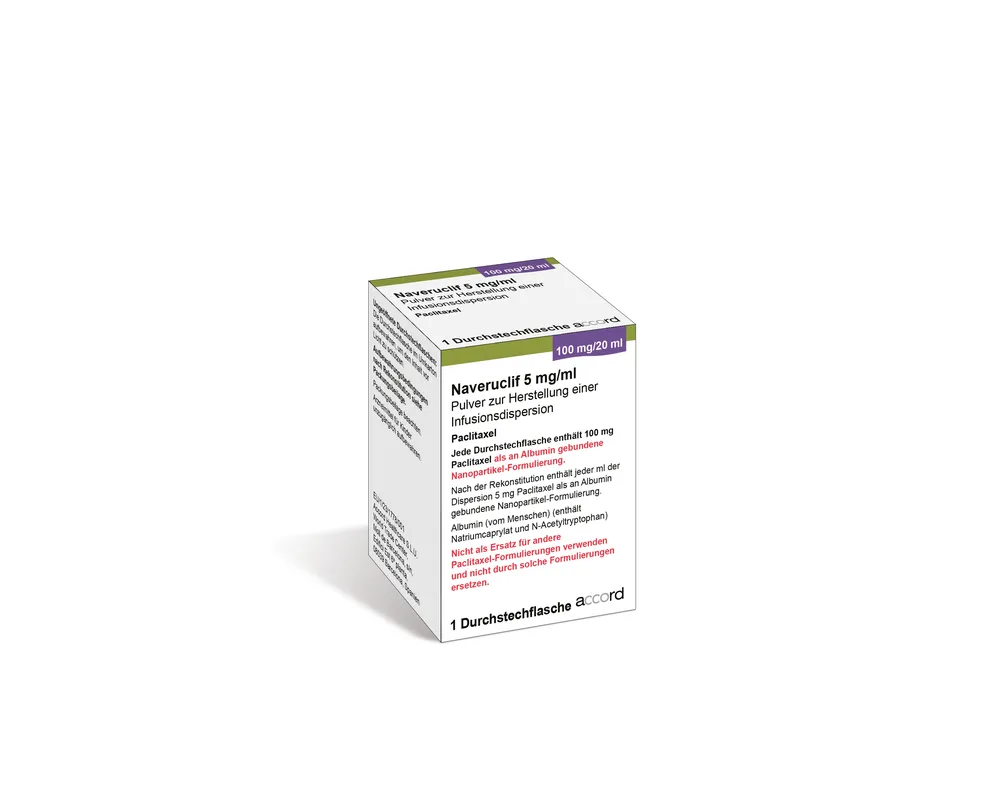
Table of Contents
Patient Information Leaflet
Introduction
Package leaflet: Information for the user
Naveruclif 5 mg/ml powder for concentrate for solution for infusion
paclitaxel
Read all of this leaflet carefully before you start using this medicine, as it contains important information for you.
- Keep this leaflet, as you may need to read it again.
- If you have any questions, ask your doctor or nurse.
- This medicine has been prescribed for you only, and you should not give it to others, even if they have the same symptoms as you, because it may harm them.
- If you experience any adverse reactions, consult your doctor or nurse, even if they are adverse reactions not listed in this leaflet. See section 4.
Contents of the leaflet
- What Naveruclif is and what it is used for
- What you need to know before using Naveruclif
- How to use Naveruclif
- Possible side effects
- How to store Naveruclif
- Contents of the pack and other information
1. What Naveruclif is and what it is used for
Naveruclif contains, as its active substance, paclitaxel bound to the human protein albumin, in the form of tiny particles called nanoparticles. Paclitaxel belongs to a group of medicines known as "taxanes" used in cancer treatment.
- Paclitaxel is the part of the medicine that acts against cancer; it works by preventing cancer cells from dividing, which causes them to die.
- Albumin is the part of the medicine that helps paclitaxel dissolve in the blood and cross the walls of blood vessels to reach the tumor. This means that it is not necessary to use other chemical agents that may cause adverse reactions which could be life-threatening. Such adverse reactions occur much less frequently with Naveruclif.
What Naveruclif is used for
Naveruclif is used to treat the following types of cancer:
Breast cancer
- Breast cancer that has spread to other parts of the body (this is called "metastatic" breast cancer).
- Naveruclif is used in metastatic breast cancer when at least one other therapy has been tried but was ineffective, and when your condition is not suitable for treatment with a group of medicines called "anthracyclines".
- Patients with metastatic breast cancer who received Naveruclif after another treatment had failed had a greater chance of experiencing tumor shrinkage and lived longer than patients who received an alternative treatment.
Pancreatic cancer
- Naveruclif is used in combination with a medicine called gemcitabine if you have metastatic pancreatic cancer. In a clinical trial, patients with metastatic pancreatic cancer (pancreatic cancer that has spread to other parts of the body) who received Naveruclif with gemcitabine lived longer than those who received gemcitabine alone.
Lung cancer
- Naveruclif is also used in combination with a medicine called carboplatin if you have the most common type of lung cancer, called "non-small cell lung cancer".
- Naveruclif is used in non-small cell lung cancer when surgery or radiotherapy are not suitable for treating the disease.
2. What you need to know before using Naveruclif
Do not use Naveruclif
- if you are allergic to paclitaxel or to any of the other components of this medicine (listed in section 6);
- if you are breastfeeding;
- if you have a low white blood cell count (neutrophil count <1500 cells/mm³ before starting treatment). Your doctor will advise you on this.
Warnings and precautions
Talk to your doctor or nurse before starting treatment with Naveruclif
- if you have impaired kidney function;
- if you suffer from severe liver disease;
- if you suffer from heart conditions.
If you experience any of the following conditions during treatment with Naveruclif, inform your doctor or nurse immediately. Your doctor may decide to interrupt treatment or reduce the dose:
- unusual bruising, bleeding, or signs of infection such as sore throat or fever;
- numbness, tingling, prickling sensations, sensitivity to touch, or muscle weakness;
- breathing problems, such as difficulty breathing or dry cough.
Children and adolescents
Naveruclif is indicated only for adults and must not be administered to children or adolescents under 18 years of age.
Other medicines and Naveruclif
Tell your doctor if you are taking or have recently taken any other medicines, including those obtained without a prescription, and herbal medicines. This is because Naveruclif may affect how some medicines work. Likewise, some medicines may affect how Naveruclif works.
Be cautious and consult your doctor when using Naveruclif together with any of the following:
- medicines used to treat infections (i.e., antibiotics such as erythromycin, rifampicin, etc.; if you are unsure whether your medicine is an antibiotic, ask your doctor, nurse, or pharmacist), and medicines used to treat fungal infections (e.g., ketoconazole);
- medicines used to stabilize mood, also known as antidepressants (e.g., fluoxetine);
- medicines used to treat seizures (epilepsy) (e.g., carbamazepine, phenytoin);
- medicines used to help lower blood lipid levels (e.g., gemfibrozil);
- medicines used for stomach acidity or stomach ulcers (e.g., cimetidine);
- medicines used to treat HIV and AIDS (e.g., ritonavir, saquinavir, indinavir, nelfinavir, efavirenz, nevirapine);
- the medicine called clopidogrel, which is used to prevent blood clots.
Pregnancy, breastfeeding, and fertility
Paclitaxel may cause severe birth defects and therefore must not be used during pregnancy. Your doctor will request a pregnancy test before starting treatment with Naveruclif.
Women of childbearing potential must use effective contraception during treatment and for at least six months after completion of treatment with Naveruclif.
Naveruclif must not be used during breastfeeding, as it is unknown whether the active substance paclitaxel is excreted in breast milk.
Men treated with Naveruclif are advised to use effective contraception and avoid fathering a child during treatment and for at least three months after treatment ends. They should also seek advice about the possibility of sperm preservation before starting treatment, due to the risk that Naveruclif treatment may cause irreversible infertility.
Consult your doctor before using this medicine.
Driving and use of machines
Some people may feel tired or dizzy after receiving Naveruclif. If this happens to you, do not drive or operate any tools or machinery.
If you are taking other medicines as part of your treatment, consult your doctor regarding your ability to drive and operate machinery.
Naveruclif contains sodium
This medicine contains less than 1 mmol of sodium (23 mg) per 100 mg; therefore, it is essentially “sodium-free”.
3. How to use Naveruclif
A doctor or nurse will administer Naveruclif into a vein through an intravenous infusion system. Your dose will be calculated based on your body surface area and blood test results. The usual dose for breast cancer is 260 mg/m² of body surface area, administered over 30 minutes. The usual dose for advanced pancreatic cancer is 125 mg/m² of body surface area, administered over 30 minutes. The usual dose for non-small cell lung cancer is 100 mg/m² of body surface area, administered over 30 minutes.
How often will Naveruclif be administered?
For the treatment of metastatic breast cancer, Naveruclif is usually given once every three weeks (day 1 of a 21-day cycle).
For the treatment of metastatic pancreatic cancer, Naveruclif is given on days 1, 8, and 15 of each 28-day cycle, with gemcitabine administered immediately after Naveruclif.
For the treatment of non-small cell lung cancer, Naveruclif is given once a week (i.e., on days 1, 8, and 15 of a 21-day cycle), with carboplatin administered once every three weeks (i.e., only on day 1 of each 21-day cycle), immediately after the Naveruclif dose.
If you have any further questions about the use of this medicine, ask your doctor or nurse.
4. Possible adverse effects
Like all medicines, this medicine can produce adverse effects, although not everyone will experience them.
Very common adverse effects may affect more than 1 in 10 people:
- Hair loss (most cases of hair loss occurred within less than one month after starting treatment with Naveruclif. When it occurs, hair loss is severe (more than 50%) in most patients)
- Skin rash
- Abnormally low levels of certain types of white blood cells (neutrophils, lymphocytes or leukocytes) in the blood
- Reduction in red blood cells
- Decreased number of platelets in the blood
- Effects on peripheral nerves (pain, numbness, tingling or loss of sensation)
- Pain in one or more joints
- Muscle pain
- Nausea, diarrhoea, constipation, mouth pain, loss of appetite
- Vomiting
- Weakness and fatigue, fever
- Dehydration, altered taste, weight loss
- Low blood potassium levels
- Depression, sleep problems
- Headache
- Chills
- Difficulty breathing
- Dizziness
- Swelling of mucous membranes and soft tissues
- Increased liver test values in liver function tests
- Pain in the limbs
- Cough
- Abdominal pain
- Nosebleed
Common adverse effects may affect up to 1 in 10 people:
- Itching, dry skin, nail disorders
- Infection, fever with low levels of a type of white blood cell (neutrophils) in the blood, flushing, mouth ulcers, severe blood infection which may be due to reduced white blood cells
- Reduction in all blood cell counts
- Chest or throat pain
- Indigestion, abdominal discomfort
- Nasal congestion
- Back pain, bone pain
- Decreased muscle coordination or difficulty reading, increased or decreased tear production, eyelash loss
- Changes in heart rate or rhythm, heart failure
- Low or high blood pressure
- Redness or swelling at the injection site
- Anxiety
- Lung infection
- Urinary tract infection
- Intestinal obstruction, inflammation of the large intestine, inflammation of the bile duct
- Acute kidney failure
- Increased bilirubin in the blood
- Coughing up blood
- Dry mouth, difficulty swallowing
- Muscle weakness
- Blurred vision
Uncommon adverse effects may affect up to 1 in 100 people:
- Weight gain, increased blood lactate dehydrogenase, impaired kidney function, increased blood glucose, increased blood phosphorus
- Reduced or absent reflexes, involuntary movements, nerve pain, fainting, dizziness when standing, tremors, facial nerve paralysis
- Irritated eyes, eye pain, red eyes, itchy eyes, double vision, reduced vision, flashing lights, blurred vision due to retinal inflammation (cystoid macular edema)
- Ear pain, ringing in the ears
- Cough with phlegm, shortness of breath when walking or climbing stairs, runny or dry nose, decreased breath sounds, fluid in the lungs, loss of voice, blood clot in the lungs, dry throat
- Gas, stomach cramps, gum pain, rectal bleeding
- Painful urination (dysuria), need to urinate more often than normal (frequent urination), blood in urine, involuntary loss of urine (urinary incontinence)
- Nail pain, nail discomfort, nail loss, hives, skin pain, photosensitivity reaction, pigmentation disorders, increased sweating, night sweats, white spots on the skin, sores, facial swelling
- Low blood phosphorus, fluid retention, low blood albumin, increased thirst, low blood calcium, low blood sugar, low blood sodium
- Pain and swelling in the nose, skin infections, catheter-related infection
- Bruising
- Pain at tumour site, tumour necrosis
- Drop in blood pressure upon standing, cold extremities
- Difficulty walking, swelling
- Allergic reaction
- Decreased liver function, enlarged liver
- Chest pain
- Nervousness
- Small skin bleeds due to blood clots
- A condition involving destruction of red blood cells and acute kidney failure
Rare adverse effects may affect up to 1 in 1,000 people:
- Skin reaction to another agent or lung inflammation following radiation
- Blood clots
- Very slow pulse, heart attack
- Leakage of medicine from the vein
- Heart's electrical conduction system disorder (atrioventricular block)
Very rare adverse effects may affect up to 1 in 10,000 people:
- Severe skin and mucous membrane inflammation/rash (Stevens-Johnson syndrome, toxic epidermal necrolysis)
Frequency not known (cannot be estimated from available data):
- Hardening/thickening of the skin (scleroderma)
Reporting of adverse effects
If you experience any adverse effect, consult your doctor or nurse, even if it is a possible adverse effect not listed in this leaflet. You may also report them directly through the national reporting system detailed in Appendix V. By reporting adverse effects, you can help provide more information on the safety of this medicine.
5. Storage of Naveruclif
Keep this medicine out of the sight and reach of children.
Do not use this medicine after the expiry date stated on the carton and vial after CAD/EXP. The expiry date refers to the last day of the month indicated.
Unopened vial: Store the vial in the outer packaging to protect it from light.
After first reconstitution, the dispersion should be used immediately. If not used immediately, the vial containing the dispersion must be placed inside its outer packaging to protect it from light and stored in the refrigerator (2°C–8°C) for a maximum of 24 hours.
The reconstituted dispersion in the infusion bag may be stored in the refrigerator (2°C–8°C) for up to 24 hours, protected from light.
The physical and chemical stability during use has been demonstrated for 24 hours at 2°C–8°C when protected from light, followed by 4 hours at 25°C when not protected from light.
Your doctor or pharmacist is responsible for the proper disposal of any unused Naveruclif.
6. Contents of the pack and other information
Composition of Naveruclif
The active substance is paclitaxel.
- Each vial contains 100 mg of paclitaxel bound to albumin in a nanoparticle formulation. After reconstitution, each ml of dispersion contains 5 mg of paclitaxel bound to albumin in a nanoparticle formulation.
- The other component is albumin (human) (containing sodium caprylate and N-acetyl-L-tryptophan), see section 2 “Naveruclif contains sodium”.
Appearance of the product and contents of the pack
Naveruclif is a white to yellow lyophilized powder or tablet for dispersion for infusion. Naveruclif is available in glass vials containing 100 mg of paclitaxel bound to albumin in a nanoparticle formulation.
Each pack contains 1 vial.
Marketing Authorization Holder and Manufacturer
Marketing Authorization Holder
Accord Healthcare S.L.U.
World Trade Center
Moll de Barcelona, s/n
Edifici Est 6ª planta
08039 Barcelona
Spain
Manufacturer
Accord Healthcare Polska Sp.z.o.o.
Ul. Lutomierska 50,
95-200, Pabianice, Poland
or
Laboratori Fundació Dau
C/ C, 12-14 Pol. Ind.
Zona Franca, Barcelona, 08040,
Spain
or
Accord Healthcare Single Member
S.A., 64th Km National Road, Athens,
Lamia, Schimatari, 32009, Greece
For further information about this medicinal product, please contact the local representative of the Marketing Authorization Holder:
AT / BE / BG / CY / CZ / DE / DK / EE / ES / FI / FR / HR / HU / IE / IS / IT / LT / LV / LU / MT / NL / NO / PL / PT / RO / SE / SI / SK
Accord Healthcare S.L.U.
Tel: +34 93 301 00 64
EL
Win Medica Α.Ε.
Τηλ: +30 210 74 88 821
Date of the most recent revision of this leaflet:
Detailed information on this medicinal product is available on the European Medicines Agency website: http://www.ema.europa.eu/.
For doctors or healthcare professionals
This information is intended solely for doctors or healthcare professionals:
Instructions for use, preparation and disposal
Preparation and administration precautions
Paclitaxel is a cytotoxic antineoplastic agent; therefore, Naveruclif must be handled with care, as with other potentially toxic drugs. Gloves, safety goggles, and protective clothing must be used. In case of skin contact, the affected area must be washed immediately and thoroughly with water and soap. In case of contact with mucous membranes, they must be thoroughly rinsed with abundant water. Naveruclif must only be prepared and administered by personnel experienced in handling cytotoxic agents. Pregnant women must not handle Naveruclif.
Due to the possibility of extravasation, close monitoring of the infusion site is recommended to detect any occurrence during administration. Limiting the infusion time of Naveruclif to 30 minutes, as per instructions, reduces the likelihood of infusion-related reactions.
Reconstitution and administration of the medicinal product
Naveruclif must be administered under the supervision of a qualified oncologist in specialized units for the administration of cytotoxic agents.
Naveruclif is supplied as a sterile lyophilized powder for reconstitution prior to use. After reconstitution, each ml of dispersion contains 5 mg of paclitaxel bound to albumin in a nanoparticle formulation. The reconstituted Naveruclif dispersion is administered intravenously using an infusion set incorporating a 15 µm filter.
Using a sterile syringe, slowly inject 20 ml of sodium chloride 9 mg/ml (0.9%) solution for infusion into one Naveruclif vial over at least 1 minute.
The solution should be directed onto the inner wall of the vial. The solution must not be injected directly onto the powder, as foaming may occur.
After adding the solution, allow the vial to stand for at least 5 minutes to ensure proper wetting of the solute. Then gently and carefully shake and/or slowly invert the vial for at least 2 minutes until complete redispersion of the powder is achieved. Foaming must be avoided. If foam or clumps form, allow the dispersion to stand for at least 15 minutes until the foam disappears.
The reconstituted dispersion should appear milky and homogeneous without visible precipitates. Some sedimentation of the reconstituted dispersion may occur. If precipitates or sedimentation are observed, gently invert the vial again to achieve complete redispersion before use.
Inspect the dispersion in the vial for particles. Do not administer the reconstituted dispersion if particles are observed in the vial.
Calculate the exact total volume of 5 mg/ml dispersion required for the patient and transfer the appropriate amount of reconstituted Naveruclif into an empty, sterile intravenous infusion bag made of PVC or non-PVC material.
The use of medical devices containing silicone oil as lubricant (e.g., syringes and IV bags) for reconstituting and administering Naveruclif may lead to the formation of protein filaments. Naveruclif must be administered using an infusion set incorporating a 15 µm filter to prevent administration of these filaments. The use of a 15 µm filter removes the filaments and does not alter the physical or chemical properties of the reconstituted medicinal product.
Using filters with a pore size smaller than 15 µm may result in filter blockage.
There is no requirement for the use of DEHP-free (di(2-ethylhexyl)phthalate) containers or administration sets when preparing or administering Naveruclif infusions.
After administration, it is recommended to thoroughly flush the intravenous line with 9 mg/ml (0.9%) sodium chloride solution for injection to ensure complete delivery of the dose.
Disposal of unused medicinal product and all materials that have come into contact with it must be carried out in accordance with local regulations.
Stability
Unopened vials of Naveruclif remain stable until the date indicated on the packaging when stored in the outer carton to protect from light. Freezing or refrigeration does not negatively affect the stability of the medicinal product. This medicinal product does not require any special storage temperature.
Stability of the reconstituted dispersion in the vial
Chemical and physical stability has been demonstrated for 24 hours at 2°C–8°C in the original container, protected from light.
Stability of the reconstituted dispersion in the infusion bag
Chemical and physical stability has been demonstrated for 24 hours at 2°C–8°C, protected from light, followed by 4 hours at 25°C, not protected from light.
However, from a microbiological standpoint, unless the reconstitution and filling process of the infusion bags excludes the risk of microbial contamination, the product should be used immediately after reconstitution and filling.
If not used immediately, the responsibility for storage times and conditions of the product in use lies with the user.
The total storage time combining the reconstituted medicinal product in the vial and in the infusion bag, when refrigerated and protected from light, is 24 hours. It may then be stored in the infusion bag for up to 4 hours at a temperature below 25°C.