Nasacort 55 micrograms/dose nasal spray suspension
Spain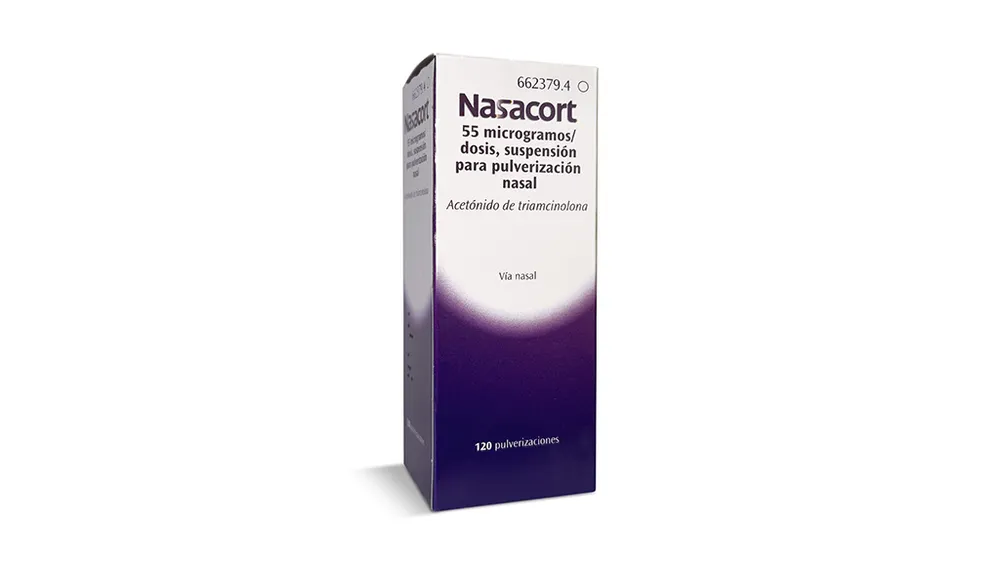
Table of Contents
Package leaflet: Information for the user
Introduction
Package leaflet: information for the patient
Nasacort 55 micrograms/dose, nasal spray suspension
Triamcinolone acetonide
Read the entire leaflet carefully before you start using this medicine, because it contains important information for you.
- Keep this leaflet, as you may need to read it again.
- If you have any questions, ask your doctor or pharmacist.
- This medicine has been prescribed for you only and must not be given to other people, even if they have the same symptoms as you, since it could harm them.
- If you experience any adverse effects, consult your doctor or pharmacist, even if they are adverse effects not listed in this leaflet. See section 4.
Contents of the leaflet
- What Nasacort is and what it is used for
- What you need to know before using Nasacort
- How to use Nasacort
- Possible side effects
- How to store Nasacort
- Contents of the pack and other information
1. What Nasacort is and what it is used for
Nasacort contains a medicine called triamcinolone acetonide. It belongs to a group of medicines known as corticosteroids, meaning it is a type of steroid. It is administered as a nasal spray to treat nasal symptoms of allergic rhinitis in adults and children over 2 years of age.
Nasal allergy symptoms include sneezing, itching, and nasal blockage, congestion, or runny nose. These symptoms may be caused by:
- Animal dander or house dust mites. This type of allergy can occur at any time of the year and is called "perennial allergic rhinitis".
- Pollen. This type of allergy, such as hay fever, may be caused by different pollens at different times of the year. It is called "seasonal allergic rhinitis".
This medicine is only effective if used regularly, and your symptoms may not improve immediately. Some people may experience relief from the first day of treatment, while in others it may take 3 to 4 days to feel improvement.
2. What you need to know before using Nasacort
Do not use Nasacort:
- if you are allergic to triamcinolone acetonide or to any of the other ingredients of this medicine (listed in section 6).
Symptoms of an allergic reaction to Nasacort include: rash (hives), itching, difficulty swallowing or breathing, swelling of the lips, face, throat, or tongue.
Warnings and precautions
Talk to your doctor or pharmacist before starting to use Nasacort:
- if you have any untreated infection in the nose or throat. If you develop a fungal infection while using Nasacort, stop using the spray until the infection has been treated.
- if you have recently had nasal surgery, or have sustained injuries or ulcers in the nose.
- if you are switching from injectable or tablet steroids to Nasacort nasal spray suspension.
- if you have had glaucoma or cataracts.
Contact your doctor if you experience blurred vision or other visual disturbances.
If you are unsure whether any of the above apply to you, consult your doctor or pharmacist before using this medicine.
Children (under 2 years of age)
This medicine is not recommended for use in children under 2 years of age.
Surgery or stressful situations
Your doctor may advise you to take a higher than usual dose of this medicine for medical reasons. If your dose is increased, inform your doctor if you are going to have surgery or if you become unwell. This is because higher-than-usual doses of this medicine may reduce your body’s ability to heal or cope with stress. If this occurs, your doctor may decide you need additional treatment with another medicine to help you.
Use of Nasacort with other medicines
Tell your doctor if you are taking or have recently taken any other medicines, including those obtained without a prescription.
Some medicines may increase the effects of Nasacort, so your doctor will monitor you closely if you are taking these medicines (including certain HIV medications: ritonavir, cobicistat).
Pregnancy, breast-feeding, and fertility
If you are pregnant, breast-feeding, think you may be pregnant, or are planning to become pregnant, consult your doctor or pharmacist before using this medicine.
Driving and using machines
Nasacort has no or negligible effects on the ability to drive or use machines.
Nasacort contains benzalkonium chloride
This medicine contains 15 micrograms of benzalkonium chloride per spray.
Benzalkonium chloride may cause irritation or inflammation inside the nose, especially when used for long-term treatment.
Systemic effects
When corticosteroids, including triamcinolone acetonide, are used for long periods or at high doses over long periods, adverse effects may occur due to absorption of the drug into the body (e.g., normal production of steroid hormones may be affected). These adverse effects are much less likely with nasal corticosteroid sprays than with orally taken corticosteroids (e.g., tablets). Speak with your doctor if you experience any adverse effects.
3. How to use Nasacort
Nasacort should only be used by nasal route.
Follow exactly the administration instructions given by your doctor or pharmacist. If in doubt, consult your doctor or pharmacist again. This medicine is effective only if used regularly. It may take 3 to 4 days before you notice an improvement in your symptoms.
How much Nasacort should you use
Adults and children (over 12 years of age)
- The usual starting dose is 2 sprays in each nostril per day.
- Once allergy symptoms are under control, the dose may be reduced to 1 spray in each nostril per day.
Children (6 to 12 years of age)
- The usual dose is 1 spray in each nostril per day.
- If symptoms do not resolve, the dose may be increased to 2 sprays in each nostril per day.
- Afterwards, the dose may be reduced to 1 spray in each nostril per day.
Children (2 to 5 years of age)
- The usual dose is 1 spray in each nostril per day.
Do not use Nasacort for longer than 3 months in children under 12 years of age.
An adult should assist a young child in using this medicine.
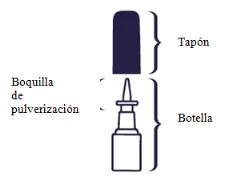
How to use the spray
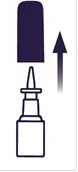
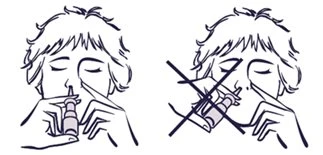
Before using your nasal spray, gently blow your nose to clear your nasal passages.
|
|
|
|
|
correct position incorrect position |
| |
| |
|
If you have not used the spray for more than two weeks:
- You need to prime the spray again, to fill the nozzle with the spray.
- You must point the nozzle away from yourself while performing this operation.
- To prime, spray once into the air before using it again.
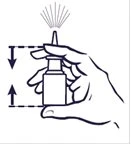
- Always shake the bottle gently before use.
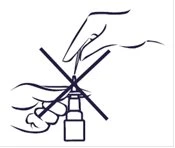
Cleaning the spray
If the spray does not work, the nozzle may be blocked. Never try to unblock it or enlarge the spray hole with a pin or sharp object. This could cause the spray to stop working.
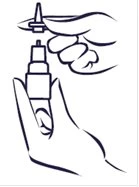
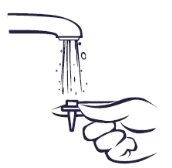
You should clean the nasal spray at least once a week. You may clean it more frequently if it becomes blocked.
Instructions for cleaning the spray pump:
|
If you use more Nasacort than you should
It is important that you take your dose exactly as prescribed by your doctor or as advised by your healthcare provider.
You should only use this medicine as recommended by your doctor; your symptoms could worsen if you use more or less than prescribed.
An overdose is unlikely, but if you have accidentally swallowed the entire contents of the container orally at once, you might experience stomach or intestinal discomfort. Speak with a doctor if you have used more Nasacort than you should.
In case of overdose or accidental ingestion, consult your doctor or pharmacist immediately or call the Toxicology Information Service at telephone number 91 562 04 20, indicating the medicine and the amount ingested.
If you forget to use Nasacort
If you forget to use Nasacort, take it as soon as you remember. Do not use a double dose to make up for the missed dose.
If you stop using Nasacort
If you stop using this medicine, your symptoms may return within a few days.
If you experience any adverse effects (withdrawal symptoms) after suddenly stopping this medicine following prolonged use, speak with your doctor. See section 4, “Possible adverse effects,” for more information.
If you have any further questions about the use of this medicine, ask your doctor or pharmacist.
4. Possible adverse effects
Like all medicines, this medicine can cause adverse effects, although not everyone will experience them.
Stop using Nasacort and seek immediate medical attention at a doctor’s office or hospital if you:
- experience an allergic reaction to Nasacort. Symptoms (frequency not known) may include: rash (hives), itching, difficulty swallowing or breathing, swelling of the lips, face, throat, or tongue.
Common adverse effects (may affect up to 1 in 10 people)
- Nasal drip, headache, irritated throat and/or cough
- Nosebleeds
- Inflammation/irritation of the respiratory tract (bronchitis)
- Heartburn or indigestion
- Flu-like symptoms (fever, muscle pain, weakness and/or fatigue)
- Dental problems
Other adverse effects (frequency not known: cannot be estimated from available data)
- Irritation and dryness inside the nose
- Nasal sinus congestion or blockage
- Sneezing
- Changes in taste and smell
- Feeling unwell (nausea)
- Sleep problems, dizziness or tiredness
- Shortness of breath (dyspnea)
- Decreased cortisol levels in the blood (laboratory values)
- Blurred vision (cataracts), increased pressure inside the eye (glaucoma)
- Blurred vision
- Sudden discontinuation of corticosteroids after prolonged use may lead to steroid withdrawal syndrome. Withdrawal symptoms such as joint pain, muscle pain, tremors, weight loss, anxiety, nasal drip, and nosebleeds may be observed with intranasal triamcinolone. However, these symptoms are extremely rare with intranasal corticosteroid sprays, and are much less likely to occur with nasal corticosteroid sprays than with orally taken corticosteroids (e.g., tablets).
In some individuals, Nasacort may damage the middle part of the inside of the nose (known as the “nasal septum”). Consult your doctor or pharmacist if you have any questions about this.
Other adverse effects in children
If your child has been using this medicine, it may affect your child’s growth. This means your doctor will need to check your child’s height periodically, and may therefore consider reducing the dose. Additionally, your doctor may consider referring you to a pediatric specialist.
Reporting of adverse effects
If you experience any adverse effect, talk to your doctor or pharmacist, even if it is a possible adverse effect not listed in this leaflet. You can also report them directly via the national reporting system included in the Spanish System for Pharmacovigilance of Human Medicines: https://www.notificaram.es. By reporting adverse effects, you can help provide more information on the safety of this medicine.
5. Storage of Nasacort
- Keep this medicine out of the sight and reach of children.
- Do not use this medicine after the expiry date stated on the packaging and on the bottle after “EXP”. The expiry date refers to the last day of the month indicated.
- Do not store above 25°C.
- After first opening Nasacort, the 30-spray pack should be used within 1 month and the 120-spray pack within 2 months.
- Medicines must not be disposed of via wastewater or household waste. Dispose of unused medicines and their packaging at the SIGRE collection point at your pharmacy. If in doubt, ask your pharmacist how to dispose of medicines and packaging you no longer need. This will help protect the environment.
6. Contents of the pack and other information
Composition of Nasacort
The active substance is triamcinolone acetonide. One spray contains 55 micrograms of triamcinolone acetonide.
The other components are:
- microcrystalline cellulose and sodium carboxymethylcellulose (dispersible cellulose)
- polysorbate 80
- purified water
- anhydrous glucose
- benzalkonium chloride (50% w/v solution)
- disodium edetate
- hydrochloric acid or sodium hydroxide (to adjust pH)
Appearance of the product and contents of the pack
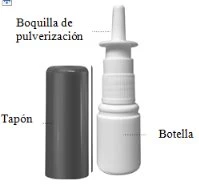
Nasacort is a nasal spray suspension. It is supplied in a white plastic bottle with a pump to deliver the spray through a nozzle. The bottle has a protective cap to keep the nozzle clean and prevent accidental actuation.
This single bottle contains at least 120 sprays (16.5 g of suspension containing 9.075 mg of triamcinolone acetonide) or at least 30 sprays (6.5 g of suspension containing 3.575 mg of triamcinolone acetonide).
Only certain package sizes may be marketed.
Marketing Authorization Holder and Manufacturer
Marketing Authorization Holder:
Opella Healthcare Spain, S.L.
C/ Rosselló i Porcel, 21
08016 Barcelona,
Spain
Manufacturer:
Bespak HC Limited
London Road, Holmes Chapel
Cheshire, CW4 8BE
United Kingdom
or
Sanofi Winthrop Industrie
30-36, avenue Gustave Eiffel
37100 Tours
France
or
Sanofi-Aventis Deutschland GmbH
65926 Frankfurt am Main
Germany
This medicinal product is authorized in the European Economic Area and in the United Kingdom (Northern Ireland) under the following names: Nasacort
Austria: Nasacort Nasenspray
Belgium: Nasacort
Bulgaria: Nasacort
Czech Republic: Triamcinolone sanofi 55 mikrogramu/dávka
Denmark: Nasacort
Estonia: Nasacort
Finland: Nasacort
Germany: Nasacort 55 Mikrogramm/Dosis
Greece: Nasacort
Hungary: Nasacort
Ireland: Nasacort nasal spray
Italy: Nasacort
Latvia: Nasacort
Lithuania: Triamcinolone acetonide Sanofi 55μg/dose nasal spray, suspension
Luxembourg: Nasacort
Netherlands: Nasacort
Poland: Nasacort
Portugal: Nasacort
Romania: Nasacort 55 micrograme/doza spray nazal, suspensie
Slovakia: Nasacort 55 mikrogramov/dávka
Slovenia: Nasacort
Spain: Nasacort 55 microgramos/dosis, suspensión para pulverización nasal
Sweden: Nasacort
United Kingdom: Nasacort nasal spray
Date of latest review of this leaflet: November 2025
Detailed information on this medicinal product is available on the website of the Spanish Agency of Medicines and Health Products (AEMPS) http://www.aemps.gob.es/