Narine Repetabs 5 mg/120 mg prolonged-release tablets
Spain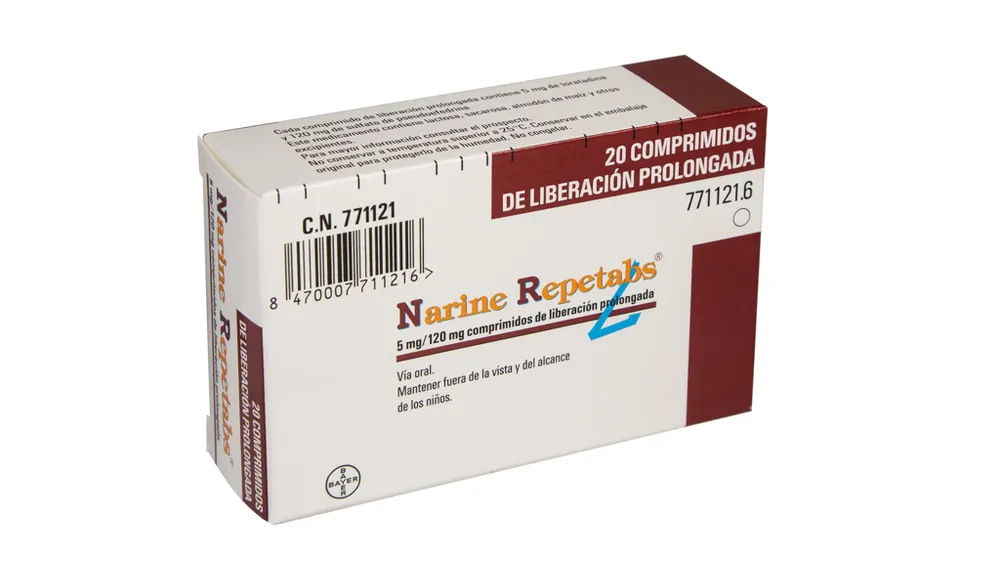
Table of Contents
Package leaflet: Information for the user
Introduction
Package leaflet: information for the user
Narine Repetabs 5mg/120mg prolonged-release tablets
loratadine/pseudoephedrine sulfate
Read the entire leaflet carefully before you start taking this medicine, because it contains important information for you.
- Keep this leaflet, as you may need to read it again.
- If you have any questions, ask your doctor or pharmacist.
- This medicine has been prescribed for you only, and you should not give it to others, even if they have the same symptoms as you, because it could harm them.
- If you experience adverse effects, consult your doctor or pharmacist, even if they are effects not listed in this leaflet. See section 4.
Contents of the leaflet:
- What Narine Repetabs is and what it is used for
- What you need to know before taking Narine Repetabs
- How to take Narine Repetabs
- Possible adverse effects
- How to store Narine Repetabs
- Contents of the pack and other information
1. What Narine Repetabs is and what it is used for
What Narine Repetabs is
Narine Repetabs tablets contain a combination of two medicines: an antihistamine (loratadine) and a decongestant (pseudoephedrine).
How Narine Repetabs works
Narine Repetabs helps reduce allergy or common cold symptoms by blocking the effects of a substance called "histamine", which the body produces when it is allergic to something. Decongestants help relieve nasal congestion.
When to use Narine Repetabs
Narine Repetabs tablets relieve symptoms associated with seasonal allergic rhinitis (hay fever), such as sneezing, runny or itchy nose or eyes, when accompanied by nasal congestion, in adults and adolescents aged 12 years and older.
2. What you need to know before taking Narine Repetabs
Do not take Narine Repetabs
- If you are allergic (hypersensitive) to loratadine, pseudoephedrine, or any of the other components of this medicine (listed in section 6).
Due to its pseudoephedrine content, do not take Narine Repetabs
- if you are also being treated with any heart or blood pressure medication.
- if you have glaucoma, difficulty urinating, urinary tract obstruction, very high blood pressure (severe hypertension) or uncontrolled hypertension, heart or blood vessel disease, have had or currently have cerebral hemorrhage, or hyperthyroidism.
- if you are being treated with monoamine oxidase inhibitors (MAO inhibitors) or have stopped such treatment less than 14 days ago.
- if you have severe, acute (sudden) or chronic (long-term) kidney disease, or kidney failure.
Warnings and precautions
Certain medical conditions may make you unusually sensitive to the decongestant pseudoephedrine contained in this medicine.
Consult your doctor or pharmacist before taking Narine Repetabs:
- if you are 60 years of age or older, as you may be more sensitive to the effects of this medicine.
- if you have diabetes mellitus, stenosing peptic ulcer (an ulcer causing narrowing of the stomach, small intestine, or esophagus), pyloroduodenal obstruction (intestinal obstruction), vesical neck obstruction (bladder neck obstruction), a history of bronchospasm (difficulty breathing due to narrowing of the lung muscles), or liver, kidney, or bladder problems.
- if you have a surgical procedure scheduled, as you may need to stop taking Narine Repetabs for a few days.
- if you are taking digitalis medications used to treat certain heart conditions, as you may require a dose adjustment.
- if you are taking methyldopa, mecamylamine, reserpine, or guanethidine for blood pressure, as you may require a dose adjustment.
- if you are taking decongestants (oral or nasal), appetite suppressants (diet pills), or amphetamines, as these medications together with Narine Repetabs may increase your blood pressure.
- if you are taking ergot alkaloids (such as dihydroergotamine, ergotamine, or methylergonovine) for migraines. Together with Narine Repetabs, these medications may increase your blood pressure.
- if you are taking linezolid (an antibiotic), bromocriptine (for infertility or Parkinson's disease), cabergoline, lisuride, or pergolide (for Parkinson's disease). Together with Narine Repetabs, these medications may increase your blood pressure.
- if you are scheduled for skin allergy tests, you must not take Narine Repetabs during the two days prior to testing, as this medicine may alter test results.
Inform your doctor if you experience or are diagnosed with any of the following:
- high blood pressure
- rapid or strong heartbeat
- irregular heart rhythm
- nausea and headache or worsening headache while using Narine Repetabs. Your doctor may advise you to stop treatment.
One of the active ingredients in Narine Repetabs, pseudoephedrine sulfate, may lead to dependence, and large amounts of pseudoephedrine sulfate can be toxic.
If you develop generalized feverish erythema associated with pustules, stop taking Narine Repetabs and contact your doctor or seek immediate medical attention. See section 4.
Sudden abdominal pain or rectal bleeding may occur while taking Narine Repetabs due to inflammation of the colon (ischemic colitis). If these gastrointestinal symptoms occur, stop taking Narine Repetabs and contact your doctor or seek immediate medical attention. See section 4.
Reduced blood flow to the optic nerve may occur with Narine Repetabs. If you experience sudden vision loss, stop taking Narine Repetabs and contact your doctor or seek immediate medical attention. See section 4.
Cases of reversible posterior encephalopathy syndrome (RPES) and reversible cerebral vasoconstriction syndrome (RCVS) have been reported after using medicines containing pseudoephedrine. RPES and RCVS are rare conditions that may involve reduced blood flow to the brain. Stop using Narine Repetabs immediately and seek immediate medical attention if you experience symptoms that could indicate RPES or RCVS (for symptoms, see section 4 "Possible side effects").
Children
Do not give this medicine to children under 12 years of age.
Taking Narine Repetabs with other medicines
Inform your doctor or pharmacist if you are taking, have recently taken, or might need to take any other medicines, including those obtained without a prescription.
Taking Narine Repetabs with alcohol
It has not been shown that Narine Repetabs enhances the effects of alcohol.
Pregnancy, breastfeeding, and fertility
If you are pregnant or breastfeeding, think you may be pregnant, or plan to become pregnant, consult your doctor or pharmacist before using this medicine.
Pregnancy
Do not take Narine Repetabs if you are pregnant.
Breastfeeding
Do not take Narine Repetabs if you are breastfeeding.
Loratadine and pseudoephedrine are excreted in breast milk. A decrease in milk volume has been reported in breastfeeding mothers using pseudoephedrine, a component of Narine Repetabs.
Driving and using machines
At the recommended dose, Narine Repetabs is not expected to cause drowsiness or reduced alertness. However, very rarely, some individuals may experience drowsiness, which could affect their ability to drive or operate machinery.
Narine Repetabs contains lactose and sucrose
Narine Repetabs contains lactose and sucrose. If your doctor has informed you that you have an intolerance to certain sugars, consult with them before taking this medicine.
Laboratory tests: Athletes should be informed that this medicine contains a component that may result in a positive analytical finding in doping control tests.
3. How to take Narine Repetabs
Follow exactly the administration instructions for this medicine given by your doctor or pharmacist. If in doubt, consult your doctor or pharmacist again.
How to take
Adults and adolescents aged 12 years and older:
The recommended dose is one Narine Repetabs prolonged-release tablet twice daily with a glass of water, regardless of meals.
This medicine is taken orally. Swallow the tablet whole; do not crush, break, or chew the tablet before swallowing.
Do not take more Narine Repetabs tablets than recommended in this leaflet, or more frequently than recommended.
Do not take this medicine for longer than 10 consecutive days unless your doctor tells you otherwise.
If you take more Narine Repetabs than you should
If you take more Narine Repetabs than you should, contact your doctor or pharmacist immediately. Drowsiness, palpitations, and headache have been reported with loratadine overdose, a component of Narine Repetabs. Seizures, palpitations, nausea, and nervousness have been reported with pseudoephedrine overdose, a component of Narine Repetabs.
In case of overdose or accidental ingestion, contact your doctor or pharmacist immediately or call the Toxicology Information Service; Telephone 91 562 04 20, indicating the medicine and the amount ingested.
If you forget to take Narine Repetabs
- If you forget to take a dose, take it as soon as you remember, and then continue taking it as usual.
- Do not take a double dose to make up for forgotten doses.
If you have any further questions about the use of this medicine, ask your doctor or pharmacist.
4. Possible adverse effects
Like all medicines, this medicine can cause adverse effects, although not everyone experiences them. Contact your doctor or pharmacist immediately if you experience an adverse effect that does not go away, is bothersome, or that you consider important.
Frequency not known: cannot be estimated from the available data
- serious conditions affecting blood vessels in the brain known as reversible posterior encephalopathy syndrome (RPES) and reversible cerebral vasoconstriction syndrome (RCVS)
Stop taking Narine Repetabs immediately and seek urgent medical assistance if you develop symptoms that may be signs of reversible posterior encephalopathy syndrome (RPES) or reversible cerebral vasoconstriction syndrome (RCVS). These include:
- sudden, severe headache
- malaise
- vomiting
- confusion
- seizures
- changes in vision
Adverse effects very commonly occurring with Narine Repetabs (may affect more than 1 in 10 patients) include: insomnia.
Adverse effects commonly occurring with Narine Repetabs (may affect up to 1 in 10 patients) include: dry mouth, nervousness, drowsiness, depression, agitation, anorexia, dizziness, dry mouth, rapid heartbeat, sore throat, nasal mucosa inflammation, constipation, nausea, headache, and fatigue.
Adverse effects uncommonly occurring (may affect up to 1 in 100 patients) include: confusion, tremor, increased sweating, hot flushes, taste disturbances, abnormal eye tearing, tinnitus, irregular heartbeat, nosebleeds, and frequent or abnormal urination with itching.
During the marketing of Narine Repetabs, the following adverse effects have been reported with very rare frequency (may affect up to 1 in 10,000 patients): severe allergic reactions including rash, hives, and facial swelling, dizziness, seizures, abnormal heart rhythms, increased blood pressure, cough, narrowing of the airways, liver problems, difficulty urinating, and hair loss.
Other adverse reactions reported only for loratadine in clinical trials and during the post-marketing period include increased appetite, rash, and stomach discomfort.
The frequency of the following adverse effects is unknown:
-
Weight gain
-
Sudden onset of fever, skin redness, or numerous small pustules (possible symptoms of acute generalized exanthematous pustulosis - AGEP) that may occur within the first 2 days of treatment with Narine Repetabs. See section 2.
Stop taking Narine Repetabs if these symptoms appear and contact your doctor or seek immediate medical attention.
- Inflammation of the colon due to reduced blood flow (ischemic colitis).
- Reduced blood flow to the optic nerve (ischemic optic neuropathy).
Reporting of adverse effects:
If you experience any type of adverse effect, consult your doctor or pharmacist, even if it is a possible adverse effect not listed in this leaflet. You may also report them directly via the Spanish Pharmacovigilance System for Human Medicinal Products: https://www.notificaram.es. By reporting adverse effects, you can help provide more information on the safety of this medicine.
5. Storage of Narine Repetabs
-
Keep this medicine out of the sight and reach of children.
-
This medicine does not require any special storage temperature. Store in the original packaging to protect it from moisture. Do not freeze.
-
Do not use this medicine after the expiry date stated on the carton and blister after EXP.
The expiry date refers to the last day of the month indicated.
-
Do not use this medicine if you notice any changes in the appearance of the tablet.
-
Medicines must not be disposed of via wastewater or household waste. Dispose of packaging and unused medicines at the SIGRE Point at your pharmacy. If in doubt, ask your pharmacist how to dispose of unused medicines and packaging. This will help protect the environment.
6. Contents of the pack and other information
Composition of Narine Repetabs
- The active substances are loratadine 5 mg and pseudoephedrine sulfate 120 mg.
- The other components are: core - monohydrate lactose, corn starch, povidone and magnesium stearate; film coating - gum arabic, anhydrous calcium sulfate, calcium sulfate dihydrate, carnauba wax, microcrystalline cellulose, oleic acid, rosin, powder soap, sucrose, talc, titanium dioxide, white wax and zein. See section 2 “Narine Repetabs contains lactose and sucrose”.
Appearance of the product and contents of the pack
Narine Repetabs 5 mg/120 mg prolonged-release tablets are supplied in blisters in pack sizes of 1, 7, 10, 14, 20, 28, 30, 50 and 100 tablets.
Only some pack sizes may be marketed.
Marketing Authorization Holder and Manufacturer
Marketing Authorization Holder
Bayer Hispania, S.L.
Av. Baix Llobregat, 3-5
08970 Sant Joan Despí (Barcelona)
Spain
Manufacturer
SAG Manufacturing, S.L.U.
Carretera N-1, Km 36
28750 San Agustín de Guadalix (Madrid)
Spain
This medicinal product is authorized in the Member States of the European Economic Area under the following names:
Austria: Clarinase
Belgium: Clarinase Repetabs
Spain: Narine Repetabs 5mg/120mg prolonged-release tablets
Greece: Clarityne-D 120/5
Portugal: Claridon
Date of the most recent review of this leaflet: 10/2024
Other sources of information
Detailed and up-to-date information on this medicinal product is available on the website of the Spanish Agency of Medicines and Health Products (AEMPS) http://www.aemps.gob.es/