Naramig 2.5 mg film-coated tablets
Spain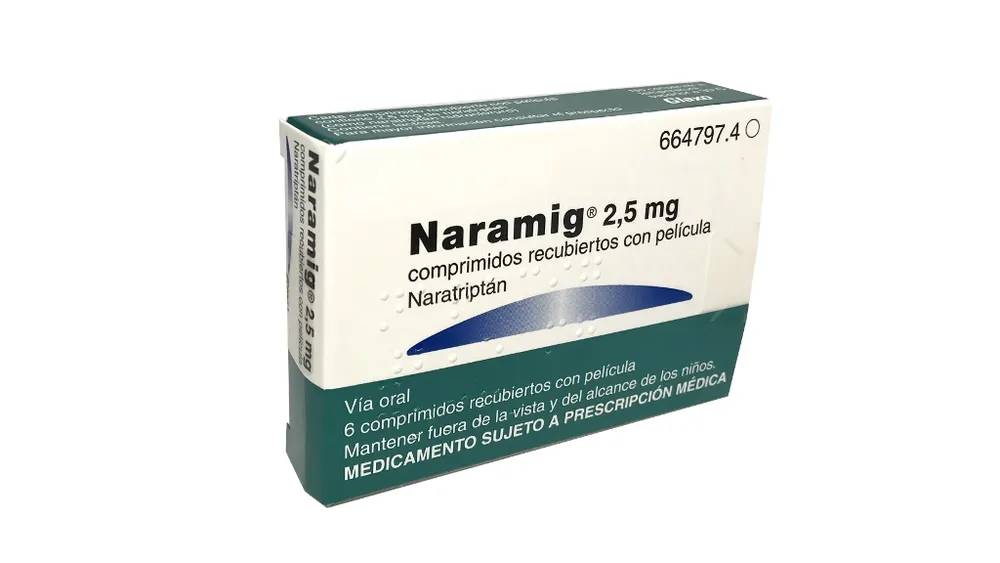
Table of Contents
Package leaflet: Information for the user
Introduction
Package leaflet: information for the user
Naramig 2.5 mg film-coated tablets
Naratriptan
Read the entire leaflet carefully before you start taking this medicine, because it contains important information for you.
- Keep this leaflet. You may need to read it again.
- If you have any questions, ask your doctor or pharmacist.
- This medicine has been prescribed for you only. Do not give it to other people, even if they have the same symptoms as you, because it may harm them.
- If you experience any side effects, talk to your doctor or pharmacist, even if it is a side effect not listed in this leaflet. See section 4.
Contents of the leaflet
- What Naramig is and what it is used for
- What you need to know before taking Naramig
- How to take Naramig
- Possible side effects
- How to store Naramig
- Contents of the pack and other information
1. What Naramig is and what it is used for
Naramig tablets contain naratriptan (hydrochloride), which belongs to a group of medicines called triptans (also known as 5-HT1 receptor agonists).
Naramig tablets are used to treat the headache pain associated with migraine.
Migraine symptoms may be due to temporary dilation of the blood vessels in the head. Naramig is believed to reduce this dilation of blood vessels, helping to relieve headache pain and other migraine symptoms such as nausea and vomiting, and sensitivity to light and sound.
2. What you need to know before taking Naramig
Do not take Naramig:
- If you are allergic to naratriptan or to any of the other ingredients of this medicine (listed in section 6).
- If you have a heart condition, such as narrowed arteries (ischaemic heart disease) or chest pain (angina), or if you have previously had a heart attack.
- If you have circulatory problems in the legs causing cramp-like pain when walking (peripheral vascular disease).
- If you have had a stroke or a mini-stroke (also known as a transient ischaemic attack or TIA).
- If you have high blood pressure. You may be able to take Naramig if you have mild hypertension and are being treated for it.
- If you have severe kidney or liver problems.
- If you are taking other migraine medicines, including those containing ergotamine, or similar medicines such as methysergide, triptans, or 5-HT1 receptor agonists.
If any of these apply to you:
→Tell your doctor and do not take Naramig.
Warnings and precautions
Talk to your doctor or pharmacist before taking Naramig.
If you have any risk factors:
- If you are a smoker or using nicotine replacement therapy, and especially
- In the case of men over 40 years of age, or
- In the case of postmenopausal women.
Very rarely, serious heart problems have occurred in people taking Naramig, even though they had no previous history of heart disease.
If you are in any of the above situations, you may have an increased risk of heart disease. Therefore:
→Tell your doctor so that your heart function can be evaluated before starting treatment with Naramig.
If you are allergic to antibiotics known as sulfonamides
If this applies to you, you may also be allergic to Naramig. If you are allergic to an antibiotic but are unsure whether it is a sulfonamide:
→Tell your doctor or pharmacist before taking Naramig.
If you take Naramig frequently
Taking Naramig too often may worsen your headaches.
→Tell your doctor if this applies to you. Your doctor may advise you to stop taking Naramig.
If you experience chest pain or tightness after taking Naramig
These effects can be intense but are usually temporary. If they do not go away quickly or become more severe:
→See a doctor immediately. Section 4 of this leaflet contains more information about this adverse effect.
If you are taking antidepressants known as SSRIs (Selective Serotonin Reuptake Inhibitors) or SNRIs (Serotonin and Norepinephrine Reuptake Inhibitors)
→Tell your doctor or pharmacist before starting Naramig.
Taking Naramig with other medicines
Tell your doctor or pharmacist if you are taking, have recently taken, or might need to take any other medicines, including herbal medicines or over-the-counter medicines.
Some medicines should not be taken with Naramig, and others may cause adverse effects when taken together with Naramig. Tell your doctor if you are taking:
- Any triptans or 5-HT1 receptor agonists used to treat migraine. Do not take Naramig together with these medicines. Do not take them again within at least 24 hours after taking Naramig.
- Ergotamine, also used to treat migraine, or similar medicines such as methysergide. Do not take Naramig together with these medicines. Stop taking these medicines at least 24 hours before taking Naramig, and do not take them again within at least 24 hours after taking Naramig.
- SSRIs (selective serotonin reuptake inhibitors) or SNRIs (serotonin and norepinephrine reuptake inhibitors) used to treat depression. Taking Naramig with these medicines may cause confusion, weakness, and/or lack of coordination. Tell your doctor immediately if this applies to you.
- St. John’s Wort (Hypericum perforatum). Taking herbal medicines containing St. John’s Wort while taking Naramig may increase the risk of adverse effects.
Pregnancy and breastfeeding
- If you are pregnant, think you may be pregnant, or are planning to become pregnant, consult your doctor or pharmacist before using this medicine. There is only limited information on the safety of Naramig during pregnancy, although currently there is no evidence of an increased risk of birth malformations. Your doctor may advise you not to take Naramig while pregnant.
- Do not breastfeed your child for 24 hours after taking Naramig. Discard any breast milk produced during this time.
Driving and use of machinery
- Both migraine symptoms and this medicine may cause drowsiness. If affected, do not drive or operate machinery.
Naramig contains lactose
This medicine contains lactose. If your doctor has informed you that you have an intolerance to certain sugars:
→Consult with them before taking this medicine.
This medicine contains less than 23 mg of sodium (1 mmol) per tablet; this is essentially "sodium-free".
3. How to take Naramig
Take Naramig only after your migraine has started
Do not take Naramig to prevent an attack
Always follow exactly the instructions given by your doctor regarding the administration of this medicine. If in doubt, consult your doctor or pharmacist again.
What dose should you take
- The normal dose for adults between 18 and 65 years of age is one 2.5 mg Naramig tablet, taken whole with a little water.
Naramig is not recommended for children under 18 years of age or for adults over 65 years of age.
When to take your dose
- It is best to take Naramig as soon as the migraine headache appears. However, it may be taken at any time during an attack.
If symptoms start again
- You may take a second Naramig tablet after 4 hours, unless you have kidney or liver impairment.
- If you have any kidney or liver impairment, do not take more than one tablet in 24 hours.
- Do not take more than two tablets in 24 hours.
If you do not get relief with the first dose
- Do not take another tablet for the same attack.
If Naramig does not provide you with any relief:
?Ask your doctor or pharmacist.
If you take more Naramig than you should
- Do not take more than 2 Naramig tablets in 24 hours.
If you take more Naramig than you should, you may become unwell. If you have taken more than 2 tablets in 24 hours:
?Inform your doctor or contact the Toxicology Information Service at telephone number 91.562.04.20, indicating the medicine and the amount taken.
If you have any further questions about the use of this medicine, ask your doctor or pharmacist.
4. Possible adverse effects
Like all medicines, this medicine can cause adverse effects, although not everyone will experience them.
Allergic reaction: see a doctor immediately (may affect up to 1 in 1,000 people)
- Signs of an allergic reaction include: skin rash, wheezing, swelling of the eyelids, face or lips, complete collapse.
If you experience any of these symptoms shortly after taking Naramig:
→ Do not take any more tablets and contact a doctor immediately.
Frequent adverse effects (may affect up to 1 in 10 people)
- Feeling sick (nausea) or being sick (vomiting), although these may be due to migraine itself.
- Tiredness, numbness or general malaise.
- Dizziness, tingling sensation or hot flushes.
If you experience any of these adverse effects:
→ Inform your doctor or pharmacist.
Uncommon adverse effects (may affect up to 1 in 100 people)
- Heaviness, pressure, tightness or pain in the chest, throat or other parts of the body. These effects may be intense but are usually transient.
If these adverse effects persist or worsen, especially chest pain:
→ Seek urgent medical attention. In a small number of people, these symptoms may be caused by a heart attack.
Other uncommon adverse effects include:
- Visual disturbances (although these may be due to migraine itself).
- Heartbeats may become faster, slower or irregular.
- Slight increase in blood pressure which may last up to 12 hours after taking Naramig.
If you experience these adverse effects:
→ Inform your doctor or pharmacist.
Rare adverse effects (may affect up to 1 in 1,000 people)
- Sleepiness (somnolence).
- Pain in the lower left part of the stomach and bloody diarrhoea (ischaemic colitis).
If you experience these adverse effects:
→ Inform your doctor or pharmacist.
Very rare adverse effects (may affect up to 1 in 10,000 people)
- Heart problems, including chest pain (angina) and heart attack.
- Poor circulation in arms and legs, causing pain and discomfort.
If you experience these adverse effects:
→ Inform your doctor or pharmacist.
Reporting of adverse effects
If you experience any type of adverse effect, consult your doctor or pharmacist, even if it is a possible adverse effect not listed in this leaflet. You can also report them directly via the Spanish Pharmacovigilance System for Human Medicinal Products, www.notificaRAM.es. By reporting adverse effects, you can help provide more information on the safety of this medicine.
5. Storage of Naramig
Keep this medicine out of the sight and reach of children.
Do not use this medicine after the expiry date stated on the packaging (EXP). The expiry date refers to the last day of the month indicated.
Do not store above 30°C.
Medicines must not be disposed of via wastewater drains or household waste. Dispose of unused medicines and their containers at the SIGRE Point at your pharmacy. If you have any doubts, ask your pharmacist how to dispose of medicines and containers you no longer need. This will help protect the environment.
6. Contents of the pack and other information
Composition of Naramig
The active substance is naratriptan (2.5 mg), as hydrochloride.
The other components of the tablet core are: microcrystalline cellulose, anhydrous lactose, sodium croscarmellose and magnesium stearate. The other components of the tablet coating are: hypromellose, titanium dioxide (E171), triacetin, yellow iron oxide (E172), indigotine (indigo carmine (E132)).
Appearance of the product and contents of the pack
Naramig tablets are green, film-coated, D-shaped, and engraved with GX CE5 on one side. They are available in child-resistant blister packs containing 2, 4, 6 or 12 tablets.
Only certain pack sizes may be marketed.
Marketing Authorization Holder and Manufacturer
Marketing Authorization Holder
Glaxo, S.A.
P.T.M. C/ Severo Ochoa, 2
28760 Tres Cantos (Madrid)
Tel: +34 900 202 700
[email protected]
Manufacturer
Delpharm Poznan Spólka Akcyjna
ul. Grunwaldzka 189
60-322 Poznan
Poland
This medicinal product is authorised in the Member States of the European Economic Area under the following names:
Belgium Naramig
Finland Naramig
France Naramig
Germany Naramig
Greece Naramig
Luxembourg Naramig
Netherlands Naramig
Portugal Naramig
Spain Naramig
Sweden Naramig
Date of the most recent review of this leaflet: June 2020.
Detailed and up-to-date information on this medicinal product is available on the website of the Spanish Agency of Medicines and Medical Devices (AEMPS) http://www.aemps.gob.es/