Naglazyme 1 mg/ml concentrate for infusion solution
Spain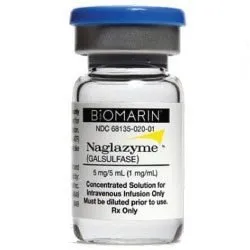
Table of Contents
Package leaflet: Information for the user
Introduction
PACKAGE LEAFLET: INFORMATION FOR THE USER
Naglazyme 1 mg/ml concentrate for solution for infusion
Galsulfase
This medicinal product is subject to additional monitoring, which will allow quicker identification of new safety information. You can help by reporting any suspected adverse reactions. Information on how to report adverse reactions is included at the end of section 4.
Read the entire leaflet carefully before you start using this medicine, as it contains important information for you.
- Keep this leaflet, as you may need to read it again.
- If you have any questions, consult your doctor.
- If you consider any of the side effects you experience to be serious, or if you notice any side effects not listed in this leaflet, inform your doctor or pharmacist.
Leaflet contents:
- What Naglazyme is and what it is used for
- What you need to know before using Naglazyme
- How to use Naglazyme
- Possible side effects
- How to store Naglazyme
- Contents of the pack and other information
1. What this Naglazyme is and what it is used for
Naglazyme is used to treat patients with MPS VI (Mucopolysaccharidosis VI).
Patients with MPS VI have low or no levels of an enzyme called N-acetylgalactosamine 4-sulfatase, which breaks down specific substances (glycosaminoglycans) in the body. As a result, these substances are not broken down and processed by the body as they should be. They accumulate in many tissues throughout the body, causing the symptoms of MPS VI.
How Naglazyme works
This medicine contains a recombinant enzyme called galsulfase, which can replace the naturally missing enzyme in patients with MPS VI. Treatment has been shown to improve walking endurance and stair-climbing capacity, and to reduce glycosaminoglycan concentrations in the body. This medicine may improve the symptoms of MPS VI.
2. What you need to know before using Naglazyme
Do not use Naglazyme
- If you have experienced severe or potentially life-threatening allergic (hypersensitivity) reactions to galsulfase or any of the other components of Naglazyme, and re-administration of the medicine was not successful.
Warnings and precautions
-
If you are treated with Naglazyme, you may develop infusion-related reactions. An infusion-related reaction is any adverse event that occurs during or up to the end of the day of the infusion (see section 4 “Possible side effects”). If you experience such a reaction, you should contact your doctor immediately.
-
If you experience an allergic reaction, your doctor may slow down or stop your infusion. Your doctor may also give you additional medications to treat any allergic reaction.
-
If you have fever or difficulty breathing before using this medicine, consult your doctor about the possibility of delaying the Naglazyme infusion.
- If you have underlying heart disease, inform your doctor at any time during treatment with Naglazyme. Your doctor may adjust the infusion based on this information.
-
This medicine has not been studied in patients with liver or kidney problems. Consult your doctor if you have renal or hepatic impairment.
-
Talk to your doctor if you experience muscle pain, numbness in the arms or legs, or any intestinal or urinary problems, as these may be caused by pressure on the spinal cord.
Other medicines and Naglazyme
Tell your doctor if you are taking or have recently taken any other medicines, including those obtained without a prescription.
Pregnancy and breastfeeding
Naglazyme should not be administered during pregnancy unless clearly necessary. Consult your doctor or pharmacist before taking any medicine. It is unknown whether galsulfase is excreted in breast milk; therefore, breastfeeding must be discontinued during treatment with Naglazyme. Consult your doctor or pharmacist before taking any medicine.
Driving and using machines
No studies have been conducted regarding the effect on the ability to drive and use machines.
This medicine contains sodium
This medicine contains 0.8 mmol (18.4 mg) of sodium (a main component of table/cooking salt) in each 5 ml vial. This corresponds to y% of the maximum recommended daily sodium intake for an adult and is administered in a sodium chloride 9 mg/ml injectable solution...
3. How to use Naglazyme
Naglazyme will be administered to you by your doctor or nurse.
The dose you receive will depend on your body weight. The recommended dose is 1 mg/kg body weight, administered once a week by intravenous infusion (given slowly through a vein). Each infusion will last approximately 4 hours. During the first hour, the infusion rate will be slow (approximately 2.5% of the total solution), and the remaining volume (approximately 97.5%) will be administered over the following 3 hours.
If you are given more Naglazyme than you should
Naglazyme is administered under the supervision of a nurse or doctor, who will ensure that the correct dose is given and take appropriate action if necessary.
If you miss a dose of Naglazyme
If you miss an infusion of Naglazyme, contact your doctor.
If you have any further questions about the use of this medicine, ask your doctor.
4. Possible adverse effects
Like all medicines, this medicine can cause adverse effects, although not everyone experiences them.
Adverse effects were mainly observed while patients were receiving the infusion or shortly afterwards ("infusion-related reactions"). The most serious adverse effects were facial swelling and fever (very common), abnormally prolonged intervals between breaths, respiratory difficulty, asthma, and urticaria (common); and swelling of the tongue and throat, and severe allergic reaction to this medicine (frequency not known).
If you experience any of these reactions, inform your doctor immediately. You may need to receive additional medicines to prevent an allergic reaction (e.g. antihistamines or corticosteroids) or to reduce fever (antipyretics).
The most common symptoms of infusion-related reactions include fever, chills, skin rash, urticaria, and difficulty breathing.
Very common adverse effects (may affect more than 1 in 10 people):
|
|
Frequent adverse effects (may affect up to 1 in 10 people):
|
|
Other adverse effects with unknown frequency:
|
|
If you experience any of these symptoms, or other symptoms not listed in this leaflet, consult your doctor immediately. You may also report them directly through the national reporting system included in Appendix V. By reporting adverse reactions, you can help provide more information on the safety of this medicine.
5. Storage of Naglazyme
Keep out of sight and reach of children.
Do not use this medicine after the expiry date stated on the vial after EXP. The expiry date refers to the last day of the month indicated.
Unopened vials:
Store in a refrigerator (between 2 °C and 8 °C).
Do not freeze.
Diluted solutions: Chemical and physical stability in use has been demonstrated for up to 4 days at room temperature (23 °C – 27 °C).
To avoid microbiological contamination, the product should be used immediately. If not used immediately, the storage conditions and duration during use are the responsibility of the user and should normally not exceed 24 hours at 2 °C – 8 °C, followed by up to 24 hours at room temperature (23 °C – 27 °C) during administration.
Do not use Naglazyme if visible particles are observed.
Medicines must not be disposed of via wastewater or household waste. Ask your pharmacist how to dispose of medicines and packaging that you no longer need. This will help protect the environment.
6. Contents of the container and other information
Composition of Naglazyme
-
The active substance is galsulfase. Each millilitre of Naglazyme contains 1 mg of galsulfase. A 5 ml vial contains 5 mg of galsulfase. Galsulfase is recombinant human N-acetylgalactosamine 4-sulfatase produced in genetically engineered Chinese hamster ovary (CHO) cells.
-
The other components are: sodium chloride, monobasic sodium phosphate monohydrate, dibasic sodium phosphate heptahydrate, polysorbate 80, water for injections.
Presentation of the product and contents of the pack
Naglazyme is supplied as a concentrate for solution for infusion. The concentrate ranges from transparent to slightly opalescent and from colourless to pale yellow, and must not contain visible particles. The solution must be diluted before it can be infused.
Pack sizes: 1 and 6 vials. Some pack sizes may not be marketed.
Marketing Authorization Holder BioMarin International Limited Shanbally, Ringaskiddy County Cork, P43 R298 Ireland | Manufacturer BioMarin International Limited Shanbally, Ringaskiddy County Cork, P43 R298 Ireland |
Date of latest review of this leaflet: MM/YYYY
This medicinal product has been authorised under "exceptional circumstances".
This type of approval means that, due to the rarity of the disease, it has not been possible to obtain complete information on this medicinal product.
The European Medicines Agency will review annually any new information that becomes available on the medicinal product, and this leaflet will be updated as necessary.
Detailed information on this medicinal product is available on the European Medicines Agency website: http://www.ema.europa.eu/. The site also provides links to other websites on rare diseases and orphan medicinal products.
<-------------------------------------------------------------------------------------------------------------------------
This information is intended for healthcare professionals only:
Naglazyme must not be mixed with any other medicinal product in the same infusion, except as mentioned below.
Each vial of Naglazyme is for single use only. The concentrate for solution for infusion must be diluted with sodium chloride 9 mg/ml (0.9%) solution for infusion using aseptic technique. It is recommended that the diluted Naglazyme solution be administered to patients using an infusion set equipped with an in-line 0.2 µm filter.
Disposal of unused medicinal product and of all materials that have been in contact with it must be carried out in accordance with local regulations.
Preparation of Naglazyme infusion (use aseptic technique)
The number of vials to be diluted will be determined according to the patient's body weight and should be removed from the refrigerator approximately 20 minutes beforehand to allow them to reach room temperature.
Before dilution, each vial should be visually inspected for the presence of particles or discoloration. The solution, which may range from clear to slightly opalescent and from colourless to pale yellow, should be free from visible particles.
A volume of sodium chloride 9 mg/ml (0.9%) solution for infusion equal to the total volume of Naglazyme to be added should be withdrawn and discarded from a 250 ml infusion bag. Use of 100 ml infusion bags should be considered in patients sensitive to fluid volume overload and weighing less than 20 kg; in such cases, the infusion rate (ml/min) should be reduced so that the total duration remains no less than 4 hours. If 100 ml bags are used, the Naglazyme volume may be added directly to the infusion bag.
The volume of Naglazyme should be added slowly to the sodium chloride 9 mg/ml (0.9%) solution for infusion.
The solution should be gently mixed for infusion.
The solution should be visually inspected for particles prior to use. Only clear, colourless solutions free from visible particles should be used.