Myocet liposomal 50 mg powder, dispersion, and solvent for concentrate for perfusion
Spain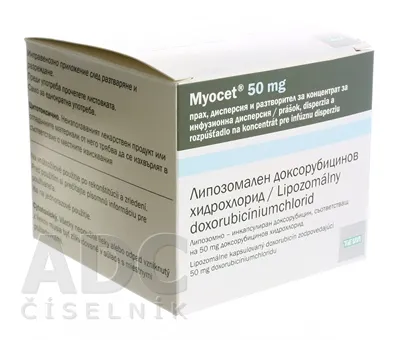
Table of Contents
- Package leaflet: Information for the user
- Introduction
- 1. What Myocet liposomal is and what it is used for
- 2. What you need to know before you are given Myocet liposomal
- 3. How Myocet liposomal is administered
- 4. Possible adverse effects
- 5. Storage of Myocet liposomal
- 6. Contents of the pack and other information
- **1. PRESENTATION**
- **3. PREPARATION FOR INTRAVENOUS ADMINISTRATION**
- **3.1 Preparation of Myocet liposomal**
Package leaflet: Information for the user
Introduction
Package leaflet: information for the user
Myocet liposomal 50 mg powder, dispersion and solvent for concentrate for dispersion for infusion.
Doxorubicin hydrochloride liposomal
Read the entire leaflet carefully before you start using this medicine, because it contains important information for you.
- Keep this leaflet, as you may need to read it again.
- If you have any questions, consult your doctor, pharmacist, or nurse.
- This medicine has been prescribed for you only, and you should not give it to others, even if they have the same symptoms as you, because it could harm them.
- If you experience any adverse reactions, consult your doctor or nurse, even if they are adverse reactions not listed in this leaflet. See section 4.
Leaflet contents
-
What Myocet liposomal is and what it is used for
-
What you need to know before Myocet liposomal is administered
-
How Myocet liposomal is administered
-
Possible adverse effects
-
How to store Myocet liposomal
-
Contents of the pack and other information
1. What Myocet liposomal is and what it is used for
Myocet liposomal contains a medicine called "doxorubicin", which damages tumour cells. This type of medicine is known as "chemotherapy". The medicine is contained within very small fat droplets called "liposomes".
Myocet liposomal is used in adult women for the first-line treatment of breast cancer that has spread (metastatic breast cancer). It is used in combination with another medicine called "cyclophosphamide". Please read the package leaflet that accompanies the medicine carefully.
2. What you need to know before you are given Myocet liposomal
Do not use Myocet liposomal
- if you are allergic to doxorubicin or to any of the other ingredients of this medicine (listed in section 6).
You must not be given Myocet liposomal if you are in this situation. If in doubt, consult your doctor or nurse before being administered Myocet liposomal.
Warnings and precautions
Talk to your doctor or nurse before starting treatment with Myocet liposomal.
Talk to your doctor or nurse before starting treatment with your medicine if:
- you have a fever, or a history of heart problems (such as a heart attack, heart failure, or long-standing high blood pressure).
- you have liver problems.
If you are in any of these situations (or if you are unsure), consult your doctor or nurse before being administered Myocet liposomal.
Tests
Your doctor will perform tests during treatment to monitor that the medicine is working properly. Your doctor will also monitor for adverse effects such as circulatory or heart problems.
Radiation therapy
If you have previously received radiation therapy, you may react to Myocet liposomal. You may experience painful, red, or dry skin. This may occur immediately or later at any time during your treatment.
Other medicines and Myocet liposomal
Using Myocet liposomal with other medicines
Inform your doctor or pharmacist if you are taking, have recently taken, or might need to take any other medicines, including those obtained without a prescription and herbal medicines, as Myocet liposomal may affect how other medicines work. Other medicines may also affect how Myocet liposomal works.
Specifically inform your doctor or nurse if you are taking any of the following medicines:
- phenobarbital or phenytoin – for epilepsy
- warfarin – to thin the blood
- streptozocin – for pancreatic cancer
- cyclosporine – to modify the immune system.
If you are in any of these situations (or if you are unsure), consult your doctor or nurse before being administered Myocet liposomal.
Pregnancy and breastfeeding
If you are pregnant or breastfeeding, think you may be pregnant, or plan to become pregnant, consult your doctor or nurse before using this medicine.
- Myocet liposomal must not be used during pregnancy unless clearly necessary.
- Women treated with Myocet liposomal must not breastfeed.
- Women who may become pregnant must use effective contraceptive methods during treatment with Myocet liposomal and for 6.5 months after treatment ends.
- Women who wish to have children after completion of treatment are advised to seek genetic counselling and advice on fertility preservation before starting treatment.
Driving and using machines
After receiving Myocet liposomal, you may feel dizzy. If you feel dizzy or are unsure how you feel, do not drive or operate tools or machinery.
Myocet liposomal contains sodium
Myocet liposomal is available in boxes containing 1 set or 2 sets of 3 vials (only certain pack sizes may be marketed). Once the 3 vials are mixed, the medicine contains approximately 108 mg of sodium (the main component of table/cooking salt). This corresponds to 5.4% of the maximum daily recommended sodium intake for an adult.
3. How Myocet liposomal is administered
This medicine will normally be given to you by a doctor or nurse. It is administered by intravenous infusion (drip) into a vein.
What dose will be given to you
Your doctor will decide the exact dose you need. This is based on your body surface area (measured in "square metres" or "m²").
The recommended dose is 60 to 75 mg of medicine per square metre of body surface area:
- administered once every three weeks
- the medicine “cyclophosphamide” is administered on the same day.
Your doctor may give you a lower dose if considered necessary.
The number of infusions you will receive depends on:
- the status of your breast cancer
- your body's response to the medicine.
Generally, the treatment duration is 3 to 6 months.
If Myocet liposomal comes into contact with the skin
Tell your doctor or nurse immediately if the medicine leaks from the infusion (drip) onto your skin. This is because Myocet liposomal can damage your skin. The infusion will be stopped immediately. Ice will be applied to the affected area for 30 minutes. The infusion will then be restarted in another vein.
If you have any further questions about the use of this medicine, ask your doctor or nurse.
4. Possible adverse effects
Like all medicines, this medicine can cause adverse effects, although not everyone will experience them. The following adverse effects may occur with this medicine.
Immediately inform your doctor or nurse if you notice any of the following adverse effects, as they are signs of an allergic reaction and may require discontinuation of the intravenous infusion:
- shortness of breath or tightness in the chest or throat
- headache or back pain
- fever or chills
- swelling or redness of the face
- feeling of tiredness, dizziness or vertigo.
If you experience any of these adverse effects, inform your doctor or nurse immediately.
Other adverse effects
Very common (may affect more than 1 in 10 patients):
- hair loss
- fever, chills, pain
- loss of appetite, diarrhoea, feeling of sickness (nausea or vomiting)
- reduced levels of certain blood cells – to detect this, your doctor will carry out frequent blood tests and decide whether any treatment is needed. Signs may include:
- increased tendency to bruise
- mouth pain, throat or mouth ulcers
- decreased resistance to infection or fever
- feeling of tiredness or dizziness, lack of energy.
Common (may affect up to 1 in 10 patients):
- muscle pain, back pain, headache
- difficulty breathing, chest pain
- sensation of thirst, pain or inflammation of the digestive tract
- shortness of breath, swelling of the ankles, muscle cramps, which may be signs of heart failure, heart rhythm disorders or low blood potassium levels
- abnormal liver function tests
- difficulty sleeping
- nosebleeds, hot flushes
- constipation, weight loss
- skin redness and nail changes.
Uncommon (may affect up to 1 in 100 patients):
- coughing up blood
- feeling restless, feeling sleepy
- low blood pressure, feeling unwell
- difficulty walking, speech problems
- abdominal pain, which may be a sign of gastric ulcer formation
- muscle weakness
- itching and dryness of the skin or inflammation around hair follicles
- swelling, redness and blistering of the skin around the injection site
- elevated blood sugar levels (detected by your doctor in a blood test)
- yellowing of the skin or eyes, which may be signs of a liver disorder known as jaundice
- changes in frequency of urination, painful urination or presence of blood in the urine.
Frequency not known: cannot be estimated from the available data:
Redness and pain in hands and feet.
Myocet liposomal may cause some adverse effects related to the infusion rate. These include flushing, fever, chills, headache and back pain. These adverse effects may resolve if the infusion is administered more slowly over a longer period of time.
Reporting of adverse effects
If you experience any adverse effect, talk to your doctor, pharmacist or nurse, even if it is a possible adverse effect not listed in this leaflet. You can also report them directly through the national reporting system detailed in Appendix V. By reporting adverse effects, you can help provide more information on the safety of this medicine.
5. Storage of Myocet liposomal
-
Keep this medicine out of the sight and reach of children.
-
Do not use this medicine after the expiry date stated on the label and carton.
-
Store in a refrigerator (between 2°C and 8°C).
-
From a microbiological standpoint, the product should be used immediately. If this is not possible, the duration and conditions of storage prior to use, after reconstitution and dilution, are the responsibility of the user and must not exceed 24 hours at a temperature of 2°C – 8°C, unless reconstitution and dilution have been carried out under controlled and validated aseptic conditions.
-
Do not use this medicine if you notice any change in the colour of the product, or any signs of precipitation or particles in suspension.
-
Medicines should not be disposed of via wastewater or household waste. Ask your pharmacist how to properly dispose of unused medicines and their packaging. This will help protect the environment.
6. Contents of the pack and other information
Composition of Myocet liposomal
- The active substance is doxorubicin encapsulated in liposomes. This corresponds to 50 mg of doxorubicin hydrochloride.
- The other components are lactose (in the doxorubicin HCl vial), phosphatidylcholine, cholesterol, citric acid, sodium hydroxide and water for injections (in the liposome vial), sodium carbonate and water for injections (in the buffer vial).
Appearance of the product and contents of the pack
Myocet liposomal consists of a powder, dispersion and solvent for concentrate for dispersion for infusion, supplied as a three-vial system: doxorubicin HCl, liposomes and buffer.
After mixing the contents of the vials, the resulting liposomal dispersion is opaque and red-orange in colour.
Myocet liposomal is available in packs containing 1 or 2 sets of the three components. Only certain pack sizes may be marketed.
Marketing Authorisation Holder
CHEPLAPHARM Arzneimittel GmbH
Ziegelhof 24
17489 Greifswald
Germany
Manufacturer
GP-Pharm
Polígon Industrial Els Vinyets - Els Fogars, Sector 2, Carretera Comarcal C244, km 22
08777 Sant Quintí de Mediona (Barcelona), Spain
Date of the most recent revision of this leaflet: {MM/YYYY}
Detailed information on this medicine is available on the European Medicines Agency website: http://www.ema.europa.eu.
This information is intended for healthcare professionals only:
PREPARATION GUIDE
Myocet liposomal 50 mg powder, dispersion and solvent for concentrate for dispersion for infusion
Liposomal doxorubicin hydrochloride
It is important to read the entire content of this guide before preparing this medicine.
1. PRESENTATION
Myocet liposomal is supplied as a three-vial system: (1) doxorubicin hydrochloride, (2) liposomes, and (3) buffer. In addition to these three components, 0.9% (w/v) sodium chloride injectable solution is required for reconstitution of doxorubicin hydrochloride. Myocet liposomal must be reconstituted before administration.
- RECOMMENDATIONS FOR SAFE HANDLING
Standard procedures for the safe handling and disposal of antineoplastic agents should be followed, namely:
- Personnel should be trained in the reconstitution of the medication.
- Pregnant women should not handle the medication.
- Personnel handling the medication during reconstitution should wear protective clothing, including masks, goggles, and gloves.
- All administration or cleaning materials, including gloves, should be placed in a high-risk waste bag for high-temperature incineration. Liquid waste may be disposed of by pouring into large amounts of water.
- Accidental contact with skin or eyes should be immediately treated with copious amounts of water.
3. PREPARATION FOR INTRAVENOUS ADMINISTRATION
Strict aseptic technique must be followed during the handling of Myocet liposomal, as it contains no preservatives.
3.1 Preparation of Myocet liposomal
Step 1. Preparation
Two alternative heating methods may be used: a Techne DB-3 Dri Block heater or a water bath:
- Turn on the Techne DB-3 Dri Block heater and set the thermostat to 75°C–76°C. Verify that the thermometer inserted into the heating block reads this temperature.
- If using a water bath, heat the water bath and allow it to equilibrate at 58°C (55°C–60°C). Check the temperature using a thermometer.
(Note that although the temperature control settings for the water bath and the heating block differ, the temperature of the vial contents will be within the same range (55°C–60°C)).
- Remove the box containing the components from the refrigerator.
Step 2. Reconstitution of doxorubicin HCl
-
Withdraw 20 ml of sodium chloride 0.9% injectable solution (not included in the package) and inject it into each vial of doxorubicin HCl to be prepared.
-
Shake well in an inverted position to ensure complete dissolution of doxorubicin.
Step 3. Heating in water bath or heating block
- Heat the reconstituted doxorubicin HCl vial in the Techne DB-3 Dri Block heater, maintaining the thermometer in the heating block at 75°C–76°C for 10 minutes (do not exceed 15 minutes).
- If using a water bath, heat the doxorubicin HCl vial, maintaining the thermometer temperature at 55°C–60°C for 10 minutes (do not exceed 15 minutes).
- While heating, proceed with Step 4.
Step 4. Adjusting the pH of liposomes
- Withdraw 1.9 ml from the liposome vial. Inject it into the buffer vial to adjust the pH of the liposomes. If overpressure occurs, release the excess air.
- Mix well.
Step 5. Add the pH-adjusted liposomes to doxorubicin
- Using a syringe, withdraw the entire contents of the pH-adjusted liposomes from the buffer vial.
- Remove the reconstituted doxorubicin HCl vial from the water bath or heating block. VORACIOUSLY SHAKE. Carefully insert a venting device with a hydrophobic filter. IMMEDIATELY (within 2 minutes), inject the pH-adjusted liposomes into the reconstituted and heated doxorubicin HCl vial. Remove the venting device.
- VORACIOUSLY SHAKE.
- WAIT AT LEAST 10 MINUTES BEFORE USE, KEEPING THE MEDICINE AT ROOM TEMPERATURE.
The Techne DB-3 Dri Block heater is fully approved for use in the reconstitution of Myocet liposomal. Three thermal blocks with two 43.7 mm diameter holes each should be used. To ensure accurate temperature control, a 35 mm immersion thermometer is recommended. |
The reconstituted Myocet liposomal preparation contains 50 mg of doxorubicin hydrochloride/25 ml of liposomal dispersion (2 mg/ml).
After reconstitution, the final product should be diluted in 0.9% (w/v) sodium chloride injection solution or 5% (w/v) glucose injection solution to a final volume of 40 ml to 120 ml per 50 mg of reconstituted Myocet liposomal, so as to obtain a final concentration of 0.4 mg/ml to 1.2 mg/ml of doxorubicin.
Once diluted, the liposomal dispersion for infusion containing doxorubicin encapsulated in liposomes should be a homogeneous, opaque, orange-red dispersion. Prior to administration, parenteral solutions should be inspected visually for particulate matter or discoloration. Do not use the preparation if foreign particles are observed.
It has been demonstrated that, after reconstitution, Myocet liposomal maintains physical and chemical stability during use for up to 8 hours at room temperature or up to 5 days when refrigerated (2°C–8°C).
From a microbiological standpoint, the product should be used immediately. If not used immediately, the responsibility for storage times and conditions prior to use lies with the user and should not exceed 24 hours at 2°C–8°C, unless reconstitution and dilution have been carried out under validated and controlled aseptic conditions.
Myocet liposomal must be administered by intravenous infusion over a period of one hour.
Warning: Myocet liposomal must not be administered subcutaneously or intramuscularly or as a bolus injection.
- DISPOSAL
Disposal of unused medicine and all materials that have come into contact with it should be carried out in accordance with local regulations.