Mynzepli 40 mg/ml solution for injection in vial
SpainTable of Contents
- Package leaflet: Information for the user
- Introduction
- 1. What MYNZEPLI is and what it is used for
- 2. What you need to know before MYNZEPLI is administered to you
- 3. How MYNZEPLI will be administered to you
- 4. Possible adverse effects
- 5. Storage of MYNZEPLI
- 6. Contents of the pack and other information
Package leaflet: Information for the user
Introduction
Package leaflet: Information for the patient
MYNZEPLI 40 mg/ml solution for injection in vial
aflibercept
This medicinal product is subject to additional monitoring, which will allow for faster identification of new safety information. You can help by reporting any adverse reactions you may experience. The end of section 4 includes information on how to report these adverse reactions.
Read the entire leaflet carefully before you are administered this medicine, as it contains important information for you.
- Keep this leaflet, as you may need to read it again.
- If you have any questions, consult your doctor.
- If you experience any adverse reactions, consult your doctor, even if they are adverse reactions not listed in this leaflet. See section 4.
Leaflet contents
- What MYNZEPLI is and what it is used for
- What you need to know before you are administered MYNZEPLI
- How MYNZEPLI will be administered to you
- Possible adverse reactions
- How to store MYNZEPLI
- Contents of the pack and other information
1. What MYNZEPLI is and what it is used for
MYNZEPLI is a solution that is injected into the eye to treat certain eye diseases in patients, known as:
- neovascular (exudative) age-related macular degeneration, commonly known as exudative AMD
- vision impairment due to macular edema caused by blockage of retinal veins (central retinal vein occlusion (CRVO) or branch retinal vein occlusion (BRVO))
- vision impairment due to diabetic macular edema (DME)
- vision impairment due to myopic choroidal neovascularization (mCNV).
Aflibercept, the active substance in MYNZEPLI, blocks the activity of a group of factors called vascular endothelial growth factor A (VEGF-A) and placental growth factor (PlGF).
In patients with exudative AMD and mCNV, when these factors are present in excess, they contribute to the abnormal formation of new blood vessels in the eye. These new blood vessels may leak components of the blood into the eye, causing damage to the ocular tissues responsible for vision.
In patients with CRVO, a blockage occurs in the main vein that carries blood away from the retina. As a result, VEGF levels increase, causing fluid leakage into the retina and thus swelling of the macula (the part of the retina responsible for sharp vision), a condition known as macular edema. When the macula fills with fluid, central vision becomes blurred.
In patients with BRVO, a blockage occurs in one or more branches of the main blood vessel that carries blood away from the retina. This leads to increased VEGF levels, causing fluid leakage into the retina and, consequently, macular swelling.
Diabetic macular edema is a swelling of the retina that occurs in patients with diabetes due to leakage of fluid from blood vessels in the macula. The macula is the part of the retina responsible for sharp vision. When the macula swells due to fluid accumulation, central vision becomes blurred.
MYNZEPLI has been shown to stop the growth of abnormal new blood vessels in the eye, which often bleed or leak fluid. MYNZEPLI can help stabilize and, in many cases, improve vision loss caused by exudative AMD, CRVO, BRVO, DME, and mCNV.
2. What you need to know before MYNZEPLI is administered to you
Do not receive MYNZEPLI
- if you are allergic to aflibercept or to any of the other ingredients of this medicine (listed in section 6)
- if you have an active infection or suspect you may have an infection in or around your eye (ocular or periocular infection)
- if you have severe inflammation of the eye (indicated by pain or redness).
Warnings and precautions
Talk to your doctor before receiving MYNZEPLI:
- If you have glaucoma.
- If you have a history of seeing flashes of light or floaters, or if there is a sudden increase in the size or number of floaters.
- If you have had eye surgery or have scheduled eye surgery within the previous four weeks or the next four weeks.
- If you have a severe form of CRVO or RVO (ischemic CRVO or RVO), treatment with MYNZEPLI is not recommended.
In addition, it is important for you to know that:
- The safety and efficacy of MYNZEPLI when administered in both eyes simultaneously has not been studied, and using it in this way may increase the risk of adverse effects.
- Injections of MYNZEPLI may cause an increase in intraocular pressure (pressure inside the eye) in some patients within 60 minutes after injection. Your doctor will monitor you after each injection.
- If you develop an infection or inflammation inside the eye (endophthalmitis) or other complications, you may experience eye pain or increased discomfort, worsening of eye redness, blurred or decreased vision, and increased sensitivity to light. It is important that any new symptoms are diagnosed and treated as soon as possible.
- Your doctor will check whether you have other risk factors that could increase the likelihood of developing a tear or detachment of the back layers of the eye (retinal tear or detachment, or tear or detachment of the retinal pigment epithelium), in which case MYNZEPLI will be administered with caution.
- MYNZEPLI should not be used during pregnancy unless the potential benefit outweighs the potential risk to the fetus.
- Women of childbearing potential must use effective contraception during treatment and for at least three months after the last injection of MYNZEPLI.
Systemic use of VEGF inhibitors—substances similar to those contained in MYNZEPLI—is potentially associated with the risk of blood vessel blockage due to blood clots (arterial thromboembolic events), which may lead to myocardial infarction or stroke. After injection of MYNZEPLI into the eye, there is a theoretical risk that such events could occur. Data on the safety of treating patients with CRVO, RVO, DME, and myopic CNV who have experienced a stroke, transient ischemic attack (TIA), or myocardial infarction within the past 6 months are limited. If any of these apply to you, MYNZEPLI will be administered with caution.
Experience is limited in treating:
- Patients with DME due to type I diabetes.
- Diabetic patients with very high average blood sugar levels (glycated hemoglobin greater than 12%).
- Diabetic patients with a diabetes-related eye disease known as proliferative diabetic retinopathy.
There is no experience in treating:
- Patients with acute infections.
- Patients with other eye diseases, such as retinal detachment or macular hole.
- Diabetic patients with uncontrolled hypertension.
- Non-Asian patients with myopic CNV.
- Patients previously treated for myopic CNV.
- Patients with damage outside the central part of the macula (extrafoveal lesions) due to myopic CNV.
If any of the above apply to you, your doctor will take this lack of information into account when deciding on treatment with MYNZEPLI.
Children and adolescents
The use of MYNZEPLI has not been studied in children and adolescents under 18 years of age, as exudative AMD, CRVO, RVO, DME, and myopic CNV occur primarily in adults. Therefore, its use is not recommended in this age group.
Use of MYNZEPLI with other medicines
Tell your doctor if you are taking, have recently taken, or might need to take any other medicines.
Pregnancy and breastfeeding
- Women of childbearing potential must use effective contraception during treatment and for at least three months after the last injection of MYNZEPLI.
- There is no experience with the use of MYNZEPLI in pregnant women. MYNZEPLI should not be used during pregnancy unless the potential benefit outweighs the potential risk to the fetus. If you are pregnant or planning to become pregnant, discuss this with your doctor before treatment with MYNZEPLI.
- Small amounts of MYNZEPLI may pass into breast milk. The effects on newborns/infants are unknown. MYNZEPLI is not recommended during breastfeeding. If you are breastfeeding, discuss this with your doctor before treatment with MYNZEPLI.
Driving and use of machines
After injection of MYNZEPLI, you may experience temporary visual disturbances. Do not drive or operate machinery while these disturbances persist.
MYNZEPLI contains sodium
This medicine contains less than 23 mg (1 mmol) of sodium per dose unit; this is essentially “sodium-free.”
3. How MYNZEPLI will be administered to you
MYNZEPLI will be administered by a physician experienced in the administration of ocular injections, under sterile (clean and sterile) conditions.
The recommended dose is 2 mg of aflibercept (0.05 ml).
MYNZEPLI is given as an injection into the eye (intravitreal injection).
Before the injection, your doctor will use a disinfecting eye rinse to carefully clean your eye to prevent infection. Your doctor will also administer a local anesthetic to reduce or prevent any pain you might feel during the injection.
Exudative AMD
Patients with exudative AMD will be treated with a monthly injection for the first three doses, followed by another injection after an additional two months.
Your doctor will then decide whether the treatment interval between injections can remain every two months or be gradually extended in increments of 2 or 4 weeks if your disease has stabilized.
If your condition worsens, the interval between injections may be shortened.
It is not necessary for you to visit your doctor between injections unless your doctor advises otherwise or you experience any problems.
Macular edema secondary to RVO (branch or central)
Your doctor will determine the most appropriate treatment schedule for you. Your treatment will begin with a series of MYNZEPLI injections given once a month.
The interval between two injections must not be less than one month.
Your doctor may decide to discontinue treatment with MYNZEPLI if you are not benefiting from continued treatment.
Treatment will continue with a monthly injection until your disease stabilizes. You may require three or more monthly injections.
Your doctor will monitor your response to treatment and may continue treatment, gradually increasing the interval between injections to stabilize your disease. If your condition worsens with a longer treatment interval, your doctor will shorten the interval between injections.
Depending on your response to treatment, your doctor will decide on the follow-up and treatment schedule.
Diabetic macular edema (DME)
Patients with DME will be treated with a monthly injection for the first five consecutive doses, followed by an injection every two months.
The interval between treatments may be maintained every two months or adjusted based on your disease status, as determined by your doctor's examination. Your doctor will decide the follow-up visit schedule.
Your doctor may decide to discontinue treatment with MYNZEPLI if it is determined that you are not benefiting from continued treatment.
Myopic choroidal neovascularization (mCNV)
Patients with mCNV will be treated with a single injection. You will only receive additional injections if your doctor's examinations show that your condition has not improved.
The interval between two injections must not be less than one month.
If your condition resolves and then returns, your doctor may restart treatment. Your doctor will determine the follow-up examination schedule.
If you miss a dose of MYNZEPLI
Schedule a new appointment to be examined and receive the injection.
Discontinuation of treatment with MYNZEPLI
Consult your doctor before stopping treatment.
If you have any further questions about the use of this medicine, ask your doctor.
4. Possible adverse effects
Like all medicines, this medicine can cause adverse effects, although not everyone will experience them.
Allergic reactions (hypersensitivity) may potentially occur. These can be serious and may require that you contact your doctor immediately.
With administration of MYNZEPLI, some adverse effects affecting the eyes may occur, which are related to the injection procedure. Some of these may be serious, including blindness, a serious infection or inflammation inside the eye (endophthalmitis), detachment, tear or bleeding of the light-sensitive layer at the back of the eye (retinal detachment or tear), clouding of the lens (cataract), bleeding in the eye (vitreous haemorrhage), detachment of the gel-like substance located inside the eye in contact with the retina (vitreous detachment), and increased pressure inside the eye (see section 2). These serious adverse effects affecting the eyes occurred in less than 1 in 1900 injections during clinical trials.
If you notice a sudden decrease in vision or an increase in pain and redness in the eye after the injection, consult your doctor immediately.
List of reported adverse effects
Below is a list of adverse effects reported as possibly related to the injection procedure or to the medicine. Do not be alarmed, as you may not experience any of these. Always consult your doctor if you suspect any adverse effect.
Very common adverse effects (may affect more than 1 in 10 people):
- worsening of vision
- bleeding at the back of the eye (retinal haemorrhage)
- blood in the eye due to bleeding from small blood vessels in the outer layers of the eye
- eye pain
Common adverse effects (may affect up to 1 in 10 people):
- detachment or tear of one of the layers at the back of the eye causing flashes of light with floating spots, which sometimes progresses to vision loss (tear/detachment of retinal pigment epithelium, tear/detachment of retina)
- degeneration of the retina (causing visual disturbances)
- bleeding in the eye (vitreous haemorrhage)
- certain forms of clouding of the lens (cataract)
- damage to the surface layer of the eyeball (cornea)
- increased pressure inside the eye
- spots in vision (floaters)
- detachment of the gel-like substance inside the eye from the retina (vitreous detachment, resulting in flashes of light with floaters)
- sensation of having something in the eye
- increased tear production
- eyelid swelling
- bleeding at the injection site – eye redness
Adverse effects known to be associated with exudative AMD; observed only in patients with exudative AMD.
Uncommon adverse effects (may affect up to 1 in 100 people):
- allergic reactions (hypersensitivity)**
- inflammation or serious infection inside the eye (endophthalmitis)
- inflammation of the iris or other parts of the eye (iritis, uveitis, iridocyclitis, anterior chamber cells)
- abnormal sensation in the eye
- eyelid irritation
- swelling of the surface layer of the eyeball (cornea)
**Allergic reactions reported included rash, itching (pruritus), hives (urticaria), and some cases of serious allergic (anaphylactic/anaphylactoid) reactions.
Rare adverse effects (may affect up to 1 in 1000 people):
- blindness
- clouding of the lens due to injury (traumatic cataract)
- inflammation of the gel-like substance inside the eye
- pus in the eye
Frequency not known (cannot be estimated from available data):
- inflammation of the white part of the eye associated with redness and pain (scleritis)
In clinical trials, an increased incidence of bleeding from small blood vessels in the outer layers of the eye (conjunctival haemorrhage) was observed in patients with exudative AMD who were receiving anticoagulant medications. This increased incidence was comparable in patients treated with ranibizumab and with MYNZEPLI.
The use of VEGF inhibitors administered systemically, substances similar to those contained in MYNZEPLI, is potentially associated with the risk of blood clots blocking blood vessels (arterial thromboembolic events), which may lead to heart attack or stroke. There is a theoretical risk that such events may occur following injection of MYNZEPLI into the eye.
As with all therapeutic proteins, there is a possibility of an immune response (antibody formation) with MYNZEPLI.
Reporting of adverse effects
If you experience any adverse effect, consult your doctor, even if it is a possible adverse effect not listed in this leaflet. You may also report them directly through the national reporting system included in Appendix V.* By reporting adverse effects, you can help provide more information on the safety of this medicine.
5. Storage of MYNZEPLI
- Keep this medicine out of the sight and reach of children.
- Do not use this medicine after the expiry date stated on the carton and label following «EXP». The expiry date refers to the last day of the month indicated.
- Store in a refrigerator (between 2 °C and 8 °C). Do not freeze.
- The unopened vial may be stored outside the refrigerator at temperatures below 25 °C for up to 24 hours.
- Store in the original packaging to protect from light.
- Medicines should not be disposed of via wastewater or household waste. Ask your pharmacist how to dispose of medicines and packaging you no longer need. This will help protect the environment.
6. Contents of the pack and other information
Composition of MYNZEPLI
- The active substance is aflibercept. One vial contains an extractable volume of at least 0.1 ml, equivalent to at least 4 mg of aflibercept. One vial provides a dose of 2 mg of aflibercept in 0.05 ml.
- The other components are: L-histidine, L-histidine monohydrochloride monohydrate, trehalose dihydrate, poloxamer 188, water for injections.
Appearance of the product and contents of the pack
MYNZEPLI is an injectable solution (injectable) in a vial. The solution is colorless to pale yellow. Pack containing 1 vial + 1 filter needle.
Marketing Authorization Holder and Manufacturer
Marketing Authorization Holder
Advanz Pharma Limited
Unit 17 Northwood House
Northwood Crescent
Dublin 9
D09 V504
Ireland
Manufacturer
Alvotech Hf
Sæmundargata 15-19
Reykjavik, 102
Iceland
Date of the most recent revision of this summary:
Other sources of information
Detailed information on this medicine is available on the European Medicines Agency website: https://www.ema.europa.eu.
This information is intended for healthcare professionals only:
The vial should be used for treatment of one eye only.
The vial contains more volume than the recommended dose of 2 mg aflibercept (equivalent to 0.05 ml). The excess volume must be discarded before administration.
Prior to administration, the solution should be visually inspected for the presence of particles, discoloration, or any physical changes. If any of these are observed, do not use the medicine.
Filter needle:
Blunt (Fill) filter needle, not suitable for skin injection.
Do not autoclave the blunt (Fill) filter needle.
The filter needle is non-pyrogenic. Do not use if the individual packaging is damaged. Dispose of the used blunt (Fill) filter needle in an approved sharps container.
Caution: Reuse of the filter needle may lead to infection or other illness/injury.
For intravitreal injection, a 30 G × ½ inch (1.27 cm) injection needle must be used.
Instructions for use of the vial:
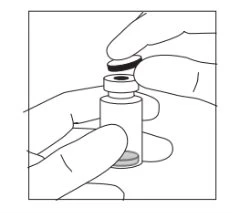
1. | Remove the plastic cap and disinfect the outer surface of the rubber stopper of the vial. |
|
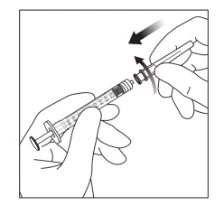
2. | Attach the supplied 5-micron, 18 G filter needle from the package to a sterile 1 mL syringe with Luer Lock adapter. |
|
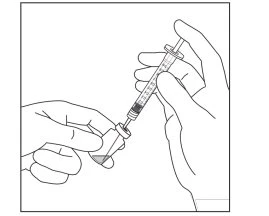
3. | Insert the filter needle through the center of the vial stopper until the needle is fully inserted into the vial and its tip reaches the bottom or lower inner edge of the vial. | |
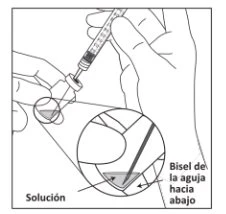
4. | Using an aseptic technique, transfer the entire contents of the MYNZEPLI vial into the syringe, keeping the vial in an upright and slightly tilted position to facilitate complete withdrawal. To avoid introducing air, ensure the bevel of the filter needle remains submerged in the solution. Continue tilting the vial during withdrawal, keeping the bevel of the filter needle submerged in the solution. | |
|
| |
5. | Ensure the plunger is sufficiently withdrawn when emptying the vial to fully empty the filter needle. | |
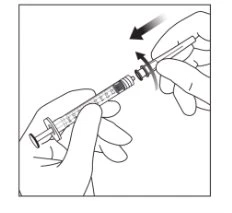
6. | Remove the filter needle and dispose of it appropriately. Note: The filter needle must not be used for intravitreal injection. | |
7. | Using an aseptic technique, firmly attach a 30 G × ½ inch (1.27 cm) injection needle to the tip of the syringe with the Luer-Lock adapter by rotating it. |
|
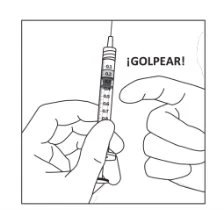
8. | Hold the syringe with the needle pointing upward and check for air bubbles. If present, gently tap the syringe with a finger until the bubbles rise to the top. |
|
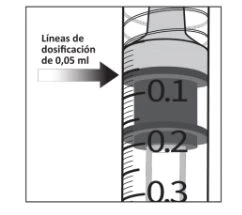
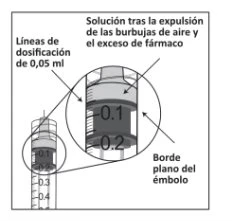
9. | Remove all air bubbles and expel excess medication by slowly pushing the plunger so that the flat edge of the plunger aligns with the 0.05 mL mark on the syringe. | |
|
| |
10. | The vial is for single use only. Withdrawing multiple doses from a single vial may increase the risk of contamination and subsequent infection. Any unused medication and all materials that have come into contact with it must be disposed of in accordance with local regulations. |