Mylotarg 5 mg powder for concentrate for solution for infusion
Spain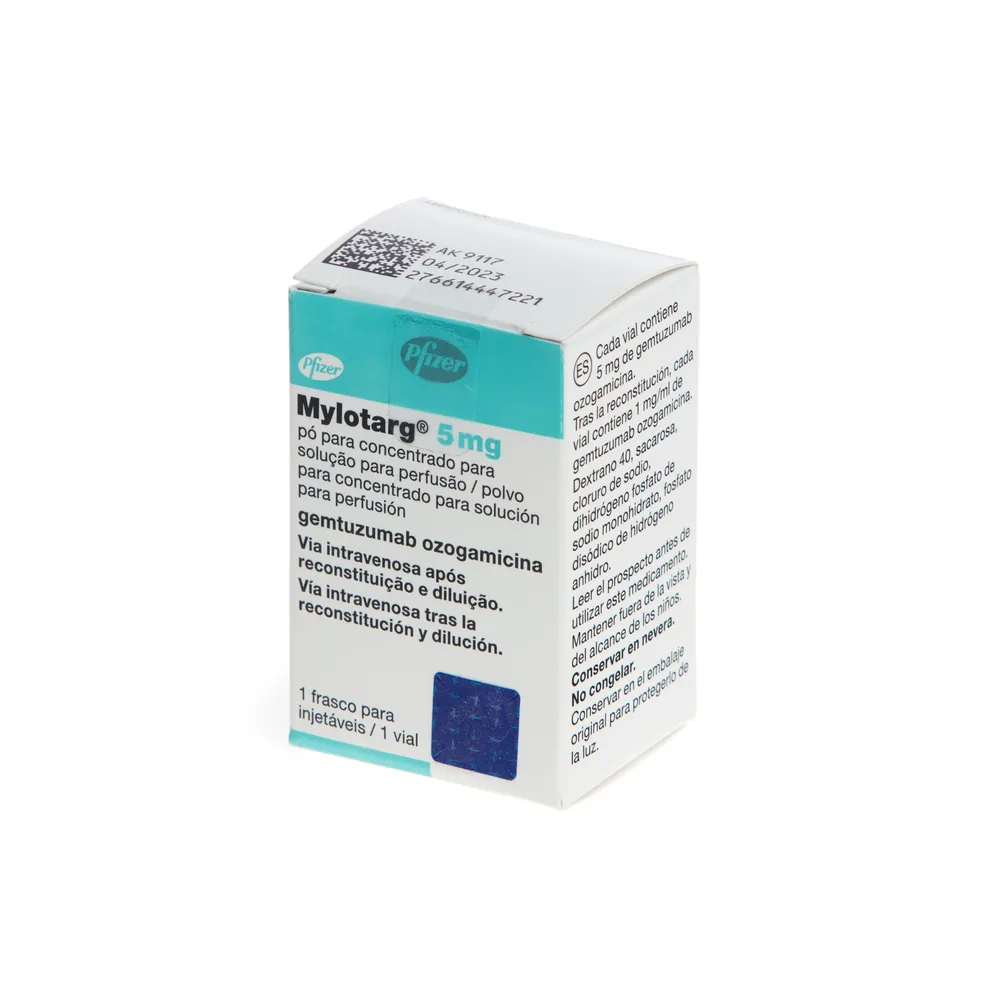
Table of Contents
Package leaflet: Information for the user
Introduction
Package leaflet: information for the user
MYLOTARG 5 mg powder for concentrate for solution for infusion
gemtuzumab ozogamicin
Read all of this leaflet carefully before you start using this medicine, because it contains important information for you.
- Keep this leaflet, as you may need to read it again.
- If you have any questions, ask your doctor or nurse.
- If you experience any side effects, talk to your doctor or nurse, even if it is a side effect not listed in this leaflet. See section 4.
Contents of the leaflet
- What MYLOTARG is and what it is used for
- What you need to know before you are given MYLOTARG
- How MYLOTARG is administered
- Possible side effects
- How to store MYLOTARG
- Contents of the pack and other information
1. What MYLOTARG is and what it is used for
MYLOTARG contains the active substance gemtuzumab ozogamicin, a cancer medicine composed of a monoclonal antibody linked to a substance designed to kill cancer cells. This substance is delivered to cancer cells via the monoclonal antibody. A monoclonal antibody is a protein that recognizes specific cancer cells.
MYLOTARG is used to treat a certain type of blood cancer called acute myeloid leukemia (AML), in which the bone marrow produces abnormal white blood cells. MYLOTARG is indicated for the treatment of AML in patients 15 years of age and older who have not received prior treatment. MYLOTARG must not be used in patients with a type of cancer called acute promyelocytic leukemia (APL).
2. What you need to know before you are given MYLOTARG
Do not be given MYLOTARG if:
- you are allergic to gemtuzumab ozogamicin or to any of the other ingredients of this medicine (listed in section 6).
Warnings and precautions
The first time you receive this medicine and during the course of treatment, inform your doctor or nurse if:
- you have or have ever had liver problems: MYLOTARG may cause, during or after treatment, a potentially life-threatening condition called veno-occlusive liver disease, in which the blood vessels of the liver become damaged and blocked due to blood clot formation, which may lead to fluid retention, rapid weight gain, enlargement of the liver (which may be painful), and ascites (excessive accumulation of fluid in the abdominal cavity).
- allergic reaction: you experience a high-pitched whistling sound when breathing (wheezing), difficulty breathing, shortness of breath, or cough with or without mucus, hives, itching, swelling, or a feeling of fever and chills (signs of an infusion-related reaction) during or shortly after the infusion of MYLOTARG.
- infection: you have or think you may have an infection, have chills or shivering, feel warm, or have a fever. Some infections may be serious and potentially life-threatening.
- bleeding: you have unusual bleeding, your gums bleed, you bruise easily, or have frequent nosebleeds.
- anemia: you have headaches, feel tired, experience dizziness, or look pale.
- infusion reaction: you experience during or shortly after the infusion of MYLOTARG symptoms such as dizziness, decreased urine output, confusion, vomiting, nausea, swelling, shortness of breath, or changes in heart rhythm (this could be a potentially life-threatening complication known as tumor lysis syndrome).
Children and adolescents
MYLOTARG must not be used in children and adolescents under 15 years of age, as available data are limited in this population.
Other medicines and MYLOTARG
Inform your doctor or nurse if you are taking, have recently taken, or might need to take any other medicines. This includes medicines obtained without a prescription and herbal remedies (medicinal herbs).
Pregnancy, breastfeeding, and fertility
If you are pregnant or breastfeeding, think you may be pregnant, or plan to become pregnant, consult your doctor or nurse before using this medicine.
Avoid becoming pregnant or fathering a child due to the potential adverse effects on the child. Women should use two effective contraceptive methods during treatment and for at least 7 months after the last dose of treatment. Men should use two effective contraceptive methods during treatment and for at least 4 months after the last dose of treatment. Contact your doctor immediately if you or your partner becomes pregnant while taking this medicine.
Ask for advice about fertility preservation before starting treatment.
If you need to receive MYLOTARG, you will have to interrupt breastfeeding during treatment and for at least 1 month after stopping treatment. Consult your doctor.
Driving and use of machines
If you feel unusually tired, dizzy, or have a headache (these are very common side effects of MYLOTARG), you should not drive or operate machinery.
MYLOTARG contains sodium
This medicine contains less than 1 mmol of sodium (23 mg) per dose; that is, essentially “sodium-free”.
3. How MYLOTARG is administered
-
A doctor or nurse will administer MYLOTARG to you through a drip into your vein (intravenous infusion), gradually over 2 hours.
-
Your doctor will decide the correct dose.
-
Your doctor or nurse may adjust the dose, interrupt, or completely stop treatment with MYLOTARG if you experience certain adverse effects.
-
Your doctor may reduce the dose depending on your response to treatment.
-
Your doctor will perform blood tests during treatment to monitor for adverse effects and to check your response to treatment.
-
Before receiving MYLOTARG, you will be given other medications to help reduce certain symptoms such as fever and chills, known as infusion-related reactions, during or shortly after the MYLOTARG infusion.
If you have any further questions about the use of this medicine, ask your doctor or nurse.
4. Possible adverse effects
Like all medicines, this medicine can cause adverse effects, although not everyone will experience them.
Some of these adverse effects may be serious and may occur during or after treatment with MYLOTARG. Immediately inform your doctor or nurse if you experience any of the following serious adverse effects (see also section 2: "What you need to know before you are given MYLOTARG"):
- Liver problems Immediately inform your doctor if you experience rapid weight gain, pain in the upper right part of the abdomen, or fluid accumulation causing abdominal swelling. Your doctor may perform blood tests and detect abnormalities in liver function tests, which could be signs of a potentially life-threatening condition called veno-occlusive liver disease.
- Bleeding (signs of a low number of blood cells known as platelets)
Immediately inform your doctor if you bruise easily or have frequent nosebleeds, or if you have tarry stools, cough up blood, produce bloody sputum, feel dizzy, faint, or confused.
- Infections (signs of a low number of white blood cells known as neutrophils)
Some infections may be serious and may be caused by viruses, bacteria, or other causes that could potentially be fatal.
-
A complication known as tumor lysis syndrome Immediately inform your doctor if you experience dizziness, reduced urine output, confusion, vomiting, nausea, swelling, shortness of breath, or irregular heartbeat.
-
Infusion-related reactions Medicines of this type (monoclonal antibodies) can cause infusion-related reactions such as rash, shortness of breath, difficulty breathing, chest tightness, chills, or fever, or back pain.
Adverse effects include:
Very common (may affect more than 1 in 10 people):
- Infections (including serious infections)
- Decreased number of platelets in the blood (cells that help blood to clot)
- Decreased number of white blood cells, which may cause general weakness and an increased tendency to develop infections
- Decreased number of red blood cells (anaemia), which may cause fatigue and shortness of breath
- High blood sugar levels
- Decreased appetite
- Headache
- Rapid heartbeat
- Bleeding
- Low blood pressure
- High blood pressure
- Shortness of breath
- Vomiting
- Diarrhea
- Abdominal pain
- General discomfort (nausea)
- Mouth inflammation
- Constipation
- Abnormal liver blood tests (which may be indicators of liver damage)
- Skin rash
- Fever
- Edema (excess fluid in body tissues, causing swelling of the hands and feet)
- Fatigue
- Chills
- Changes in levels of different enzymes in the blood (may appear in blood tests)
- Prolonged blood clotting time (which may lead to prolonged bleeding)
- High levels of uric acid in the blood
Common (may affect up to 1 in 10 people):
- Signs of infusion-related reactions such as rash, shortness of breath, difficulty breathing, chest tightness, chills or fever, back pain during or after MYLOTARG infusion
- Signs of enlarged liver (hepatomegaly), such as abdominal swelling
- Abnormal liver function
- Excessive accumulation of fluid in the abdomen/stomach
- Indigestion
- Inflammation of the esophagus (swallowing tube)
- Veno-occlusive liver disease (VOD), including signs of enlarged liver, pain in the upper right part of the abdomen, yellowing of the skin and whites of the eyes, fluid accumulation in the abdomen, weight gain, abnormal liver test results
- Yellowing of the skin or whites of the eyes due to liver or blood problems (jaundice)
- Redness of the skin
- Itching of the skin
- Organ failure
Uncommon (may affect up to 1 in 100 people):
- Liver failure
- Budd-Chiari syndrome, which includes pain in the upper right part of the abdomen, an abnormally large liver, and/or fluid accumulation in the abdomen associated with blood clots in the liver. Symptoms may also include general discomfort (nausea) and/or vomiting.
Frequency not known (cannot be estimated from available data):
- Interstitial pneumonia (lung inflammation causing cough and difficulty breathing)
- Inflammation of the intestine associated with low white blood cell counts
- Inflammation of the urinary bladder causing bladder bleeding
Reporting of adverse effects
If you experience any adverse effect, consult your doctor, pharmacist, or nurse, even if they are possible adverse effects not listed in this leaflet. You can also report them directly through the national reporting system included in Appendix V. By reporting adverse effects, you can help provide more information on the safety of this medicine.
5. Storage of MYLOTARG
MYLOTARG will be stored by healthcare professionals in the hospital or clinic.
Keep this medicine out of the sight and reach of children.
Do not use this medicine after the expiry date stated on the vial and outer packaging following EXP. The expiry date refers to the last day of the month indicated.
Unopened vial: Store in a refrigerator (between 2°C and 8°C). Do not freeze. Keep in the original packaging to protect from light.
Reconstituted and diluted solution: Protect reconstituted and diluted MYLOTARG solutions from light. Solutions should be used immediately. Do not freeze the reconstituted or diluted solution.
If not used immediately:
-
After reconstitution, the original vial may be stored for up to 16 hours in a refrigerator (between 2°C and 8°C) or up to 3 hours at room temperature (below 30°C).
-
The diluted solution may be stored for up to 18 hours in a refrigerator (between 2°C and 8°C) and up to 6 hours at room temperature (below 30°C). The permitted time at room temperature (below 30°C) includes the time required for preparation of the diluted solution, equilibration if necessary, and administration. The maximum time from preparation of the diluted solution to administration must not exceed 24 hours.
Do not use this medicine if you notice particles or discoloration before administration.
Medicines should not be disposed of via wastewater or household waste. Ask your pharmacist how to dispose of medicines and containers you no longer need. This will help protect the environment.
6. Package contents and other information
Composition of MYLOTARG
- The active substance is gemtuzumab ozogamicine.
- One vial contains 5 mg of gemtuzumab ozogamicine.
- After reconstitution, each ml of the concentrate solution contains 1 mg of gemtuzumab ozogamicine.
- The other components are dextran 40, sucrose, sodium chloride, monosodium phosphate monohydrate, disodium hydrogen phosphate anhydrous. See section 2, “MYLOTARG contains sodium”.
Appearance of the medicinal product and contents of the pack
MYLOTARG is a powder for concentrate for solution for infusion. It is presented as a paste or white to off-white powder.
Each pack contains 1 type I amber glass vial with a rubber stopper and flip-off cap.
Marketing Authorization Holder
Pfizer Europe MA EEIG
Boulevard de la Plaine 17
1050 Brussels
Belgium
Manufacturer
Pfizer Service Company BV
Hermeslaan 11
1932 Zaventem
Belgium
More information about this medicinal product is available upon request to the local representative of the Marketing Authorization Holder:
Belgium/Belgium/Belgium Luxembourg/Luxembourg Pfizer NV/SA Tel/Tel: +32 (0)2 554 62 11 | Lithuania Pfizer Luxembourg SARL, branch in Lithuania Tel: +370 5 251 4000 |
| Hungary Pfizer Ltd. Tel: +36 1 488 37 00 |
Czech Republic Pfizer, spol. s r.o. Tel: +420 283 004 111 | Malta Vivian Corporation Ltd. Tel: +356 21344610 |
Denmark Pfizer ApS Tel: +45 44 20 11 00 | Netherlands Pfizer bv Tel: +31 (0)800 63 34 636 |
Germany PFIZER PHARMA GmbH Tel: +49 (0)30 550055 51000 | Norway Pfizer AS Tel: +47 67 52 61 00 |
Estonia Pfizer Luxembourg SARL, Estonian branch Tel: +372 666 7500 | Austria Pfizer Corporation Austria Ges.m.b.H. Tel: +43 (0)1 521 15-0 |
Greece Pfizer Hellas S.A. Tel: +30 210 6785800 | Poland Pfizer Polska Sp. z o.o. Tel: +48 22 335 61 00 |
Spain Pfizer, S.L. Tel: +34 91 490 99 00 | Portugal Laboratórios Pfizer, Lda. Tel: +351 21 423 5500 |
France Pfizer Tel: +33 (0)1 58 07 34 40 | Romania Pfizer Romania S.R.L. Tel: +40 (0) 21 207 28 00 |
Croatia Pfizer Croatia d.o.o. Tel: + 385 1 3908 777 | Slovenia Pfizer Luxembourg SARL Pfizer, advisory branch for pharmaceutical activities, Ljubljana Tel: + 386 (0)1 52 11 400 |
Ireland Pfizer Healthcare Ireland Tel: 1800 633 363 (toll free) +44 (0)1304 616161 | Slovakia Pfizer Luxembourg SARL, organisational unit Tel: + 421 2 3355 5500 |
Iceland Icepharma hf. Tel: +354 540 8000 | Finland Pfizer Oy Tel: +358 (0)9 430 040 |
Italy Pfizer S.r.l. Tel: +39 06 33 18 21 | Sweden Pfizer AB Tel: +46 (0)8 550-520 00 |
Cyprus Pfizer Hellas S.A. (Cyprus Branch) Tel: +357 22817690 | United Kingdom (Northern Ireland) Pfizer Limited Tel: +44 (0) 1304 616161 |
Latvia Pfizer Luxembourg SARL, Latvian branch Tel: + 371 670 35 775 |
Date of the most recent review of this summary:
Other sources of information
Detailed information on this medicine is available on the European Medicines Agency website: http://www.ema.europa.eu. Links to other websites on rare diseases and orphan medicines are also available.
This information is intended for healthcare professionals only:
Use appropriate aseptic techniques for reconstitution and dilution procedures. MYLOTARG is light-sensitive and must be protected from ultraviolet light during reconstitution, dilution, and administration.
Reconstitution
- Calculate the required dose (mg) of MYLOTARG.
- Prior to reconstitution, allow the vial to reach room temperature (below 30°C) for approximately 5 minutes. Reconstitute each 5 mg vial with 5 ml of Water for Injections to obtain a single-use solution of 1 mg/ml gemtuzumab ozogamicin.
- Gently swirl the vial to aid dissolution. Do not shake.
- Inspect the reconstituted solution for particles or discoloration. The reconstituted solution may contain small white to off-white particles, ranging from opaque to translucent, amorphous or fiber-like in appearance.
- MYLOTARG does not contain bacteriostatic preservatives.
- If the reconstituted solution cannot be used immediately, it may be stored in the original vial for up to 16 hours in the refrigerator (between 2°C and 8°C) or up to 3 hours at room temperature (below 30°C). Protect from light and do not freeze.
Dilution
- Calculate the required volume of reconstituted solution needed to achieve the appropriate dose based on the patient's body surface area. Withdraw this amount from the vial using a syringe. MYLOTARG vials contain 5 mg of drug without overfill. When reconstituted to a concentration of 1 mg/ml as directed, the extractable volume from the vial is 4.5 mg (4.5 ml). Protect from light. Discard any unused reconstituted solution remaining in the vial.
- Doses should be diluted to a concentration between 0.075 mg/ml and 0.234 mg/ml according to the following instructions:
- Doses below 3.9 mg should be prepared for administration in a syringe. Add the reconstituted MYLOTARG solution to a syringe containing Sodium Chloride 9 mg/ml (0.9%) Injection Solution to achieve a final concentration between 0.075 mg/ml and 0.234 mg/ml. Protect from light.
- Doses equal to or greater than 3.9 mg should be diluted in a syringe or intravenous bag with an appropriate volume of Sodium Chloride 9 mg/ml (0.9%) Injection Solution to ensure a final concentration between 0.075 mg/ml and 0.234 mg/ml. Protect from light.
- Gently invert the infusion container to mix the diluted solution. Do not shake.
- After dilution with Sodium Chloride 9 mg/ml (0.9%) Injection Solution, MYLOTARG solution should be administered immediately. If not used immediately, the diluted solution may be stored for up to 18 hours in the refrigerator (between 2°C and 8°C) and up to 6 hours at room temperature (below 30°C). The permitted time at room temperature (below 30°C) includes the time required for preparation of the diluted solution, equilibration if needed, and administration to the patient. The total time from preparation of the diluted solution to completion of administration must not exceed 24 hours. Protect from light and do not freeze.
- It is recommended that the infusion container be made of polyvinyl chloride (PVC) with DEHP, ethylene vinyl acetate (EVA), or polyolefin (polypropylene and/or polyethylene).
Administration
- Filtration of the diluted solution is required. A low-protein-binding in-line filter made of polyethersulfone (PES) with a pore size of 0.2 microns must be used for MYLOTARG infusion.
- Doses administered via syringe must use small-bore infusion lines (microbore) with an in-line low-protein-binding polyethersulfone (PES) 0.2-micron filter.
- During infusion, the intravenous bag or syringe must be protected from light (including ultraviolet light) using a light-blocking cover. The infusion line does not need to be protected from light.
- Infuse the diluted solution over 2 hours. The infusion must be completed within the permitted 6-hour stability period of the diluted solution at room temperature (below 30°C).
- It is recommended that infusion lines be made of PVC (with or without DEHP), polyurethane, or polyethylene.
Do not mix or co-administer MYLOTARG in the same infusion with other medications.
Disposal
Established procedures for the disposal of hazardous waste should be followed for anticancer drugs.