Mydriasert 0.28 mg/5.4 mg ophthalmic insert
Spain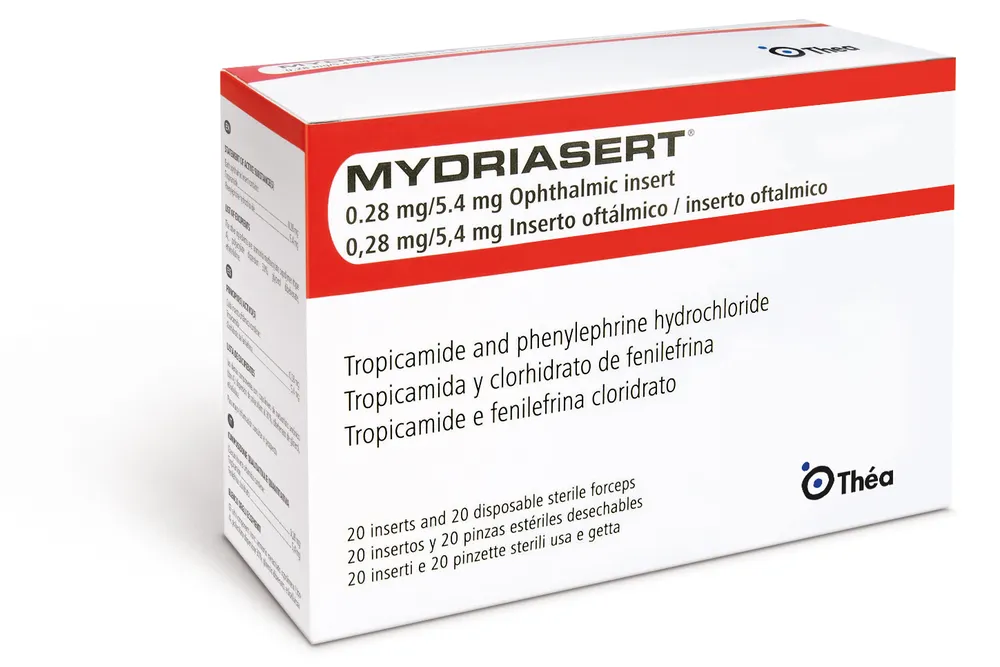
Table of Contents
Package leaflet: Information for the user
Introduction
PACKAGE LEAFLET: INFORMATION FOR THE USER
MYDRIASERT 0.28 mg/5.4 mg ophthalmic insert
Tropicamide and phenylephrine hydrochloride
Read the entire leaflet carefully before you start using this medicine, because it contains important information for you.
- Keep this leaflet, as you may need to read it again.
- If you have any questions, ask your doctor, pharmacist, or nurse.
- This medicine has been prescribed for you only, and you should not give it to other people, even if they have the same symptoms as you, because it may harm them.
- If you experience any adverse effects, consult your doctor, pharmacist, or nurse, even if they are effects not listed in this leaflet. See section 4.
Leaflet contents:
- What MYDRIASERT is and what it is used for
- What you need to know before using MYDRIASERT
- How to use MYDRIASERT
- Possible side effects
- How to store MYDRIASERT
- Contents of the pack and other information
1. What MYDRIASERT is and what it is used for
MYDRIASERT is an ophthalmic product, which means it is for ocular treatment only.
The use of MYDRIASERT is restricted to healthcare professionals.
MYDRIASERT will be placed in the lower eyelid of your eye by medical personnel. It is used to achieve mydriasis (pupil dilation) prior to surgical procedures or for diagnostic purposes.
2. What you need to know before using MYDRIASERT
DO NOT USE MYDRIASERT in the following cases:
- If you are allergic to tropicamide or phenylephrine hydrochloride, or to any of the other components of this medicine (listed in section 6).
- In patients with closed-angle glaucoma or at risk of precipitated glaucoma (increased intraocular pressure).
- In children under 12 years of age.
WARNINGS AND PRECAUTIONS
- Since this medicine causes prolonged visual disturbances, remember to attend your appointment accompanied (see possible adverse effects).
- If you experience discomfort after insertion of the insert, inform your doctor: displacement or, more rarely, loss of the insert may occur.
- If you suffer from severe dry eye, your doctor may apply a drop of saline solution into the eye to reduce the risk of eye irritation.
- If you have hypertension (high blood pressure), atherosclerosis (thickening of arterial walls), heart disease, hyperthyroidism (overactive thyroid gland), or prostate disorders, inform your doctor.
- In certain predisposed individuals, mydriatics (agents that dilate the pupil) may trigger an acute glaucoma attack (due to a sudden increase in eye pressure).
- The use of soft hydrophilic contact lenses is not recommended during treatment.
Children and adolescents
Mydriasert must not be used in children under 12 years of age, as children appear to be more susceptible to the risks of serious adverse effects.
The use of Mydriasert is not recommended in children and adolescents between 12 and 18 years of age due to lack of adequate clinical experience.
Use of MYDRIASERT with other medicines
Inform your doctor if you are using other pupil-dilating medicines (mydriatics) different from Mydriasert, so that your doctor is aware of the total amount of mydriatics to which you are exposed.
Inform your doctor or pharmacist if you are taking, have recently taken, or might need to take any other medicines, including those obtained without a prescription. Although Mydriasert is applied locally, this information may be important because medicines can interact with each other.
Pregnancy and breastfeeding
There are insufficient data on the use of Mydriasert or its active components in pregnant women. Therefore, Mydriasert should not be used during pregnancy unless clearly necessary.
Use during breastfeeding is not recommended.
Driving and using machines
Do not drive or operate machinery, as MYDRIASERT may cause bothersome visual disturbances for several hours (glare due to prolonged pupil dilation).
Important information about some components of MYDRIASERT
Athletes should be advised that this medicinal product contains an active substance (phenylephrine hydrochloride) that may cause positive results in doping tests.
3. How to use MYDRIASERT
FOR USE BY HEALTHCARE PROFESSIONALS ONLY.
Mydriasert is intended for use in adults. Mydriasert must not be ingested.
The healthcare professional will place a single insert behind the lower eyelid of the relevant eye. The healthcare professional will remove the insert once the pupil is sufficiently dilated, prior to surgery or examination. The insert must not be left in the eye for longer than 2 hours.
If you use more MYDRIASERT than you should
Since a healthcare professional will place only one insert into the eye, the risk of using more than the recommended amount of Mydriasert is unlikely. However, if the healthcare professional needs to administer a mydriatic eye drop in addition to Mydriasert, there may be a risk of overdose of the active components of Mydriasert.
Some symptoms of overdose of the active components of Mydriasert may include extreme fatigue, sweating, dizziness, slow heartbeat, coma, headache, fast heartbeat, dry mouth and skin, unusual drowsiness, flushing, and prolonged pupil dilation.
In case of overdose, contact the toxicology information service at telephone number: 91 562 04 20.
If you have any further questions about the use of this product, ask your doctor, pharmacist, or nurse.
4. Possible adverse effects
Like all medicines, this medicine may cause adverse effects, although not everyone experiences them.
Frequent: may affect up to 1 in 10 people:
- Itching
- Blurred vision
- Visual discomfort due to perception of the presence or movement of the insert.
Uncommon: may affect up to 1 in 100 people:
- Tearing
- Irritation
- Glare due to prolonged pupil dilation
- Superficial punctate keratitis (inflammation of the cornea).
Rare: may affect up to 1 in 1,000 people:
- Allergic reactions: eyelid inflammation (blepharitis), conjunctival inflammation (conjunctivitis).
Very rare: may affect up to 1 in 10,000 people:
- Seizures.
Corneal ulcer (small erosion of the eye surface) and corneal edema (swelling of the eye surface) have been observed when the insert has been accidentally left in the eye.
In predisposed individuals, MYDRIASERT may trigger an acute glaucoma attack (sudden increase in intraocular pressure): if unusual symptoms occur after administration (redness, pain, and visual disturbances), consult your doctor immediately.
Although unlikely after ocular administration, the active components in MYDRIASERT may cause the following adverse effects, which should be considered:
- Increase in blood pressure, tachycardia,
- very rarely, serious events such as cardiac arrhythmia,
- tremor, pallor, headache, dry mouth.
Additional adverse effects in children:
Frequency not known: cannot be estimated from available data:
- Fluid or swelling in the lungs
- Pallor around the eyes in premature infants
Reporting of adverse effects
If you experience any type of adverse effect, consult your doctor, pharmacist, or nurse, even if it is a possible adverse effect not listed in this leaflet. You can also report them directly via the Spanish Pharmacovigilance System for Human Medicinal Products: https://www.notificaram.es. By reporting adverse effects, you can help provide more information on the safety of this medicine.
5. Storage of MYDRIASERT
Keep out of the sight and reach of children.
Do not use this medicine after the expiry date stated on the sachet after
"EXP.". The expiry date refers to the last day of the month indicated.
Do not store above 25°C.
Use immediately after opening the sachet.
Do not use MYDRIASERT if you notice any damage to the sachet seal or to the insert.
6. Contents of the pack and other information
Composition of MYDRIASERT
-
The active substances are tropicamide 0.28 mg and phenylephrine hydrochloride 5.4 mg per ocular insert.
-
The other components are ammonium methacrylate copolymer (type A), 30% polycarbophil dispersion, glyceryl dibehenate and ethylcellulose.
Appearance of the product and pack size
MYDRIASERT is supplied in a pouch.
MYDRIASERT appears as a small white elongated tablet (4.3 mm x 2.3 mm).
Each pack contains another pouch with sterile disposable forceps used to place MYDRIASERT in the eye.
Pack sizes: 1 insert and 1 pair of forceps, 10 inserts and 10 pairs of forceps, 20 inserts and 20 pairs of forceps, 50 inserts and 50 pairs of forceps, or 100 inserts and 100 pairs of forceps.
Not all pack sizes may be marketed.
Marketing Authorization Holder and Manufacturer
Marketing Authorization Holder
Laboratoires THEA
Rue Louis Blériot, 12
F-63017 Clermont-Ferrand Cedex 2, France
Manufacturer
BENAC
27A, Avenue Paul Langevin
17180 Périgny, France
or
BENAC
5 rue Albert Turpain
17000 La Rochelle (France)
Local representative:
Laboratorios Thea S.A.
C/ Enric Granados, nº 86-88, 2nd floor
08008 Barcelona, Spain
This medicinal product is authorized in the European Economic Area member states under the following names:
Germany Mydriasert
Austria Mydriasert
Belgium Mydriasert
Denmark Mydriasert
Spain Mydriasert
Finland Mydriasert
France Mydriasert
Italy Mydriasert
Luxembourg Mydriasert
Netherlands Mydriasert
Portugal Mydriasert
United Kingdom Mydriasert
Sweden Mydriasert
This leaflet was approved in November 2021.
This information is intended for medical or healthcare professionals only.
Do not ingest.
Before using the product, check the integrity of the pouch. If the pouch seal is damaged, sterility can no longer be guaranteed; in such case, use another insert from an intact pack.
DOSAGE
The healthcare professional places a single ocular insert into the lower conjunctival sac of the relevant eye, up to 2 hours before surgery or the investigative procedure.
Paediatric population
Mydriasert is contraindicated in children under 12 years of age.
There are no data in children aged 12 to 18 years. Mydriasert is not recommended in these patients.
METHOD OF ADMINISTRATION
Cut along the sealed edge at the dotted line, open the pouch and locate the insert. Pull down the lower eyelid by pinching it with the thumb and index finger (A) and place the ocular insert into the lower conjunctival sac using the sterile disposable forceps provided in the pack, which must be discarded immediately after use (B).
INSTRUCTIONS FOR USE
The ocular insert must not remain in the lower conjunctival sac for more than two hours. The physician may remove the ocular insert as soon as sufficient mydriasis has been achieved for the surgical or investigative procedure; the insert must be removed at the latest 30 minutes after adequate pupil dilation has been obtained. If discomfort occurs, ensure that the insert has been correctly placed at the base of the lower conjunctival sac.
PRECAUTION: REMOVAL OF THE OCULAR INSERT
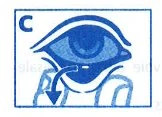
Prior to surgery or a procedure, and as soon as the required mydriasis has been achieved, the ocular insert must be removed from the lower conjunctival sac using a sterile surgical forceps, or a sterile swab, or a sterile irrigation or washing solution, by pulling down the lower eyelid (C).
|
|
|


Do not reuse the insert for the other eye of the same patient or for another patient.
Discard the insert after use. (See also section 3)