Multihance 529 mg/ml solution for injection
Spain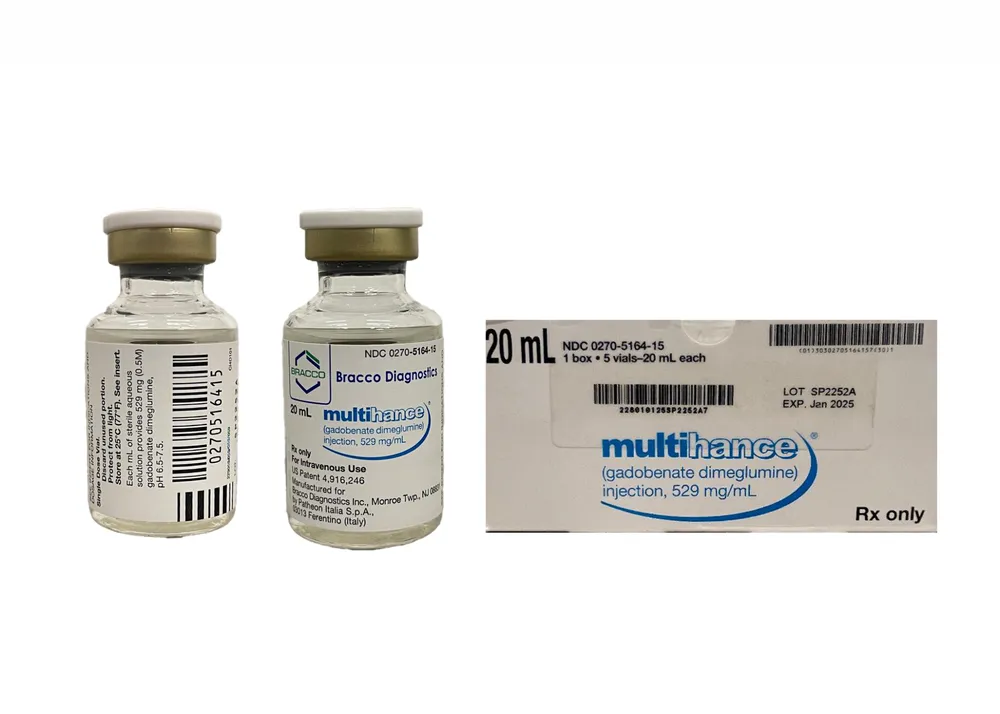
Table of Contents
Patient Information Leaflet
Introduction
Patient Information Leaflet
MultiHance 529 mg/ml injectable solution
Gadobenate dimeglumine
Read the entire leaflet carefully before you start using this medicine, as it contains important information for you.
|
Package leaflet contents:
- What MultiHance is and what it is used for
- What you need to know before using MultiHance
- How to use MultiHance
- Possible side effects
- Storage of MultiHance
- Contents of the pack and other information
1. What MultiHance is and what it is used for
MultiHance is a special dye (or contrast agent) containing the metal gadolinio that enhances liver images in Magnetic Resonance (MR) scans. This helps your doctor identify abnormalities in your liver.
This medicine is for diagnostic use only.
MultiHance is approved for use in children over 2 years of age.
2. What you need to know before using MultiHance
MultiHance should only be administered in hospitals or clinics where equipment and trained medical personnel are available to manage allergic reactions.
Accumulation in the body
MultiHance works because it contains a metal called gadolinium. Studies have shown that small amounts of gadolinium may accumulate in the body, including in the brain. No adverse effects have been observed due to gadolinium accumulation in the brain.
Do not use MultiHance
- if you are allergic to gadobenate dimeglumine or to any of the other ingredients of this medicine (listed in section 6).
- if you have previously experienced any allergic reaction (hypersensitivity reaction), such as rash, itching, hives, or difficulty breathing after injection of any contrast agent used for MRI scans.
Consult your doctor if you think you fall into any of these categories.
Children
MultiHance must not be given to children under 2 years of age.
Warnings and precautions
Talk to your doctor before using MultiHance if:
- you have a heart condition or high blood pressure
- you have a history of epilepsy or brain injury
- you have a pacemaker or any other metallic object such as clips, screws, or plates in your body, as these may interfere with the magnet of the MRI scanner
- your kidneys are not functioning properly
- you have recently undergone, or are scheduled to undergo, a liver transplant.
Your doctor may decide to perform a blood test to check your kidney function before deciding to use MultiHance, especially if you are 65 years of age or older.
Use of MultiHance with other medicines
There are no data on interactions between MultiHance and other medicines.
Tell your doctor if you are taking, have recently taken, or might need to take any other medicines.
Pregnancy and breastfeeding
Consult your doctor before using any medicine.
Pregnancy:
Gadobenic acid crosses the placenta. It is unknown whether it affects the fetus. You must inform your doctor if you are pregnant, think you might be pregnant, or are planning to become pregnant, as MultiHance must not be used during pregnancy unless strictly necessary.
Breastfeeding:
Inform your doctor if you are breastfeeding or about to start breastfeeding. Your doctor will decide whether you should continue breastfeeding or interrupt it for 24 hours after administration of MultiHance.
Driving and use of machines
No effects of MultiHance on driving or the use of tools or machines are known. Ask your doctor whether you can drive and whether it is safe for you to use any tools or machines.
Important information about some of the components of MultiHance
During storage, the MultiHance solution may release small amounts of benzyl alcohol (an alcohol derivative).
Please inform your doctor if you are allergic to benzyl alcohol.
3. How to use MultiHance
MultiHance is injected into a vein, usually in the arm, before the MRI scan. The amount injected in milliliters depends on your body weight in kilograms.
Recommended dose:
Liver MRI: 0.1 ml per kilogram of body weight
The medical staff performing the scan will administer the MultiHance injection. They must ensure that the needle is correctly placed; inform them if you feel pain or a burning sensation at the injection site during administration.
You must remain in the hospital for one hour following the injection.
Dosage in special populations
Renal impairment
The use of MultiHance is not recommended in patients with severe kidney problems or in patients who have recently undergone or are about to undergo a liver transplant. However, if use is required, only a single dose of MultiHance should be administered per scan, and a second injection must not be given until at least 7 days have passed.
Elderly patients
If you are 65 years of age or older, dose adjustment is not required, but a blood test may be performed to check your kidney function.
If you use more MultiHance than you should
In case of overdose, you will be closely monitored and symptomatic treatment will be administered.
In the event of an overdose, contact your doctor immediately or call the Toxicology Information Service at telephone number: 91 562 04 20, indicating the medication and the amount administered.
If you have any further questions about the use of this medicine, ask your doctor.
4. Possible adverse effects
Like all medicines, MultiHance may cause adverse effects, although not everyone experiences them. Most of the adverse effects reported with MultiHance have been mild, non-prolonged, and resolved spontaneously without residual effects. However, serious and potentially life-threatening reactions have been reported, which sometimes lead to death.
Possible adverse effects | |
Frequent: (More than 1 in 100 people and less than 1 in 10 people) |
|
Uncommon: (More than 1 in 1,000 people and less than 1 in 100 people) |
|
Rare: (More than 1 in 10,000 people and less than 1 in 1,000 people) |
|
Frequency not known (cannot be estimated from available data) |
|
Cases of nephrogenic systemic fibrosis (which causes skin hardening and may also affect soft tissues and internal organs) have been reported in patients who received MultiHance together with other gadolinium-containing contrast agents.
If you think you are experiencing any adverse reaction after the injection of MultiHance, inform immediately the medical staff responsible for your examination.
If you have any further questions after reading this leaflet, please ask the medical staff responsible for your examination.
Reporting of adverse reactions
If you experience any type of adverse reaction, consult your doctor, even if it is a possible adverse reaction not listed in this leaflet. You may also report them directly through the Spanish Pharmacovigilance System for Human Medicinal Products: www.notificaRAM.es. By reporting adverse reactions, you can help provide more information on the safety of this medicine.
5. Storage of MultiHance
- Keep this medicine out of the sight and reach of children.
- Do not use this medicine after the expiry date stated on the container after EXP. The expiry date is the last day of the month indicated.
- Do not freeze.
- MultiHance should be administered immediately after being drawn into the syringe.
- Do not use MultiHance if you notice that the container or closure has been damaged, the solution has discolored, or if there are any other problems.
- Medicines must not be disposed of via wastewater or household waste. The hospital pharmacy will dispose of unused product or waste materials. This helps protect the environment.
6. Contents of the container and additional information
Composition of MultiHance
- The active substance is gadobenic acid in the form of gadobenate dimeglumine.
- 1 ml of injectable solution contains: 334 mg of gadobenic acid (0.5 mmol) as gadobenate dimeglumine (529 mg).
- The other component (excipient) is water for injections.
Presentation of the product and contents of the container
MultiHance is a sterile aqueous solution (particle-free, clear or slightly yellowish) for intravenous injection.
MultiHance is supplied to hospitals in single-dose glass vials containing 5 ml, 10 ml, 15 ml or 20 ml of solution.
MultiHance is also supplied in kits with administration devices: 15 ml and 20 ml vials, MRI power injector syringe (65 ml syringe (polyethylene terephthalate/polycarbonate), 115 ml syringe (polyethylene terephthalate/polycarbonate), connector (PVC/polycarbonate/polypropylene/silicone), 2 tips (ABS), 20 G safety catheter.
Only certain pack sizes may be marketed.
Marketing Authorization Holder and Manufacturer
Marketing Authorization Holder:
Bracco Imaging s.p.a.
Via Egidio Folli, 50
20134 Milan (Italy)
Manufacturer:
Patheon Italia s.p.a.
2º Trav. SX Via Morolense, 5
03013 Ferentino (Italy)
BIPSO GmbH
Robert-Gerwig-Strasse 4
78224 Singen (Germany)
Bracco Imaging S.p.A.
Bioindustry Park - Via Ribes, 5
10010 Colleretto Giacosa (TO) (Italy)
For further information about this medicinal product, please contact the local representative of the Marketing Authorization Holder:
Laboratorios Farmacéuticos ROVI, S.A.
Julián Camarillo, 35
28037 Madrid
Tel: 913756230
Date of the most recent review of this summary: May 2024
Detailed and up-to-date information on this medicinal product is available on the website of the Spanish Agency of Medicines and Health Products (AEMPS) http://www.aemps.gob.es/.
This information is intended for healthcare professionals only.
Method of administration
MultiHance should be drawn into a syringe immediately before use and must not be diluted. Any unused product should be discarded and must not be used for other MRI scans.
To minimize the potential risk of extravasation of MultiHance into soft tissues, it is important to verify that the intravenous cannula or needle is correctly placed in a vein.
The product should be administered intravenously as a bolus or by slow injection (10 ml/min). See table for post-contrast imaging.
After injection, a flush with sodium chloride 9 mg/ml (0.9%) solution for injection should be administered.
Post-contrast imaging:
Liver | Dynamic image | Immediately after injection. |
Delayed image | Between 40 and 120 minutes after injection, depending on the type of diagnostic image required. |
Before administering MultiHance, it is recommended to evaluate all patients for potential renal dysfunction through laboratory tests.
Cases of nephrogenic systemic fibrosis (NSF) have been reported following the use of certain gadolinium-based contrast agents in patients with severe acute or chronic renal impairment (GFR or glomerular filtration rate < 30 ml/min/1.73 m²). Patients undergoing liver transplantation are at particular risk due to the high incidence of renal failure in this group. Since there is a possibility that NSF may occur with MultiHance, its use should be avoided in patients with severe renal impairment and in patients during the perioperative period of liver transplantation, unless the diagnostic information is essential and cannot be obtained by non-contrast magnetic resonance imaging (MRI).
If the use of MultiHance cannot be avoided, the dose should not exceed 0.05 mmol/kg body weight. Due to the lack of data on repeated administration, MultiHance should not be readministered unless an interval of at least 7 days has elapsed between injections.
Since renal elimination of gadobenate dimeglumine may be reduced in elderly patients, it is especially important to evaluate patients aged 65 years and older for potential renal dysfunction.
Hemodialysis shortly after administration of MultiHance may be helpful in eliminating MultiHance from the body. There is no evidence to support initiating hemodialysis for the prevention or treatment of NSF in patients not already undergoing hemodialysis.
MultiHance should not be used during pregnancy unless the woman's clinical condition necessitates treatment with gadobenate dimeglumine.
The decision to continue or interrupt breastfeeding 24 hours after administration of gadobenate dimeglumine should be made at the discretion of the physician and the breastfeeding mother.
The detachable label from the vials should be affixed to the patient's medical record to allow accurate documentation of the gadolinium-based contrast agent used. The administered dose should also be recorded. If electronic patient records are used, the product name, batch number, and dose should be entered into the patient's medical record.