Multaq 400 mg film-coated tablets
Spain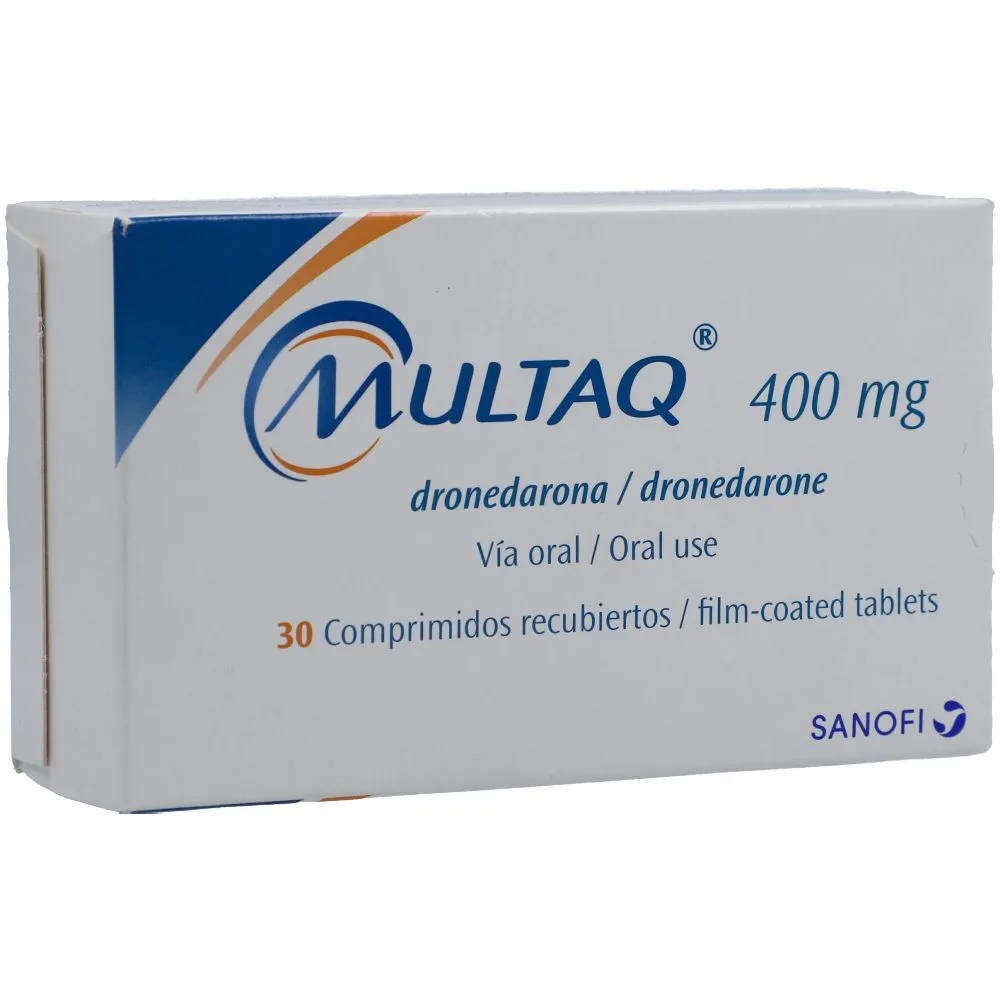
Table of Contents
Package leaflet: Information for the user
Introduction
Package leaflet: information for the patient
MULTAQ 400 mg film-coated tablets
dronedarone
Read the entire leaflet carefully before you start taking this medicine, because it contains important information for you.
- Keep this leaflet. You may need to read it again.
- If you have any questions, ask your doctor or pharmacist.
- This medicine has been prescribed for you only. Do not pass it on to others. It may harm them even if their symptoms are the same as yours.
- If you experience any adverse effects, talk to your doctor or pharmacist, even if they are not listed in this leaflet. See section 4.
Leaflet contents
- What MULTAQ is and what it is used for
- What you need to know before taking MULTAQ
- How to take MULTAQ
- Possible adverse effects
- How to store MULTAQ
- Contents of the pack and other information
1. What MULTAQ is and what it is used for
MULTAQ contains an active substance called dronedarone. It belongs to a group of medicines known as antiarrhythmics, which help regulate your heartbeat.
MULTAQ is used if you have a problem with your heart rhythm (atrial fibrillation: your heart beats irregularly) and your normal heart rhythm has spontaneously returned or has been restored by a treatment called cardioversion.
MULTAQ prevents your irregular heart rhythm problem from recurring. MULTAQ is used only in adults.
Your doctor will consider all possible treatment options before prescribing MULTAQ to you.
2. What you need to know before taking MULTAQ
Do not take MULTAQ:
-
if you are allergic to dronedarone or to any of the other ingredients of this medicine (listed in section 6),
-
if you have a nerve problem in your heart (heart block). Your heart may beat very slowly or you may feel dizzy. If you have had a pacemaker implanted for this problem, you may use MULTAQ,
-
if you have a very slow heart rate (less than 50 beats per minute),
-
if your ECG (electrocardiogram) shows a heart problem called "prolonged corrected QT interval" (this interval is more than 500 milliseconds),
-
if you have a type of atrial fibrillation (AF) called permanent atrial fibrillation. In permanent AF, AF has been present for a long time (at least 6 months) and a decision has been made not to restore your heart rhythm to normal sinus rhythm with a treatment called cardioversion,
-
if you have instability (drops) in your blood pressure that could cause inadequate blood flow to your organs,
-
if you have or have had a condition where your heart cannot pump blood properly throughout your body (a disease called heart failure). You may have swollen feet or legs, trouble breathing when lying down or sleeping, or shortness of breath during physical activity,
-
if the percentage of blood pumped out of your heart with each contraction is too low (a condition called left ventricular dysfunction),
-
if you previously took amiodarone (another antiarrhythmic medicine) and had lung or liver problems,
-
if you are taking medicines for infections (including fungal infections or AIDS), allergies, heart rhythm problems, depression, or after an organ transplant (see section “Taking MULTAQ with other medicines”. This will give you more details about which medicines you must not take with MULTAQ),
- if you have severe liver problems,
- if you have severe kidney problems,
- if you are taking dabigatran (see section “Taking MULTAQ with other medicines”).
If any of the above conditions apply to you, do not take MULTAQ.
Warnings and precautions
Talk to your doctor or pharmacist before starting MULTAQ if:
-
you have a condition that causes low levels of potassium or magnesium in your blood. This condition must be corrected before starting treatment with MULTAQ,
-
you are over 75 years old,
-
you have a disease in which the blood vessels supplying the heart become hardened and narrowed (coronary artery disease).
While taking MULTAQ, inform your doctor if:
- your atrial fibrillation becomes permanent while taking MULTAQ. You must stop taking MULTAQ,
- you develop swollen feet or legs, difficulty breathing when lying down or sleeping, shortness of breath during activity, or weight gain (signs and symptoms of heart failure),
- you experience any of the following signs or symptoms related to liver problems: discomfort or pain in the stomach area (abdomen), loss of appetite, nausea, vomiting, yellowing of the skin or whites of the eyes (jaundice), dark urine, fatigue (especially when associated with the symptoms listed above), or itching,
- you develop difficulty breathing or a dry cough. Contact your doctor, who will check your lungs.
If any of the above conditions apply to you (or if you are unsure), consult your doctor or pharmacist before taking MULTAQ.
Blood tests, cardiac and pulmonary tests
While taking MULTAQ, your doctor may perform tests to monitor your health and the effects of the medicine.
- Your doctor may assess the electrical activity of your heart using an ECG (electrocardiogram).
- Your doctor will request blood tests to check your liver function before starting and during treatment with MULTAQ.
- If you are taking blood-thinning medicines such as warfarin, your doctor will request a blood test called INR to ensure your medicine is working properly.
- Your doctor may also request other blood tests. Results of one blood test used to assess kidney function (blood creatinine levels) may be altered by MULTAQ. Your doctor will take this into account when interpreting your blood levels and will use an adjusted reference value for "normal" blood creatinine.
- Your doctor may monitor your lungs.
In some cases, it may be necessary to stop treatment with MULTAQ.
Inform any healthcare professional performing blood tests that you are taking MULTAQ.
Use in children and adolescents
MULTAQ is not recommended for children and adolescents under 18 years of age.
Other medicines and MULTAQ
Tell your doctor or pharmacist if you are taking, have recently taken, or might need to take any other medicines.
Your doctor may prescribe a medicine to prevent blood clots, depending on your clinical condition.
MULTAQ and other medicines may interact and cause serious adverse effects. Your doctor may adjust the dose of other medicines you are taking.
You must not take any of the following medicines with MULTAQ:
- other medicines used to control fast or irregular heartbeats such as flecainide, propafenone, quinidine, disopyramide, dofetilide, sotalol, amiodarone,
- certain antifungal medicines such as ketoconazole, voriconazole, itraconazole, or posaconazole,
- certain antidepressants known as tricyclic antidepressants,
- certain tranquilizers known as phenothiazines,
- bepridil for chest pain caused by heart disease,
- telithromycin, erythromycin, or clarithromycin (antibiotics for infections),
- terfenadine (a medicine for allergies),
- nefazodone (a medicine for depression),
- cisapride (a medicine for stomach acid reflux and digestive problems),
- ritonavir (a medicine for HIV infection),
- dabigatran (a medicine to prevent blood clots).
Consult your doctor or pharmacist if you are taking any of the following medicines:
- other medicines for high blood pressure, chest pain caused by heart disease, or other heart problems such as verapamil, diltiazem, nifedipine, metoprolol, propranolol, or digoxin,
- certain cholesterol-lowering medicines (such as simvastatin, lovastatin, atorvastatin, or rosuvastatin),
- certain medicines that prevent blood clots such as warfarin, rivaroxaban, edoxaban, and apixaban,
- certain antiepileptic medicines known as phenobarbital, carbamazepine, or phenytoin,
- sirolimus, tacrolimus, everolimus, and cyclosporine (used after organ transplant),
- St. John’s wort – a herbal remedy for depression,
- rifampicin – for tuberculosis.
Taking MULTAQ with food and drink
Do not drink grapefruit juice while taking MULTAQ. It may increase blood levels of dronedarone and increase the risk of adverse effects.
Pregnancy and breastfeeding
If you are pregnant or breastfeeding, think you may be pregnant, or plan to become pregnant, consult your doctor before taking this medicine.
- If you are a woman of childbearing potential, your doctor will perform a pregnancy test before starting treatment with MULTAQ.
- MULTAQ is not recommended during pregnancy or if you suspect you might be pregnant.
- Do not take MULTAQ if you are a woman of childbearing potential and are not using a reliable contraceptive method.
- Use an effective method of contraception during treatment and for 7 days after the last dose of MULTAQ.
- Stop taking the tablets and contact your doctor immediately if you become pregnant while taking MULTAQ.
- It is not known whether MULTAQ passes into breast milk. You and your doctor must decide whether to take MULTAQ or breastfeed. Do not breastfeed during treatment with MULTAQ and for 7 days after the last dose.
Driving and using machines
MULTAQ generally does not affect the ability to drive or operate machinery. However, your ability to drive or operate machinery may be impaired by adverse effects such as fatigue.
MULTAQ contains lactose
Lactose is a type of sugar. If your doctor has informed you that you have an intolerance to certain sugars, consult your doctor before taking this medicine.
3. How to take MULTAQ
Follow exactly the instructions for taking this medicine as given by your doctor. If in doubt, ask your doctor or pharmacist.
Treatment with MULTAQ will be supervised by a doctor experienced in the treatment of heart disease.
If you need to switch from amiodarone (another medicine for irregular heartbeat) to MULTAQ, your doctor may give you special instructions, such as pausing amiodarone before switching. Inform your doctor about all the medicines you are taking.
How much to take
The usual dose is one 400 mg tablet twice daily. Take:
- one tablet with breakfast and
- one tablet with dinner.
If you think that your medicine may be having too strong or too weak an effect, consult your doctor or pharmacist.
Taking this medicine
Swallow the tablet whole with water during a meal. The tablet cannot be divided into equal doses.
If you take more MULTAQ than you should
Contact your doctor, nearest emergency department, or hospital immediately. Take the medicine’s packaging with you.
If you forget to take MULTAQ
Do not take a double dose to make up for missed doses. Take the next dose at the usual time.
If you stop taking MULTAQ
Do not stop taking this medicine without first talking to your doctor or pharmacist.
If you have any further questions about using this medicine, ask your doctor or pharmacist.
4. Possible adverse effects
Like all medicines, MULTAQ may cause adverse effects, although not everybody gets them.
The following adverse effects have been reported with this medicine:
Contact your doctor immediately if you notice any of the following serious adverse effects – because you may need urgent medical attention
Very common (may affect more than 1 in 10 people)
- Problems in which your heart does not pump blood properly throughout your body as it should (congestive heart failure). In clinical studies, this adverse effect was observed at a similar frequency in patients who took MULTAQ and in patients who received placebo. Signs include swollen feet or legs, difficulty breathing when lying down or sleeping, shortness of breath when moving, or weight gain.
Common (may affect up to 1 in 10 people)
- Diarrhoea, vomiting which in excess may lead to kidney problems.
- Slow heartbeats.
Uncommon (may affect up to 1 in 100 people)
- Inflammation of the lungs (including lung scarring and thickening). Signs include breathing difficulties or dry cough.
Rare (may affect up to 1 in 1,000 people)
- Liver problems including potentially fatal liver failure. Signs include discomfort or pain in the stomach area (abdomen), loss of appetite, nausea, vomiting, yellowing of the skin or whites of the eyes (jaundice), darkening of the urine, fatigue (especially associated with the above-mentioned symptoms), itching.
- Allergic reactions including swelling of the face, lips, mouth, tongue or throat.
Other adverse effects
Very common
- changes in the results of a blood test: your blood creatinine level,
- changes in your ECG (electrocardiogram) called QTc Bazett prolongation.
Common
- problems with your digestive system such as indigestion, diarrhoea, nausea, vomiting and stomach pain,
- tiredness,
- skin problems such as rash or itching,
- change in blood test results used to check your liver function.
Uncommon
- other skin problems such as redness of the skin or eczema (redness, itching, burning or blisters),
- your skin is more sensitive to sunlight,
- change in the taste of things.
Rare
- loss of sense of taste,
- inflammation of blood vessels (vasculitis including leukocytoclastic vasculitis).
Reporting of adverse effects
If you experience any adverse effect, talk to your doctor or pharmacist, even if it is a possible adverse effect not listed in this leaflet. You can also report them directly through the national reporting system detailed in Annex V. By reporting adverse effects, you can help provide more information on the safety of this medicine.
5. Storage of MULTAQ
Keep this medicine out of sight and reach of children.
Do not use this medicine after the expiry date stated on the blister and packaging after EXP. The expiry date is the last day of the month indicated.
This medicine does not require any special storage conditions.
Do not use this medicine if you notice any visible signs of deterioration.
Medicines should not be disposed of via wastewater or household waste. Ask your pharmacist how to dispose of medicines and containers you no longer need. This will help protect the environment.
6. Contents of the pack and other information
Composition of MULTAQ
- The active substance is dronedarone.
Each tablet contains 400 mg of dronedarone (as hydrochloride).
- The other components of the tablet core are hypromellose (E464), corn starch, crospovidone (E1202), poloxamer 407, lactose monohydrate (see section 2 “MULTAQ contains lactose”), colloidal anhydrous silica, magnesium stearate (E572).
- The other components of the coating are hypromellose (E464), macrogol 6000, titanium dioxide (E171), carnauba wax (E903).
Appearance of the product and contents of the pack
MULTAQ is a film-coated oval white tablet, with a double wave engraved on one side and “4142” on the other.
MULTAQ film-coated tablets are available in packs of 20, 50, 60 tablets in opaque PVC and aluminum blisters, and 100 x 1 tablet in perforated unit-dose aluminum and opaque PVC blisters.
Only certain pack sizes may be marketed.
Marketing Authorization Holder
Sanofi Winthrop Industrie
82 avenue Raspail
94250 Gentilly
France
Manufacturer
Sanofi Winthrop Industrie
1 rue de la Vierge, Ambarès & Lagrave
F-33565 Carbon Blanc Cedex - France
Sanofi-Aventis Deutschland GmbH
Brüningstrasse 50
Industriepark Höchst
D-65926 Frankfurt
Germany
For further information about this medicinal product, please contact the local representative of the Marketing Authorization Holder:
Belgium/Belgium/Belgium Sanofi Belgium Tel/Tel: +32 (0)2 710 54 00 | Lithuania Swixx Biopharma UAB Tel: +370 5 236 91 40 |
Bulgaria Swixx Biopharma EOOD Tel.: +359 (0)2 4942 480 | Luxembourg/Luxembourg Sanofi Belgium Tél/Tel: +32 (0)2 710 54 00 (Belgium/Belgium) |
Czech Republic Sanofi s.r.o. Tel: +420 233 086 111 | Hungary SANOFI-AVENTIS Zrt. Tel.: +36 1 505 0050 |
Denmark Sanofi A/S Tlf: +45 45 16 70 00 | Malta Sanofi S.r.l. Tel: +39 02 39394275 |
Germany Sanofi-Aventis Deutschland GmbH Tel: 0800 52 52 010 Tel. from abroad: +49 69 305 21 131 | Netherlands Sanofi B.V. Tel: +31 20 245 4000 |
Estonia Swixx Biopharma OÜ Tel: +372 640 10 30 | Norway sanofi-aventis Norge AS Tlf: +47 67 10 71 00 |
Greece sanofi-aventis AEBE Tel: +30 210 900 16 00 | Austria sanofi-aventis GmbH Tel: +43 1 80 185 – 0 |
Spain sanofi-aventis, S.A. Tel: +34 93 485 94 00 | Poland Sanofi Sp. z o.o. Tel.: +48 22 280 00 00 |
France Sanofi Winthrop Industrie Tél: 0 800 222 555 Call from abroad: +33 1 57 63 23 23 | Portugal Sanofi - Produtos Farmacêuticos, Lda. Tel: +351 21 35 89 400 |
Croatia sanofi-aventis Croatia d.o.o. Tel: +385 1 600 34 00 | Romania Sanofi Romania SRL Tel: +40 (0) 21 317 31 36 |
Ireland sanofi-aventis Ireland Ltd. T/A SANOFI Tel: +353 (0) 1 403 56 00 | Slovenia Swixx Biopharma d.o.o. Tel: +386 1 235 51 00 |
Iceland Vistor hf. Tel: +354 535 7000 | Slovakia Swixx Biopharma s.r.o. Tel: +421 2 208 33 600 |
Italy Sanofi S.r.l. Tel: 800.536 389 | Finland Sanofi Oy Puh/Tel: +358 (0) 201 200 300 |
Cyprus C.A. Papaellinas Ltd. Tel: +357 22 741741 | Sweden Sanofi AB Tel: +46 (0)8 634 50 00 |
Latvia Swixx Biopharma SIA Tel: +371 6 616 47 50 | United Kingdom (Northern Ireland) sanofi-aventis Ireland Ltd. T/A SANOFI Tel: +44 (0) 800 035 2525 |
Date of the most recent review of this leaflet: July 2024
Other sources of information
Detailed information on this medicinal product is available on the website of the European Medicines Agency http://www.ema.europa.eu/.