Mucofluid 200 mg/ml solution for nebulization and solution for endotracheopulmonary instillation
Spain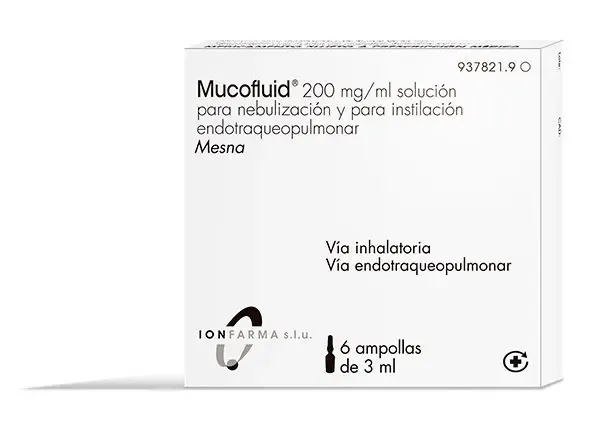
Table of Contents
Package leaflet: Information for the user
Introduction
PACKAGE LEAFLET: INFORMATION FOR THE USER
Mucofluid 200 mg/ml solution for nebulization and for endotracheopulmonary instillation
Mesna
Read the entire leaflet carefully before you start using this medicine.
- Keep this leaflet, as you may need to read it again.
- If you have any questions, ask your doctor or pharmacist.
- This medicine has been prescribed for you. Do not give it to other people, even if they have the same symptoms, as it may harm them.
- If you consider any of the side effects you experience to be severe, or if you notice any side effects not listed in this leaflet, inform your doctor or pharmacist.
Leaflet contents:
- What Mucofluid is and what it is used for
- Before you use Mucofluid
- How to use Mucofluid
- Possible side effects
- How to store Mucofluid
- Further information
1. What Mucofluid is and what it is used for
Mucofluid is a mucolytic medicine that binds to proteins in mucus fragments and solubilizes them, facilitating their elimination.
By nebulization it is used in:
- mucoviscidosis,
- obstructive pathologies of the respiratory tract due to mucus plugging.
By endotracheal instillation it is used:
- to facilitate the aspiration and drainage of retained mucus and exudates in the respiratory tract during anesthesia or intensive care,
in bronchoscopy, to ensure better visualization of the areas to be examined.
2. Before using Mucofluid
Do not use Mucofluid
- If you are allergic (hypersensitive) to mesna, to other compounds containing a thiol group or sulfonamides, or to any of the other components of Mucofluid.
- If you have asthma without mucus obstruction, or in case of status asthmaticus.
- If you have severe renal insufficiency.
- If you are intolerant to aerosols.
- If you are unable to cough or expectorate adequately.
- In children under 2 years of age.
Take special care with Mucofluid
- Mucofluid is intended exclusively for use via nebulizer or endotracheopulmonary instillation and must be administered only under medical supervision.
- Its use is not recommended in children under 12 years of age.
- In asthmatic patients, the product should be administered only if there is retention of mucus and bronchial exudates, and always in the presence of a physician or in a healthcare facility.
- Any type of device may be used, provided that the circuit through which the product passes is made of plastic, glass, or stainless steel. Mucofluid must not come into direct contact with unprotected rubber or metal.
- A whitish deposit may form in devices or circuits, which can be removed by rinsing with water.
- The solution should ideally be administered at room temperature.
- Because this product is easily oxidized, it is preferable to open the ampoule immediately before use. The solution may be used up to 24 hours after opening, provided it is stored below 25°C.
- Accidental intravenous injection or oral absorption does not endanger the patient. However, accidental intramuscular injection may cause local tissue necrosis (tissue death due to lack of blood supply).
Use of other medicines
Inform your doctor or pharmacist if you are using or have recently used any other medicines, including those obtained without a prescription.
Mucofluid may be used simultaneously via local application together with other medicines such as antibiotics (to treat infections), bronchodilators (to treat asthma-type respiratory disorders), corticosteroids (to treat inflammatory conditions), and anesthetics when administered intravenously.
It is recommended not to mix Mucofluid in the same solution with aminoglycosides (streptomycin, kanamycin, neomycin, gentamicin), as these become inactivated. However, there is no problem with using these antibiotics systemically and Mucofluid via local application.
Due to physicochemical incompatibility, it is recommended not to mix Mucofluid in the same solution with:
- certain antibiotics (oxytetracycline, carbenicillin, and erythromycin)
- aminophylline (a medicine used to treat asthma)
- lipiodol (a radiological contrast medium)
- cisplatin (a medicine used to treat certain tumors)
- nitrogen gas
If you undergo urine testing, false positive results may occur in the determination of certain components (sulfites or ketones) due to the presence in urine of certain substances (disulfides or free thiol groups) after administration of mesna.
Pregnancy and breastfeeding
Consult your doctor or pharmacist before using any medicine.
There are insufficient data on the use of mesna in pregnant women.
Mucofluid must not be used during pregnancy unless clearly necessary.
Mucofluid should be avoided during breastfeeding, or breastfeeding should be discontinued, while receiving treatment with Mucofluid.
Driving and use of machines
The influence of Mucofluid on the ability to drive and use machines is none or negligible.
3. How to use Mucofluid
Follow exactly the administration instructions for Mucofluid provided by your doctor. Consult your doctor if you have any doubts.
Mucofluid can be administered:
By nebulization: The solution can be used undiluted, or it may be diluted with an equal volume of distilled water or physiological saline. The solution can preferably be administered via a nasal piece, mask, or chamber.
The usual therapeutic dose is 3 ml (600 mg) to 6 ml (1200 mg) of undiluted product per day, divided into 3 to 4 doses daily.
The maximum dose is 24 ml (4.8 g) of undiluted product per day.
By endotracheal instillation: The solution must be diluted with an equal volume of distilled water or physiological saline. The diluted solution can be administered through an endotracheal tube or tracheostomy cannula.
The usual therapeutic dose is 1 ml or 2 ml of 10% diluted solution per hour.
The maximum dose is 24 ml (4.8 g) per day.
Treatment should be limited to the shortest possible duration, and if there is insufficient clinical improvement, the patient's condition should be reevaluated, with possible adjustment of therapy. In cystic fibrosis, Mucofluid should be administered according to symptomatology.
If you use more Mucofluid than you should:
Cases of overdose have not been reported.
After administration of large volumes of solution and sudden liquefaction of mucus, partial pulmonary flooding (partial accumulation of fluid in the lungs) may occur, causing transient disturbances in ventilation. The patient should be closely monitored and symptomatic treatment administered.
In case of overdose or accidental ingestion, contact the Toxicology Information Service. Telephone (91) 562 04 20.
If you forget to use Mucofluid:
Do not use a double dose to make up for missed doses.
If you stop using Mucofluid:
Do not discontinue treatment with Mucofluid without first consulting your doctor.
If you have any further questions about the use of this product, ask your doctor or pharmacist.
4. Possible adverse effects
Like all medicines, Mucofluid can have adverse effects, although not everyone will experience them.
The adverse effects reported with Mucofluid are:
-
Chest pain.
-
Hypersensitivity (allergy).
-
Cough.
-
Bronchospasm (contraction of the bronchi, causing narrowing and breathing difficulty).
- Dysgeusia (disturbance of taste sensation (bad taste, bitter taste, etc.)).
-
Angioneurotic edema (hives or welts due to swelling beneath the skin).
-
Erythematous rash (reddish skin eruption).
-
Urticaria (itching).
Bronchospasm may occur, particularly in sensitive asthmatic patients. Especially in children, vomiting and gastrointestinal discomfort due to excessive fluidification and swallowing of mucus may appear.
A sensation of retrosternal burning (central chest area, behind the sternum) may occasionally occur with the 200 mg/ml concentration solution (in this case, the solution should be diluted to 100 mg/ml).
If you consider any of the adverse effects you experience to be severe, or if you notice any adverse effects not listed in this leaflet, inform your doctor or pharmacist.
5. Storage of Mucofluid
Keep out of the reach and sight of children.
Do not use this medicine after the expiry date stated on the packaging after EXP. The expiry date refers to the last day of the month indicated.
This medicine does not require any special storage conditions.
Since it is a product easily oxidized, it is preferable to open the ampoule immediately before use. The solution may be used up to 24 hours after opening, if stored below 25°C.
Medicines must not be disposed of via wastewater or household waste. Unused medicines and their containers should be handed over to the SIGRE Point at your pharmacy. If you have any doubts, please ask your pharmacist how to dispose of unused medicines and their packaging. This will help protect the environment.
6. Information for the user
Composition of Mucofluid
-
The active substance is mesna. Each ml of Mucofluid contains 200 mg of mesna. Each 3 ml ampoule contains 600 mg of mesna.
-
The other components are: disodium edetate, sodium hydroxide (for pH adjustment) and water for injections.
Appearance of the medicinal product and contents of the pack
Mucofluid is a clear, colourless solution.
The solution is supplied in colourless glass ampoules.
Mucofluid is available in packs containing 6 ampoules of 3 ml solution.
Marketing Authorisation Holder and Manufacturer
Marketing Authorisation Holder:
IONFARMA, S.L.
Peru, 228
08020 Barcelona, Spain
Manufacturer:
Laboratorios Reig Jofré, S.A.
Gran Capitan, 10
08970 Sant Joan Despí (Barcelona), Spain
This leaflet was last approved in September 2023.
Detailed and up-to-date information on this medicinal product is available on the website of the Spanish Agency for Medicines and Health Products (AEMPS) http://www.aemps.gob.es/