Moxon 0.4 mg film-coated tablets
Spain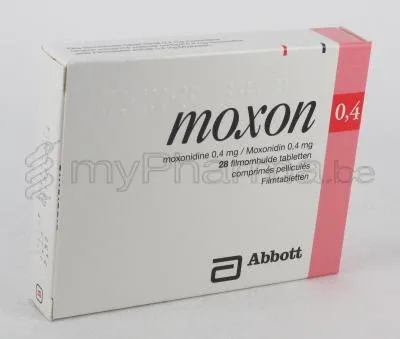
Table of Contents
Package leaflet: Information for the user
Introduction
Package leaflet: information for the user
Moxon 0.4 mg film-coated tablets
Moxonidine
Read the entire leaflet carefully before you start taking this medicine because it contains important information for you.
- Keep this leaflet, as you may need to read it again.
- If you have any questions, consult your doctor or pharmacist.
- This medicine has been prescribed for you only and must not be given to other people, even if they have the same symptoms as you, because it could harm them.
- If you experience any adverse effects, consult your doctor or pharmacist, even if these adverse effects are not listed in this leaflet. See section 4.
Contents of the leaflet
- What Moxon is and what it is used for
- What you need to know before taking Moxon
- How to take Moxon
- Possible side effects
- How to store Moxon
- Contents of the pack and other information
1. What Moxon is and what it is used for
Moxon belongs to a group of medicines called imidazoline receptor agonists (medicines that lower blood pressure).
Moxon is indicated for the treatment of arterial hypertension.
2. What you need to know before taking Moxon
Do not take Moxon
- If you are allergic to the active substance or to any of the other components of the medicine.
- If your heart beats slowly due to a condition called sick sinus syndrome or second- or third-degree AV block.
- If you have bradycardia.
- If you have heart failure.
Warnings and precautions
Talk to your doctor or pharmacist before starting Moxon:
- If you have a heart condition called first-degree AV block.
- If you have severe coronary artery disease or unstable chest pain (angina).
- If you have kidney problems. Your doctor may need to adjust the dose.
- If you are taking a beta-blocker (used to treat high blood pressure, arrhythmias, and other heart disorders) and both medicines need to be discontinued, the beta-blocker should be stopped first, followed by moxonidine a few days later.
- Do not stop treatment with moxonidine abruptly; discontinue gradually over a period of 2 weeks.
- If you are elderly, as your initial dose will be lower and you will need to be monitored more closely for possible adverse effects.
Children and adolescents
Moxon is not recommended for use in children and adolescents under 18 years of age due to lack of data on safety and efficacy.
Taking Moxon with other medicines
Tell your doctor or pharmacist if you are using, have recently used, or might need to use any other medicines.
Certain medicines may interact with Moxon; in such cases, it may be necessary to adjust the dose or discontinue treatment with one of the medicines.
It is especially important that you inform your doctor if you are taking any of the following medicines:
- Other medicines that lower blood pressure. Moxon may enhance the effect of these medicines.
- Medicines for depression, such as imipramine or amitriptyline. Concomitant use with Moxon is not recommended.
- Tranquilizers, sedatives, sleeping medicines (hypnotics), benzodiazepines (used to treat anxiety). Moxon may increase the sedative effect of these medicines.
- Moxon is eliminated from the body through the kidneys via a process called tubular excretion. Other medicines that are also eliminated by tubular excretion may affect how Moxon works.
Taking Moxon with food, drinks, and alcohol
Moxon may be taken with or without food.
You should avoid consuming alcohol. Alcohol increases the sedative effect of Moxon.
Pregnancy and breastfeeding
If you are pregnant or breastfeeding, think you may be pregnant, or are planning to become pregnant, consult your doctor before using this medicine.
Talk to your doctor or pharmacist before using any medicine.
Moxon should not be taken during pregnancy unless strictly necessary.
Moxon should not be taken during breastfeeding.
Driving and using machines
There is no information available regarding whether Moxon affects the ability to drive or operate machinery. Drowsiness and dizziness have been reported. This should be taken into account when performing these activities.
Moxon contains lactose
If your doctor has informed you that you have an intolerance to certain sugars, consult with him before taking this medicine.
3. How to take Moxon
Follow exactly the administration instructions for Moxon given by your doctor or pharmacist. If in doubt, consult your doctor or pharmacist again.
The usual starting dose of moxonidine is 0.2 mg daily. The daily dose may be increased up to a maximum of 0.6 mg, divided into two doses. The maximum dose that may be administered to a patient in a single dose is 0.4 mg. Doses should be individually adjusted according to the patient's response.
Patients with impaired renal function
In patients with moderate or severe renal impairment, the initial dose is 0.2 mg daily. If necessary and if well tolerated, the dose may be increased to 0.4 mg daily.
In patients undergoing hemodialysis, the initial dose is 0.2 mg daily. If necessary and if well tolerated, the dose may be increased to 0.3 mg daily.
Use in children and adolescents
Moxon is not recommended for use in children and adolescents under 18 years of age due to lack of data on safety and efficacy.
If you take more Moxon than you should
Contact your doctor immediately, go to the nearest hospital, or contact the Toxicology Information Service at telephone number 91 562 04 20 if you have taken more tablets than prescribed by your doctor.
If you forget to take Moxon
If you forget to take a dose, take it as soon as you remember. However, if less than 4 hours remain before the next dose, wait until the next dose and take it at the usual time.
Do not take a double dose to make up for missed doses.
If you stop taking Moxon
If you have any further questions about the use of this medicine, ask your doctor, pharmacist, or nurse.
4. Possible adverse effects
Like all medicines, this medicine can cause adverse effects, although not everyone experiences them.
Stop taking Moxon and go to the doctor immediately if you notice any of the following adverse effects, as they may require urgent treatment:
- Swelling of the face, lips, or mouth (angioedema). This is very rare, as it may affect up to 1 in every 100 people who take it.
Other adverse effects include:
Very common (may affect more than 1 in 10 people):
- Dry mouth
Common (may affect up to 1 in 10 people):
- Back pain
- Headache
- Tiredness (asthenia)
- Dizziness, vertigo
- Skin rash, itching (pruritus)
- Difficulty sleeping (insomnia), feeling drowsy (somnolence)
- Feeling sick (nausea), diarrhoea, vomiting, indigestion (dyspepsia)
Uncommon (may affect up to 1 in 100 people):
- Neck pain
- Feeling nervous
- Fainting (syncope)
- Swelling (oedema)
- Ringing or noises in the ears (tinnitus)
- Slow heartbeats (bradycardia)
- Low blood pressure, including when standing up or upon standing after sitting or lying down for some time
Reporting of adverse effects
If you experience any type of adverse effect, consult your doctor, pharmacist, or nurse, even if it is a possible adverse effect not listed in this leaflet. You can also report them directly via the Spanish System for Pharmacovigilance of Human Medicines: https://www.notificaram.es. By reporting adverse effects, you can help provide more information on the safety of this medicine.
5. Storage of Moxon
Keep this medicine out of sight and reach of children.
Do not store above 30°C.
Do not use Moxon after the expiry date stated on the packaging after “CAD” or “EXP”. The expiry date refers to the last day of the month indicated.
Medicines must not be disposed of via wastewater or household waste. Dispose of empty containers and unused medicines at the SIGRE collection point at your pharmacy. Ask your pharmacist how to dispose of containers and medicines you no longer need. This will help protect the environment.
6. Contents of the pack and other information
Composition of Moxon
- The active substance is moxonidine. Each tablet contains 0.4 mg of moxonidine.
- The other components are lactose monohydrate, povidone K25, crospovidone, magnesium stearate, hypromellose 2910, ethylcellulose 30% solution, macrogol 6000, talc, iron oxide red (E 172), and titanium dioxide (E 171).
Appearance of the product and pack contents
Moxon 0.4 mg is presented as film-coated tablets. Each pack contains 30 or 60 tablets.
Marketing Authorization Holder and Manufacturer
Marketing Authorization Holder:
Viatris Healthcare Limited
Damastown Industrial Park
Mulhuddart, Dublin 15
Dublin
Ireland
Manufacturer:
Mylan Laboratories SAS
Route de Belleville – Lieu dit Maillard
01400 Châtillon sur Chalaronne
France
For further information about this medicinal product, please contact the local representative of the Marketing Authorization Holder:
Viatris Pharmaceuticals, S.L.
C/ General Aranaz, 86
28027 Madrid
Spain
Date of the most recent revision of this leaflet: January 2019
Detailed and up-to-date information on this medicinal product is available on the website of the Spanish Agency for Medicines and Health Products (AEMPS) http://www.aemps.gob.es/