Mirazul 1.25 mg/ml eye drops solution
Spain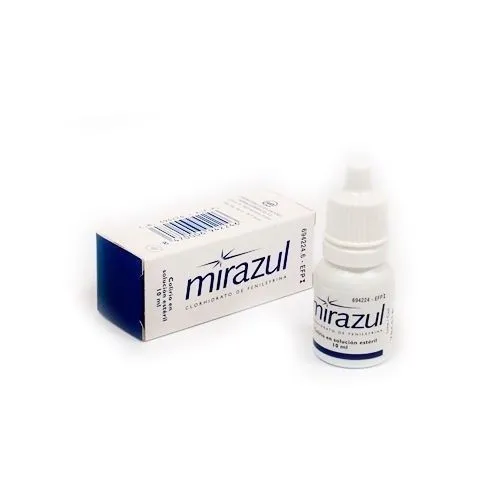
Table of Contents
Package leaflet: Information for the user
Introduction
Package leaflet: information for the patient
Mirazul 1.25 mg/ml eye drops, solution
Phenylephrine hydrochloride
Read the entire leaflet carefully before you start using this medicine, because it contains important information for you.
Follow exactly the instructions for administration of the medicine contained in this
leaflet or those indicated by your doctor, pharmacist, or nurse.
- Keep this leaflet, as you may need to read it again.
- If you need advice or more information, consult your pharmacist.
- If you experience any adverse effects, consult your doctor, pharmacist, or nurse, even if they are adverse effects not listed in this leaflet. See section 4.
- You should consult a doctor if you worsen or do not improve after 5 days.
Contents of the leaflet:
- What Mirazul is and what it is used for
- What you need to know before using Mirazul
- How to use Mirazul
- Possible side effects
- How to store Mirazul
- Contents of the pack and other information
1. What Mirazul is and what it is used for
Mirazul belongs to a group of medicines called ocular decongestants.
Phenylephrine hydrochloride is a drug belonging to the sympathomimetic group used as decongestants. It has a vasoconstrictor effect (causes narrowing of blood vessels), producing rapid and prolonged decongestion and relieving eye irritation.
Mirazul is a solution for eye drops indicated to relieve eye irritation caused by smoke, air, dust, chlorine in swimming pools, seawater, stuffy environments, contact lenses, cosmetics, eye strain, etc. in adults.
You should consult a doctor if symptoms worsen or do not improve after 5 days.
2. What you need to know before using Mirazul
Do not use Mirazul:
- If you are allergic to phenylephrine hydrochloride or any of the other ingredients of this medicine (listed in section 6).
- If you have glaucoma (increased pressure inside the eye), as the vasoconstrictive action of phenylephrine may cause a transient increase in intraocular pressure (pressure of the eye's fluids).
- If you are taking, or have taken within the previous 21 days, any monoamine oxidase inhibitor (MAOI) medicines (such as certain antidepressants).
- If you have a serious thyroid disorder (overactive thyroid gland).
- If you have dry rhinitis (inflammation of the mucous membranes inside the nose).
- In children under 12 years of age.
Warnings and precautions
Consult your doctor, pharmacist, or nurse before using Mirazul.
- If you have high blood pressure.
- If you have advanced arteriosclerosis (advanced hardening of the arteries).
- If you have orthostatic hypotension (decrease in blood pressure upon changing position).
- If you have long-standing insulin-dependent diabetes.
- If you have heart disease, including severe ischemic heart disease (temporary reduction in blood flow to the heart).
During administration, care must be taken not to touch the dropper tip to the eye, hands, or any other object. The container should be closed immediately after use.
If there is no improvement after 5 days of treatment, or if symptoms worsen while using the medicine, discontinue use and consult your doctor.
Chronic use of this medicine may cause rebound congestion in the eye.
When patients are not yet accustomed to contact lenses, this medicine should not be used for more than 5 consecutive days without consulting a doctor, to avoid masking possible eye irritation due to improper contact lens fit.
If eye pain, headache, blurred vision or changes in vision, light sensitivity, or eye redness occur, consult your doctor.
Children
Mirazul must not be used in children under 12 years of age, as children appear to be more sensitive to the risk of serious adverse effects.
Mirazul is not recommended for children between 12 and 18 years of age due to lack of adequate clinical experience.
Use of Mirazul with other medicines
Tell your doctor or pharmacist if you are taking, have recently taken, or might need to take any other medicines.
- Tricyclic antidepressants (amitriptyline, doxepine, trimipramine) and MAOIs (isocarboxazid, iproniazid, moclobemide), which are medicines used to treat depression, as well as reserpine and guanethidine (medicines used to lower blood pressure), may increase the effect of this medicine.
- This medicine is incompatible with the local anesthetic butacaine.
- The mydriatic response (pupil dilation) to phenylephrine hydrochloride is reduced when the patient is simultaneously treated with levodopa (a medicine used to treat Parkinson's disease).
Pregnancy and breastfeeding
If you are pregnant or breastfeeding, think you may be pregnant, or are planning to become pregnant, consult your doctor or pharmacist before using this medicine.
Since risk to the fetus cannot be excluded, the use of Mirazul during pregnancy is not recommended.
Breastfeeding women should consult their doctor before using this medicine, as it is not definitively known whether phenylephrine hydrochloride passes into breast milk.
Driving and use of machines
Mirazul has a mydriatic effect (abnormal dilation of the pupil with iris immobility) which increases with dose. This medicine may cause disturbances in visual accommodation (eye adjustment), and therefore may reduce reaction time. For this reason, driving or operating machinery after administration is not recommended.
Mirazul contains benzoic acid
This medicine may be slightly irritating to the skin, eyes, and mucous membranes because it contains benzoic acid.
Avoid contact with soft contact lenses. It may alter the color of soft contact lenses.
Remove contact lenses before application and wait at least 15 minutes before reinserting them.
3. How to use Mirazul
Follow exactly the instructions for administering this medicine provided in this leaflet or those given by your doctor or pharmacist. If in doubt, ask your doctor, pharmacist, or nurse.
The recommended dose is 1-2 drops in each eye, as needed, 3 or 4 times a day if necessary.
How to use Mirazul:
Mirazul is for ophthalmic use
- Wash your hands before using Mirazul.
- Hold the open container with one hand, between the thumb and index finger.
- Using the index finger of the other hand, gently pull down the lower eyelid of the eye.
- Gently squeeze the container to release one or two drops into the eye.
- After application, keep the eye closed for a few moments to help distribute the liquid over the entire eye surface.
- Repeat the previous steps for the other eye.
- Close the container tightly after each use.
If you use more Mirazul than you should
If you have used more Mirazul than recommended, this may cause symptoms such as elevated blood pressure, increased or decreased heart rate.
In case of overdose or accidental ingestion, go to a medical center, indicating the product and the amount ingested, or contact the Toxicology Information Service: Tel.: 91.562.04.20.
If you have any further questions about the use of this product, ask your doctor or pharmacist.
4. Possible adverse effects
Like all medicines, this medicine may produce adverse effects, although not everyone will experience them.
The following adverse effects may occur, the frequency of which has not been accurately determined: allergic conjunctivitis, mydriasis (dilation of the pupils), disturbances in visual accommodation, eye irritation, or contact dermatitis.
Reporting of adverse effects
If you experience any type of adverse effect, consult your doctor, pharmacist, or nurse, even if the adverse effects are not listed in this leaflet. You may also report them directly through the Spanish Pharmacovigilance System for Human Medicinal Products: www.notificaram.es. By reporting adverse effects, you can help provide more information on the safety of this medicine.
5. Storage of Mirazul
Keep this medicine out of sight and reach of children.
Do not use this medicine after the expiry date stated on the packaging after "EXP". The expiry date refers to the last day of the month indicated.
Discard the product one month after unsealing and opening the container.
Do not use Mirazul if you observe any change in colour of the solution or if cloudiness occurs.
Medicines must not be disposed of via wastewater or household waste. Ask your pharmacist how to dispose of medicines and packaging that you no longer need. This will help protect the environment.
6. Contents of the container and other information
Composition of Mirazul
- The active substance of Mirazul is phenylephrine hydrochloride. Each ml of solution contains 1.25 mg of phenylephrine hydrochloride.
- The other components are disodium phosphate, benzoic acid (E-210), ethanol 0.0037% v/v, chlorobutanol, benzyl alcohol, terpineol, methylene blue, sodium chloride and water for injections.
Appearance of the product and contents of the container
Mirazul is an eye drop solution supplied in a 10 ml bottle.
Marketing Authorization Holder and Manufacturer:
Holder:
LABORATORIO DE APLICACIONES FARMACODINÁMICAS, S.A.
Grassot, 16 – 08025 Barcelona (Spain)
Date of the most recent review of this leaflet: June 2021
Detailed information on this medicine is available on the website of the European Medicines Agency: http://www.ema.europa.eu/, and on the website of the Spanish Agency of Medicines and Health Products (AEMPS) http://www.aemps.gob.es/