Minjuvi 200 mg powder for concentrate for infusion solution
Spain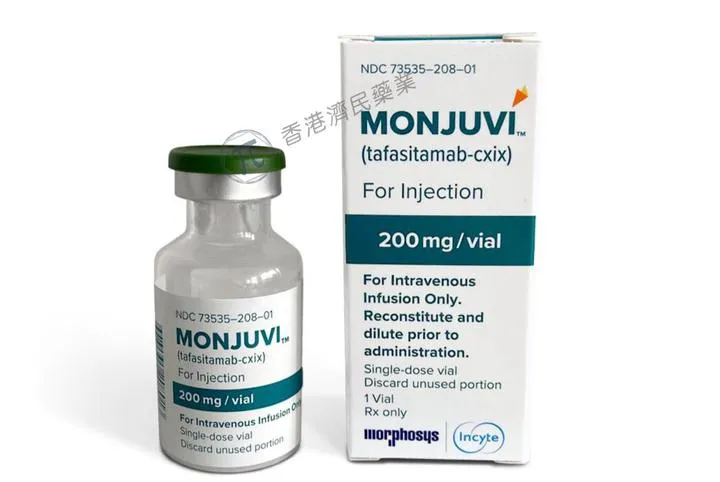
Table of Contents
Package leaflet: Information for the user
Introduction
Package leaflet: information for the user
MINJUVI 200 mg powder for concentrate for solution for infusion
tafasitamab
This medicinal product is subject to additional monitoring, which will allow for faster identification of new safety information. You can help by reporting any side effects you may experience. Section 4 includes information on how to report side effects.
Read all of this leaflet carefully before you start using this medicine, because it contains important information for you.
- Keep this leaflet; you may need to read it again.
- If you have any questions, ask your doctor or pharmacist.
- If you experience any side effects, talk to your doctor or pharmacist, even if they are side effects not listed in this leaflet. See section 4.
Contents of the leaflet
- What MINJUVI is and what it is used for
- What you need to know before using MINJUVI
- How to use MINJUVI
- Possible side effects
- How to store MINJUVI
- Contents of the pack and other information
1. What MINJUVI is and what it is used for
What MINJUVI is
MINJUVI contains the active substance tafasitamab. It is a type of protein called a monoclonal antibody designed to destroy cancer cells. This protein works by binding to a specific target on the surface of a type of white blood cells called B-cells or B-lymphocytes. When tafasitamab binds to the surface of these cells, the cells die.
What MINJUVI is used for
MINJUVI is used to treat adults with the following blood cancers affecting B-lymphocytes:
- Diffuse large B-cell lymphoma (DLBCL)
- Follicular lymphoma (FL)
It is used when the cancer has come back (relapsed) or has not responded (refractory) to at least one prior treatment. In the case of relapsed or refractory DLBCL, MINJUVI is also used when patients are not eligible for stem cell transplant.
Which other medicines MINJUVI is given with
In patients with relapsed or refractory DLBCL, MINJUVI is used together with another cancer medicine called lenalidomide at the beginning of treatment, after which MINJUVI treatment continues alone.
In patients with relapsed or refractory FL, MINJUVI is used together with two other cancer medicines called lenalidomide and rituximab.
2. What you need to know before using MINJUVI
Do not use MINJUVI
- if you are allergic to tafasitamab or any of the other ingredients of this medicine (listed in section 6)
Warnings and precautions
Talk to your doctor or pharmacist before starting treatment with MINJUVI if you have an infection or a history of recurrent infections.
During treatment with MINJUVI, you may experience the following:
- Infusion-related reactions
Infusion-related reactions may occur more frequently during the first infusion. Your doctor will monitor you for infusion-related reactions during the MINJUVI infusion. Immediately inform your doctor if you experience reactions such as fever, chills, flushing, rash, or difficulty breathing within 24 hours after the infusion.
Your doctor will give you premedication before each infusion to reduce the risk of infusion-related reactions. If you do not experience reactions, your doctor may decide that you no longer need these medications for subsequent infusions.
- Reduction in blood cell counts
Treatment with MINJUVI may reduce the number of certain blood cells in your body, such as white blood cells called neutrophils, platelets, and red blood cells. Immediately inform your doctor if you have a fever of 38 °C or higher or show signs of bruising or bleeding, as these may be signs of reduced blood cell counts. Your doctor will monitor your blood cell counts throughout treatment and before the start of each treatment cycle.
- Infections
Serious infections, including potentially life-threatening infections, may occur during and after treatment with MINJUVI. Inform your doctor if you notice signs of infection such as fever of 38 °C or higher, chills, cough, or pain when urinating.
- Progressive multifocal leukoencephalopathy (PML)
PML is a potentially fatal and very rare brain infection. Immediately inform your doctor if you experience symptoms such as memory loss, difficulty speaking or walking, vision problems, or numbness or weakness in the face, arms, or legs.
If you have any of these symptoms before or during treatment with MINJUVI, or notice any changes, inform your doctor immediately, as they could be signs of PML.
- Tumor lysis syndrome
Some people may develop unusually high levels of certain substances (such as potassium and uric acid) in the blood due to the rapid breakdown of cancer cells during treatment. This is known as tumor lysis syndrome. Inform your doctor if you have symptoms such as nausea, vomiting, loss of appetite, fatigue, dark urine, reduced urine output, pain in the side or back, muscle cramps, numbness, or palpitations. Your doctor may give you treatment before each infusion to reduce the risk of tumor lysis syndrome and may perform blood tests to detect it.
Contact your doctor immediately if you notice any of these problems.
Children and adolescents
MINJUVI is not recommended in children and adolescents under 18 years of age, as there is no information available on its use in this age group.
Other medicines and MINJUVI
Tell your doctor or pharmacist if you are taking, have recently taken, or might need to take any other medicines.
The use of live vaccines is not recommended during treatment with tafasitamab.
Pregnancy and breastfeeding
If you are pregnant or breastfeeding, think you may be pregnant, or plan to become pregnant, consult your doctor or pharmacist before using this medicine.
- Contraception
Women of childbearing potential are advised to use effective contraception during treatment with MINJUVI and for at least 3 months after the end of treatment.
- Pregnancy
Do not use MINJUVI during pregnancy if you are of childbearing potential and not using contraceptive methods. Pregnancy must be ruled out before starting treatment. Inform your doctor immediately if you become pregnant or suspect you may be pregnant during treatment with MINJUVI.
MINJUVI is administered in combination with lenalidomide for up to 12 cycles**. Lenalidomide can cause fetal harm and must not be used during pregnancy or in women of childbearing potential**, unless all requirements of the lenalidomide pregnancy prevention program are met. Your doctor will provide you with further information and recommendations.
- Breastfeeding
Do not breastfeed during treatment with MINJUVI and for at least 3 months after the last dose. It is unknown whether tafasitamab passes into breast milk.
Driving and using machines
The influence of MINJUVI on the ability to drive and use machines is negligible or minor. However, fatigue has been reported in patients taking tafasitamab, and this should be taken into account when driving or operating machinery.
MINJUVI contains sodium
This medicine contains 37.0 mg of sodium (a main component of cooking/table salt) per dose of 5 vials (the dose for a patient weighing 83 kg). This corresponds to 1.85% of the maximum daily recommended sodium intake for an adult.
MINJUVI contains polysorbate
This medicine contains 1 mg of polysorbate 20 per vial. Polysorbates may cause allergic reactions. Inform your doctor if you have any known allergies.
3. How to use MINJUVI
Your treatment will be supervised by a physician experienced in the treatment of cancer. MINJUVI will be administered intravenously as an infusion (drip). During and after the infusion, you will be monitored frequently for infusion-related adverse reactions.
MINJUVI is given in 28-day cycles. The dose you receive is based on your body weight and will be calculated by your physician.
If you have relapsed or refractory diffuse large B-cell lymphoma (DLBCL)
The recommended dose is 12 mg of tafasitamab per kilogram of body weight. It is administered as an intravenous infusion according to the following schedule:
- Cycle 1: infusion on days 1, 4, 8, 15, and 22 of the cycle
- Cycles 2 and 3: infusion on days 1, 8, 15, and 22 of each cycle
- Cycle 4 and onwards: infusion on days 1 and 15 of each cycle
In addition, your physician will prescribe lenalidomide capsules to be taken for up to twelve cycles. The recommended initial dose of lenalidomide is 25 mg once daily on days 1 to 21 of each cycle.
Your physician may adjust the initial dose and subsequent dosing as necessary.
After up to twelve cycles of combination therapy, treatment with lenalidomide is discontinued. Treatment with MINJUVI continues in subsequent cycles until disease progression or until you experience unacceptable adverse effects.
If you have relapsed or refractory follicular lymphoma (FL)
The recommended dose is 12 mg of tafasitamab per kilogram of body weight. It is administered as an intravenous infusion according to the following schedule:
- Cycles 1 to 3: infusion on days 1, 8, 15, and 22 of each cycle
- Cycles 4 to 12: infusion on days 1 and 15 of each cycle
In addition, your physician will prescribe:
-
A dose of rituximab of 375 mg per square meter of body surface area, administered as an intravenous infusion on days 1, 8, 15, and 22 of cycle 1, and thereafter on day 1 of each cycle from cycle 2 through cycle 5.
-
Lenalidomide capsules for up to twelve cycles.
The recommended initial dose of lenalidomide is 20 mg once daily on days 1 to 21 of each cycle. Your physician may adjust the initial and subsequent doses as necessary.
After up to five cycles of combination treatment, rituximab is discontinued. After up to twelve cycles, treatment with MINJUVI and lenalidomide is also discontinued.
If you have received more MINJUVI than you should
Since this medicine is administered in a hospital setting under the supervision of a physician, this is unlikely. Inform your physician if you think you may have received too much MINJUVI.
If you have any further questions about the use of this medicine, ask your physician or pharmacist.
4. Possible adverse effects
Like all medicines, this medicine can cause adverse effects, although not everyone experiences them.
Tell your doctor or nurse immediately if you notice any of the following serious adverse effects (you may need urgent medical treatment). They may be new symptoms or a change in your current symptoms.
- Severe infections; possible symptoms: fever, chills, sore throat, cough, shortness of breath, nausea, vomiting, diarrhea. These may be particularly important if you have been told that you have low levels of white blood cells called neutrophils.
- Pneumonia (lung infection)
- Sepsis (bloodstream infection)
Other adverse effects
Tell your doctor or nurse immediately if you notice any of the following adverse effects:
Very common (may affect more than 1 in 10 people)
-
Reduced number of blood cells
- White blood cells, especially a type called neutrophils; possible symptoms: fever of 38°C or higher or any signs of infection
- Platelets; possible symptoms: unusual bruising or bleeding without injury or only minor injury
- Red blood cells; possible symptoms: pale skin or lips, tiredness, shortness of breath
-
Bacterial, viral, or fungal infections, such as respiratory infections, bronchitis, lung inflammation, urinary tract infections
-
Skin rash
-
Itching
-
Infusion-related reactions
- These reactions may occur during infusion of MINJUVI or within 24 hours after the infusion. Possible symptoms include fever, chills, flushing, or difficulty breathing
-
Low blood potassium levels in blood tests
-
Muscle cramps
-
Back pain
-
Swelling of the arms or legs due to fluid retention
-
Weakness, tiredness, general feeling of being unwell
-
Fever
-
Diarrhea
-
Constipation
-
Abdominal pain
-
Nausea
-
Vomiting
-
Cough
-
Shortness of breath
-
Loss of appetite
-
Headache
Common (may affect up to 1 in 10 people)
-
Worsening of breathing difficulty due to narrowing of the lung airways, known as chronic obstructive pulmonary disease (COPD)
-
Abnormal skin sensations, such as tingling, itching, or numbness
-
Skin redness
-
Chills
-
Altered sense of taste
-
Hair loss
-
Abnormal sweating
-
Pain in arms and legs
-
Muscle and joint pain
-
Weight loss
-
Nasal congestion
-
Inflammation of the membranes lining organs such as the mouth
-
Low levels of a type of white blood cell called lymphocytes in blood tests
-
An immune system disorder called hypogammaglobulinemia
-
In blood tests, low levels of
- Calcium
- Magnesium
-
In blood tests, high levels of
- C-reactive protein, which may indicate inflammation or infection
- Serum creatinine, a byproduct of muscle tissue breakdown
- Liver enzymes: gamma-glutamyl transferase, transaminases
- Bilirubin, a yellow breakdown product of blood pigment
-
A type of skin cancer called basal cell carcinoma
Uncommon (may affect up to 1 in 100 people)
- Abnormal levels of chemicals in the blood caused by the rapid destruction of cancer cells during treatment (tumour lysis syndrome)
Reporting of adverse effects
If you experience any adverse effect, talk to your doctor or pharmacist, even if it is a possible adverse effect not listed in this leaflet. You can also report them directly through the national reporting system detailed in Appendix V. By reporting adverse effects, you can help provide more information on the safety of this medicine.
5. Storage of MINJUVI
Keep this medicine out of the sight and reach of children.
Do not use this medicine after the expiry date stated on the label of the vial and on the outer carton after EXP. The expiry date refers to the last day of the month indicated.
Store in a refrigerator (between 2 °C and 8 °C).
Keep the vial in the outer packaging to protect it from light.
Disposal of unused medicine and of all materials that have come into contact with it must be carried out in accordance with local regulations.
6. Contents of the pack and other information
Composition of MINJUVI
- The active substance is tafasitamab. One vial contains 200 mg of tafasitamab. After reconstitution, each ml of solution contains 40 mg of tafasitamab.
- The other components are sodium citrate dihydrate, citric acid monohydrate, trehalose dihydrate, and polysorbate 20 (see section 2 “MINJUVI contains sodium and polysorbate”).
Appearance of the product and contents of the pack
MINJUVI is a powder for concentrate for solution for infusion. It is a white to slightly yellow lyophilised powder in a clear glass vial with a rubber stopper, aluminium seal, and plastic flip-off cap.
Each carton contains 1 vial.
Marketing Authorisation Holder and Manufacturer
Incyte Biosciences Distribution B.V.
Paasheuvelweg 25
1105 BP Amsterdam
The Netherlands
Date of the most recent review of this leaflet:
This medicinal product has been authorised under a “conditional approval”. This type of approval means that further information on this medicinal product is expected.
The European Medicines Agency will review new information on this medicinal product at least once a year, and this leaflet will be updated as necessary.
Other sources of information
Detailed information on this medicinal product is available on the website of the European Medicines Agency: http://www.ema.europa.eu.
This leaflet is available on the European Medicines Agency website in all languages of the European Union/European Economic Area.
This information is intended for healthcare professionals only:
MINJUVI is supplied in sterile single-use vials without preservatives.
MINJUVI must be reconstituted and diluted before intravenous infusion.
Use appropriate aseptic techniques for reconstitution and dilution.
Instructions for reconstitution
- Determine the tafasitamab dose based on the patient’s body weight by multiplying 12 mg by the patient’s weight (kg). Then calculate the number of tafasitamab vials required (each vial contains 200 mg of tafasitamab).
- Using a sterile syringe, carefully add 5.0 ml of sterile water for injection to each MINJUVI vial. Direct the stream onto the vial walls and not directly onto the lyophilised powder.
- Gently swirl the reconstituted vial(s) to aid dissolution of the lyophilised powder. Do not shake or vigorously agitate. Do not withdraw the contents until all solid material has completely dissolved. The lyophilised powder should dissolve within 5 minutes.
- The reconstituted solution should appear as a clear, colourless to slightly yellow solution. Before proceeding, visually inspect for particles and discolouration. If the solution is cloudy, discoloured, or contains visible particles, discard the vial.
Instructions for dilution
- Use an infusion bag containing 250 ml of 9 mg/ml (0.9%) sodium chloride injection solution.
- Calculate the total volume required of the reconstituted tafasitamab solution at 40 mg/ml.
- Withdraw and discard an equal volume from the infusion bag.
- Withdraw the calculated total volume (ml) of reconstituted tafasitamab solution from the vial(s) and slowly add it to the 9 mg/ml (0.9%) sodium chloride infusion bag. Discard any unused tafasitamab remaining in the vial.
- The final concentration of the diluted solution should be between 2 mg/ml and 8 mg/ml of tafasitamab.
- Gently mix the intravenous bag by slowly inverting it. Do not shake.
Instructions for administration
- During the first infusion of cycle 1, the intravenous infusion rate should be 70 ml/h for the first 30 minutes. After this, the rate should be increased so that the first infusion is completed within 2.5 hours.
- All subsequent infusions should be administered over a period of 1.5 to 2 hours.
- Do not administer together with other medicinal products through the same infusion line.
- Do not administer MINJUVI as an intravenous push or bolus.
Reconstituted solution (before dilution)
Chemical and physical in-use stability has been demonstrated for up to 30 days between 2 °C and 8 °C or for up to 24 hours at 25 °C.
From a microbiological standpoint, the reconstituted solution should be used immediately. If not used immediately, the in-use storage conditions and duration are the responsibility of the user and normally should not exceed 24 hours between 2 °C and 8 °C, unless reconstitution was carried out under controlled and validated aseptic conditions. Do not freeze or shake.
Diluted solution (for infusion)
Chemical and physical in-use stability has been demonstrated for up to 14 days between 2 °C and 8 °C, followed by up to 24 hours at a maximum of 25 °C.
From a microbiological standpoint, the diluted solution should be used immediately. If not used immediately, the storage times prior to use and the conditions are the responsibility of the user and should not exceed 24 hours between 2 °C and 8 °C, unless dilution was performed under controlled and validated aseptic conditions. Do not freeze or shake.
Disposal of unused medicinal product and of all materials that have come into contact with it should be carried out in accordance with local regulations.