Midazolam Serraclinics 1 mg/ml solution for injection and infusion EFG
Spain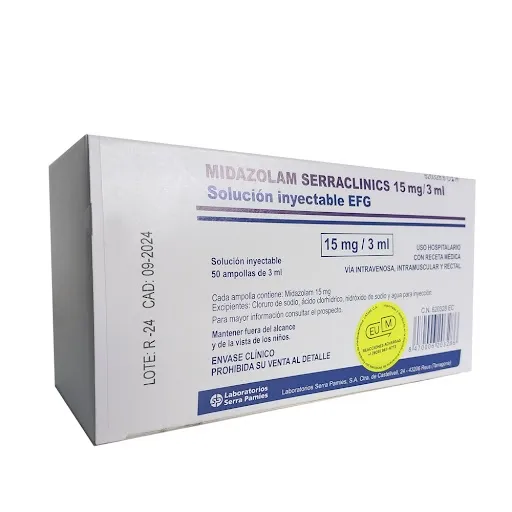
Table of Contents
- Package leaflet: Information for the user
- Introduction
- 1. What Midazolam Serraclinics is and what it is used for
- 2. What you need to know before using Midazolam Serraclinics
- 3. How to use Midazolam Serraclinics
- 4. Possible adverse effects
- 5. Storage of Midazolam Serraclinics
- 6. Contents of the pack and other information
Package leaflet: Information for the user
Introduction
Package leaflet: information for the patient
Midazolam Serraclinics 1 mg/ml solution for injection and infusion EFG
Read this entire leaflet carefully before you start using this medicine, because it contains important information for you.
-
Keep this leaflet, as you may need to read it again.
- If you have any questions, ask your doctor, pharmacist, or nurse.
-
This medicine has been prescribed for you only, and you should not give it to other people, even if they have the same symptoms as you, because it may harm them.
- If you experience any adverse effects, consult your doctor, pharmacist, or nurse, even if these are adverse effects not listed in this leaflet. See section 4.
Contents of the leaflet
- What Midazolam Serraclinics is and what it is used for
- What you need to know before using Midazolam Serraclinics
- How to use Midazolam Serraclinics
- Possible side effects
- How to store Midazolam Serraclinics
- Contents of the pack and other information
1. What Midazolam Serraclinics is and what it is used for
The active substance in Midazolam Serraclinics is midazolam; it belongs to the group of benzodiazepines, medicines known as hypnotics (sleep-inducing agents) and sedatives (medicines that reduce nervous excitation).
Midazolam Serraclinics is indicated:
In adults for:
?Conscious Sedation before and during diagnostic or therapeutic procedures with or without local anesthesia.
?Anesthesia
- Premedication prior to anesthesia induction.
- Induction of anesthesia.
- As a sedative component in combined anesthesia.
?Sedation in Intensive Care Units (ICU).
?Conscious Sedation before and during diagnostic or therapeutic procedures with or without local anesthesia.
?Anesthesia
- Premedication prior to anesthesia induction.
?Sedation in Intensive Care Units (ICU).
2. What you need to know before using Midazolam Serraclinics
This medicine should only be used when appropriate resuscitation equipment is available for each type of patient, as intravenous administration of Midazolam Serraclinics may depress myocardial contractility (reduced heart contractions) and cause apnea (cessation of breathing).
Do not use Midazolam Serraclinics
- If you are allergic to midazolam, to benzodiazepines, or to any of the other ingredients of this medicine (listed in section 6).
- For conscious sedation if the patient has severe respiratory insufficiency or acute respiratory depression.
Warnings and precautions
Talk to your doctor, pharmacist, or nurse before starting to use Midazolam Serraclinics.
-
If administered to:
-
Adults over 60 years of age.
-
Pediatric patients, especially those with cardiovascular instability.
-
Patients with chronic diseases or who are debilitated, such as:
-
Patients with chronic respiratory insufficiency.
-
Patients with chronic renal insufficiency.
-
Patients with impaired cardiac function.
-
Patients with impaired hepatic function.
-
Patients with myasthenia gravis (severe muscle weakness).
These high-risk patients require lower doses and must be continuously monitored for early signs of vital function disturbances.
-
Patients with a history of alcohol or drug abuse.
-
Patients receiving premedication: careful observation of the patient after administration is mandatory, as interindividual sensitivity varies and overdose symptoms may occur.
-
The following aspects should also be considered during treatment with this medicine:
-
Tolerance
A certain decrease in effectiveness has been reported when Midazolam Serraclinics is used for prolonged sedation in intensive care units (ICU).
- Dependence
When Midazolam Serraclinics is used for prolonged sedation in the ICU, physical dependence may occur. The risk of dependence increases with dose and duration of treatment.
- Withdrawal symptoms
Prolonged treatment with Midazolam Serraclinics in the ICU may lead to physical dependence. Therefore, abrupt discontinuation of treatment may be accompanied by withdrawal symptoms. The following symptoms may occur: headache, myalgia (muscle pain), anxiety, tension, restlessness, confusion, irritability, rebound insomnia, mood disturbances, hallucinations, and seizures. Since the risk of withdrawal symptoms is higher after abrupt discontinuation, it is recommended to gradually reduce the dose (see section on how Midazolam Serraclinics will be administered to you).
- Amnesia
Midazolam Serraclinics causes anterograde amnesia (partial or total loss of memory for events occurring just after regaining consciousness; this effect is often highly desirable in situations such as before and during surgical procedures and diagnostic interventions). The duration of amnesia is directly related to the administered dose. Prolonged amnesia may pose problems for outpatients who are expected to be discharged after the procedure. After receiving midazolam by parenteral route, patients may leave the hospital or clinic only if accompanied by another person.
- Paradoxical reactions
Paradoxical reactions have been reported with Midazolam Serraclinics, such as agitation, involuntary movements (tonic-clonic seizures and muscle tremor), hyperactivity, hostility, rage reaction, aggressive behavior, paroxysmal excitement (episodes of excitement), threats, and verbal abuse. These reactions may occur with high doses or when the injection is administered rapidly. Such reactions are most frequently observed in children and elderly patients.
Children and adolescents
Use in children under 6 months of age is not recommended for conscious sedation or anesthesia.
Other medicines and Midazolam Serraclinics
Tell your doctor or pharmacist if you are taking, have recently taken, or might need to take any other medicines.
Certain medicines may interact with Midazolam Serraclinics; in such cases, it may be necessary to adjust the dose or discontinue treatment with one of the medicines.
It is important to inform your doctor if you are taking or have recently taken any of the following medicines:
- Itraconazole, Fluconazole, and Ketoconazole (medicines used to treat fungal infections)
- Verapamil and Diltiazem (calcium channel blockers)
- Erythromycin and Clarithromycin (macrolide antibiotics)
- Cimetidine and Ranitidine (medicines used to treat gastroduodenal ulcers)
- Saquinavir and other protease inhibitors (medicines used in the treatment of HIV infection (AIDS))
- CNS depressants (opioids, antipsychotics, and other benzodiazepines)
- Opioids, phenobarbital, and benzodiazepines. Additional respiratory depression must be especially monitored when these drugs are used concomitantly with Midazolam Serraclinics.
Additional sedation should be considered when Midazolam Serraclinics is combined with sedative drugs.
Intravenous administration of Midazolam Serraclinics reduces the minimum alveolar concentration (MAC) of inhaled anesthetics required for general anesthesia.
Use of Midazolam Serraclinics with food, drinks, and alcohol
Alcohol may significantly enhance the sedative effect of Midazolam Serraclinics. Consumption of alcohol should be avoided when Midazolam Serraclinics is administered.
Pregnancy, breastfeeding, and fertility
If you are pregnant or breastfeeding, think you may be pregnant, or are planning to become pregnant, consult your doctor or pharmacist before using this medicine.
Midazolam Serraclinics should not be used during pregnancy unless absolutely necessary. It is preferable not to use it for cesarean section.
The risk to the fetus should be considered when Midazolam Serraclinics is administered for any surgical procedure near the end of pregnancy.
Breastfeeding women are advised to suspend breastfeeding for 24 hours after administration of Midazolam Serraclinics.
Driving and using machines
Midazolam Serraclinics is a medicine that causes drowsiness. Do not drive or operate machinery if you feel sleepy or if your attention and reaction ability are impaired. Pay special attention at the beginning of treatment or when the dose is increased.
Midazolam Serraclinics contains sodium
This medicine contains less than 23 mg of sodium (1 mmol) per ml; this is essentially “sodium-free.”
3. How to use Midazolam Serraclinics
Follow exactly the instructions for administration of this medicine given by your doctor or pharmacist. If in doubt, consult your doctor or pharmacist again.
Your doctor will determine the duration of your treatment with Midazolam Serraclinics.
Dosage and methods of administration
Midazolam Serraclinics is a potent sedative that requires dose adjustment and slow administration. Your doctor will adjust the dose according to clinical needs, physical condition, age, weight, and concomitantly administered drugs.
Midazolam Serraclinics can be administered as an intravenous bolus, intravenous infusion, intramuscular injection, or rectally.
If you have been given more Midazolam Serraclinics than you should
Symptoms:
Symptoms of overdose include: drowsiness, mental confusion, lethargy, muscle relaxation, or paradoxical excitation. More severe symptoms include arreflexia (absence of normal reflexes), hypotension, cardiopulmonary depression, apnea (respiratory pause), and coma.
If you have been given more Midazolam Serraclinics than you should, contact your doctor or pharmacist immediately.
In case of overdose or accidental ingestion, contact the Toxicology Information Service. Telephone (91) 562 04 20.
Treatment in case of overdose
In most cases, monitoring vital functions is sufficient. Treatment of overdose requires special attention to respiratory and cardiovascular functions in an intensive care unit (ICU).
4. Possible adverse effects
Like all medicines, this medicine can cause adverse effects, although not everyone will experience them.
Adverse effects may occur with certain frequencies, defined as follows:
Very common (may affect more than 1 in 10 people)
Common (may affect up to 1 in 10 people)
Uncommon (may affect up to 1 in 100 people)
Rare (may affect up to 1 in 1,000 people)
Very rare (may affect up to 1 in 10,000 people)
Frequency not known (cannot be estimated from the available data)
The following adverse reactions have been reported (very rarely) with administration of Midazolam Serraclinics:
Skin and subcutaneous tissue disorders: skin rash (reddening of the skin), urticaria (allergy), pruritus (itching).
Central and peripheral nervous system and psychiatric disorders: drowsiness and prolonged sedation, decreased alertness, confusion, euphoria, hallucinations, fatigue, headache, dizziness, ataxia (lack of coordination of movements), postoperative sedation, and anterograde amnesia (duration of which is directly related to the administered dose). Anterograde amnesia may persist after the end of the procedure, and in isolated cases, prolonged amnesia has been reported.
Paradoxical reactions have been described, such as agitation, involuntary movements (tonic/clonic movements and muscle tremor), hyperactivity, hostility, anger reaction, aggressiveness, paroxysmal excitement, threats, and insults, particularly in children and elderly patients.
Seizures have been reported more frequently in infants and premature newborns.
The use of Midazolam Serraclinics, even at therapeutic doses, may promote the development of physical dependence following prolonged intravenous administration; abrupt discontinuation of the drug may be accompanied by withdrawal symptoms, such as seizures.
Gastrointestinal disorders: nausea, vomiting, hiccups, constipation, and dry mouth.
Cardiorespiratory disorders: serious cardiorespiratory adverse events: respiratory depression, apnea (pause in breathing), respiratory arrest or cardiac arrest, hypotension, changes in heart rate, vasodilatory effects, dyspnea (shortness of breath), and laryngospasm.
Potentially life-threatening events are more likely in patients over 60 years of age and in those with pre-existing respiratory insufficiency or impaired cardiac function, particularly when the injection is administered too rapidly or when a high dose is given.
General disorders: generalized allergic reactions: skin reactions, cardiovascular reactions, bronchospasm, anaphylactic shock (severe allergic reaction).
Application site disorders: erythema (redness) and pain at the injection site, circulatory disturbances (thrombophlebitis and thrombosis).
Seek immediate medical attention or call for an ambulance by telephone if the patient experiences any of the following adverse effects:
- Swelling of the face, lips, tongue, or throat causing difficulty swallowing or breathing.
Stop taking Midazolam Serraclinics and contact your doctor immediately if you notice any of the following side effects. They may be potentially life-threatening and may require urgent medical treatment:
- Anaphylactic shock (a potentially life-threatening allergic reaction). Signs may include sudden rash, itching or lumpy rash (urticaria), and swelling of the face, lips, tongue, or other body parts. You may also experience shortness of breath, wheezing, or difficulty breathing, or pale skin, weak and rapid pulse, or feeling faint. Additionally, you may experience chest pain, which could be a sign of a potentially serious allergic reaction called Kounis syndrome.
If any other reaction not described in this leaflet occurs, consult your doctor or pharmacist.
Reporting of adverse effects
If you experience any type of adverse effect, talk to your doctor or pharmacist, even if they are possible adverse effects not listed in this leaflet. You can also report them directly via the Spanish Pharmacovigilance System for Human Medicinal Products: https://www.notificaram.es. By reporting adverse effects, you can help provide more information on the safety of this medicine.
5. Storage of Midazolam Serraclinics
Keep this medicine out of the sight and reach of children.
Do not use this medicine after the expiry date stated on the carton after EXP. The expiry date refers to the last day of the month indicated.
Do not freeze. A precipitate may form, which dissolves upon shaking the contents at room temperature.
Do not store above 25°C.
Your doctor or pharmacist is responsible for the storage of midazolam. They are also responsible for the proper disposal of any unused medicine remaining after administration.
6. Contents of the pack and other information
- The active substance is midazolam. Each 5 ml ampoule contains 5 mg of midazolam.
- The other components (excipients) are: sodium chloride, hydrochloric acid (for pH adjustment), sodium hydroxide (for pH adjustment), and water for injections.
Appearance of the product and pack contents
Midazolam Serraclinics is presented as an injectable solution in 5 ml ampoules. The solution is transparent, colourless or slightly yellow. Each pack contains 10 or 50 ampoules.
Only certain pack sizes may be marketed.
Marketing Authorisation Holder and Manufacturer:
Laboratorios Serra Pamies, S.A.
Ctra. Castellvell, 24
43206 REUS (Tarragona)
Date of the most recent review of this summary: August 2023
Detailed information on this medicinal product is available on the website of the Spanish Agency of Medicines and Health Products (AEMPS) (http://www.aemps.gob.es/).
This information is intended for healthcare professionals only:
For conscious sedation prior to a diagnostic or surgical procedure, midazolam is administered intravenously (IV). The dose must be individualised and adjusted accordingly, and must not be given as a rapid bolus injection. The onset of sedation may vary individually depending on the patient's physical condition and the specific circumstances of dosing. If necessary, additional doses may be administered according to individual needs. The medicinal product begins to act approximately 2 minutes after injection. Maximum effect is achieved within 5 to 10 minutes.
Compatibility with infusion solutions
Midazolam Serraclinics ampoules solution may be diluted with 0.9% sodium chloride, 5% and 10% dextrose, 5% levulose, Ringer's solution, and Hartmann's solution, using a mixing ratio of 15 mg midazolam per 100–1000 ml of solution. These solutions remain stable for 24 hours at room temperature or for 3 days at 5°C. Midazolam Serraclinics ampoules solution must not be diluted with Macrodex 6% in dextrose or mixed with alkaline injections.
Adults
Intravenous (IV) injection of midazolam should be administered slowly at a rate of approximately 1 mg over 30 seconds.
Children
Use in children under 6 months of age is not recommended for conscious sedation or anaesthesia, as there is very limited data available in this population.
-
IV administration: the dose of midazolam should be slowly titrated until the desired clinical effect is achieved. The initial dose of midazolam should be administered over 2 to 3 minutes. An additional 2 to 5 minutes should be allowed to accurately assess the sedative effect before initiating the procedure or repeating the dose. If further sedation is required, dosing should be further adjusted in small increments until the appropriate level of sedation is achieved.
-
Rectal administration: the total dose of midazolam usually ranges between 0.3 and 0.5 mg/kg. Rectal administration of the ampoule solution is performed using a plastic applicator attached to the end of a syringe. If the volume to be administered is too small, water may be added to achieve a total volume of 10 ml. The total dose should be administered at once, and repeated rectal administration should be avoided.
-
IM administration: this route should only be used in exceptional cases. Rectal administration is preferred, as IM injection is painful.
Management in case of overdose
In most cases, monitoring of vital functions is sufficient. In the management of overdose, special attention should be paid to respiratory and cardiovascular functions in an intensive care unit (ICU). Flumazenil, a benzodiazepine antagonist, is indicated in cases of severe intoxication associated with coma or respiratory depression. Caution must be exercised when using flumazenil in cases of mixed drug overdose and in patients with epilepsy already treated with benzodiazepines. Flumazenil must not be used in patients treated with tricyclic antidepressants or epileptogenic drugs, or in patients with electrocardiogram abnormalities (QRS or QT prolongation).