Metvix 160 mg/g cream
Spain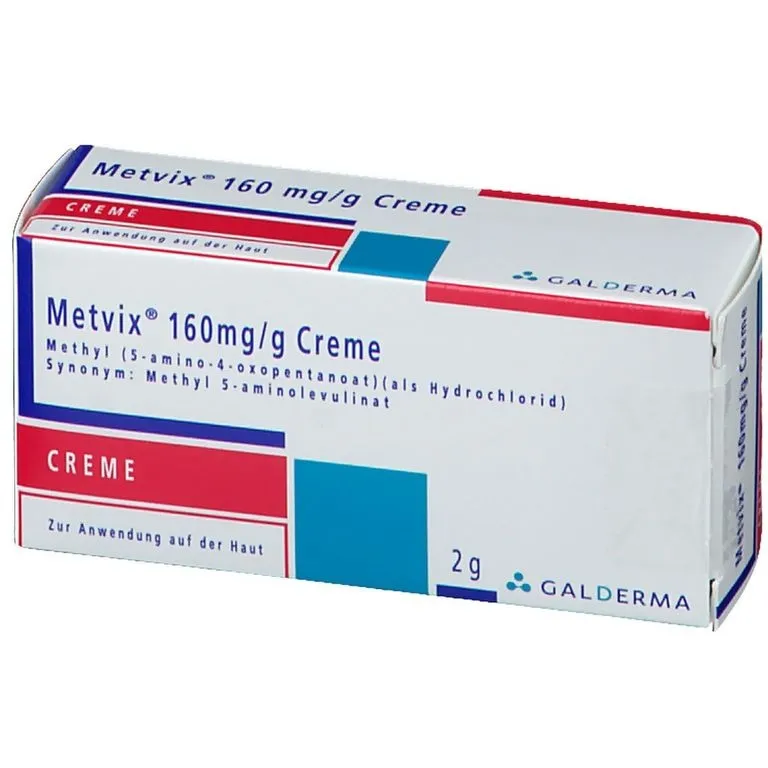
Table of Contents
Patient Information Leaflet
Introduction
Patient Information Leaflet
Metvix 160 mg/g cream
Methyl aminolevulinate
Read the entire package leaflet carefully before you start using this medicine, because it contains important information for you.
- Keep this leaflet, as you may need to read it again.
- If you have any questions, ask your doctor or pharmacist.
- This medicine has been prescribed for you only, and you should not give it to other people, even if they have the same symptoms as you, because it may harm them.
- If you experience any adverse effects, consult your doctor, even if the effects are not listed in this leaflet. See section 4.
Contents of the leaflet
- What Metvix is and what it is used for
- What you need to know before using Metvix
- How to use Metvix
- Possible side effects
- How to store Metvix
- Contents of the pack and other information
1. What Metvix is and what it is used for
Metvix is used for the treatment of pre-cancerous skin lesions on the face and scalp (known as actinic keratosis), which are areas of skin damaged by sunlight and have become rough and scaly. Having these lesions means you may have an increased risk of developing skin cancer in the future unless they are treated.
Metvix is also used in the treatment of basal cell carcinoma (BCC), a type of skin cancer that can cause red, scaly patches (called superficial BCC) or a small lump or series of small lumps on the skin (called nodular BCC). These lesions bleed easily and do not heal. Metvix is used when other treatments are not suitable.
Metvix may also be used to treat Bowen's disease (a pre-cancerous condition appearing as pink to red patches that slowly enlarge) when surgery is not appropriate.
The treatment involves applying Metvix and then exposing the area to light. The damaged cells absorb the methyl aminolevulinate from the cream and are destroyed upon exposure to light (a process known as photodynamic therapy). The healthy skin surrounding the lesions remains unaffected.
2. What you need to know before using Metvix
Do not use Metvix:
- if you are allergic to methyl aminolevulinate or to any of the ingredients of this medicine (listed in section 6). Metvix cream contains arachis oil (peanut oil): Do not use this medicine if you are allergic to peanuts or soya.
- if you have a certain type of skin cancer with whitish-yellow patches called morpheaform basal cell carcinoma.
- or if you have a rare inherited disease called porphyria.
Warnings and precautions
Talk to your doctor before starting treatment with Metvix: Your doctor will consider whether the following could be important for you:
- if your skin lesions are of a certain type (pigmented, deep or located in the genital area).
- if you have "thick" actinic keratosis lesions.
- if you have extensive lesions caused by Bowen’s disease.
- if you are taking medicines that suppress your immune system, such as steroids or cyclosporine.
- if your Bowen’s disease has been caused by exposure to arsenic (a harmful chemical).
- if you have a history of hypertension.
You must avoid contact of Metvix with the eyes. Metvix cream must not be applied to the eyelids or mucous membranes.
The active substance methyl aminolevulinate may cause skin allergy resulting in angioedema. If you experience any of the following symptoms: swelling of the face, tongue or throat; rash or difficulty breathing, you must stop treatment with Metvix and contact your doctor immediately.
If you are using a red light source and increase either the application time or the intensity of the light, a more severe skin reaction may occur (see section 4 – Possible side effects). In very rare cases, photodynamic therapy with a red light source may increase the risk of developing temporary memory loss (including confusion or disorientation); if such symptoms occur, you should contact your doctor immediately.
Exposure to sunlight and UV therapy
As a general precaution, exposure to sunlight of the treated areas and surrounding skin should be avoided for two days following treatment. If you are undergoing ultraviolet light treatment (UV light therapy), this treatment must be stopped before starting treatment with Metvix.
Pregnancy and breastfeeding
Treatment with Metvix is not recommended during pregnancy.
If you are pregnant or breastfeeding, think you may be pregnant, or are planning to become pregnant, consult your doctor or pharmacist before taking this medicine.
Driving and using machines
No effects on the ability to drive or operate machinery are expected.
Metvix contains arachis oil (peanut oil), cetostearyl alcohol and methyl and propyl parahydroxybenzoate.
If you are allergic to peanut or soya oil, do not use this medicine. Metvix also contains cetostearyl alcohol, which may cause local skin reactions (contact dermatitis). Methyl and propyl parahydroxybenzoate (E-218, E-216) may cause allergic reactions (possibly delayed).
3. How to use Metvix
The treatment consists of applying Metvix and then exposing the area to light. The light source for the treatment of actinic keratosis may be daylight (natural or artificial) or a red light lamp. Your doctor will decide which treatment option to use, depending on your lesions. The light source for the treatment of basal cell carcinoma and Bowen's disease is always a red light lamp.
Adults (including elderly patients)
Treatment of actinic keratosis, basal cell carcinoma, and Bowen's disease with red light lamp
The use of Metvix with a red light lamp requires specific knowledge in photodynamic therapy. Therefore, it must be administered in the presence of a doctor, nurse, or other healthcare professional trained in the use of photodynamic therapy.
Preparation of lesions and application of Metvix
Each skin lesion will be prepared prior to treatment by removing scales and crusts and gently scraping the skin surface. This preparation helps Metvix and light reach all parts of the lesion. Some skin cancer lesions are covered by an intact layer of skin, which will be removed according to your doctor's instructions.
Metvix is applied with a spatula as a layer (approximately 1 mm thick) to the lesions or fields of cancerization and to a small surrounding area of skin. Direct contact of Metvix with the eyes must be avoided. After applying the cream, the treated area is covered with a dressing. The dressing is removed and the cream is then washed off after 3 hours.
Illumination using red light lamp
Immediately after washing, the treated area is exposed to red light. To protect your eyes from the intense light, protective glasses will be provided for you to wear during light exposure.
During the same treatment session, multiple cancerization fields or lesions may be treated.
Treatment of actinic keratosis with natural daylight
Considerations before treatment
Metvix daylight treatment can be used if temperature conditions allow you to comfortably remain outdoors for 2 hours. The effectiveness of the treatment has been shown to be similar whether the treatment is performed on a sunny or cloudy day. If the weather is rainy or rain is expected, natural daylight Metvix treatment should not be used.
Preparation of lesions and application of Metvix
Before preparing the lesion or cancerization field, a suitable sunscreen must be applied to all areas, including the treatment areas that will be exposed to daylight. Only the sunscreen specifically recommended by your doctor should be used. Do not use sunscreens containing physical filters such as titanium dioxide or zinc oxide, as these filters inhibit the absorption of visible light and may affect treatment efficacy.
Only sunscreens with chemical filters should be used.
Each skin lesion will be prepared before treatment by removing scales and crusts and gently scraping the skin surface. This preparation helps Metvix and light reach all parts of the lesion.
A thin layer of Metvix should be applied with a spatula or glove to the lesion or cancerization field. Direct contact of Metvix with the eyes must be avoided.
Illumination with natural daylight
You must go outdoors within 30 minutes after applying Metvix and remain outdoors for 2 hours in full daylight, or, if necessary, in a shaded outdoor area. It is recommended not to stay indoors during this period. Ensure that the treatment area is continuously exposed to daylight and is not covered by clothing. It is important to follow these instructions to ensure treatment success and to minimize pain during light exposure. After the 2-hour exposure period, Metvix must be washed off.
During the same treatment session, multiple cancerization fields or lesions may be treated.
Treatment of actinic keratosis with artificial daylight lamp
The use of Metvix with an artificial daylight lamp requires specific knowledge in photodynamic therapy. Therefore, it must be administered in the presence of a doctor, nurse, or other healthcare professional trained in the use of photodynamic therapy.
Preparation of lesions and application of Metvix
Each skin lesion will be prepared before treatment by removing scales and crusts and gently scraping the skin surface. This preparation helps Metvix and light reach all parts of the lesion. A thin layer of Metvix is applied to the lesions or cancerization fields using a spatula or glove. Direct contact of Metvix with the eyes must be avoided.
Illumination with artificial daylight lamp
After application of the cream, or no later than 30 minutes after application, the treated area is exposed to artificial daylight for 2 hours. After the 2-hour exposure period, Metvix must be washed off. During the same treatment session, multiple cancerization fields or lesions may be treated.
Number of treatments
- For the treatment of actinic keratosis, one photodynamic therapy session will be administered.
- For the treatment of basal cell carcinoma and Bowen's disease, two sessions will be administered, with a one-week interval between sessions.
Follow-up
Your doctor will determine, after three months, whether your lesion has responded adequately and may take a small tissue sample (biopsy) and perform a cellular examination. Treatment may be repeated after this period, if necessary.
Use in children and adolescents
Metvix treatment is not suitable for children and adolescents under 18 years of age.
If you stop using Metvix
If treatment is stopped before starting daylight therapy or before receiving a full light dose when using red light, or before completing the 2-hour daylight exposure, the effectiveness of the treatment may be reduced.
If you have any further questions about the use of this medicine, ask your doctor.
4. Possible adverse effects
Like all medicines, this medicine can cause adverse effects, although not everyone experiences them.
The following adverse effects have been reported when using Metvix with red light. Clinical trial studies using Metvix with daylight showed similar adverse effects, except for a significant reduction in pain when daylight is used.
Very common (may affect more than 1 in 10 patients): skin pain (with red light), skin burning sensation, crusting, skin redness.
Pain and burning sensations at the treatment site during and after light exposure were the most common adverse effects, occurring in more than half of treated patients. These local reactions are generally mild to moderate in severity, but rarely require interruption of light therapy. These reactions usually begin during or shortly after light treatment and last for a few hours, typically improving on the same treatment day. Redness and swelling may persist for 1 or 2 weeks, or occasionally for a longer period. Repeating the treatment does not worsen these reactions.
Common (may affect up to 1 in 10 patients):
Effects at the application site: numbness, tingling or itching sensation, bleeding (may occur after lesion preparation), skin warmth, infection, open wounds (ulceration), swelling/edema of the skin, blisters, itching, skin peeling, oozing.
Effects outside the application site: headache, and sensation of warmth.
Uncommon (may affect up to 1 in 100 patients):
Effects at the application site: skin irritation, urticaria, areas of lighter or darker skin after healing, photosensitivity, photosensitivity reaction, malaise, eye swelling, eye pain, nausea, rash, and fatigue.
Frequency not known (frequency cannot be estimated from available data):
- Allergic reaction which may cause angioedema with the following symptoms: swelling of the face, tongue or throat, or difficulty breathing. • Eyelid swelling, pustules and eczema (dry, flaky skin) at the application site, and signs of contact allergy. • Increased blood pressure may be induced by pain associated with the use of red light.
- Temporary memory loss (including confusion or disorientation).
Reporting of adverse effects
If you experience any type of adverse effect, consult your doctor or pharmacist, even if it is a possible adverse effect not listed in this leaflet. You may also report them directly via the Spanish Pharmacovigilance System for Human Medicines: https://www.notificaram.es. By reporting adverse effects, you can help provide more information on the safety of this medicine.
5. Storage of Metvix
Keep this medicine out of the sight and reach of children.
Store in a refrigerator (between 2°C and 8°C).
Once the tube has been opened, the cream must be used within 3 months.
Do not use this medicine after the expiry date stated on the carton and on the tube after EXP. The expiry date refers to the last day of the month indicated.
Do not use this medicine if you notice visible signs of deterioration (for example, darkening of the colour from pale yellow to brown).
Medicines must not be disposed of via wastewater or household waste. Dispose of empty containers and any unused medicines at the SIGRE collection point at your pharmacy. If in doubt, ask your pharmacist how to dispose of containers and medicines you no longer need. This will help protect the environment.
6. Contents of the pack and other information
Composition of Metvix
- The active substance is methyl aminolevulinate 160 mg/g (as hydrochloride).
- The other components are glyceryl monostearate, cetyl alcohol, stearyl alcohol, polyoxyl 40 stearate, methyl parahydroxybenzoate (E-218), propyl parahydroxybenzoate (E-216), disodium edetate, glycerol, light liquid paraffin, cholesterol, isopropyl myristate, peanut oil, refined almond oil, oleic alcohol, and purified water.
Appearance of the product and contents of the pack
The cream is cream to pale yellow in colour. The cream is packed in tubes containing 2 g of cream.
Marketing Authorisation Holder and Manufacturer:
Marketing Authorisation Holder
Laboratorios Galderma, S.A.
Serrano Galvache, 56
28033 Madrid
Spain
Manufacturer:
Laboratoire GALDERMA
ZI Montdésir
74540 ALBY SUR CHERAN
France
or
Galderma Laboratorium GmbH
Toulouser Allee 23a
40211 Düsseldorf
Germany
This medicinal product is authorised in the Member States of the European Economic Area under the following names:
Metvix: Austria, Belgium, Czech Republic, Germany, Denmark, Greece, Spain, Finland, Ireland, Iceland, Italy, Luxembourg, Netherlands, Norway, Portugal, Sweden, Slovakia, United Kingdom
Date of the most recent review of this leaflet: June 2022
Detailed and up-to-date information on this medicinal product is available on the website of the Spanish Agency of Medicines and Health Products (AEMPS) http://www.aemps.es