Metoxaleno Macopharma 20 micrograms/ml solution for modification of blood components
Spain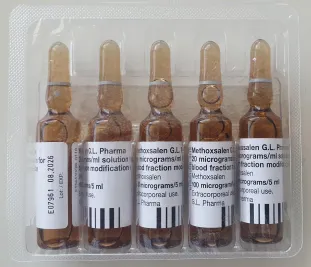
Table of Contents
- Package leaflet: Information for the user
- Introduction
- 1. What Metoxaleno Macopharma is and what it is used for
- 2. What you need to know before using Metoxaleno Macopharma
- 3. How to use Metoxalen Macopharma
- 4. Possible adverse effects
- 5. Storage of Metoxalene Macopharma
- 6. Contents of the pack and other information
Package leaflet: Information for the user
Introduction
Package leaflet: Information for the patient
Metoxaleno Macopharma 20 micrograms/ml solution for modification of blood components
Read the entire leaflet carefully before you start using this medicine because it contains important information for you.
- Keep this leaflet as you may need to read it again.
- If you have any questions, ask your doctor or pharmacist.
- If you experience any side effects, talk to your doctor or pharmacist, even if they are not listed in this leaflet. See section 4.
Leaflet contents:
- What Metoxaleno Macopharma is and what it is used for
- What you need to know before using Metoxaleno Macopharma
- How to use Metoxaleno Macopharma
- Possible side effects
- How to store Metoxaleno Macopharma
- Contents of the pack and other information
1. What Metoxaleno Macopharma is and what it is used for
The active substance in this medicine is methoxsalen, a drug that is activated by ultraviolet radiation.
Methoxsalen binds to white blood cells (leukocytes) outside the body and is activated by ultraviolet light (long-wave ultraviolet light). The leukocytes are then returned to the body. This process is known as photoapheresis. As a result of this process, diseased white blood cells can be destroyed to prevent them from attacking the body from within. This interrupts the immune system's defense mechanism to stop the symptoms of the disease.
This medicine is used to relieve the skin symptoms of advanced cutaneous T-cell lymphoma (a tumor that develops in the skin and is caused by specific white blood cells known as T-lymphocytes) when other treatments have not been effective.
2. What you need to know before using Metoxaleno Macopharma
Do not use Metoxaleno Macopharma
- if you are allergic to methoxsalen, related substances (psoralens), or any of the other components of this medicine (listed in section 6),
- if you have skin cancer (e.g., melanoma or basal cell carcinoma);
- if you suffer from a disease associated with increased sensitivity to light (photosensitivity), such as porphyria, systemic lupus erythematosus, or albinism,
- if you are sexually active and of childbearing age and have not taken any contraceptive measures,
- if you have had your eye lens removed,
- if you are pregnant or breastfeeding.
Photoapheresis procedure must not be performed:
- if your body cannot tolerate the temporary loss of blood caused by the treatment, for example due to heart disease or severe anemia;
- if you have had your spleen removed,
- if you have a blood coagulation disorder,
- if you have a high white blood cell count (more than 25,000/mm³).
Warnings and precautions
Consult your doctor before receiving treatment with this medicine:
- If you regularly take medications to lower blood pressure, you should wait until after the photoapheresis treatment to take them.
- For photoapheresis to be effective, the triglyceride concentration (a specific fat component) in your blood should be as low as possible. Therefore, your doctor will instruct you to fast before each treatment.
- During treatment with this medicine, sexually active men and women of childbearing age must use an appropriate contraceptive method.
- If you have liver problems, your doctor may require monitoring of your liver function values.
Important notes to prevent skin and eye damage
This medicine will make your skin more sensitive to sunlight and artificial light similar to sunlight. Since the amount of medicine used in photoapheresis treatment is very low, this adverse effect is unlikely to occur. However, to minimize the risk of adverse effects, especially on the eyes and skin, you must not expose yourself to sunlight during the first 24 hours after photoapheresis treatment.
During treatment with this medicine and for the following 24 hours, you must wear special wrap-around sunglasses that block UVA rays to protect your eyes from damage.
Inform your doctor if you have liver function problems, as you may need to continue these sun protection precautions for a longer period.
Children and adolescents
This medicine is not intended for use in children and adolescents (under 18 years of age), as there is insufficient experience in this age group.
Other medicines and Metoxaleno Macopharma
Inform your doctor if you are taking, have recently taken, or might need to take any other medicines.
Phenytoin (a medicine used to treat seizures) may cause faster elimination of this medicine from the body and thus reduce the effectiveness of photoapheresis treatment.
The effect of this medicine may be altered by substances that also destroy cells or increase light sensitivity. These include:
- other medicines used to treat skin diseases (e.g., anthralin, coal tar, griseofulvin, retinoids),
- various antibiotics (e.g., tetracyclines, fluoroquinolones) and chemotherapeutic agents (e.g., nalidixic acid, sulfonamides),
- medicines used to treat diabetes (sulfonylureas, particularly tolbutamide),
- diuretics ("water tablets", e.g., thiazides, furosemide),
- medicines with calming and/or sedative effects (phenothiazines),
- certain medicines affecting blood coagulation (oral anticoagulants derived from coumarin, halogenated derivatives of salicylanilide),
- dyes (e.g., methylene blue/toluidine blue, rose bengal, methyl orange),
- medicines containing caffeine.
Use of Metoxaleno Macopharma with beverages and alcohol
You should avoid drinking coffee or tea during treatment with this medicine. The substances they contain (caffeine, theophylline) may prolong the duration of light sensitivity.
You should avoid alcohol during treatment with methoxsalen because the effects of ethanol (alcohol) contained in this medicine may be increased when taken together with other medicines.
Pregnancy and breastfeeding
This medicine must not be used during pregnancy or breastfeeding.
If you are pregnant or breastfeeding, think you may be pregnant, or plan to become pregnant, consult your doctor or pharmacist before using this medicine.
If you are sexually active and of childbearing age, you must use appropriate contraceptive methods during treatment with this medicine, as the active substance, methoxsalen, may harm a child conceived during treatment. In men and women, contraceptive measures should be continued for 3 months and 6 months, respectively, after completion of the last photoapheresis treatment cycle.
Driving and use of machines
Warning: this medicine may affect reaction ability and the ability to drive.
You must not drive or operate machinery immediately after treatment.
Metoxaleno Macopharma contains ethanol and sodium
This medicine contains 10.4% ethanol (alcohol); this small amount corresponds to 10.4 mg/ampoule.
This medicine contains small amounts of ethanol (alcohol), less than 100 mg per millilitre. In extracorporeal therapy, systemic effects on the body are expected to be limited. However, the prescribing doctor will monitor for possible interactions with other medicines. Special caution is required in patients with liver disorders, alcoholism, epilepsy, brain injury, or brain disease.
This medicine contains less than 23 mg (1 mmol) of sodium per millilitre; hence, it is essentially "sodium-free".
3. How to use Metoxalen Macopharma
This medicine is always administered by a specialist doctor who is fully familiar with handling this medicine. Your doctor will decide how many treatment sessions you need.
Method of administration
Extracorporeal use (i.e., outside the patient's body).
The contents of the ampoule are never injected directly into the patient.
A healthcare professional specially trained in photopheresis will use a needle to remove a small amount of blood from one of your veins. This blood is separated into red blood cells, white blood cells, and plasma. The red blood cells and most of the plasma are returned to the bloodstream during the procedure. The white blood cells and the remaining plasma are mixed with an individually calculated dose of this medicine, exposed to ultraviolet (UV) light radiation, and then returned to your body.
During your treatment and for 24 hours afterwards, you must wear special UV-A blocking sunglasses at all times to prevent eye damage, which could lead to cataract formation.
Duration of treatment
During the first 3 months, patients are recommended to be treated on 2 consecutive days every 2 to 4 weeks. Afterwards, the 2-day treatment cycles usually occur once every 3 to 4 weeks.
Once the best therapeutic response has been achieved, the intervals between treatments will gradually be extended, up to 4 or 8 weeks, and thereafter treatment should continue every 8 weeks.
Photopheresis should be performed for at least 6 months.
If you respond well to treatment or if your condition does not worsen, photopheresis should continue for 2 years or longer.
If you do not respond to photopheresis alone, your doctor may recommend adding another medication (e.g., interferon, bexarotene, or both).
This is a general guideline. Your doctor may adjust the treatment cycle according to your individual symptoms and response.
The procedure lasts a total of three to four hours, from the time the doctor inserts the needle until all blood components are returned to you.
Patients with hepatic or renal impairment
If you have liver or kidney problems, your doctor will likely monitor your blood counts regularly. This medicine has not been clinically tested in patients with impaired renal or hepatic function.
After treatment
After receiving treatment, you must avoid direct sunlight for at least 24 hours, as skin damage may occur, such as sunburn, and, over the long term, premature skin aging. If you need to go outdoors, cover your skin, use a high-protection-factor sunscreen, and wear special sunglasses (see above).
If you use more Metoxalen Macopharma than you should
An overdose is unlikely. However, if you have received an overdose, you should remain in a darkened room for 24 hours or longer.
If you have any further questions about the use of this medicine, ask your doctor.
4. Possible adverse effects
Like all medicines, this medicine may cause adverse effects, although not everyone will experience them.
The following adverse effects have been reported:
Frequent (may affect up to 1 in 10 people)
- infections.
- low blood pressure, dizziness.
- nausea, vomiting.
- complications at the venous access site following repeated venous punctures.
Frequency not known (cannot be estimated from available data)
- eye changes due to exposure to light (phototoxic reactions), such as clouding of the lens (cataract formation) and inflammation of the middle layer of the eye (choroid), leading to inflammation of the retina (chorioretinitis);
- skin changes due to exposure to light (phototoxic reactions), such as itching or redness of the skin;
- fever (mild fever may occur between 2 and 12 hours after treatment).
Reporting of adverse effects:
If you experience any type of adverse effect, consult your doctor or pharmacist, even if it is a possible adverse effect not listed in this leaflet. You may also report them directly through the Spanish Pharmacovigilance System for Human Medicines: https://www.notificaRAM.es. By reporting adverse effects, you can help provide more information on the safety of this medicine.
5. Storage of Metoxalene Macopharma
Keep in the original packaging to protect from light. This medicine should be used immediately after opening.
Keep this medicine out of the sight and reach of children.
Do not use this medicine after the expiry date stated on the carton. The expiry date is the last day of the month indicated.
Do not use this medicine if visible particles are present.
Medicines should not be disposed of via wastewater or household waste. Ask your pharmacist how to dispose of medicines and packaging you no longer need. This helps protect the environment.
6. Contents of the pack and other information
Composition of Methoxsalen Macopharma
- The active substance is methoxsalen. One 5 ml ampoule contains 100 micrograms (μg) of methoxsalen. 1 ml of solution contains 20 micrograms of methoxsalen.
- The other components are: sodium chloride, 96% ethanol, water for injections.
Appearance of Methoxsalen Macopharma and contents of the pack
Clear, colourless solution, free from visible particles.
The solution has a pH value of 5.0 to 7.0.
Methoxsalen is supplied in 5 ml amber glass ampoules, packed in PVC blisters/trays, covered or not with a transparent film, and placed in a carton box.
Pack sizes: 50 ampoules
Marketing Authorisation Holder
Maco Pharma
Rue Lorthiois
59420 Mouvaux
France
Manufacturer
G.L. Pharma GmbH
Schlossplatz 1
8502 Lannach
Austria
For further information about this medicinal product, please contact the local representative of the Marketing Authorisation Holder:
Maco España S.L.
Avenida de la Vega, 1
28108 Alcobendas,
Madrid - Spain
This medicinal product is authorised in the EEA Member States under the following names:
Austria: Methoxsalen Macopharma 20 micrograms /mL, Lösung zur Modifikation einer Blutfraktion
Belgium: Methoxsalen Macopharma 20 Mikrogramm/mL Lösung zur Modifikation einer Blutfraktion (German)/Methoxsalen Macopharma 20 microgrammes /mL solution pour la préparation ex vivo de fractions sanguines (French)/Methoxsalen Macopharma 20 micrograms/ml oplossing voor het modificeren van een bloedfractie (Dutch)
Czech Republic: Methoxsalen Maco Pharma
Slovenia: Metoksalen Maco Pharma, 20 mikrogramov/ml raztopina za modificiranje krvnih frakcij
Spain: Metoxaleno Macopharma 20 microgramos/ml solución para modificación de las fracciones sanguíneas
France: METHOXSALEN MACOPHARMA 20 microgrammes/mL, solution pour la modification de la fraction sanguine
Germany, Denmark, Hungary, Italy, Poland, Sweden: Methoxsalen Macopharma
United Kingdom: Methoxsalen Macopharma 20 micrograms/ml solution for blood fraction modification
Date of the most recent revision of this leaflet: September 2021
Detailed information on this medicinal product is available on the website of the Spanish Agency of Medicines and Health Products (AEMPS) http://www.aemps.gob.es/.