Metopirone 250 mg soft capsules
Spain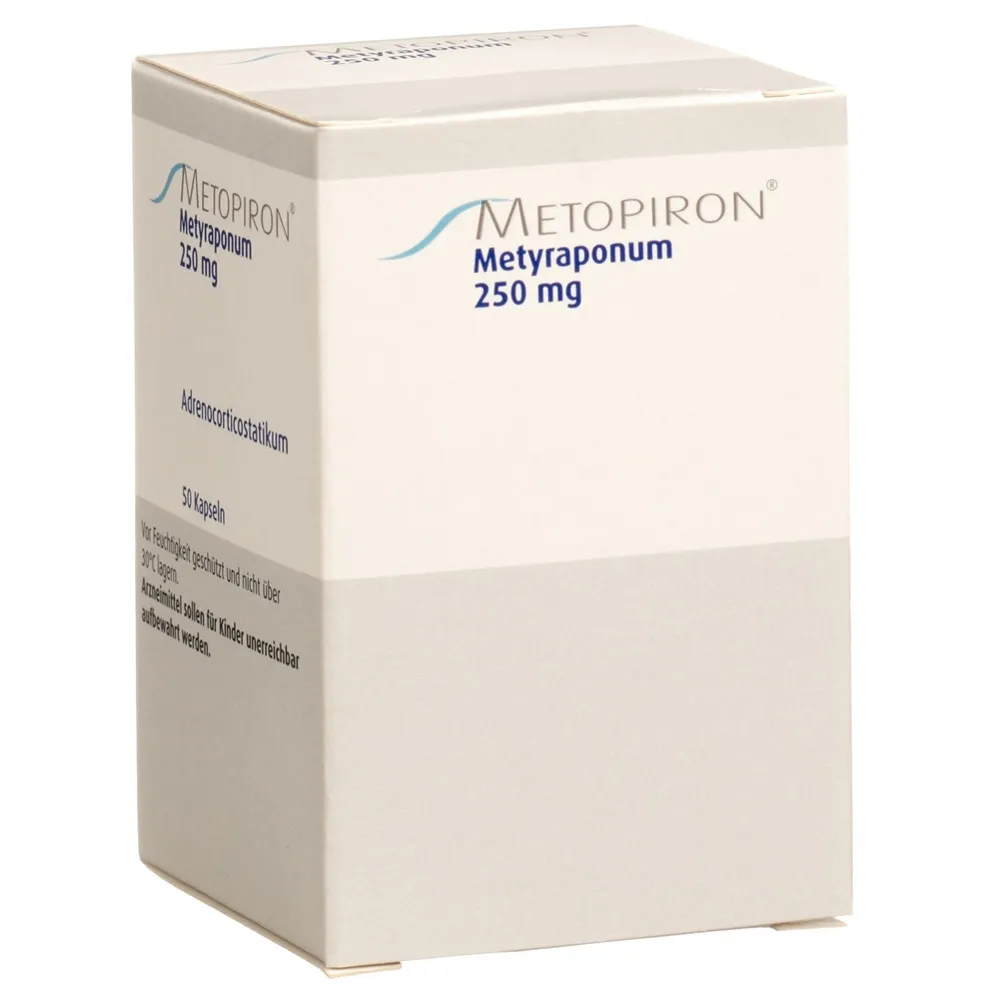
Table of Contents
Patient Information Leaflet
Introduction
Patient Information Leaflet
Metopirone 250 mg soft capsules
metirapone
Read the entire leaflet carefully before you start taking this medicine, as it contains important information for you.
- Keep this leaflet. You may need to read it again.
- If you have any questions, ask your doctor or nurse.
- This medicine has been prescribed for you only, and you must not give it to other people, even if they have the same symptoms as you, because it may harm them.
- If you experience any adverse reactions, consult your doctor or nurse, even if they are adverse reactions not listed in this leaflet. See section 4.
Leaflet Contents
- What Metopirone is and what it is used for.
- What you need to know before taking Metopirone.
- How to take Metopirone.
- Possible side effects.
- How to store Metopirone.
- Contents of the pack and other information.
1. What Metopirone is and what it is used for
Metopirone contains 250 mg of metyrapone. Metyrapone belongs to a group of medicines used as tests to assess pituitary function. Metyrapone is used as a diagnostic test to determine whether you have insufficient levels of ACTH, a hormone secreted by the pituitary gland that regulates cortisol secretion, or to help diagnose a specific type of Cushing's syndrome.
The medicine may also be used to treat the signs and symptoms of endogenous Cushing's syndrome by reducing elevated levels of cortisol (a hormone produced by the adrenal glands). Cushing's syndrome is a set of symptoms caused by high levels of cortisol produced in the body by the adrenal glands.
2. What you need to know before taking Metopirone
Do not take Metopirone as a diagnostic test for ACTH deficiency:
- if you have a condition in which the adrenal glands do not produce sufficient steroid hormones, cortisol or aldosterone, known as Addison's disease.
Do not take Metopirone:
- if you are allergic to metyrapone or to any of the other ingredients of this medicine (listed in section 6).
Warnings and precautions
Talk to your doctor before taking Metopirone for a diagnostic test
- if you have, or think you may have, a condition in which your hormone levels are low (for example, reduced cortisol production by the adrenal glands or severe hypopituitarism). Your doctor will need to perform a test to confirm whether Metopirone is suitable for you,
- if you have liver disease or liver damage, as this may cause the medicine to act more slowly,
- if you are taking medications such as glucocorticoids; your doctor may decide that you should not undergo the Metopirone test, as you would need to stop taking them.
During treatment with Metopirone
Metopirone may temporarily reduce the amount of hormones produced by the adrenal glands (cortisol), but your doctor will correct this with appropriate hormone therapy.
If you have Cushing's syndrome, your doctor may also prescribe medications to prevent the development of infections. However, if you experience shortness of breath and fever for hours or days, contact your doctor immediately, as you may be developing a serious lung infection.
Tests before and during treatment with Metopirone
Your doctor will perform a blood test before starting treatment and regularly during treatment. This is to detect any possible abnormalities in your potassium levels and also to measure your cortisol levels. Depending on the results, your doctor may adjust the dose and/or prescribe corrective treatment.
Depending on your cardiac risk factors, your doctor may decide to perform an ECG before starting or during treatment with Metopirone.
Contact your doctor if you experience any of the following symptoms: weakness, fatigue, dizziness, loss of appetite, nausea, vomiting, diarrhoea or abdominal pain. These symptoms, as well as low blood pressure, elevated potassium levels, low sodium levels or low blood glucose levels, may be signs of hypocortisolism (insufficient cortisol levels in the blood).
Therefore, your doctor will monitor your blood pressure and perform blood tests. If hypocortisolism is diagnosed, your doctor may decide to administer temporary steroid replacement therapy (glucocorticoids), and/or reduce the dose or discontinue Metopirone treatment.
If you take Metopirone for a prolonged period
Your blood pressure may increase while taking this medicine.
Other medicines and Metopirone
Tell your doctor or pharmacist if you are taking, have recently taken or might need to take any other medicines, as they could affect the results of the test with this medicine. The following medicines may affect the results of the Metopirone test:
- Anticonvulsants used to control epilepsy (e.g. phenytoin, barbiturates).
- Antidepressants and neuroleptics used to treat anxiety, depression or psychiatric disorders (e.g. amitriptyline, chlorpromazine, alprazolam).
- Hormones affecting the hypothalamic-pituitary axis, which regulates many bodily processes such as stress, emotions, energy levels, digestion and the immune system (e.g. cortisol, hydrocortisone, ACTH, tetracosactin).
- Corticosteroids.
- Antithyroid medications used to treat thyroid gland disorders (e.g. thyroxine, liothyronine, carbimazole).
- Cyproheptadine, used to treat allergies (e.g. Periactin).
You must not take Metopirone together with paracetamol without consulting your doctor.
Pregnancy, breastfeeding and fertility
Use during pregnancy
Metopirone is not recommended for women of childbearing age who are not using contraceptive methods.
If you are pregnant, think you may be pregnant, or plan to become pregnant, consult your doctor as soon as possible to determine whether you should stop or continue taking Metopirone.
If you take this medicine during pregnancy, your doctor will need to monitor your baby's cortisol levels during the first week of life, if necessary.
Use during breastfeeding
Breastfeeding must be discontinued during treatment with Metopirone, as there is a possibility that metyrapone may pass into breast milk and affect the infant.
Driving and use of machines
If you feel dizzy or lightheaded after taking this medicine, you should not drive or operate machinery until these effects have subsided.
Metopirone contains sodium parahydroxybenzoate (E215) and sodium propylparahydroxybenzoate (E217), which may cause allergic reactions (possibly delayed).
Metopirone contains sodium
This medicine contains less than 1 mmol of sodium (23 mg) per capsule, i.e. essentially "sodium-free".
Monitoring and supervision
When used as a diagnostic test, this medicine should only be administered in the presence of a healthcare professional, as they will need to monitor your body's response to the medicine.
3. How to take Metopirone
Follow exactly the instructions given by your doctor for taking this medicine. If in doubt, consult your doctor or pharmacist again. If you are to be given Metopirone for the diagnosis of Cushing's syndrome, you will need to go to the hospital to have some tests performed.
Use in adults
If you are to undergo a short test with a single dose (to assess pituitary function):
You will be asked to swallow the capsule(s) with yoghurt or milk around midnight. A blood sample will then be taken in the morning, which will be reviewed by your doctor. The recommended dose is 30 mg/kg. The same dose is used in children.
If you are to undergo a multiple-dose test (to assess pituitary function and to help diagnose a specific type of Cushing's syndrome):
Your doctor will begin collecting 24-hour urine samples 24 hours before administering this medicine. You will then be given 2–3 capsules (500–750 mg) every 4 hours, over the following 24 hours. You must take the capsules with milk or after a meal. Your doctor will collect further urine samples during the subsequent 24 hours.
If you are receiving treatment for the signs and symptoms of endogenous Cushing's syndrome:
Your dose will be individualized and may range from 1 capsule (250 mg) to 24 capsules (6 g) per day, given in three or four divided doses. Your doctor may periodically adjust the dose of Metopirone in order to restore normal cortisol levels.
You must always follow your doctor's instructions exactly and must never change the dose unless your doctor instructs you to do so.
Use in children
For the multiple-dose test, children should be given 15 mg/kg, with a minimum dose of 250 mg every 4 hours.
For the management of Cushing's syndrome, the dose should be individually adjusted based on cortisol levels and tolerability.
If you take more Metopirone than you should
If you take too many capsules, inform your doctor or nurse immediately or go to the emergency department. You may experience nausea and stomach pain and/or diarrhoea. You may also feel dizzy, tired, have a headache, start sweating, and develop high blood pressure. Administration of activated charcoal and hydrocortisone may be necessary.
If you forget to take Metopirone
If you accidentally miss a dose of capsules, take it as soon as you remember. If it is almost time for your next dose, do not take a double dose to make up for the missed dose; instead, continue taking the capsules as usual.
If you have any further questions about the use of this medicine, ask your doctor or pharmacist.
4. Possible adverse effects
Like all medicines, this medicine can cause adverse effects, although not everyone will experience them.
Some adverse effects may be serious:
- Immediately inform your doctor if you have two or more of these symptoms: weakness, dizziness, fatigue, loss of appetite, nausea, vomiting, abdominal pain, diarrhoea. These may indicate adrenal insufficiency (low cortisol levels). Adrenal insufficiency occurs when metyrapone reduces cortisol levels too much. It is more likely to occur during periods of dose escalation of metyrapone or increased stress. Your doctor will treat this by using a hormone medicine to compensate for the lack of cortisol and/or adjusting the dose of metyrapone.
- Immediately inform your doctor if you experience bleeding or bruising lasting longer than normal, if you notice blood in your gums, nose or skin, or if you feel tired most of the time. This may indicate a decrease in the number of red blood cells and/or white blood cells and/or platelets.
See also Section 2 “During treatment with Metopirone”.
Adverse effects by frequency:
Very common adverse effects (may affect more than 1 in 10 people):
- Adrenal insufficiency (low cortisol levels)
- Loss of appetite
- Headache
- Dizziness (lightheadedness)
- High blood pressure (hypertension)
- Nausea (feeling sick)
- Abdominal pain (stomach pain)
- Diarrhoea
- Allergic skin reactions (urticaria, rash (reddening of the skin), itching)
- Joint pain
- Swelling of limbs, hands or feet
- Asthenic disorders (tiredness, fatigue)
Common adverse effects (may affect up to 1 in 10 people):
- Low potassium levels (hypokalaemia)
- Feeling tired or drowsy
- Low blood pressure (hypotension)
- Vomiting
- Acne
- Excessive growth of hair in unusual areas (hirsutism)
- Muscle pain
Frequency not known (cannot be estimated from available data):
- Abnormal liver function (elevated liver enzymes)
- Leucopenia, anaemia, thrombocytopenia (decrease in the number of red blood cells, white blood cells or platelets in the blood)
- Alopecia (hair loss)
- Pulmonary infection
Reporting of adverse effects
If you experience any type of adverse effect, talk to your doctor or pharmacist, even if it is a possible adverse effect not listed in this leaflet. You can also report them directly via the Spanish Pharmacovigilance System for Human Medicines: https://www.notificaram.es. By reporting adverse effects, you can help provide more information on the safety of this medicine.
5. Storage of Metopirone
Keep this medicine out of the sight and reach of children.
Do not use this medicine after the expiry date stated on the bottle and carton after the letters EXP. The expiry date refers to the last day of the month indicated. Use within two months of first opening.
Keep the bottle tightly closed to protect it from moisture.
Store below 25°C.
Medicines must not be disposed of via wastewater or household waste. Dispose of unused medicines and their containers at a SIGRE collection point at your pharmacy. If you are unsure, ask your pharmacist how to dispose of medicines and containers you no longer need. This will help protect the environment.
6. Contents of the pack and other information
Composition of Metopirone
- The active substance is metyrapone. Each capsule contains 250 mg of metyrapone.
- The other components are: ethyl vanillin, gelatin, glycerol, macrogol 400, macrogol 4000, p-methoxyacetophenone, sodium ethyl parahydroxybenzoate (E215), sodium propyl parahydroxybenzoate (E217), titanium dioxide (E171), and purified water. The printing ink (red) on the capsules contains carminic acid (E120), aluminum chloride hexahydrate, sodium hydroxide, hypromellose, and propylene glycol.
Appearance of the product and contents of the container
Soft, oblong, opaque gelatin capsule, white to yellowish-white in colour, printed with "M01" in red ink, containing a slightly yellowish, viscous to gelatinous content. Capsule size: 18.5 mm in length, 7.5 mm in diameter.
Each plastic bottle contains 50 capsules.
Marketing Authorization Holder Esteve Pharmaceuticals S.A. Passeig de La Zona Franca 109 Planta 4 08038 Barcelona Spain +34 93 446 60 00 | Manufacturer Responsible DELPHARM LILLE SAS - LYS LEZ LANNOY Parc d'activités Roubaix-Est 22 Rue de Toufflers CS 50070 , 59452 LYS LEZ LANNOY, France |
This medicinal product is authorised in the European Economic Area member states under the following names:
Metopirone: Ireland, Croatia, Czech Republic, Latvia, Denmark, Finland, Netherlands, Portugal, Poland, Spain, Sweden
Metycor: Slovenia, Austria, Norway
Metyrapone Esteve: France
Metopiron: Germany
Cormeto: Italy, Estonia, Hungary
Date of the most recent review of this leaflet: 01/2026 Detailed and up-to-date information on this medicinal product is available on the website of the Spanish Agency for Medicines and Health Products (AEMPS) http://www.aemps.gob.es/ .