Metalyse 5,000 units (25 mg) powder for solution for injection
Spain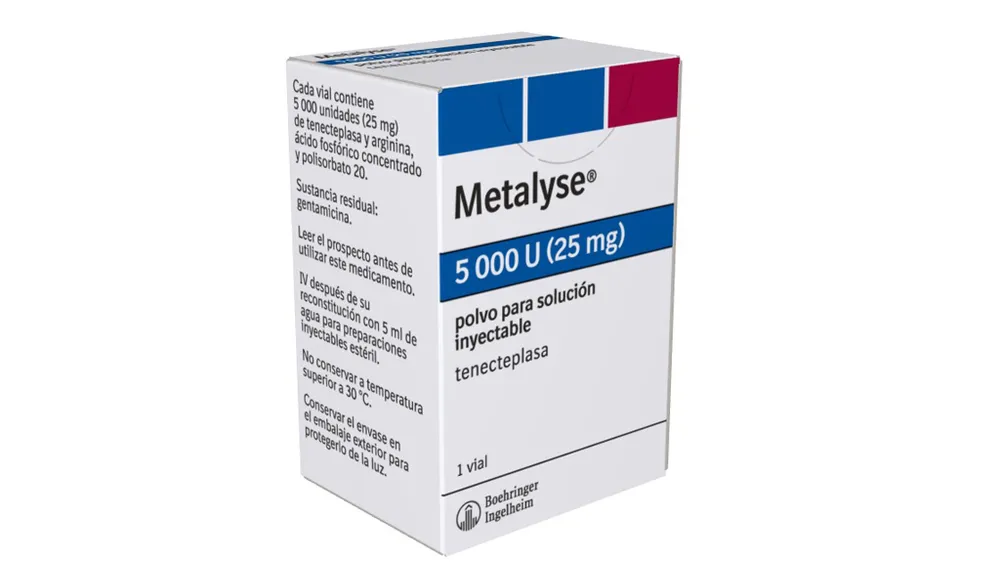
Table of Contents
Package leaflet: Information for the user
Introduction
Package leaflet: information for the user
Metalyse 5000 units (25 mg) powder for solution for injection
tenecteplase
Read the entire leaflet carefully before you are given this medicine, because it contains important information for you.
- Keep this leaflet, as you may need to read it again.
- If you have any questions, ask your doctor or pharmacist.
- If you experience any adverse effects, consult your doctor or pharmacist, even if they are effects not listed in this leaflet. See section 4.
Contents of the leaflet
- What Metalyse is and what it is used for
- What you need to know before being given Metalyse
- How Metalyse is administered
- Possible side effects
- How to store Metalyse
- Contents of the pack and other information
1. What Metalyse is and what it is used for
Metalyse consists of powder for injectable solution.
Metalyse belongs to a group of medicines called thrombolytics. These medicines help dissolve blood clots. Tenecteplase is a recombinant, fibrin-specific plasminogen activator.
Metalyse is used in adults for the treatment of stroke caused by a blood clot in a brain artery (acute ischaemic stroke) when less than 4.5 hours have passed since the last time you were free of symptoms of the current stroke.
2. What you need to know before Metalyse is administered to you
Metalyse will not be prescribed or administered by your doctor
-
if you have previously had a sudden, life-threatening allergic reaction (severe hypersensitivity) to tenecteplase, to any of the other components of this medicine (listed in section 6), or to gentamicin (a residual substance from the manufacturing process). If treatment with Metalyse is nevertheless considered necessary, resuscitation equipment must be immediately available for use if required;
-
if you currently have or have recently had a disease that increases your risk of bleeding (haemorrhage), including:
-
a bleeding disorder or tendency to bleed;
-
uncontrolled, very high blood pressure;
-
a head injury;
-
inflammation of the membrane surrounding the heart (pericarditis); inflammation or infection of the heart valves (endocarditis);
-
severe liver disease;
-
oesophageal varices (enlarged veins in the oesophagus);
-
gastric or intestinal ulcers;
-
blood vessel abnormalities (e.g., an aneurysm);
-
certain tumours;
-
bleeding in the brain or skull;
-
if you are taking tablets/capsules to "thin" the blood (anticoagulants), unless an appropriate test has confirmed that there is no clinically significant activity of that medication;
-
if you have a very severe stroke;
-
if your stroke causes only mild symptoms;
-
if your symptoms improve rapidly before receiving Metalyse;
-
if your prothrombin time (a blood test to assess how your blood clots) is abnormal. This test may be abnormal if you have received heparin (a medicine used to "thin" the blood) within the previous 48 hours;
-
if you have diabetes and have previously had a stroke;
-
if you have had a stroke within the previous three months;
-
if your platelet count (thrombocytes) in the blood is very low;
-
if you have very high blood pressure (above 185/110) that can only be reduced by injection of medication;
-
if your blood sugar (glucose) level is very low (below 50 mg/dL) or very high (above 400 mg/dL);
-
if you have recently undergone major surgery, including brain or spinal surgery;
-
if you have recently undergone a biopsy (a procedure to obtain a tissue sample);
-
if you have inflamed pancreas (pancreatitis).
Warnings and precautions
Your doctor will exercise special caution with Metalyse
- if you have had any allergic reaction other than sudden, life-threatening allergic reactions (severe hypersensitivity) to tenecteplase, to any of the other components of this medicine (listed in section 6), or to gentamicin (a residual substance from the manufacturing process);
- if you currently have or have recently had any other condition that increases the risk of bleeding, for example:
- an intramuscular injection;
- a minor injury such as a puncture of large blood vessels;
- if you are over 80 years of age, you may have a worse outcome regardless of treatment with Metalyse.
However, in general, the benefit-risk ratio of Metalyse in patients over 80 years of age is positive, and age alone is not a barrier to treatment with Metalyse;
- if you have received cardiopulmonary resuscitation (chest compressions) for more than 2 minutes;
- if you have ever had a stroke caused by a blood clot in a brain artery (ischaemic stroke);
- if you have a heart valve abnormality (e.g., mitral stenosis) with an abnormal heart rhythm (e.g., atrial fibrillation);
- if you have high blood pressure;
- if you experienced seizures (convulsions) at the onset of the stroke;
- if you have diabetes;
- if signs of acute ischaemic stroke persist after low blood sugar levels have been corrected, your doctor may still consider thrombolytic treatment;
- if you have previously been administered Metalyse.
Children and adolescents
The use of Metalyse is not recommended in children and adolescents under 18 years of age.
Other medicines and Metalyse
Inform your doctor or pharmacist if you are taking, have recently taken, or might need to take any other medicine. It is especially important that you inform your doctor if you are taking or have recently taken:
- any medicine used to "thin" the blood;
- certain medicines used to treat high blood pressure (ACE inhibitors).
Pregnancy and breastfeeding
If you are pregnant or breastfeeding, think you may be pregnant, or are planning to become pregnant, consult your doctor before this medicine is administered to you.
Metalyse contains polysorbate 20
This medicine contains 2.0 mg of polysorbate 20 in each 25 mg vial. Polysorbates may cause allergic reactions. Inform your doctor if you have any known allergy.
3. How Metalyse is administered
The doctor calculates your dose of Metalyse according to your body weight, following the scheme below:
Body weight (kg) | Less than 60 | 60 to 70 | 70 to 80 | 80 to 90 | Greater than 90 |
Metalyse (U) | 3 000 | 3 500 | 4 000 | 4 500 | 5 000 |
Metalyse is administered as a single intravenous injection by a physician experienced in the use of this type of medication.
Your physician will administer Metalyse to you as soon as possible after the onset of the stroke, as a single dose.
4. Possible adverse effects
Like all medicines, this medicine can cause adverse effects, although not everyone experiences them.
The following adverse effects have been reported in patients who have received Metalyse:
Very common (may affect more than 1 in 10 people):
- bleeding
- bleeding in the brain (cerebral haemorrhage). Following cerebral haemorrhage or other serious bleeding events, death or permanent disability may occur.
Common (may affect up to 1 in 10 people):
- bleeding at the injection or puncture site
- nosebleeds
- genitourinary bleeding (you may notice blood in your urine)
- bruising
- gastrointestinal bleeding (e.g., stomach or intestinal bleeding)
Uncommon (may affect up to 1 in 100 people):
- internal bleeding in the abdomen (retroperitoneal haemorrhage)
- eye bleeding (ocular haemorrhage)
Rare (may affect up to 1 in 1,000 people):
- low blood pressure (hypotension)
- bleeding in the lungs (pulmonary haemorrhage)
- hypersensitivity (anaphylactoid reactions), e.g., rash, urticaria, breathing difficulty (bronchospasm)
- bleeding around the heart (haemopericardium)
- blood clots in the lung (pulmonary embolism) and in blood vessels of other organ systems (thrombotic embolism)
Frequency not known (cannot be estimated from available data):
- fat embolism (clots formed by fat)
- nausea
- vomiting
- increase in body temperature (fever)
- blood transfusions as a consequence of bleeding
In cases of cerebral haemorrhage, neurological effects have been reported, e.g., somnolence, speech disorders, paralysis of parts of the body (hemiparesis), and seizures.
Reporting of adverse effects
If you experience any adverse effect, consult your doctor or nurse, even if it is a possible adverse effect not listed in this leaflet. You may also report them directly through the national reporting system detailed in Appendix V. By reporting adverse effects, you can help provide more information on the safety of this medicine.
5. Storage of Metalyse
Keep this medicine out of the sight and reach of children.
Do not use this medicine after the expiry date stated on the label and the carton after EXP.
Do not store above 30 °C.
Keep the container in the outer packaging to protect it from light.
After reconstitution, Metalyse may be stored for 24 hours at 2–8 °C and for 8 hours at 30 °C. However, for microbiological reasons, the reconstituted injectable solution is usually used immediately by your doctor.
Medicines must not be disposed of via wastewater or household waste. Ask your pharmacist how to dispose of medicines and containers you no longer need. This will help protect the environment.
6. Contents of the pack and other information
Composition of Metalyse
-
The active substance is tenecteplase.
-
Each vial contains 5,000 units (25 mg) of tenecteplase. Each ml contains 1,000 units of tenecteplase when reconstituted with 5 ml of water for injections.
-
The other components are arginine, concentrated phosphoric acid (E 338), and polysorbate 20 (E 432).
-
Contains gentamicin as a residual substance from the manufacturing process.
Appearance of the product and contents of the pack
The pack contains one vial with a 25 mg lyophilized powder of tenecteplase.
Marketing Authorization Holder and Manufacturer
Marketing Authorization Holder
Boehringer Ingelheim International GmbH
Binger Strasse 173
55216 Ingelheim am Rhein
Germany
Manufacturer
Boehringer Ingelheim Pharma GmbH & Co. KG
Birkendorfer Strasse 65
88397 Biberach/Riss
Germany
Boehringer Ingelheim France
100‑104 avenue de France
75013 Paris
France
Further information on this medicinal product is available upon request by contacting the local representative of the Marketing Authorization Holder:
Belgium/Belgium/Belgium Boehringer Ingelheim SComm Tel/Tel: +32 2 773 33 11 | Lithuania Boehringer Ingelheim RCV GmbH & Co KG Lithuanian branch Tel: +370 5 2595942 |
| Luxembourg/Luxembourg Boehringer Ingelheim SComm Tel/Tel: +32 2 773 33 11 |
Czech Republic Boehringer Ingelheim spol. s r.o. Tel: +420 234 655 111 | Hungary Boehringer Ingelheim RCV GmbH & Co KG Hungarian Branch Office Tel: +36 1 299 89 00 |
Denmark Boehringer Ingelheim Danmark A/S Tlf.: +45 39 15 88 88 | Malta Boehringer Ingelheim Ireland Ltd. Tel: +353 1 295 9620 |
Germany Boehringer Ingelheim Pharma GmbH & Co. KG Tel: +49 (0) 800 77 90 900 | Netherlands Boehringer Ingelheim B.V. Tel: +31 (0) 800 22 55 889 |
Estonia Boehringer Ingelheim RCV GmbH & Co KG Estonian branch Tel: +372 612 8000 | Norway Boehringer Ingelheim Danmark Norwegian branch Tlf: +47 66 76 13 00 |
Greece Boehringer Ingelheim Hellas Monoprosopi A.E. Tel: +30 2 10 89 06 300 | Austria Boehringer Ingelheim RCV GmbH & Co KG Tel: +43 1 80 105‑7870 |
Spain Boehringer Ingelheim España, S.A. Tel: +34 93 404 51 00 | Poland Boehringer Ingelheim Sp. z o.o. Tel: +48 22 699 0 699 |
France Boehringer Ingelheim France S.A.S. Tél: +33 3 26 50 45 33 | Portugal Boehringer Ingelheim Portugal, Lda. Tel: +351 21 313 53 00 |
Croatia Boehringer Ingelheim Zagreb d.o.o. Tel: +385 1 2444 600 | Romania Boehringer Ingelheim RCV GmbH & Co KG Vienna – Bucharest Branch Tel: +40 21 302 28 00 |
Ireland Boehringer Ingelheim Ireland Ltd. Tel: +353 1 295 9620 | Slovenia Boehringer Ingelheim RCV GmbH & Co KG Ljubljana Branch Tel: +386 1 586 40 00 |
Iceland Vistor ehf. Tel: +354 535 7000 | Slovakia Boehringer Ingelheim RCV GmbH & Co KG Organizational Unit Tel: +421 2 5810 1211 |
Italy Boehringer Ingelheim Italia S.p.A. Tel: +39 02 5355 1 | Finland Boehringer Ingelheim Finland Ky Tel/Puh: +358 10 3102 800 |
Cyprus Boehringer Ingelheim Hellas Monoprosopi A.E. Tel: +30 2 10 89 06 300 | Sweden Boehringer Ingelheim AB Tel: +46 8 721 21 00 |
Latvia Boehringer Ingelheim RCV GmbH & Co KG Latvian branch Tel: +371 67 240 011 |
Date of the most recent review of this leaflet: {MM/YYYY}
Other sources of information
Detailed information on this medicinal product is available on the website of the European Medicines Agency: https://www.ema.europa.eu.
This leaflet can be found on the European Medicines Agency website in all languages of the European Union/European Economic Area.