Mestinon 60 mg tablets
Spain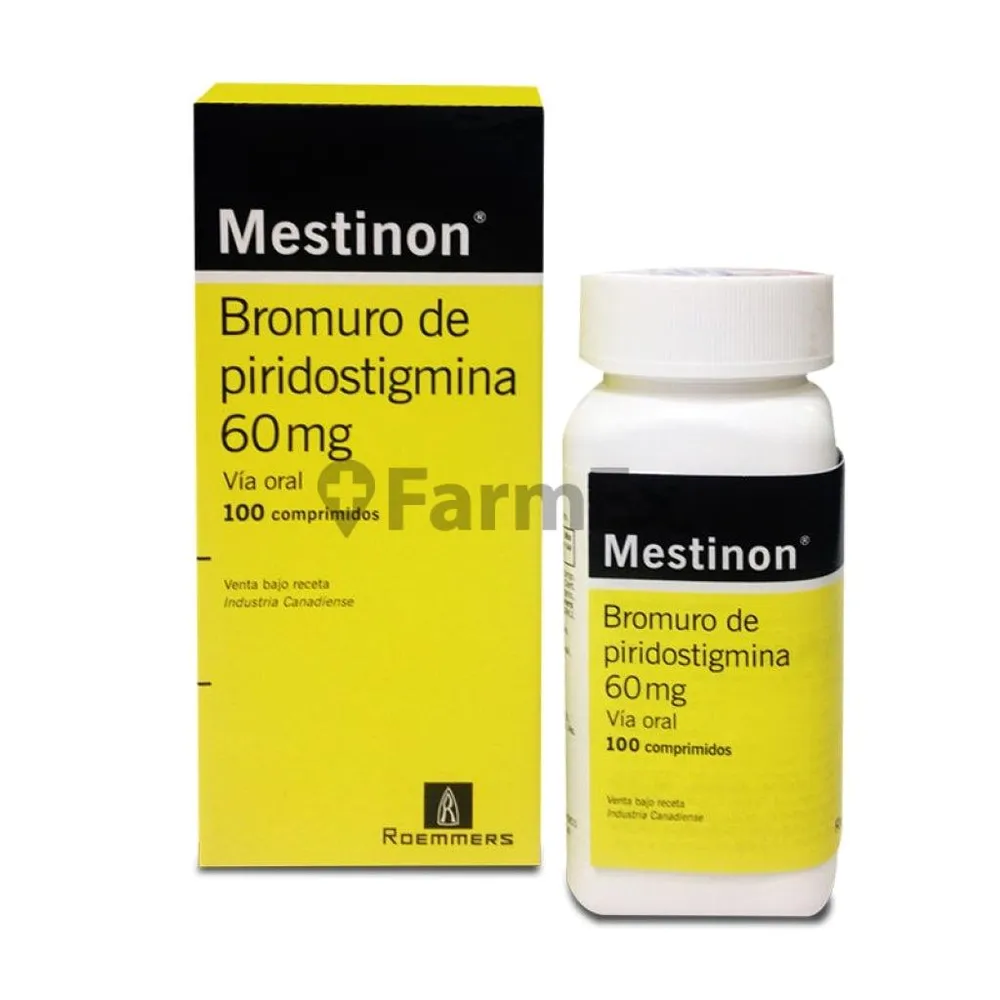
Table of Contents
Package leaflet: Information for the user
Introduction
Package leaflet: information for the user
Mestinon 60 mg tablets
Pyridostigmine bromide
Read all of this leaflet carefully before you start taking this medicine because it contains important information for you.
- Keep this leaflet. You may need to read it again.
If you have any questions, ask your doctor or pharmacist.
- This medicine has been prescribed for you only and must not be given to other people, even if they have the same symptoms as you, because it could harm them.
- If you experience any side effects, talk to your doctor or pharmacist, even if the side effects are not listed in this leaflet. See section 4.
Contents of the leaflet:
- What Mestinon is and what it is used for
- What you need to know before taking Mestinon
- How to take Mestinon
- Possible side effects
- How to store Mestinon
- Contents of the pack and other information
1. What Mestinon is and what it is used for
Mestinon belongs to a group of medicines known as cholinesterase inhibitors. It helps nerve impulses to be transmitted from the nerves to the muscles. In this way, the muscle can function properly.
Mestinon is used for the treatment of:
Adults and children:
- Myasthenia gravis (an autoimmune disease causing muscle weakness).
Adults:
- Paralytic ileus (intestinal obstruction caused by paralysis of the intestinal wall).
2. What you need to know before taking Mestinon
Do not take Mestinon
- if you are allergic to the active substance or to any of the other components of this medicine (listed in section 6).
- if you have constipation or are unable to urinate, unless otherwise directed by your doctor.
Warnings and precautions
Talk to your doctor before starting to take Mestinon:
- if you have asthma or chronic obstructive pulmonary disease (COPD).
- if you have any cardiovascular disease such as bradycardia, atrioventricular block, or coronary occlusion.
- if you have low blood pressure.
- if you have vagotonia (a condition in which vagus nerve activity causes symptoms such as slow heartbeat, low blood pressure, constipation, sweating, and painful muscle spasms).
- if you have a stomach ulcer.
- if you have epilepsy or Parkinson's disease.
- if you have hyperthyroidism (increased function of the thyroid gland).
- if you have kidney problems.
- if you have undergone surgery to remove your thymus gland. In this case, your doctor may need to reduce the dose of Mestinon.
Taking Mestinon with other medicines
Tell your doctor or pharmacist if you are taking, have recently taken, or might need to take any other medicines.
It is especially important that you inform your doctor if you are taking any of the following medicines, as taking them together with Mestinon may cause one or both medicines to be less effective:
- Immunosuppressants (medicines used to suppress the immune system)
- Corticosteroid medicines
- Medicines containing methylcellulose as a component
- Antimuscarinics (medicines used for airway disorders, such as atropine and hyoscine)
- Muscle relaxants, such as pancuronium or vecuronium. Pyridostigmine may prolong the effect of depolarizing muscle relaxants (e.g., suxamethonium).
- Aminoglycoside antibiotics
- Local anesthetics and certain general anesthetics
- Antiarrhythmics (medicines used for heart rhythm disorders)
Pregnancy, breastfeeding, and fertility
If you are pregnant or breastfeeding, think you may be pregnant, or are planning to become pregnant, consult your doctor or pharmacist before using this medicine.
Pregnancy:
The safety of pyridostigmine in pregnant women has not been established. If you are pregnant, your doctor will prescribe this medicine only if they consider that the benefits of treatment outweigh the potential risks to you and your baby.
Breastfeeding:
Studies indicate that only small amounts pass into breast milk. While taking this medicine during breastfeeding, your doctor will monitor for possible effects on the infant.
Fertility:
The safety of pyridostigmine regarding human fertility has not been established. Studies in rats have not suggested any negative effect on reproduction.
Driving and using machines
Mestinon may impair visual acuity and, consequently, reaction ability, as well as the ability to drive and operate machinery.
This medicine contains lactose. If your doctor has informed you that you have an intolerance to certain sugars, consult with them before taking this medicine.
3. How to take Mestinon
Follow exactly the instructions given by your doctor for the administration of this medicine. If in doubt, consult your doctor again.
This medicine should be taken so that it works when you need it most, for example, upon waking and at mealtimes. The tablets take about 30 minutes to start working after they have been taken; therefore, you should try to take the first dose of the day when you get up, and other doses 30 minutes before meals.
Swallow the tablets with a glass of water. If you have difficulty swallowing, you may break the tablets into smaller pieces.
The tablet may be divided into equal doses.
The recommended dose will depend on your condition:
Myasthenia gravis
Adults
The usual dose is half to 3 tablets (30–180 mg) per dose, administered 2–4 times daily. The total daily dose is normally 2 to 20 tablets (120–1200 mg). However, your doctor may consider an even higher dose if you have myasthenia gravis. The effect of each dose may last 3 to 4 hours during the day, and 6 hours at night, since physical activity is reduced.
Use in children and adolescents
Children under 6 years: the initial dose is half a tablet (30 mg) of Mestinon.
Children aged 6 to 12 years: the initial dose is 1 tablet (60 mg) of Mestinon.
Your doctor will gradually increase the dose, assessing your response in increments of 15–30 mg per day. The total daily dose is normally half to 6 tablets (30–360 mg).
Paralytic ileus
Adults
The usual dose is 1 to 4 tablets (60 mg to 240 mg) per day.
The frequency of these doses may vary depending on the patient's needs.
Patients with renal disease
If you have any kidney disease, your doctor will prescribe the appropriate dose.
If you take more Mestinon than you should
It is important to take only the dose your doctor has indicated.
In case of overdose or accidental ingestion, contact your doctor or pharmacist immediately or call the Toxicology Information Service at telephone number 91 562 04 20, indicating the medicine and the amount ingested.
In cases of intoxication, symptoms may include abdominal cramps, increased intestinal movement, diarrhea, nausea and vomiting, increased bronchial and salivary secretions, bronchospasm, increased sweating, and pupillary constriction (miosis).
Muscle cramps, fasciculations (mild muscle contractions), and generalized weakness up to paralysis may also occur; cardiac rhythm disturbances that could lead to cardiac arrest; a drop in blood pressure that could result in cardiovascular collapse; and respiratory and cerebral oxygen deficiency.
Agitation, confusion, difficulty speaking, nervousness, irritability, hallucinations, seizures, and coma may also appear.
In such cases, it is important to stop treatment with Mestinon immediately and go to the nearest hospital.
If you forget to take Mestinon
Do not take a double dose to make up for forgotten doses.
If you forget to take a dose, take it as soon as you remember. If it is almost time for your next dose, do not take the missed dose and continue with your regular dosing schedule. If you have missed several doses, consult your doctor.
If you stop taking Mestinon
It is important that you continue taking this medicine until your doctor tells you otherwise.
If you have any further questions about the use of this medicine, ask your doctor or pharmacist.
4. Possible adverse effects
Like all medicines, this medicine may cause adverse effects, although not everyone experiences them.
The following adverse effects have been observed with the use of Mestinon. If any of these symptoms occur, you should inform your doctor immediately, as they may indicate a crisis.
Rare adverse effects (may affect up to 1 in 1,000 patients):
- Skin rash (usually disappears shortly after stopping the medication).
Adverse effects of unknown frequency (cannot be estimated from the available data):
- Hypersensitivity to the medicine.
- Syncope.
- Slow or rapid heartbeat, loss of consciousness or low blood pressure, chest pain (Prinzmetal's angina).
- Contraction of the pupil, increased tearing, visual disturbances such as blurred vision.
- Increased bronchial secretion along with contraction of the muscle surrounding the bronchi.
- Diarrhoea, nausea, vomiting, increased intestinal motility, increased salivation, abdominal pain or discomfort, cramps.
- Increased muscle weakness, fasciculations (mild muscle contractions), tremors and muscle cramps or decreased muscle tone (flaccidity).
- Urinary incontinence.
- Increased sweating, itching.
- Flushing.
Reporting of adverse effects:
If you experience any type of adverse effect, consult your doctor or pharmacist, even if it is a possible adverse effect not listed in this leaflet. You may also report them directly via the Spanish Pharmacovigilance System for Human Medicines: https://www.notificaram.es. By reporting adverse effects, you can help provide more information on the safety of this medicine.
5. Storage of Mestinon
Keep this medicine out of the sight and reach of children.
No special storage conditions are required.
Do not use this medicine after the expiry date stated on the packaging after EXP. The expiry date is the last day of the month indicated.
Medicines must not be disposed of via wastewater or household waste. Dispose of empty containers and unused medicines at the SIGRE collection point at your pharmacy. If you have any doubts, ask your pharmacist how to dispose of containers and medicines you no longer need. This will help protect the environment.
6. Contents of the pack and other information
Composition of Mestinon
- The active substance is pyridostigmine bromide.
- The other components are monohydrate lactose, silicic acid, maize starch, talc, magnesium stearate and potato starch.
Nature of the product and pack contents
Brown glass bottle with white cap, containing 100 tablets.
Marketing Authorization Holder
Viatis Healthcare Limited
Damastown Industrial Park
Mulhuddart, Dublin 15
Dublin
Manufacturer
Labiana Pharmaceuticals, S.A.
C/ Casanova, 27-31; 08757 - Corbera de Llobregat (Barcelona) Spain
Further information on this medicinal product can be obtained by contacting the local representative of the Marketing Authorization Holder:
Viatris Pharmaceuticals, S.L.
C/ General Aranaz, 86
28027 Madrid
Spain
Date of the most recent revision of this leaflet: March 2018
Detailed and up-to-date information on this medicinal product is available on the website of the Spanish Agency for Medicines and Health Products (AEMPS) http://www.aemps.gob.es/