Mepivacaine Normogen 30 mg/ml solution for injection EFG
Spain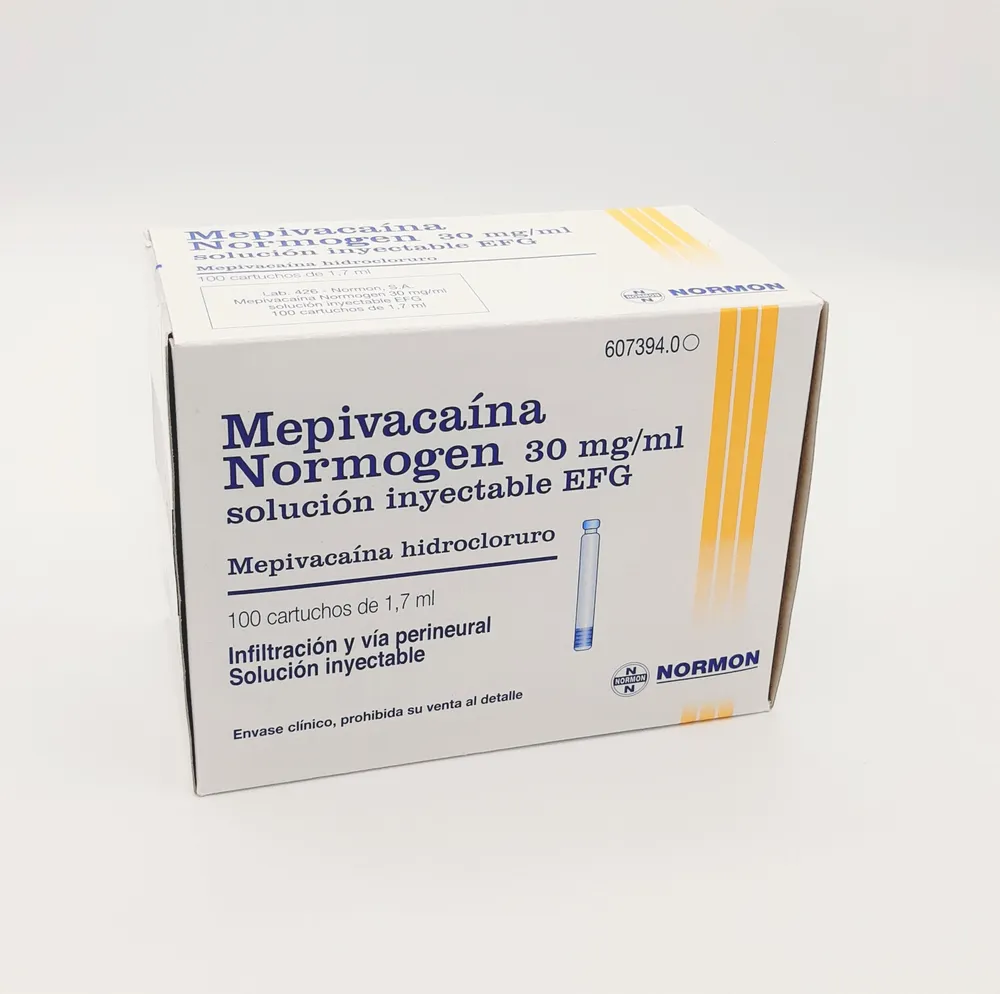
Table of Contents
- Package Leaflet: Information for the User
- Introduction
- **Mepivacaína Normogen 30 mg/ml injectable solution EFG**
- 1. What Mepivacaína Normogen 30 mg/ml is and what it is used for
- 2. What you need to know before using Mepivacaíne Normogen 30 mg/ml
- **Warnings and precautions**
- **Other medicines and Mepivacaine Normogen 30 mg/ml**
- **Use of Mepivacaine Normogen 30 mg/ml with food**
- **Pregnancy, lactation and fertility**
- **Driving and using machines**
- **Mepivacaine Normogen 30 mg/ml contains sodium**
- **Use in athletes**
- 3. How to use Mepivacaine Normogen 30 mg/ml
- **If you are given more Mepivacaína Normogen 30 mg/ml than you should receive**
- 4. Possible adverse effects
- **Reporting of adverse reactions**
- 5. Storage of Mepivacaine Normogen 30 mg/ml
- 6. Contents of the container and additional information
- **Appearance of the product and contents of the container**
- **Marketing Authorization Holder and Manufacturing Responsible Party**
Package Leaflet: Information for the User
Introduction
Package Leaflet: Information for the Patient
Mepivacaína Normogen 30 mg/ml injectable solution EFG
Mepivacaine hydrochloride
Read this entire leaflet carefully before you start using this medicine, because it contains important information for you.
- Keep this leaflet, as you may need to read it again.
- If you have any questions, consult your doctor or pharmacist.
- This medicine has been prescribed for you only, and you should not give it to other people, even if they have the same symptoms as you, because it could harm them.
- If you experience any adverse effects, consult your doctor, dentist, or pharmacist, even if they are adverse effects not listed in this leaflet. See section 4.
Contents of the leaflet
- What Mepivacaína Normogen 30 mg/ml is and what it is used for
- What you need to know before using Mepivacaína Normogen 30 mg/ml
- How to use Mepivacaína Normogen 30 mg/ml
- Possible adverse effects
- Storage of Mepivacaína Normogen 30 mg/ml
- Contents of the pack and other information
1. What Mepivacaína Normogen 30 mg/ml is and what it is used for
Mepivacaína Normogen 30 mg/ml is a local anaesthetic that numbs a specific area to prevent or minimize pain. This medicine is used for local dental procedures in adults, adolescents, and children over 4 years of age (with a body weight of approximately 20 kg). It contains the active substance mepivacaine hydrochloride and belongs to the group of nervous system anaesthetics.
2. What you need to know before using Mepivacaíne Normogen 30 mg/ml
Do not use Mepivacaíne Normogen 30 mg/ml:
- if you are allergic to mepivacaíne or to any of the other ingredients of this medicine (listed in section 6);
- if you are allergic to other local anaesthetics of the same group (e.g., lidocaine, bupivacaine);
- if you have:
- heart disorders due to an abnormality in the electrical impulse that triggers the heartbeat (severe conduction disturbances);
- uncontrolled epilepsy not managed by treatment;
- Children under 4 years of age (body weight approximately 20 kg)
Warnings and precautions
Consult your dentist before starting to use Mepivacaine Normogen 30 mg/ml:
- If you have severe heart disorders;
- If you have severe anemia;
- If you have high blood pressure (severe or untreated hypertension);
- If you have low blood pressure (hypotension);
- If you have epilepsy;
- If you have liver disease;
- If you have kidney disease;
- If you have a disease affecting the nervous system and causing neurological disorders (porphyria);
- If you have high acidity in the blood (acidosis);
- If you have poor blood circulation;
- If your general health condition is poor;
- If the area around the injection site is swollen or infected.
If any of these situations apply to you, speak with your dentist. He or she may decide to reduce your dose.
Other medicines and Mepivacaine Normogen 30 mg/ml
Inform your dentist if you are taking, have recently taken, or might need to take any other medicines, particularly:
- other local anesthetics;
- medicines used to treat stomach and intestinal burning or ulcers (such as cimetidine);
- tranquilizers and sedatives;
- medicines used to stabilize heart rhythm (antiarrhythmics);
- cytochrome P450 1A2 inhibitors;
- medicines used to treat high blood pressure (propranolol).
Use of Mepivacaine Normogen 30 mg/ml with food
Avoid eating, including chewing gum, until normal sensation has returned, to prevent the risk of biting the lips, inner cheeks, or tongue, especially in children.
Pregnancy, lactation and fertility
If you are pregnant or breastfeeding, think you may be pregnant, or are planning to become pregnant, consult your doctor, dentist or pharmacist before using this medicine.
As a precautionary measure, it is preferable to avoid using this product during pregnancy unless strictly necessary.
Breastfeeding mothers are advised not to breastfeed for 10 hours following anaesthesia with this product.
Driving and using machines
This medicine may have a minor influence on the ability to drive and use machines. Dizziness (including sensation of "spinning", fatigue, and visual disturbances) and loss of consciousness may occur after administration of this medicine (see section 4). You should not leave the dental office until your abilities have returned (usually within 30 minutes) after the dental procedure.
Mepivacaine Normogen 30 mg/ml contains sodium
This medicine contains less than 23 mg (1 mmol) of sodium per cartridge, which means it is essentially "sodium-free".
Use in athletes
Athletes are advised that this medicine contains a component that may produce a positive analytical finding in doping controls.
3. How to use Mepivacaine Normogen 30 mg/ml
Mepivacaine Normogen 30 mg/ml should only be used by, or under the supervision of, dentists, stomatologists, or other trained physicians, via slow local injection.
They will determine the correct dose and adjust it according to the procedure, your age, weight, and general health condition.
The lowest effective dose required to achieve adequate anesthesia should be used. This medicine is administered as an injection into the oral cavity.
If you are given more Mepivacaína Normogen 30 mg/ml than you should receive
The following symptoms may be signs of toxicity due to excessive doses of local anesthetics: agitation, numbness of the lips and tongue, prickling and tingling around the mouth, dizziness, visual and auditory disturbances, tinnitus, muscle stiffness or muscle spasms, low blood pressure, and slow or irregular heartbeat. If you experience any of these effects, the injection must be stopped immediately and emergency medical assistance should be sought.
In case of overdose or accidental ingestion, contact the Toxicology Information Service (Tel. 91 562 04 20), indicating the product and the amount received.
If you have any further questions about the use of this medicine, ask your doctor or dentist.
4. Possible adverse effects
Like all medicines, this medicine can cause adverse effects, although not everyone experiences them.
After administration of Mepivacaïne Normogen 30 mg/ml, one or more of the following adverse effects may occur.
Frequent adverse effects (may affect up to 1 in 10 people):
Headache
Rare adverse effects (may affect up to 1 in 1,000 people):
- Skin rash, itching, swelling of the face, lips, gums, tongue and/or throat, and difficulty breathing, wheezing/asthma, hives (urticaria): these may be symptoms of hypersensitivity reactions (allergic or allergy-like reactions);
- Pain due to nerve injury (neuropathic pain);
- Burning sensation, prickling, and tingling of the skin without apparent physical cause around the mouth (paresthesia);
- Abnormal sensation inside and around the mouth (hypoesthesia);
- Metallic taste, distortion of taste, loss of taste sensation (dysgeusia);
- Dizziness (mild lightheadedness);
- Tremor;
- Loss of consciousness, seizure (convulsion), coma;
- Fainting;
- Confusion, disorientation;
- Speech disorders, excessive talkativeness;
- Restlessness, agitation;
- Disturbance of sense of balance (disequilibrium);
- Somnolence;
- Blurred vision, difficulty focusing clearly on an object, visual disturbances;
- Sensation of spinning (vertigo);
- Inability of the heart to contract effectively (cardiac arrest), rapid and irregular heartbeats (ventricular fibrillation), severe and constricting chest pain (angina pectoris);
- Problems with coordination of heartbeat (conduction disorders, atrioventricular block), abnormally slow and irregular heart rate (bradycardia), abnormally accelerated heart rate (tachycardia), palpitations;
- Low blood pressure;
- Increased blood flow (hyperemia);
- Difficulty breathing, abnormally slow or very rapid breathing;
- Yawning;
- Dizziness, vomiting, mouth or gum ulcers, swelling of the tongue, lips, or gums;
- Excessive sweating;
- Muscle spasms;
- Chills;
- Swelling at the injection site.
Very rare adverse effects (may affect up to 1 in 10,000 people):
- High blood pressure;
Possible side effects (frequency cannot be estimated from available data):
- Euphoria, anxiety/nervousness;
- Involuntary eye movements, eye problems such as pupil constriction, drooping of the upper eyelid (as in Horner's syndrome), dilated pupil, posterior displacement of the eyeball into the orbit due to changes in orbital volume (called enophthalmos), double vision or loss of vision;
- Ear disorders such as tinnitus, auditory hypersensitivity;
- Inability of the heart to contract effectively (myocardial depression);
- Widening of blood vessels (vasodilation);
- Changes in skin color accompanied by confusion, cough, rapid breathing, and rapid heartbeat, sweating: these may be symptoms of tissue oxygen deficiency (hypoxia);
- Rapid or difficult breathing, somnolence, headache, inability to think clearly, and drowsiness, which may be signs of high carbon dioxide concentration in the blood (hypercapnia);
- Voice alteration (hoarseness);
- Swelling of the mouth, lips, tongue, and gums, excessive salivation;
- Fatigue, feeling of weakness, sensation of warmth, pain at the injection site;
- Nerve injury.
Reporting of adverse reactions
If you experience any type of adverse reaction, consult your doctor or dentist, even if they are possible adverse reactions not listed in this leaflet. You may also report them directly through the Spanish Pharmacovigilance System for Human Medicines: www.notificaram.es. By reporting adverse reactions, you can help provide more information on the safety of this medicine.
5. Storage of Mepivacaine Normogen 30 mg/ml
Keep this medicine out of the sight and reach of children. This medicine does not require any special storage conditions.
Do not use this medicine after the expiry date stated on the label of the cartridge and on the box, following "EXP". The expiry date refers to the last day of the month indicated.
Do not use this medicine if you notice any visible signs of deterioration.
Cartridges are for single use only. The medicine should be administered immediately after opening the cartridge. Any unused solution must be discarded.
Medicines must not be disposed of via wastewater or household waste. Ask your dentist, doctor, or pharmacist how to properly dispose of unused medicines and their packaging. This will help protect the environment.
6. Contents of the container and additional information
Composition of Mepivacaine Normogen 30 mg/ml
The active substance is mepivacaine hydrochloride.
1 ml of injectable solution contains 30.00 mg of mepivacaine hydrochloride.
Each 1.7 ml cartridge of injectable solution contains 51 mg of mepivacaine hydrochloride.
The other ingredients are: sodium chloride, sodium hydroxide (to adjust pH), and water for injection.
Appearance of the product and contents of the container
This medicine is a clear, colourless solution.
Mepivacaine Normogen 30 mg/ml is available in glass cartridges.
Pack containing 1 cartridge of 1.7 ml.
Pack containing 50 cartridges of 1.7 ml.
Pack containing 100 cartridges of 1.7 ml.
Not all pack sizes may be marketed.
Marketing Authorization Holder and Manufacturing Responsible Party
LABORATORIOS NORMON, S.A.
Ronda de Valdecarrizo, 6 – 28760 Tres Cantos – Madrid (SPAIN)
Date of the most recent review of this leaflet: July 2020
Detailed information on this medicinal product is available on the website of the Spanish Agency of Medicines and Medical Devices (AEMPS) http://www.aemps.gob.es