Menopur 1200 IU powder and solvent for solution for injection
Spain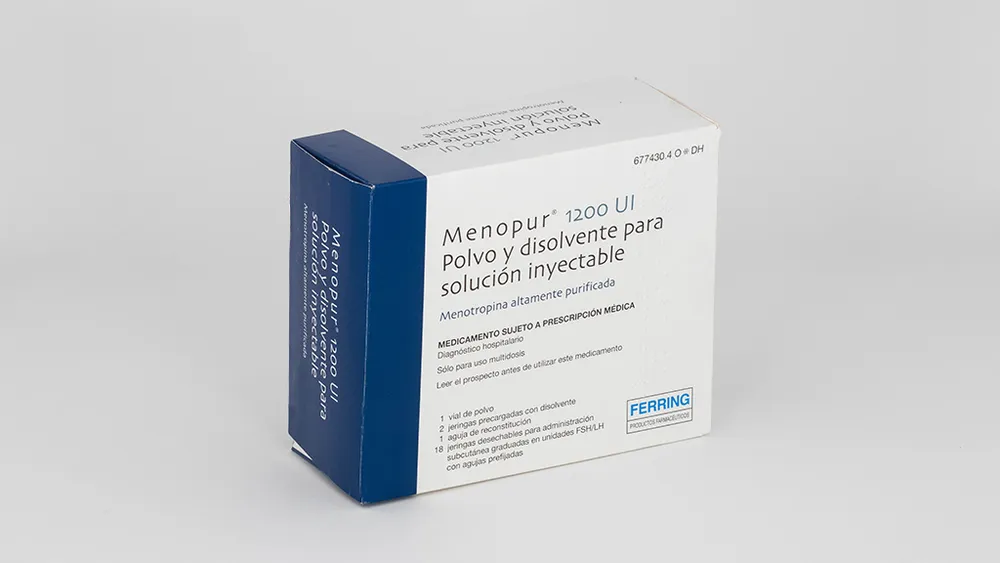
Table of Contents
Patient Information Leaflet
Introduction
Patient Information Leaflet
Menopur 1200 IU
powder and solvent for injectable solution
Menotropin
Read the entire leaflet carefully before starting to take this medicine, as it contains important information for you.
- Keep this leaflet, as you may need to read it again.
- If you have any questions, consult your doctor or pharmacist.
- This medicine has been prescribed for you only, and you should not give it to others, even if they have the same symptoms as you, because it could harm them.
- If you experience any adverse reactions, consult your doctor or pharmacist, even if they are adverse reactions not listed in this leaflet (see section 4).
Leaflet Contents
- What Menopur is and what it is used for
- What you need to know before using Menopur
- How to use Menopur
- Possible side effects
- How to store Menopur
- Contents of the pack and other information
1. What Menopur is and what it is used for
Menopur is supplied as a powder that must be mixed with a liquid (solvent) before use. It is administered as an injection under the skin or into a muscle.
The active substance in Menopur is highly purified and known as menotropin. Menotropin is extracted from the urine of postmenopausal women and contains three hormones: follicle-stimulating hormone (FSH), human chorionic gonadotropin (hCG), and luteinizing hormone (LH).
hCG, extracted from the urine of pregnant women, may be added to contribute to the total LH bioactivity.
FSH, hCG, and LH are natural hormones produced in women. They help the reproductive organs function normally.
Menopur is indicated for the treatment of infertility in the following situations:
- Women who are unable to become pregnant because their ovaries do not produce eggs (including polycystic ovary syndrome). Menopur is used in women who have been treated with a medicine called clomiphene citrate for infertility, but this medicine has not worked.
- Women undergoing assisted reproductive technology (ART) programs (including in vitro fertilization/embryo transfer [IVF/ET], gamete intrafallopian transfer [GIFT], intracytoplasmic sperm injection [ICSI]). Menopur helps the ovaries develop multiple egg-containing sacs (follicles) in which an egg can develop (multiple follicular development).
- Infertility in men with hypogonadotropic hypogonadism or normogonadotropic hypogonadism: in combination with human chorionic gonadotropin to stimulate spermatogenesis.
2. What you need to know before using Menopur
Before starting treatment with Menopur, you and your partner should be evaluated by a doctor to determine the causes of infertility. In particular, the following conditions should be checked so that the most appropriate treatment can be administered:
- Dysfunction of the thyroid gland and adrenal cortex
- High levels of a hormone called prolactin (hyperprolactinemia)
- Tumors of the pituitary gland (a gland located at the base of the brain)
- Tumors of the hypothalamus (an area located beneath the part of the brain called the thalamus).
If you know you have any of the conditions listed above, please inform your doctor before starting treatment with Menopur.
Do not use Menopur if:
- You are allergic (hypersensitive) to menotropin or to any of the other components of this medicine listed in section 6.
In women:
- If you have a tumor of the uterus, ovaries, breasts, or certain areas of the brain such as the hypothalamus-pituitary region
- Ovarian enlargement or cysts not caused by polycystic ovary syndrome
- Malformations of the genital organs or uterus (womb)
- Vaginal bleeding of unknown cause
- Fibroids (benign tumors) in the uterus (womb)
- If you are pregnant or breastfeeding
- If you have premature menopause
In men:
- Prostate carcinoma
- Testicular tumor
Warnings and precautions
If you experience:
- Abdominal pain
- Abdominal swelling
- Nausea
- Vomiting
- Diarrhea
- Weight gain
- Difficulty breathing
- Decreased urine output
Contact your doctor immediately, even if symptoms develop several days after the last injection. These may be signs of excessive ovarian activity, which can become severe.
If these symptoms become severe, infertility treatment must be discontinued and you should receive treatment in a hospital.
Following the recommended dose and careful monitoring of treatment will reduce the likelihood of experiencing these symptoms.
Even if you stop using Menopur, you may still experience these symptoms. Please contact your doctor immediately if you develop any of these symptoms.
While undergoing treatment with this medicine, your doctor will usually order ultrasounds and sometimes blood tests to monitor your response to treatment.
When being treated with hormones such as Menopur, the risk may be increased of:
- Ectopic pregnancy (pregnancy outside the uterus), especially if you have a history of fallopian tube disease
- Miscarriage
- Multiple pregnancy (twins, triplets, etc.)
- Congenital malformations (physical defects present at birth)
Some women who have been treated with various infertility medications have developed tumors of the ovaries and other reproductive organs. It is not yet known whether treatment with hormones such as this medicine causes these problems.
The formation of blood clots in blood vessels (veins or arteries) is more likely in pregnant women. Infertility treatment may increase the likelihood of this occurring, especially if you are overweight or have a known blood clotting disorder (thrombophilia), or if you or a family member (blood relative) has had clotting problems. Inform your doctor if you think this applies to you.
Use in children
Menopur is not indicated for use in children.
Use of Menopur with other medicines
Inform your doctor or pharmacist if you are taking, have recently taken, or might need to take any other medicines.
No interaction studies have been conducted with Menopur in humans.
When treating infertile men, menotropin and human chorionic gonadotropin may be administered simultaneously.
Clomiphene citrate is another medicine used in infertility treatment. If Menopur is used at the same time as clomiphene citrate, the effect on the ovaries may be increased.
Pregnancy and breastfeeding
If you are pregnant or breastfeeding, think you may be pregnant, or plan to become pregnant, consult your doctor or pharmacist before using this medicine.
Menopur is not indicated under any circumstances for the treatment of pregnant women or women who are breastfeeding.
Driving and use of machines
It is very rare for Menopur to affect the ability to drive and use machines.
Important information about some of the components of Menopur:
Menopur contains less than 1 mmol of sodium chloride (23 mg) per dose and is therefore essentially sodium-free.
3. How to use Menopur
Follow exactly the administration instructions for Menopur given by your doctor.
If in doubt, consult your doctor or pharmacist again.
- Women who do not ovulate (do not produce eggs):
Treatment will begin within the first 7 days of the menstrual cycle (day 1 is the first day of the period). Treatment should be administered daily for at least 7 days.
The usual initial dose is 75–150 IU daily. This dose may be increased according to your response to treatment, up to a maximum of 225 IU per day. An individual dose should be administered for at least 7 days before the dose is adjusted by the doctor. The recommended dose increase is 37.5 IU per adjustment (and not more than 75 IU). The treatment cycle should be discontinued if there is no adequate response after 4 weeks.
When an optimal response is achieved, a single injection of another hormone called human chorionic gonadotropin (hCG), at a dose of 5,000 to 10,000 IU, will be administered 1 day after the last dose of Menopur. Intercourse is recommended on the same day as hCG administration and the following day. Alternatively, intrauterine insemination may be performed (injection of sperm directly into the uterus). Your doctor should monitor your progress closely for at least 2 weeks after hCG administration.
Your doctor will monitor the effect of Menopur treatment. Depending on your progress, your doctor may decide to discontinue treatment with Menopur and not administer the hCG injection. In this case, you must use a contraceptive method (condom) or abstain from sexual intercourse until your next period begins.
ii. Women in assisted reproduction programs:
If you are also receiving treatment with GnRH agonists (a medicine that helps the hormone called Gonadotropin-Releasing Hormone (GnRH) to function), treatment with Menopur should begin approximately 2 weeks after starting the GnRH agonist treatment.
If you are also receiving treatment with GnRH antagonists, treatment with Menopur should begin on day 2 or 3 of the menstrual cycle (day 1 is the first day of the period).
Menopur should be administered daily for at least 5 days. The recommended initial dose of Menopur is 150–225 IU. This dose may be increased according to your response to treatment, up to a maximum of 450 IU per day. The dose should not be increased by more than 150 IU per adjustment. Typically, treatment is not recommended for longer than 20 days.
If there are sufficient ovarian follicles, a single injection of a medicine called human chorionic gonadotropin (hCG), at a dose of up to 10,000 IU, will be administered to induce ovulation (release of an egg).
Your doctor should monitor your progress closely for at least 2 weeks after hCG administration.
Your doctor will monitor the effect of Menopur treatment. Depending on your progress, your doctor may decide to discontinue treatment with Menopur and not administer the hCG injection. In this case, you must use a contraceptive method (condom) or abstain from sexual intercourse until your next period begins.
Infertility in men:
Initially, between 1,000 and 3,000 IU of human chorionic gonadotropin (hCG) is administered three times a week until normal serum testosterone levels are achieved.
Afterwards, a dose of Menopur of 75–150 IU (1–2 vials) is administered three times a week by intramuscular (IM) injection for several months.
Use in children
Menopur has no appropriate indications for use in children.
INSTRUCTIONS FOR USE:
If your doctor instructs you to self-inject Menopur, you must follow any instructions provided to you.
The first injection of this medicine should be administered under the supervision of a doctor or nurse.
Menopur is supplied as a powder in a vial and must be dissolved using two pre-filled syringes containing solvent before injection. The solvents to be used for diluting Menopur are provided in pre-filled syringes.
Menopur 1200 IU must be reconstituted with the two pre-filled syringes containing solvent before use.
After dissolving the powder with the solvents, the vial contains medication for several days of treatment; therefore, you must ensure that you only withdraw the amount of medication prescribed by your doctor.
Your doctor has prescribed you a dose of Menopur in IU (international units). You must use one of the 18 provided administration syringes graduated in FSH/LH IU (international units).
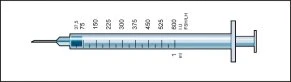
Follow the steps below:
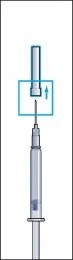
1 | 2 |
-
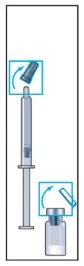
Remove the protective cap from the vial of powder and the rubber stopper from the pre-filled syringe containing the solvent (image 1).
-
Firmly attach the thin needle (reconstitution needle) to the pre-filled syringe with the solvent, and remove the needle's protective cap (image 2).
|
|
|
|
|
|
|
3 | 4 | 5 | 6 |
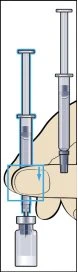
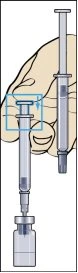
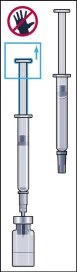
-
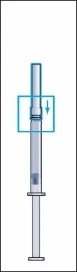
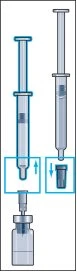
Insert the needle through the center of the rubber stopper of the powder vial and slowly inject all the liquid, to avoid the formation of bubbles (image 3).
-
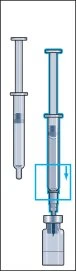
When the solvent is added, a slight overpressure is created in the vial. Therefore, release the syringe plunger so it rises on its own for about 10 seconds. This will eliminate excess pressure in the vial (image 4).
-
Carefully remove the syringe from the needle with a twisting motion, leaving the needle in the vial.
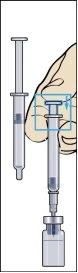
Remove the rubber cap from the syringe of the second pre-filled solvent syringe and firmly attach it to the needle fixed in the vial. Inject slowly all the liquid to avoid the formation of bubbles (image 5).
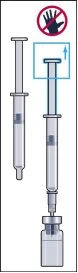
- When the solvent is added, a slight overpressure is created in the vial. Therefore, release the syringe plunger so it rises on its own for about 10 seconds. This will eliminate excess pressure in the vial (image 6).
Remove the syringe and the reconstitution needle.
7 8 9 10
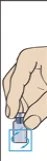
- The powder will dissolve rapidly (within 2 minutes), forming a clear solution. Although dissolution usually begins when only a few drops of solvent have been added, the full amount of solvent must be added. To aid dissolution of the powder, gently rotate the vial (image 7). Do not shake, as this may cause the formation of air bubbles.
Do not use the reconstituted solution if it contains particles or is not clear.
The powder vial is now dissolved using the two solvent syringes and is ready for use.
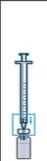
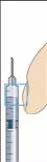
- Take the administration syringe with the pre-attached needle and insert the needle vertically into the center of the vial. The administration syringe already contains a small amount of air, which should be injected into the vial above the liquid. Turn the vial upside down and withdraw the prescribed dose of Menopur into the administration syringe for injection (image 8).
REMEMBER: since the vial contains medication for several days of treatment, you must ensure that you withdraw only the amount of medication prescribed by your doctor.
-
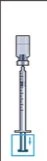
Remove the syringe from the vial and withdraw a small amount of air from the syringe (image 9).
-
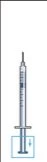
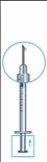
Gently tap the administration syringe so that all air bubbles rise to the top (image 10). Carefully push out all the air until the first drop of solution appears at the needle tip.
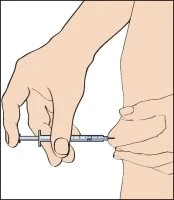
Your doctor or nurse will tell you where to inject (e.g., front of the thigh, abdomen, etc.). Before injection, clean the skin at the injection site with an alcohol swab.
11
- To inject, pinch the skin to create a skin fold and insert the needle quickly at a 90-degree angle to the body. Press the plunger to inject the solution (image 11), then withdraw the syringe.
After removing the syringe, apply pressure to the injection site to control any bleeding. Gentle massage at the injection site will help disperse the solution under the skin.
Do not dispose of used materials in household waste; they must be properly discarded.
- For additional injections with the reconstituted Menopur solution, repeat steps 8 to 11.
If you use more Menopur than you should. In case of overdose or accidental ingestion of the solution, contact your doctor or pharmacist immediately or call the Toxicology Information Service at telephone number 91 562 04 20, stating the medication and amount used.
If you forget to use Menopur, do not use a double dose to make up for missed doses. Please inform your doctor or pharmacist.
If you have any further questions about the use of this medicine, ask your doctor or pharmacist.
4. Possible adverse effects
Like all medicines, Menopur may cause adverse effects, although not everyone experiences them.
Treatment with Menopur can cause high levels of ovarian activity, which may lead to a condition called Ovarian Hyperstimulation Syndrome (OHSS), especially in women with polycystic ovaries. Symptoms include: abdominal distension and discomfort, nausea, vomiting, diarrhoea, weight gain. In some severe cases of OHSS, rare complications have been reported, including fluid accumulation in the abdomen, pelvis and/or pleural cavity, difficulty breathing, reduced urine output, formation of blood clots in blood vessels (thromboembolism), and ovarian torsion. If you experience any of these symptoms, contact your doctor immediately, even if they develop several days after the last injection.
Allergic reactions (hypersensitivity) may occur when using this medicine. Symptoms of these reactions may include: rash, itching, swelling of the throat, and difficulty breathing. If you experience any of these symptoms, contact your doctor immediately.
The following common adverse effects occur in between 1 and 10 out of every 100 patients treated:
- Abdominal pain
- Headache
- Nausea
- Abdominal bloating (fullness)
- Pelvic pain
- Ovarian hyperstimulation resulting in high levels of activity (Ovarian Hyperstimulation Syndrome)
- Local reactions at the injection site (such as pain, redness, bruising, swelling, and/or irritation)
The following uncommon adverse effects occur in between 1 and 10 out of every 1,000 patients treated:
- Vomiting
- Abdominal discomfort
- Diarrhoea
- Fatigue
- Dizziness
- Fluid-filled sacs in the ovaries (ovarian cysts)
- Breast complications (including breast pain, breast tenderness, breast discomfort, nipple pain, and breast swelling)
- Hot flushes
The following rare adverse effects occur in between 1 and 10 out of every 10,000 patients treated:
- Acne
- Skin rash
In addition to the adverse effects listed above, the following adverse effects have been reported after Menopur has been marketed, with unknown frequency:
- Vision disturbances
- Fever
- Feeling unwell
- Allergic reactions
- Weight gain
- Muscle and joint pain (e.g. back, neck, arm, and leg pain)
- Ovarian torsion as a complication of increased ovarian activity due to hyperstimulation
- Pruritus (itching)
- Urticaria (hives)
- Blood clots as a complication of increased ovarian activity due to hyperstimulation
Reporting of adverse effects
If you experience any adverse effect, talk to your doctor or pharmacist, even if it is a possible adverse effect not listed in this leaflet. You may also report them directly through the Spanish Pharmacovigilance System for Human Medicines: https://www.notificaRAM.es. By reporting adverse effects, you can help provide more information on the safety of this medicine.
5. Storage of MENOPUR
Keep out of sight and reach of children.
Before reconstitution, store in a refrigerator (2°C – 8°C). Do not freeze. Keep in the original packaging to protect from light.
After reconstitution, the solution may be stored for up to 28 days at a maximum temperature of 25°C.
The reconstituted solution must not be administered if it contains particles or is not clear.
Do not use Menopur after the expiry date stated on the packaging after "EXP". The expiry date refers to the last day of the month indicated.
Medicines must not be disposed of via wastewater or household waste. Return any unused medicines and their containers to the SIGRE collection point at your pharmacy. If you are unsure, ask your pharmacist how to dispose of unused medicines and their packaging. This will help protect the environment.
6. ADDITIONAL INFORMATION
Composition of Menopur
The active substance is highly purified menotropin (human menopausal gonadotropin, hMG-HP), corresponding to 1200 IU of follicle-stimulating hormone (FSH) bioactivity and 1200 IU of luteinizing hormone (LH) bioactivity.
After reconstitution with the 2 ml of solvent provided, 1 ml of the reconstituted solution contains 600 IU of highly purified menotropin.
The other components of the powder are: lactose monohydrate, polysorbate 20, dibasic sodium phosphate heptahydrate (as buffer and pH adjuster), and phosphoric acid (for pH adjustment).
The components of the solvent are: metacresol and water for injection.
Appearance of the medicinal product and contents of the container
Menopur is a powder and solvent for injectable solution.
Menopur is a white to greyish, compacted lyophilized powder presented in a glass vial, together with two pre-filled syringes containing the solvent (a clear, colourless solution) for reconstitution, one reconstitution needle, and 18 disposable graduated FSH/LH unit syringes with pre-attached needles for administration.
Marketing Authorization Holder and Manufacturer:
Marketing Authorization Holder
Ferring, S.A.U
C/ del Arquitecto Sánchez Arcas nº3, 1º
28040 Madrid
Spain
Manufacturer:
FERRING GmbH
Wittland 11,
D-24109 Kiel
GERMANY
This patient information leaflet was approved in November 2025
Detailed and up-to-date information on this medicinal product is available on the website of the Spanish Agency for Medicines and Health Products (AEMPS) http://www.aemps.gob.es/