Menjugate 10 micrograms solution for injection in pre-filled syringe
Spain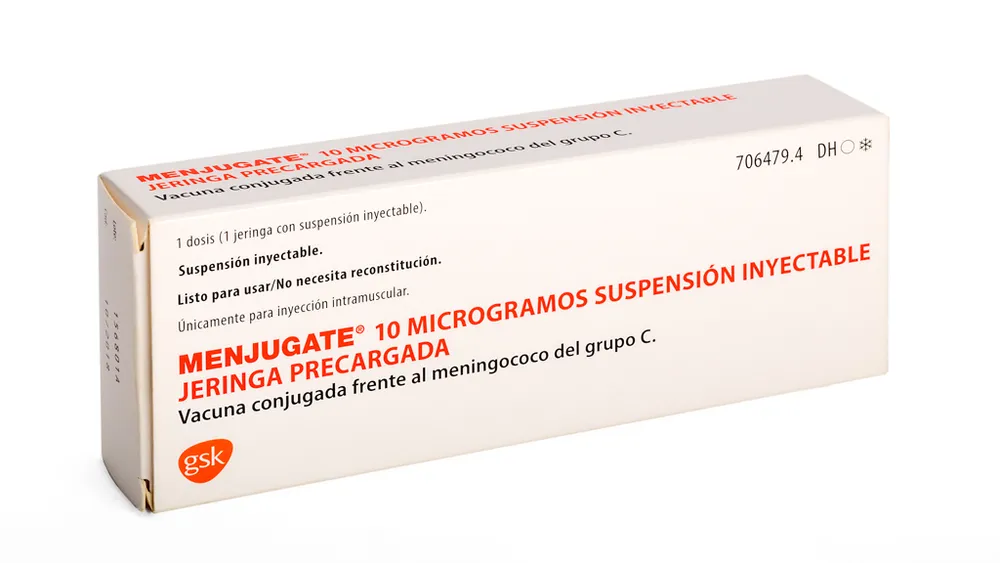
Table of Contents
Package leaflet: Information for the user
Introduction
Package leaflet: information for the user
MENJUGATE 10 micrograms injectable suspension pre-filled syringe
Conjugate vaccine against group C meningococcus
Read all of this leaflet carefully before you or your child starts using this medicine, because it contains important information for you or your child.
- Keep this leaflet, as you may need to read it again.
- If you have any questions, ask your doctor or nurse.
- This vaccine has been prescribed only for you or your child and must not be given to other people.
- If you or your child experience any adverse reactions, consult your doctor or nurse, even if they are adverse reactions not listed in this leaflet. See section 4.
Contents of the leaflet:
- What Menjugate is and what it is used for
- What you need to know before you or your child start using Menjugate
- How to use Menjugate
- Possible side effects
- How to store Menjugate
- Contents of the pack and other information
1. What Menjugate is and what it is used for
Menjugate is a vaccine used to prevent diseases caused by the bacterium Neisseria meningitidis group C (also known as meningococcal group C bacteria). The vaccine works by stimulating the production of protective antibodies against meningococcus of serogroup C.
The Neisseria meningitidis group C bacterium can cause serious, sometimes fatal infections such as meningitis and septicemia (blood infection).
This vaccine is used for active immunization of infants from 2 months of age, adolescents, and adults, and protects only against meningococcal bacteria of group C. It does not protect against other groups of meningococcal bacteria or against other causes of meningitis or septicemia (blood infection).
If you or your child experience neck pain/stiffness or sensitivity to light (photophobia), drowsiness or confusion, or red or purple rash resembling bruising that does not fade under pressure, you must contact your doctor or go to Emergency services immediately.
This vaccine cannot cause meningitis C (group C meningococcal disease).
This vaccine contains the diphtheria protein CRM197. Menjugate does not protect against diphtheria.
This means that you (or your child) must receive other vaccines to protect against diphtheria when necessary or as advised by your doctor.
2. What you need to know before you or your child are given Menjugate
Do not use Menjugate if you or your child:
- have ever had an allergic reaction to the active substances or to any of the other components of Menjugate (listed in section 6)
- have ever had an allergic reaction to diphtheria toxoid (a substance used in many other vaccines)
Warnings and precautions
Fainting, feeling faint, and other stress-related reactions may occur as a response to needle injection. Inform your doctor or nurse if you (or your child) have previously experienced this type of reaction.
Consult your doctor or nurse before you or your child receive Menjugate, or if you or your child:
- have haemophilia or any other condition affecting blood clotting (e.g. a low platelet count known as thrombocytopenia), or are taking any medication that affects blood clotting
- have a weakened immune system for any reason (for example, if you (or your child) do not produce antibodies effectively, or if you (or your child) are taking medications that suppress the immune response to infections, such as cancer treatments or high-dose corticosteroids)
- are receiving treatment that blocks the part of the immune system known as complement activation, such as eculizumab. Even if you have been vaccinated with Menjugate, you still have an increased risk of invasive disease caused by the bacterium Neisseria meningitidis group C
- have had your spleen removed or have been told that your spleen does not function properly
- have an infectious illness or high fever. In such cases, vaccination with Menjugate may need to be postponed. However, a mild infection (e.g. a cold) is not sufficient reason to delay vaccination
- are over 65 years of age
- have a kidney disease in which large amounts of protein appear in the urine (called nephrotic syndrome). Relapses have been reported following vaccination.
This vaccine only protects against group C meningococcal bacteria. It does not protect against other groups of meningococcal bacteria.
Latex-sensitive individuals (for syringe presentation):
Although natural rubber latex has not been detected in the syringe cap, the safety of Menjugate in individuals sensitive to latex has not been established.
Use of Menjugate with other medicines
Inform your doctor or nurse if you (or your child) are taking, have recently taken, or might need to take any other medicines.
Menjugate may be given at the same time as other vaccines, but any other injectable vaccine should be administered at a different injection site, preferably in a different arm or leg from where Menjugate is injected.
This includes:
- Oral or injectable polio vaccines.
- Vaccines against diphtheria and tetanus, alone or in combination with the pertussis (whooping cough) vaccine.
- Vaccine against Haemophilus influenzae type B (Hib disease).
- Hepatitis B vaccine given alone or as combination vaccines against diphtheria, tetanus, Hib disease, polio, and pertussis.
- Combined measles, mumps, and rubella (MMR) vaccines.
- Combined pneumococcal vaccine.
These other vaccines should be administered at the routinely recommended ages.
Pregnancy and breastfeeding
If you are pregnant or breastfeeding, think you may be pregnant, or are planning to become pregnant, consult your doctor or nurse before receiving Menjugate. However, if you are at high risk of infection with group C meningococcal bacteria, your doctor or nurse may advise you to receive Menjugate.
Driving and using machines
You may feel dizzy or experience other adverse effects after the injection. This could affect your ability to drive or operate machinery. Do not drive or use machines until you know how Menjugate affects you.
Menjugate contains:
This medicine contains less than 23 mg of sodium (1 mmol) per dose; this is essentially "sodium-free".
3. How to use Menjugate
Menjugate will be administered by a doctor or nurse.
The vaccine is normally administered into the thigh muscle in infants and into the shoulder muscle in older children, adolescents, and adults. Your doctor or nurse will take care to ensure that the vaccine is not injected into a blood vessel and will make sure it is administered into muscle and not into the skin.
In children from 12 months of age and older, adolescents, and adults: a single dose (0.5 ml) of vaccine is recommended.
In infants from 2 to 12 months of age: two doses of Menjugate should be given, with at least two months between doses.
To maintain protection, a booster dose should be administered after completion of the two-dose vaccination schedule in children. Your doctor will inform you when this booster dose should be given to your child.
See the section for healthcare professionals at the end of this leaflet for information on vaccine handling.
If you are given more Menjugate than you should
Since Menjugate is administered by a doctor or nurse, and each injection is a single dose of 0.5 millilitres, it is highly unlikely that you (or your child) would receive an overdose of the vaccine. If you have any concerns about the amount of vaccine you (or your child) have received, speak to your doctor or nurse.
If you have any further questions about the use of Menjugate, ask your doctor or nurse.
4. Possible adverse effects
Like all medicines, Menjugate may produce adverse effects, although not everyone experiences them.
If a severe allergic reaction occurs (usually in less than 1 in 10,000 people), inform your doctor immediately / take your child to the Emergency Department, as urgent medical treatment may be required.
The symptoms of severe allergic reactions may include:
- Swelling of the lips, mouth, or throat (which could cause difficulty swallowing).
- Difficulty breathing with wheezing or coughing.
- Rash and swelling of the hands, feet, and ankles.
- Loss of consciousness.
- Very low blood pressure.
These very rare adverse reactions may appear immediately or very soon after injection and usually resolve rapidly once appropriate treatment has been administered.
Other allergic reactions may begin several days after the vaccine is administered.
These could include:
- Rash, sometimes with itching, purple spots, or redness of the skin.
- Blistering rashes that could also cause ulcers in the mouth and around the genital organs.
The adverse effects most commonly reported during clinical trials usually lasted only one to two days and were generally not serious. The adverse effects were:
Very common (may affect more than 1 in 10 people)
- In all age groups: redness, swelling, and tenderness/pain at the injection site, which usually did not require medical attention. Rarely, redness or swelling of at least 3 cm and tenderness causing discomfort during movement lasting more than 48 hours has been reported.
- Infants: dizziness (vomiting).
- Infants and young children (between 12 and 36 months): irritability, somnolence, difficulty sleeping, loss of appetite, and diarrhea.
- Secondary school-aged children: headache.
- Older children and adults: muscle and joint pain, general malaise.
- Adults: general malaise (with nausea).
Common (may affect 1 in 10 people)
- In all age groups: fever (but rarely severe).
- Infants and young children (between 12 and 36 months): crying.
- Young children (between 12 and 36 months): dizziness (vomiting).
- Primary school-aged children: headache.
Other adverse effects reported during routine vaccination programs:
Very rare (may affect 1 in 10,000 people)
Different age groups:
- Swollen lymph nodes
- Dizziness
- Fainting
- Numbness
- Tingling or cramps
- Temporary reduction in muscle tone
- Visual disturbances and light sensitivity. These usually occur together with headache and dizziness
- Extensive swelling of the vaccinated limb
Although seizures have been very rarely reported after vaccination with Menjugate, some of these reports in adolescents and adults are considered likely to be fainting episodes. In infants and young children, seizures were usually associated with high fever. Most affected individuals recovered rapidly.
Very infrequent reports of relapse of a kidney disorder called nephrotic syndrome have occurred after vaccination with this type of vaccine.
In babies born very prematurely (before 28 weeks of gestation), prolonged breathing pauses may occur for 2–3 days after vaccination.
Reporting of adverse effects
If you or your child experience any adverse effect, consult your doctor or nurse, even if it is a possible adverse effect not listed in this leaflet. You may also report them directly via the Spanish Pharmacovigilance System for Human Medicines at www.notificaRAM.es. By reporting adverse effects, you can help provide more information on the safety of this medicine.
5. Storage of Menjugate
Keep this vaccine out of the sight and reach of children.
Do not use Menjugate after the expiry date stated on the packaging. This vaccine contains one vial or one syringe.
Store in a refrigerator (2°C – 8°C). Do not freeze. Keep the vial or syringe in the outer packaging to protect it from light.
Medicines should not be disposed of via wastewater or household waste. Ask your doctor or nurse how to dispose of unused medicines and their packaging.
Dispose of unused packaging and medicines at the SIGRE point at your pharmacy. If in doubt, ask your pharmacist how to dispose of medicines and packaging you no longer need. This will help protect the environment.
6. Contents of the pack and other information
Composition of Menjugate
Each 0.5 ml dose of vaccine contains the following amount of active substance: 10 micrograms of oligosaccharide from Neisseria meningitidis group C (strain C11) chemically conjugated to 12.5–25.0 micrograms of CRM197 protein from Corynebacterium diphtheriae.
The active substance is adsorbed onto aluminium hydroxide (0.3 to 0.4 mg Al3+) in 0.5 ml (1 dose) of vaccine.
The other components are: sodium chloride, histidine and water for injections (see also the end of section 2).
Appearance of Menjugate and contents of the pack
Menjugate is an injectable suspension.
Each dose of Menjugate is presented as:
- A vial containing an opalescent white suspension
or
- A syringe containing an opalescent white suspension
Pack sizes: 1, 5 or 10 doses. Not all pack sizes may be marketed.
Marketing Authorisation Holder and Manufacturer
Marketing Authorisation Holder:
GSK Vaccines S.R.L.
Via Fiorentina 1
53100 Siena, Italy
Local representative:
GlaxoSmithKline, S.A.
P.T.M C/Severo Ochoa, 2
28760 Tres Cantos (Madrid)
Tel: +34 900 202 700
Manufacturer:
GSK Vaccines S.R.L.
Bellaria-Rosia
53018 Sovicille (Siena), Italy
Date of the most recent review of this leaflet:
January 2020
This information is intended for healthcare professionals only:
Syringe:
Gently shake the syringe containing the vaccine before administration. Remove the cap from the syringe and attach a suitable needle. The vaccine should be inspected visually for the presence of particulate matter or discoloration prior to administration. Ensure that the syringe contains no air bubbles before injecting the vaccine. If any foreign particles and/or physical changes in appearance are observed, the vaccine should be discarded.
Vial:
Gently shake the vial containing the vaccine. Using a syringe and a suitable needle (21G, 1½ inches [40 mm] in length), withdraw the entire contents of the vial. Before injection, replace the needle with a suitable administration needle. The vaccine should be inspected visually for the presence of particulate matter or discoloration prior to administration. Ensure that the syringe contains no air bubbles before injecting the vaccine. If any foreign particles and/or physical changes in appearance are observed, the vaccine should be discarded.
Detailed and up-to-date information on this medicinal product is available on the website of the Spanish Agency of Medicines and Health Products (AEMPS) http://www.aemps.es/