MegaloTect 100 U/ml solution for infusion
Spain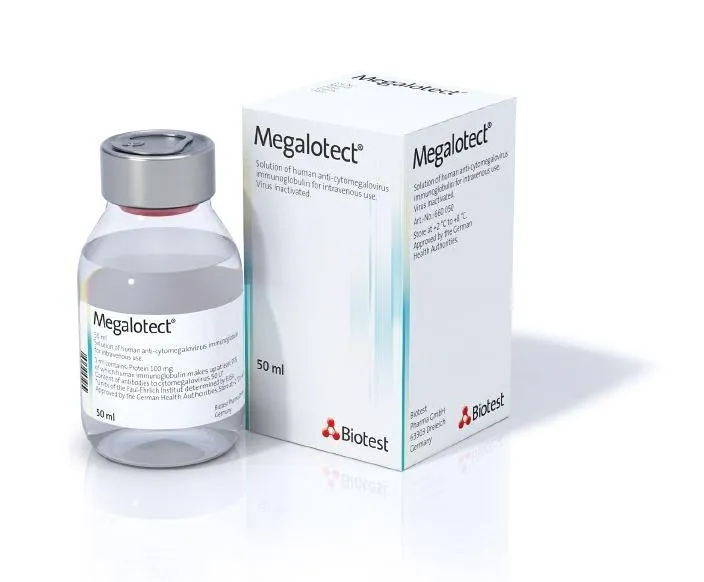
Table of Contents
- Package leaflet: Information for the user
- Introduction
- 1. What Megalotect is and what it is used for
- 2. What you need to know before using Megalotect
- Reactions to infusion
- If you notice any of the following signs of a reaction during the infusion of Megalotect, such as headache, flushing, chills, muscle pain, wheezing, rapid heartbeat, back pain, nausea, or low blood pressure, inform your doctor immediately.
- 3. How to use Megalotect
- 4. Possible adverse effects
- 5. Storage of Megalotect
- 6. Contents of the container and additional information
Package leaflet: Information for the user
Introduction
Package leaflet: information for the user
Megalotect 100 U/ml solution for infusion
Human cytomegalovirus immunoglobulin
Read the entire leaflet carefully before you start using this medicine, because it contains important information for you.
- Keep this leaflet, as you may need to read it again.
- If you have any questions, ask your doctor, pharmacist or nurse.
- This medicine has been prescribed for you only, and you should not give it to others, even if they have the same symptoms as you, because it could harm them.
- If you experience any adverse effects, consult your doctor, pharmacist or nurse, even if they are adverse effects not listed in this leaflet. See section 4.
Leaflet contents
- What Megalotect is and what it is used for
- What you need to know before using Megalotect
- How to use Megalotect
- Possible side effects
- How to store Megalotect
- Contents of the pack and other information
1. What Megalotect is and what it is used for
Megalotect
- belongs to the group of immunoglobulins. These medicines contain antibodies (antibodies are part of the body's immune system).
- contains antibodies against cytomegalovirus.
- is a solution for infusion administered by intravenous drip (infusion).
Megalotect is given to patients receiving immunosuppressive therapy (treatment to suppress the immune system), particularly after organ transplantation, to prevent the clinical manifestation of cytomegalovirus infection.
Your doctor will consider the concomitant use of antiviral agents with Megalotect.
2. What you need to know before using Megalotect
Do not use Megalotect
- if you are allergic to human anticytomegalovirus immunoglobulin or to any of the other components of this medicine (listed in section 6).
- if you have immunoglobulin A deficiency, particularly if you have antibodies against immunoglobulin A in your blood, as this may lead to anaphylaxis.
Warnings and precautions
Talk to your doctor, pharmacist, or nurse before receiving Megalotect.
- if you are receiving human immunoglobulin for the first time, after a prolonged interruption of treatment, or if the immunoglobulin product has been changed. In these cases, the frequency of adverse reactions may be higher, and your doctor will monitor you closely.
- if you are allergic to immunoglobulins (see section "Do not use Megalotect"). You may be allergic to immunoglobulins without knowing it, even if you have previously received them and tolerated them well. However, hypersensitivity reactions are rare.
- if you have an untreated infection or an underlying chronic inflammation
- if you
- are overweight or elderly,
- have high blood pressure (hypertension), diabetes, or a vasculopathy,
- have a greater tendency for blood to clot,
- have been bedridden for a long time,
- have low blood volume (hypovolemia) or abnormally high blood viscosity,
- have pre-existing kidney disease or are taking medicines that may harm the kidneys.
In these cases, there is an increased risk of experiencing adverse effects. Your doctor may interrupt treatment with Megalotect or take other precautionary measures (e.g. using a particularly low infusion rate).
Reactions to infusion
If you notice any of the following signs of a reaction during the infusion of Megalotect, such as headache, flushing, chills, muscle pain, wheezing, rapid heartbeat, back pain, nausea, or low blood pressure, inform your doctor immediately.
Inform your doctor immediately if you experience these reactions during administration of Megalotect. Your doctor will decide whether to reduce the infusion rate or stop it completely, and will initiate the necessary medical measures to manage such reactions.
Safety information regarding infections
Megalotect is prepared from human plasma (the liquid part of blood). When medicines derived from human blood or plasma are administered, certain measures must be taken to prevent infections from being transmitted to patients. The blood from all donors is tested for viruses and infections. In addition, the manufacturing process for blood or plasma includes steps that can inactivate or remove viruses.
Despite these measures, when medicines derived from human blood or plasma are administered, the possibility of transmitting infectious agents cannot be completely ruled out.
The measures taken are considered effective against viruses such as:
- human immunodeficiency virus (HIV),
- hepatitis A virus (HAV),
- hepatitis B virus (HBV),
- hepatitis C virus (HCV).
The measures taken have limited effectiveness against viruses such as:
- parvovirus B19.
To date, immunoglobulins have not been associated with hepatitis A or parvovirus B19 infections. This is because the antibodies contained in Megalotect provide protection against these infections.
We strongly recommend that you record the name and batch number of each dose of Megalotect you receive. The batch number provides information about the raw materials used in your medicine. This allows, if necessary, the relationship between you and the raw material used to be established.
Children and adolescents
The warnings and special precautions applicable to adults also apply to children and adolescents.
Other medicines and Megalotect
Inform your doctor or pharmacist if you are taking, have recently taken, or might need to take any other medicines.
Megalotect may reduce the effectiveness of certain vaccines, for example, the effectiveness of vaccines against:
- measles
- rubella
- mumps
- varicella
If you have received Megalotect, you should wait at least 3 months before receiving certain vaccines, and at least one year before receiving the measles vaccine.
Please avoid concomitant use of loop diuretics with Megalotect.
Children and adolescents
The interactions mentioned for adults are expected to be the same for children and adolescents.
Pregnancy, breastfeeding, and fertility
If you are pregnant or breastfeeding, think you might be pregnant, or are planning to become pregnant, consult your doctor or pharmacist before using this medicine.
Your doctor will decide whether Megalotect can be used during pregnancy and breastfeeding.
Driving and using machines
The influence of Megalotect on the ability to drive and operate machinery is minimal. If you experience adverse effects during treatment, wait until they resolve before driving or operating machinery.
3. How to use Megalotect
Your treating physician will administer Megalotect.
The recommended dose is 1 ml per kg of body weight per day for adults, children, and adolescents.
The medicine will be administered at least a total of 6 times, at intervals of 2 or 3 weeks. Your doctor will decide the exact number of infusions you need and when to start treatment.
Megalotect is administered via an intravenous infusion set ("drip"). This medicine must be at room or body temperature before use.
If you use more Megalotect than you should
An overdose of Megalotect may cause fluid overload and hyperviscosity (thickening) of the blood, especially if you are over 65 years of age and/or have cardiac or renal insufficiency.
If you think you have received more Megalotect than you should, consult your doctor as soon as possible.
In case of overdose or accidental ingestion, call the Toxicology Information Service immediately at 915620420.
If you have any further questions about the use of this medicine, ask your doctor, pharmacist, or nurse.
4. Possible adverse effects
Like all medicines, this medicine can cause adverse effects, although not everyone experiences them.
The following adverse effects have been reported spontaneously with Megalotect:
Not known: Frequency cannot be estimated from the available data
- Anaemia (haemolytic anaemia)
- Severe allergic reactions, such as anaphylactic shock, anaphylactic reactions, anaphylactoid reactions, hypersensitivity
- Headache, dizziness
- Vomiting
- Skin reactions such as rash, abnormal redness of the skin, itching
- Joint pain
- Blood test results indicating impaired kidney function (increased serum creatinine levels) and/or acute kidney injury
- Chills, fever, fatigue
Generally, normal human immunoglobulin preparations may cause the following adverse reactions (in decreasing frequency):
- Chills, headache, dizziness, fever, vomiting, allergic reactions, nausea, joint pain, low blood pressure, and moderate back pain
- Decrease in red blood cell count due to their destruction in blood vessels (haemolytic reactions [reversible]) and (rarely) haemolytic anaemia requiring blood transfusion
- (Rarely) sudden drop in blood pressure and, in isolated cases, anaphylactic shock
- (Rarely) transient skin reactions (including cutaneous lupus erythematosus, frequency not known)
- (Very rarely) thromboembolic reactions such as heart attack (myocardial infarction), stroke, blood clots in the blood vessels of the lungs (pulmonary embolism), clots in a vein (deep vein thrombosis)
- Cases of transient acute inflammation of the protective membranes covering the brain and spinal cord (aseptic spinal meningitis)
- Cases of blood test results indicating kidney dysfunction and/or sudden kidney failure
- Cases of transfusion-related acute lung injury (TRALI). This causes fluid accumulation unrelated to the heart in the air spaces of the lungs (non-cardiogenic pulmonary oedema). You would experience significant breathing difficulty (respiratory distress), rapid breathing (tachypnoea), abnormally low oxygen levels in the blood (hypoxia), and increased body temperature (fever).
Reporting of adverse effects
If you experience any type of adverse effect, talk to your doctor or pharmacist, even if it is a possible adverse effect not listed in this leaflet. You can also report them directly via the Spanish Pharmacovigilance System for Human Medicines: https://www.notificaram.es. By reporting adverse effects, you can help provide more information on the safety of this medicine.
5. Storage of Megalotect
Keep this medicine out of the sight and reach of children.
Do not use this medicine after the expiry date stated on the carton and vial after EXP.
Store in a refrigerator (between 2 °C and 8 °C). Keep in the original packaging to protect from light.
Do not freeze.
The product should be inspected visually before use: the solution should be transparent or slightly opalescent (with a milky appearance) and colourless or pale yellow. Do not use Megalotect if the solution is cloudy or if sediment has formed.
The medicine should be used immediately after opening.
Medicines must not be disposed of via wastewater or household waste. Ask your pharmacist how to dispose of medicines and packaging you no longer need. This will help protect the environment.
6. Contents of the container and additional information
Composition of Megalotect
The active substance is human anti-cytomegalovirus immunoglobulin (CMVIG).
1 ml of solution contains:
50 mg of human plasma proteins, of which at least 96% is immunoglobulin G (IgG), with an anti-cytomegalovirus (CMV) antibody content of 100 U*.
Each 10 ml vial contains: 500 mg of human plasma proteins (of which at least 96% is immunoglobulin G), with an anti-CMV antibody content of 1,000 U*.
Each 50 ml vial contains: 2,500 mg of human plasma proteins (of which at least 96% is immunoglobulin G), with an anti-CMV antibody content of 5,000 U*.
The distribution of IgG subclasses is approximately 65% IgG1, 30% IgG2, 3% IgG3, 2% IgG4.
Maximum content of immunoglobulin A (IgA) is 2,000 micrograms/ml.
- Units of the Paul Ehrlich Institute reference preparation
The other components are glycine and water for injections.
Appearance of the product and contents of the container
Megalotect is a transparent or slightly opalescent (milky-appearing), colorless or slightly yellowish solution in colorless glass vials.
Megalotect is available in the following pack sizes:
One carton contains 1 vial with 10 ml (1,000 U) of infusion solution
One carton contains 1 vial with 50 ml (5,000 U) of infusion solution
Only some pack sizes may be marketed.
Marketing Authorization Holder and Manufacturer
Biotest Pharma GmbH
Landsteinerstraße 5
63303 Dreieich
Germany
Tel.: +49 6103 801-0
Fax: +49 6103 801-150
E-mail: [email protected]
For further information about this medicinal product, please contact the local representative of the Marketing Authorization Holder:
Grifols Movaco, S.A.
Can Guasc, s/n – Parets del Vallès
08150 Barcelona
Spain
This medicinal product is authorized in the Member States of the European Economic Area under the following names:
Croatia, Germany, Hungary: Cytotect CP Biotest
Austria: Cytotect CP Biotest 100 E/ml Infusionslösung
Italy: Cytomegatect
Spain: Megalotect 100 U/ml solution for infusion
Greece, Poland, Portugal: Megalotect CP
Belgium, Netherlands: Megalotect 100 E/ml
Slovenia: Megalotect 100 e./ml raztopina za infundiranje
Date of the most recent review of this summary: 05/2023
This information is intended for healthcare professionals only:
Dosage and method of administration
Administration should begin on the day of transplantation. In the case of bone marrow transplantation, prophylaxis may also be initiated up to 10 days before the procedure, especially in CMV-seropositive patients. At least a total of 6 doses should be administered at intervals of 2 to 3 weeks.
Method of administration
Intravenous route.
Megalotect is administered intravenously by infusion at an initial rate of 0.08 ml/kg body weight/hour for 10 minutes. If an adverse reaction occurs, the infusion rate should be reduced or the infusion stopped. If well tolerated, the infusion rate may be gradually increased to a maximum of 0.8 ml/kg body weight/hour for the remainder of the infusion.
Warnings and precautions
The infusion rate may be associated with certain serious adverse reactions to the medicinal product. The recommended infusion rate must be strictly followed. Patients must be closely monitored and carefully observed for any symptoms during the infusion period.
Adverse reactions may occur more frequently:
- with a high infusion rate
- in patients receiving human immunoglobulin for the first time, or in rare cases when switching from another immunoglobulin product, or when a long time has passed since the last infusion.
Possible complications may often be avoided by ensuring that:
- patients are not sensitive to human immunoglobulin. Therefore, initially administer the product slowly (0.08 ml/kg body weight/hour).
- patients are carefully monitored during the infusion period for any symptoms. In particular, patients who have not previously been treated with human immunoglobulin, patients switching from other intravenous human immunoglobulin (IVIG) products, or those in whom a long time has passed since the last infusion, must be monitored in hospital during the first infusion and for the first hour after the first infusion for possible adverse effects. Other patients should be observed for at least 20 minutes after administration.
If an adverse reaction occurs, the infusion rate should be reduced or the infusion stopped. The required treatment depends on the type, nature, and severity of the adverse reaction.
In case of shock, standard medical treatment should be applied.
In all patients, immunoglobulin therapy requires:
- adequate hydration prior to starting immunoglobulin infusion
- monitoring of urine output
- monitoring of serum creatinine levels
- avoidance of concomitant use of loop diuretics
Hypersensitivity
Hypersensitivity reactions are uncommon. They may occur in patients with anti-IgA antibodies.
Anaphylaxis may develop in patients
- with undetectable IgA who have anti-IgA antibodies
- who have previously tolerated treatment with human immunoglobulin
In case of shock, standard medical treatment should be applied.
Thromboembolism
Clinical evidence indicates an association between intravenous immunoglobulin (IVIG) administration and thromboembolic events such as myocardial infarction, stroke, pulmonary embolism, and deep vein thrombosis. These events are believed to be related to a relative increase in blood viscosity due to the high influx of immunoglobulin in at-risk patients. Caution is advised when prescribing and administering immunoglobulins to obese patients and to patients with pre-existing risk factors for thrombotic events (such as advanced age, hypertension, diabetes mellitus, history of vasculopathy or thrombotic episodes, patients with acquired or hereditary thrombophilias, patients immobilized for prolonged periods, severely hypovolemic patients, or patients with conditions that increase blood viscosity).
In patients at risk of thromboembolic adverse reactions, IVIG products should be administered at the lowest possible infusion rate and at the lowest effective dose.
Acute renal failure
Cases of acute renal failure have been reported in patients treated with intravenous immunoglobulin (IVIG). In most cases, risk factors have been identified, such as pre-existing renal insufficiency, diabetes mellitus, hypovolemia, obesity, concomitant use of nephrotoxic drugs, or age over 65.
Renal parameters should be evaluated before IVIG infusion, especially in patients considered at higher potential risk of developing acute renal failure, and again at appropriate intervals. In patients at risk of acute renal failure, IVIG products should be administered at the lowest possible infusion rate and dose.
In case of renal insufficiency, discontinuation of the immunoglobulin product should be considered.
Although reports of renal dysfunction and acute renal failure have been associated with the use of many authorized IVIG-containing medicinal products that include various excipients such as sucrose, glucose, and maltose, those containing sucrose as a stabilizer accounted for a disproportionate share of the total number. In at-risk patients, immunoglobulin products not containing these excipients should be considered. Megalotect does not contain sucrose, glucose, or maltose.
Aseptic Meningitis Syndrome (AMS)
AMS has been reported in association with intravenous immunoglobulin (IVIG) therapy. The syndrome typically begins several hours to 2 days after initiation of IVIG treatment. Cerebrospinal fluid (CSF) analysis is frequently positive, showing pleocytosis up to several thousand cells/mm³, predominantly granulocytic, and elevated protein concentrations up to several hundred mg/dl. AMS occurs more frequently in association with high-dose IVIG treatment (2 g/kg).
Patients presenting with these signs and symptoms should undergo a thorough neurological examination, including cerebrospinal fluid (CSF) studies, to rule out other causes of meningitis.
Discontinuation of IVIG therapy has resulted in resolution of AMS within several days without sequelae.
Hemolytic anemia
Intravenous immunoglobulins (IVIG products) may contain blood group antibodies that act as hemolysins and induce in vivo coating of red blood cells with immunoglobulin, leading to a positive direct antiglobulin test (positive direct Coombs test) and, rarely, hemolysis. Hemolytic anemia may develop as a consequence of IVIG treatment and may be potentiated by erythrocyte sequestration. Patients receiving IVIG should be monitored for clinical signs and symptoms of hemolysis.
Neutropenia/Leukopenia
A transient decrease in neutrophil count and/or episodes of neutropenia, sometimes severe, have been reported after IVIG treatment. This typically occurs within hours or days after IVIG administration and resolves spontaneously within 7 to 14 days.
Transfusion-Related Acute Lung Injury (TRALI)
Non-cardiogenic acute lung injury (transfusion-related acute lung injury, TRALI) has occasionally been reported in patients receiving IVIG. TRALI is characterized by severe hypoxia, dyspnea, tachypnea, cyanosis, fever, and hypotension. Symptoms of TRALI usually develop during or within 6 hours after infusion, often within the first 1–2 hours. Therefore, recipients of IVIG should be closely monitored, and IVIG infusion should be immediately stopped in case of pulmonary adverse reactions. TRALI is a potentially life-threatening condition that requires immediate treatment in an intensive care unit.
Interference with serological tests
After administration of immunoglobulin, the transient increase in various passively transferred antibodies in the patient's blood may lead to false-positive results in serological tests.
Passive transfer of antibodies to erythrocyte antigens, e.g., A, B, and D, may interfere with certain serological tests for erythrocyte antibodies, such as the direct antiglobulin test (DAT, direct Coombs test).
Incompatibilities and special handling precautions
This medicinal product must not be mixed with other medicinal products, including other IVIG products.
The medicine should be used immediately after opening.
The medicine should be at room or body temperature before use.
Products should be inspected visually before administration. The solution should be clear or slightly opalescent and colorless or pale yellow. Do not use a solution that is cloudy or contains sediment.