Manidipino Viatris 10 mg tablets EFG
Spain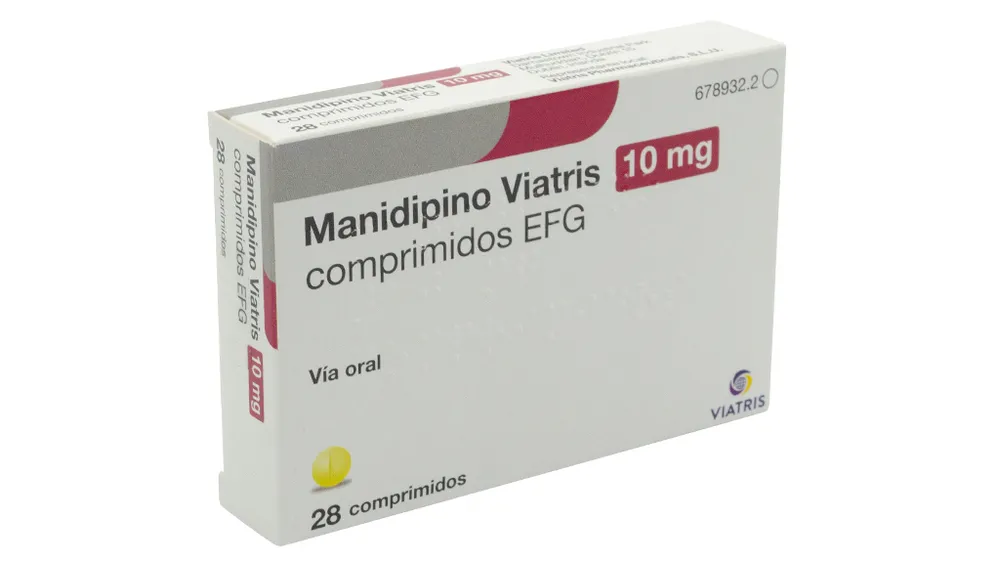
Table of Contents
Package leaflet: Information for the user
Introduction
Package leaflet: Information for the user
Manidipino Viatris 10 mg tablets EFG
Read the entire leaflet carefully before you start taking this medicine because it contains important information for you.
- Keep this leaflet as you may need to read it again.
- If you have any questions, ask your doctor or pharmacist.
- This medicine has been prescribed for you only and must not be given to other people, even if they have the same symptoms as you, because it could harm them.
- If you experience any adverse effects, consult your doctor or pharmacist, even if they are adverse effects not listed in this leaflet. See section 4.
Contents of the leaflet
- What Manidipino Viatris is and what it is used for
- What you need to know before taking Manidipino Viatris
- How to take Manidipino Viatris
- Possible side effects
- How to store Manidipino Viatris
- Contents of the pack and other information
1. What Manidipino Viatris is and what it is used for
Manidipino Viatris tablets contain 10 mg of the active substance manidipino dihydrochloride, which belongs to a group of medicines called dihydropyridine calcium channel blockers.
Manidipino is indicated for the treatment of mild to moderate essential arterial hypertension (high blood pressure).
Manidipino works by relaxing blood vessels, thereby reducing blood pressure.
2. What you need to know before taking Manidipino Viatris
Do not take Manidipino Viatris
- If you are allergic to manidipine, other dihydropyridines, or any other ingredient of this medicine (listed in section 6).
- If you have unstable angina (chest pain not caused by stress, physical exertion, or occurring at night) or have had a heart attack within the past 4 weeks (myocardial infarction).
- If you have untreated congestive heart failure.
- If you have severe renal impairment (creatinine clearance <10 ml/min).
- If you have moderate to severe hepatic impairment.
- If you are a child.
Warnings and precautions
Consult your doctor or pharmacist before taking Manidipino Viatris
- If you have mild liver problems, as the effects of manidipine may be increased (see section 3 “How to take Manidipino Viatris”).
- If you are elderly, a dose reduction may be recommended (see section 3 “How to take Manidipino Viatris”).
- If you are undergoing peritoneal dialysis.
- If you have heart problems such as left-sided heart valve disorders causing reduced blood flow, one-sided heart failure, or a very slow heartbeat due to electrical activity disturbances in the heart not controlled by a pacemaker.
Other medicines and Manidipino Viatris
Inform your doctor or pharmacist if you are taking, have recently taken, or might need to take any other medicines, including those obtained without a prescription, or medicines for the following conditions:
- High blood pressure, such as diuretics, beta-blockers, or prazosin.
- Viral or bacterial infections, such as ketoconazole, itraconazole, erythromycin, clarithromycin, or rifampicin.
- Mental disorders, such as antidepressants and antipsychotics.
- Epilepsy, such as phenytoin, carbamazepine, or phenobarbital.
- Chemotherapy and radiotherapy, such as amifostine.
- HIV treatment, such as protease inhibitors.
- Stomach problems, such as cimetidine.
- Irregular heartbeat (such as amiodarone, quinidine, digoxin).
- Muscle stiffness and limited movement, such as baclofen.
- Allergies (such as terfenadine, astemizole).
- Swelling or increased immune system activity, or when pituitary and adrenal glands are not functioning properly, such as corticosteroids or tetracosactide.
- Enlarged prostate gland, such as alfuzosin, doxazosin, tamsulosin, or terazosin.
Manidipino Viatris with food and drinks
Do not drink alcohol or grapefruit juice during treatment with manidipine, as both alcohol and grapefruit juice may lower blood pressure.
Pregnancy and breastfeeding
Manidipine must not be taken during pregnancy. The use of manidipine should be avoided during breastfeeding, as it is unknown whether this medicine passes into breast milk. If treatment with manidipine is necessary, breastfeeding must be discontinued.
Fertility
Abnormalities in sperm heads have been reported, which may impair fertility in patients treated with medicines such as manidipine.
If you are pregnant or breastfeeding, think you may be pregnant, or are planning to have a baby, consult your doctor or pharmacist before taking this medicine.
Driving and using machines
This medicine may cause drowsiness; therefore, caution is advised when driving or operating machinery.
Manidipino Viatris contains lactose
If your doctor has informed you that you have an intolerance to certain sugars, consult your doctor before taking this medicine.
3. How to take Manidipino Viatris
Always follow exactly the instructions given by your doctor or pharmacist for taking this medicine. You should consult your doctor or pharmacist if you have any doubts.
If you notice that the effect of manidipine is too strong or too weak, consult your doctor or pharmacist.
Use in children and adolescents
Children and adolescents must not take Manidipino Viatris.
Duration of treatment
Your doctor will tell you how long to take the medicine. Do not stop treatment until your doctor tells you to do so.
Method of administration
The tablets should be taken in the morning after breakfast, without chewing and with a little liquid.
The recommended starting dose is 10 mg once daily.
If after 2–4 weeks of treatment the antihypertensive effect of manidipine is not sufficient, your doctor may increase the dose to 20 mg once daily.
The break line is only intended to help divide the tablet if you have difficulty swallowing it.
Elderly patients or if you have renal or hepatic impairment
If you are elderly or if you suffer from renal or hepatic impairment, your doctor may prescribe a lower dose (10 mg once daily).
If you take more Manidipino Viatris than you should
If you (or someone else) ingest a large number of tablets at the same time, or if you think a child has taken any of the tablets, contact immediately the nearest hospital emergency department or your doctor. As with other calcium channel blockers, an overdose is expected to cause blood vessel dilation, which could lead to low blood pressure and increased heart rate.
In case of overdose or accidental ingestion, contact your doctor or pharmacist immediately or call the Toxicology Information Service at telephone number: 91 562 04 20, indicating the medicine and the amount ingested.
If you forget to take Manidipino Viatris
If you miss a dose, take it as soon as possible and then take the following doses as prescribed.
Do not take a double dose to make up for the missed dose.
If you stop taking Manidipino Viatris
Before stopping Manidipino Viatris, contact your doctor.
If you have any doubts about how to take this medicine, consult your doctor or pharmacist.
4. Possible adverse effects
Like all medicines, this medicine can cause adverse effects, although not everybody gets them.
The following serious adverse effects may occur while taking Manidipino Viatris. If any of these occur, consult your doctor or go to the nearest hospital.
Very rare (may affect up to 1 in 10,000 people)
- Heart attack; in some patients with pre-existing angina, an increase in frequency, duration, and severity of these episodes may be observed.
Other possible adverse effects
Frequent (may affect up to 1 in 10 people)
- Headache.
- Dizziness.
- Vertigo.
- Swelling caused by fluid retention (edema).
- Fast or irregular heartbeat (palpitations).
- Hot flushes.
Uncommon (may affect up to 1 in 100 people)
- Tingling sensation of the skin.
- Weakness or lack of energy.
- Increased heart rate.
- Low blood pressure.
- Difficulty breathing.
- Malaise (nausea).
- Vomiting.
- Constipation.
- Dry mouth.
- Digestive disorders.
- Skin rashes.
- Eczema.
- Increase in liver enzymes and/or increase in kidney parameters (may be seen in blood tests).
Rare (may affect up to 1 in 1,000 people)
- Sleepiness.
- Somnolence.
- Elevated blood pressure.
- Stomach pain.
- Abdominal pain.
- Skin redness.
- Itching and irritability.
- Increase in bilirubin, which may be seen in blood tests.
- Diarrhea.
- Loss of appetite (anorexia).
- Yellowish discoloration of the skin or the whites of the eyes (jaundice).
Very rare (may affect up to 1 in 10,000 people)
- Inflammation or changes in the gums, which usually resolves upon discontinuation of treatment.
Frequency not known (cannot be estimated from available data)
- Skin peeling or shedding, small spots on the skin.
- Extrapyramidal syndrome has been reported with other medicines of this class.
- Muscle pain.
- Breast enlargement, with or without tenderness, in men (gynecomastia).
- Cloudy fluid (when performing dialysis through a tube in the abdomen).
Reporting of adverse effects:
If you experience any type of adverse effect, talk to your doctor or pharmacist, even if it is a possible adverse effect not listed in this leaflet. You can also report them directly via the Spanish Pharmacovigilance System for Human Medicinal Products: https://www.notificaram.es . By reporting adverse effects, you can help provide more information on the safety of this medicine.
5. Storage of Manidipino Viatris
Keep this medicine out of the sight and reach of children.
Do not use manidipino after the expiry date stated on the packaging after EXP. The expiry date refers to the last day of the month indicated.
This medicine does not require any special storage conditions.
Medicines must not be disposed of via wastewater or household waste. Any unused medicines or waste materials, including packaging, should be returned to the SIGRE point at your pharmacy. If you are unsure, ask your pharmacist how to dispose of medicines and packaging you no longer need. This will help protect the environment.
6. Information provided
Contents of Manidipino Viatris
The active substance is manidipine dihydrochloride 10 mg.
Each tablet contains 10 mg of manidipine dihydrochloride.
The other components are lactose monohydrate (see section 2 “Manidipino Viatris contains lactose”), corn starch, low-substituted hydroxypropylcellulose, hydroxypropylcellulose, magnesium stearate, riboflavin.
Appearance of Manidipino Viatris and contents of the pack
The tablets are round, convex, yellow in colour, with a central break line.
Manidipino Viatris is available in pack sizes of 14, 28, 30, 56, 84, 90, 98 and 112 tablets.
Only certain pack sizes may be marketed.
Marketing Authorization Holder and Manufacturer
Marketing Authorization Holder
Viatris Limited
Damastown Industrial Park
Mulhuddart, Dublin 15
Dublin
Ireland
Manufacturer
Abiogen Pharma SpA
Via Meucci 36, Ospedaletto
56014 Pisa – Italy
or
Doppel Farmaceutici S.r.l.
Via Volturno, 48
20089 Quinto de Stampi, Rozzano, Milano
Italy
or
Vamfarma S.r.l.
Via Kennedy, 5
26833 Comazzo
Italy
For further information about this medicinal product, please contact the local representative of the Marketing Authorization Holder:
Viatris Pharmaceuticals, S.L.U.
C/ General Aranaz, 86
28027 - Madrid
Spain
This medicinal product has been authorised in the Member States of the European Economic Area under the following names:
Spain: Manidipino Viatris 10 mg tablets EFG
France: Manidipine Viatris 10 mg tablet
Date of latest revision of the package leaflet: November 2024
Detailed information on this medicine is available on the website of the Spanish Agency of Medicines and Health Products (AEMPS) https://www.aemps.gob.es/