Manidipino Cinfa 20 mg tablets EFG
Spain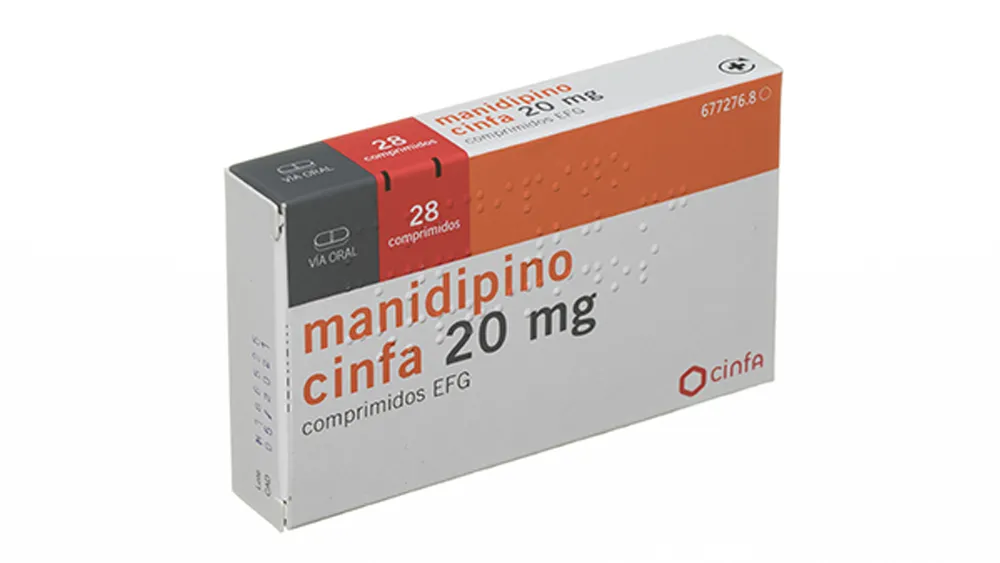
Table of Contents
- Package leaflet: Information for the user
- Introduction
- 1. What manidipino cinfa is and what it is used for
- 2. What you need to know before starting to take manidipino cinfa
- **Do not take manidipino cinfa**
- 3. How to take manidipino cinfa
- 4. Possible adverse effects
- 5. Storage of manidipino cinfa
- 6. Contents of the pack and other information
Package leaflet: Information for the user
Introduction
Package leaflet: information for the user
manidipino cinfa 20 mg tablets EFG
Manidipine hydrochloride
Read all of this leaflet carefully before you start taking this medicine, because it contains important information for you.
- Keep this leaflet. You may need to read it again.
- If you have any questions, ask your doctor or pharmacist.
- This medicine has been prescribed for you only, and you should not give it to others, even if they have the same symptoms as you. It may harm them.
- If you experience any adverse reactions, consult your doctor or pharmacist, even if they are adverse reactions not listed in this leaflet. See section 4.
Contents of the leaflet
- What manidipino cinfa is and what it is used for
- What you need to know before taking manidipino cinfa
- How to take manidipino cinfa
- Possible side effects
- How to store manidipino cinfa
- Contents of the pack and other information
1. What manidipino cinfa is and what it is used for
manidipino cinfa contains manidipino hydrochloride as the active substance. Manidipino belongs to a group of medicines called calcium channel blockers, which block the flow of calcium into smooth muscle cells of blood vessels, causing vasodilation and the resulting reduction in blood pressure.
manidipino cinfa is indicated for the treatment of high blood pressure (mild to moderate essential hypertension).
2. What you need to know before starting to take manidipino cinfa
Do not take manidipino cinfa
- If you are allergic to manidipine, to other calcium channel blockers, or to any of the other ingredients of this medicine (listed in section 6).
- If you have severe kidney disease.
- If you have heart problems, for example if you have had a myocardial infarction within the last 4 weeks, or if you suffer from unstable angina (chest pain due to inadequate oxygen supply to the heart), or if you have heart failure and are not receiving specific treatment;
- If you have moderate or severe liver disease.
Manidipine must not be administered to children or adolescents under 18 years of age.
Warnings and precautions
Talk to your doctor or pharmacist before starting to take manidipino cinfa
- If you have certain heart problems (for example, left ventricular dysfunction, obstruction of the left ventricular outflow tract, right-sided heart failure in patients with untreated sick sinus syndrome without a pacemaker).
- If you have heart rhythm disorders.
- If you are elderly or have mild liver problems (see section 3 “How to take manidipino cinfa”).
- If you are undergoing peritoneal dialysis.
You should also inform your doctor:
- If you are pregnant, think you may be pregnant, are trying to become pregnant, or are breastfeeding (see section “Pregnancy and Breast-feeding”).
Taking manidipino cinfa with other medicines
Tell your doctor or pharmacist if you are taking, have recently taken, or might need to take any other medicines.
It is especially important that you tell your doctor if you are taking any of the following medicines:
- Diuretics (used to remove water from the body by increasing urine production) and other medicines that lower blood pressure, such as beta-blockers or other antihypertensive drugs. These medicines may increase the blood pressure-lowering effect of manidipine;
- Medicines that may affect the metabolism of the active substance in manidipine, such as antiprotease drugs, cimetidine (used to treat gastric ulcers), or certain antibiotics (used to treat bacterial infections, such as clarithromycin, erythromycin, and rifampicin), or certain antifungals (used to treat fungal infections, such as ketoconazole and itraconazol), or phenytoin, carbamazepine, phenobarbital, terfenadine, astemizole, or class III antiarrhythmics used for heart rhythm disorders (such as amiodarone and quinidine);
- Medicines containing digoxin, used in the treatment of heart disorders.
If you are taking any of the medicines listed above, your doctor may prescribe a different medicine or adjust the dose of manidipine or of another medicine.
Taking manidipino cinfa with food, drinks and alcohol
Do not take manidipine with grapefruit juice, as blood pressure may drop too much. Alcohol consumption may enhance the blood pressure-lowering effect of manidipine.
Pregnancy and breast-feeding
If you are pregnant or breastfeeding, think you may be pregnant, or plan to become pregnant, consult your doctor or pharmacist before using this medicine.
Pregnancy
Talk to your doctor if you are pregnant, think you may be pregnant, or are trying to become pregnant.
Since manidipine should not be taken during pregnancy, your doctor will advise you to stop treatment before becoming pregnant or as soon as you know you are pregnant, and will recommend appropriate alternative treatment.
Breast-feeding
Talk to your doctor if you are breastfeeding or before starting to breastfeed. Manidipine should be avoided in women who are breastfeeding. If treatment with manidipine cannot be discontinued, your doctor will advise you to stop breastfeeding.
Talk to your doctor or pharmacist before using any medicine.
Driving and using machines
Occasionally, in some patients during treatment for high blood pressure, this medicine may cause dizziness. In such cases, you should discuss this with your doctor before engaging in activities such as driving or operating machinery.
manidipino cinfa contains lactose.
If your doctor has informed you that you have an intolerance to certain sugars, consult him before taking this medicine.
3. How to take manidipino cinfa
Follow exactly the instructions for use of this medicine provided by your doctor or pharmacist. If in doubt, consult your doctor or pharmacist again.
Dosage
Initially, the recommended dose of manidipino is 10 mg once daily. After 2–4 weeks, if the reduction in blood pressure is considered insufficient, your doctor may increase this dose to 20 mg once daily (recommended maintenance dose).
Manidipino must not be administered to children or adolescents (see section “Do not take manidipino cinfa”).
Dose reduction
If you are elderly, or if you have any kidney or liver disease, your doctor may prescribe a reduced dose.
Administration
Manidipino should be taken in the morning after breakfast. The tablet should be swallowed whole, without chewing, with an adequate amount of water.
Try to take your daily dose at the same time each day.
Duration of treatment
It is important that you continue taking manidipino until your doctor tells you otherwise. Take exactly the prescribed dose and do not modify it without first speaking to your doctor.
If you take more manidipino cinfa than you should
In case of overdose or accidental ingestion, contact your doctor or pharmacist immediately or call the Toxicology Information Service at telephone number 91 562 04 20, indicating the medicine and the amount ingested.
If you forget to take manidipino cinfa
If you forget to take a dose of manidipino, take the next dose as scheduled.
Do not take a double dose to make up for forgotten doses.
If you stop taking manidipino cinfa
It is important that you continue taking manidipino until your doctor tells you otherwise.
If you have any further questions about the use of this medicine, ask your doctor or pharmacist.
4. Possible adverse effects
Like all medicines, this medicine can cause adverse effects, although not everyone experiences them.
If adverse effects occur, they will mainly be mild and temporary. However, some adverse effects may be serious and require medical attention.
Frequent adverse effects (may affect up to 1 in 10 patients):
Fluid accumulation in tissues causing swelling (edema), hot flushes, dizziness, palpitations.
Uncommon adverse effects (may affect up to 1 in 100 patients):
Painful tingling or numbness (paresthesia), increased heart rate (tachycardia), reduction in blood pressure (hypotension), difficulty breathing (dyspnea), weakness, dry mouth, nausea, vomiting, constipation, gastrointestinal discomfort, skin rash, skin inflammation with redness and itching (eczema), transient abnormalities in laboratory blood tests of certain enzymes (ALT, AST, LDH, GammaGT, ALP, blood urea nitrogen and blood creatinine).
Rare adverse effects (may affect up to 1 in 1,000 patients):
Irritability, skin redness, itching, stomach pain (gastralgia), abdominal pain, drowsiness, chest pain, chest pain due to inadequate blood supply to the heart (angina pectoris), diarrhea, decreased appetite (anorexia), abnormal blood test results (e.g., increased blood bilirubin), jaundice.
Very rare adverse effects (may affect up to 1 in 10,000 patients):
Myocardial infarction, in patients with pre-existing angina pectoris may experience an increase in frequency, duration or severity of these attacks, inflammation or changes in the gums, which require careful dental care but usually resolve upon discontinuation of treatment.
Adverse effects of unknown frequency (cannot be estimated from available data):
Abnormal redness of the skin (erythema multiforme), skin disease with abnormal redness and scaling (exfoliative dermatitis), muscle pain, breast swelling with or without pain in men (gynecomastia), cloudy fluid (when performing dialysis through a tube in the abdomen).
Reporting of adverse effects
If you experience any type of adverse effect, consult your doctor or pharmacist, even if it is a possible adverse effect not listed in this leaflet. You may also report them directly via the Spanish Pharmacovigilance System for Human Medicinal Products: https://www.notificaram.es. By reporting adverse effects, you can help provide more information on the safety of this medicine.
5. Storage of manidipino cinfa
Keep this medicine out of the sight and reach of children.
Do not use this medicine after the expiry date stated on the packaging after EXP. The expiry date is the last day of the month indicated.
This medicine does not require any special storage conditions.
Medicines must not be disposed of via wastewater or household waste. Dispose of unused medicines and their containers at the SIGRE point at your pharmacy. If in doubt, ask your pharmacist how to dispose of medicines and containers you no longer need. This will help protect the environment.
6. Contents of the pack and other information
Composition of manidipino cinfa
- The active substance is manidipino hydrochloride, 20 mg.
- The other components are monohydrate lactose, corn starch, low-substituted hydroxypropylcellulose, hydroxypropylcellulose, magnesium stearate and riboflavin (E-101).
Appearance of the product and contents of the pack
manidipino cinfa 20 mg tablets are presented as yellow oval, scored tablets.
Each pack contains 28 tablets.
Marketing Authorization Holder and Manufacturer
Marketing Authorization Holder
Laboratorios Cinfa, S.A.
Carretera Olaz-Chipi, 10. Polígono Industrial Areta
31620-Huarte (Navarra) – Spain
Manufacturer
ABIOGEN PHARMA S.P.A
Via Meucci, 36
56121 Ospedaletto, Italy
or
DOPPEL FARMACEUTICI, S.R.L.
Via Volturno, 48 Quinto De Stampi
I-20089 Rozzano, Milan, Italy
or
Laboratorios Cinfa, S.A.
Carretera Olaz-Chipi, 10. Polígono Industrial Areta
31620-Huarte (Navarra) – Spain
or
VAMFARMA, S.R.L.
Via Kennedy, 5
26833 Comazzo (LO)
Italy
Date of the most recent revision of this leaflet: September 2024
Detailed and up-to-date information on this medicinal product is available on the website of the Spanish Agency of Medicines and Health Products (AEMPS) http://www.aemps.gob.es/
You can access detailed and updated information about this medicine by scanning with your mobile phone (smartphone) the QR code included in the package leaflet and outer packaging. You may also access this information at the following internet address: https://cima.aemps.es/cima/dochtml/p/73230/P_73230.html
QR code: https://cima.aemps.es/cima/dochtml/p/73230/P_73230.html