Madopar 200 mg/50 mg tablets
Spain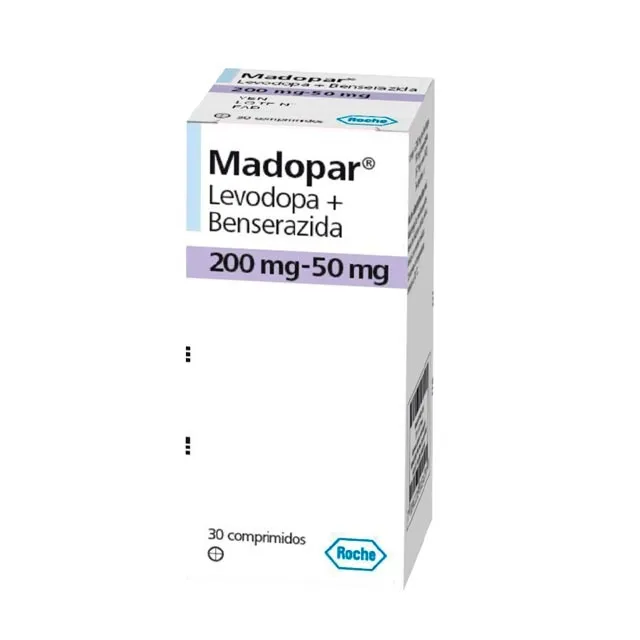
Table of Contents
Package leaflet: Information for the user
Introduction
Package leaflet: information for the user
Madopar 200 mg/50 mg tablets
Levodopa / Benserazide
Read all of this leaflet carefully before you start taking this medicine because it contains important information for you.
- Keep this leaflet as you may need to read it again.
- If you have any further questions, ask your doctor or pharmacist.
- This medicine has been prescribed for you only and must not be given to other people, even if they have the same symptoms as you. It could harm them.
- If you get any side effects, talk to your doctor or pharmacist. This includes any side effects not listed in this leaflet. See section 4.
Contents of the leaflet
- What Madopar is and what it is used for
- What you need to know before taking Madopar
- How to take Madopar
- Possible side effects
- How to store Madopar
- Contents of the pack and other information
1. What Madopar is and what it is used for
Madopar is indicated for the treatment of Parkinson's disease.
Madopar contains two active substances, levodopa and benserazide.
Madopar works as follows:
- In your body, levodopa is converted into dopamine. Dopamine is the active substance your brain needs to treat Parkinson's disease.
- Benserazide allows more of the administered levodopa to reach your brain before levodopa is converted into dopamine.
2. What you need to know before taking Madopar
Do not take Madopar
- if you are allergic (hypersensitive) to levodopa or benserazide or to any of the other components of this medicine (listed in section 6).
- if you are taking medicines known as MAO inhibitors (medicines used to treat depression), except selegiline, rasagiline, and moclobemide.
- if you have closed-angle glaucoma, high pressure in the eye.
- if you have severe endocrine disorders: phaeochromocytoma (a tumour of the adrenal gland causing high blood pressure), hyperthyroidism (overactive thyroid gland), Cushing's syndrome (excess of the hormone cortisol).
- if you have severe kidney, liver, or heart disorders.
- if you have severe psychiatric disorders with psychotic components (personality disturbances and loss of contact with reality).
- if you are under 25 years of age.
- if you are pregnant or breastfeeding.
- if you become pregnant during treatment with Madopar, inform your doctor immediately.
Warnings and precautions
Talk to your doctor or pharmacist before starting Madopar:
- if you have mild or moderate liver or kidney impairment.
- if you have diabetes, as you may require more frequent blood sugar monitoring.
- if you have open-angle glaucoma, your doctor may perform periodic checks of your intraocular pressure.
- if you have orthostatic hypotension (low blood pressure associated with changes in posture, causing dizziness).
- if you have ever had a heart attack or heart problems, your cardiac function will be monitored at the start of treatment and periodically throughout treatment.
- if you notice that you fall asleep suddenly during the day or feel excessively sleepy (see also section “Driving and use of machines”).
- if you have any other illness before starting treatment with Madopar.
- if you are scheduled for surgery, as your doctor may need to interrupt your Madopar treatment.
When starting treatment, blood tests may be requested to monitor liver function and other blood parameters.
At the beginning of treatment, you may experience a temporary worsening of symptoms, which improves with appropriate dose adjustment.
This medicine may alter the results of certain laboratory tests.
Before starting and during treatment, periodic skin examinations should be performed.
After prolonged treatment, involuntary movements or episodes of freezing may occur, which can be reduced or eliminated by lowering the dose.
Depression and suicidal thoughts may occur during treatment with Madopar, although they may also be due to your underlying disease. If you feel depressed during treatment, contact your doctor.
In some patients treated with medicines for Parkinson's disease, cases of pathological gambling, increased sexual desire, compulsive spending, excessive or compulsive eating have been reported, all of which may be related to taking higher than prescribed doses of medication.
You should continue your treatment as directed by your doctor. Stopping suddenly could cause potentially life-threatening side effects (see section 3).
Use in children
Madopar must not be given to children or patients under 25 years of age.
Taking Madopar with other medicines
Inform your doctor or pharmacist if you are taking, have recently taken, or might need to take any other medicines.
This is extremely important because taking more than one medicine at the same time may increase or reduce the effect of Madopar. Therefore, you should not take Madopar with any other medicine unless specifically prescribed by your doctor.
Madopar should be used with caution when taken together with certain medicines such as:
- monoamine oxidase inhibitors (MAO inhibitors) (used to treat depression). Combining these medicines with Madopar could cause excessively high blood pressure. This could also occur if you have taken an MAO inhibitor within the last two weeks (see 'Do not take Madopar', above).
- other medicines used to treat Parkinson's disease, as they may increase adverse effects.
- ferrous sulfate (used to treat iron deficiency).
- metoclopramide and domperidone (used to treat digestive disorders).
- medicines belonging to a group called opioids (used to relieve pain).
- antihypertensive medicines containing reserpine.
- neuroleptic medicines (used to treat certain psychiatric disorders including anxiety, severe schizophrenia, nausea, dizziness, and hiccups).
- antipsychotic medicines.
- dose adjustment of levodopa is recommended when used with antidepressant medicines.
- medicines used to treat high blood pressure: your blood pressure could become too low. Your doctor may need to adjust the dose of your antihypertensive treatment.
- medicines belonging to a group called sympathomimetics, such as epinephrine, norepinephrine, isoproterenol, and amphetamines, should not be used at the same time as Madopar: the effect of these medicines could be enhanced. Your doctor may need to adjust the dose of your sympathomimetic treatment.
Madopar may interfere with laboratory tests measuring levels of certain chemicals in the blood. Urine tests may give false positive results for ketones.
Taking Madopar with food and drinks
The absorption of levodopa may be delayed by high-protein foods.
It is recommended to take the medicine at least 30 minutes before or 1 hour after meals. Gastrointestinal side effects, which may occur mainly at the beginning of treatment, can be managed by taking Madopar with a low-protein food (e.g. a biscuit) or with liquid.
Pregnancy and breastfeeding
If you are pregnant or breastfeeding, think you might be pregnant, or are planning to become pregnant, consult your doctor or pharmacist before using this medicine.
Madopar must not be taken during pregnancy. There is a risk of causing skeletal malformations in the unborn child.
A pregnancy test is recommended before starting treatment to rule out pregnancy.
If you are of childbearing age, you should use reliable contraceptive methods.
If you become pregnant while taking this medicine, you must stop treatment immediately.
You must not breastfeed while taking Madopar.
Driving and use of machines
Depending on your individual response to treatment, Madopar may affect your ability to drive or operate machinery. Therefore, exercise caution until you know how this medicine affects you.
Madopar may cause drowsiness (excessive sleepiness) and sudden episodes of falling asleep. If you feel very sleepy or notice that you fall asleep suddenly, wait until you are fully awake again before driving or performing any activity requiring alertness. Failure to do so may put yourself and others at risk of serious or even fatal injury.
Madopar contains sodium
This medicine contains less than 23 mg of sodium (1 mmol) per tablet; therefore, it is essentially “sodium-free”.
3. How to take Madopar
Follow exactly the administration instructions for this medicine as given by your doctor. If in doubt, consult your doctor or pharmacist.
Remember to take your medicine.
Your doctor will advise you on the duration of your treatment with Madopar. Do not stop the treatment prematurely or abruptly, as this could cause serious reactions. Therefore, strictly follow your doctor's instructions regarding discontinuation of treatment. Treatment with Madopar must be carried out only under the supervision and recommendations of your doctor.
The usual dose varies from individual to individual, as it depends on each patient's symptoms and their individual response to treatment.
Treatment with Madopar is generally started at low doses, for example one-quarter of a tablet two to four times daily.
After three to seven days, your doctor may, if necessary, begin increasing your dose until adequate control of your symptoms is achieved.
The maximum dose is generally no more than four tablets per day.
If you have previously taken levodopa with another decarboxylase inhibitor, you must stop taking it 12 hours before starting Madopar.
The switch from levodopa to Madopar can be made directly according to the following scheme: for Madopar 200 mg/50 mg, one-half tablet less than half the number of 500 mg levodopa tablets or capsules previously taken daily by the patient will be prescribed.
It is possible that at the beginning of treatment a temporary worsening of symptoms may occur, which improves with proper dose adjustment.
It may take several weeks before the full effect of your medicine becomes apparent.
It is recommended to take Madopar half an hour before or one hour after meals. If gastrointestinal discomfort occurs, it is recommended to take it with some food or liquid.
If you take more Madopar than you should
If you have taken more Madopar than you should, contact your doctor, pharmacist, or call the Toxicology Information Service immediately at telephone number: 91 562 04 20, indicating the medicine and the amount taken. It is advisable to bring the medicine’s packaging and leaflet to the healthcare professional.
In case of overdose, involuntary movements, confusion, and insomnia may occur. Less frequently, nausea, vomiting, or cardiac arrhythmias may appear.
If you forget to take Madopar
Do not take a double dose to make up for forgotten doses.
Take the next dose as usual.
If you stop taking Madopar
Treatment with Madopar must not be stopped abruptly, as this could cause serious reactions. Therefore, strictly follow your doctor's instructions for discontinuing treatment.
If you have any further questions about the use of this medicine, ask your doctor or pharmacist.
4. Possible adverse effects
Like all medicines, Madopar may produce adverse effects, although not everyone experiences them.
Adverse effects with unknown frequency (cannot be estimated from available data) that may occur during treatment with Madopar:
-
fluctuations in response such as "freezing" (sudden difficulty in movement), "end-of-dose" (return of symptoms before the next dose), and "on-off" phenomena (sudden changes between periods of good symptom control and periods of poor symptom control) *
-
distorted or impaired voluntary movements (dyskinesia)
-
involuntary movements *
-
hallucinations, especially in the elderly
-
disorientation in time, especially in the elderly
-
skin allergic reactions such as itching and rash
-
orthostatic hypotension
-
decrease in red blood cells, white blood cells, or platelets (hemolytic anemia, leukopenia, or thrombocytopenia)
-
changes in liver enzymes (increased transaminases and alkaline phosphatase)
-
agitation, especially in the elderly
-
anxiety, particularly in the elderly
-
sleep disturbances, especially in the elderly
-
delirium, mainly in the elderly
-
loss of appetite
-
excessive daytime sleepiness (sleep)
-
sudden episodes of sleep
-
abnormal heart rhythm
-
decrease in blood pressure, which improves with dose reduction
-
restless legs syndrome
-
depression **
-
disturbances or loss of taste **
-
nausea **
-
vomiting **
-
diarrhea **
-
discoloration of urine, usually reddish in color. Other body fluids may also become discolored, such as saliva, tongue, teeth, or oral mucosa.
-
mild euphoria
-
aggression
-
dopamine dysregulation syndrome: cognitive and behavioral disturbances, pathological gambling (gambling disorder), increased libido, compulsive shopping, compulsive eating
-
gastrointestinal disturbances: discoloration of saliva, tongue, teeth, and oral mucosa
-
increased blood urea levels
-
flushing and sweating
-
eating disorders, anorexia
-
In the later stages of treatment, and in many cases after the medicine has been taken for many years, unusual, uncontrollable movements of the arms, legs, face, and tongue or fluctuations in response may occur. These may resolve if the daily dose is adjusted or if the dosing schedule is better distributed throughout the day.
** These side effects usually occur at the beginning of treatment and can generally be managed by taking Madopar with food or drink and increasing the dose more slowly.
In patients treated with dopaminergic agonists for Parkinson's disease, including levodopa, especially at high doses, cases have been reported with signs of pathological gambling (gambling disorder), increased libido, hypersexuality, compulsive spending, and compulsive eating, which are generally reversible upon dose reduction or discontinuation of treatment.
If you consider any of the adverse effects you experience to be severe, or if you notice any adverse effects not listed in this leaflet, inform your doctor or pharmacist.
Reporting of adverse effects
If you experience any type of adverse effect, consult your doctor or pharmacist, even if it is an adverse effect not listed in this leaflet. You may also report them directly via the Spanish Pharmacovigilance System for Human Medicinal Products: www.notificaRAM.es/. By reporting adverse effects, you can help provide more information on the safety of this medicine.
5. Storage of Madopar
Keep this medicine out of the sight and reach of children.
Do not store above 30°C. Keep the container tightly closed to protect it from moisture.
Store in the original packaging.
Do not use this medicine after the expiry date stated on the container after EXP. The expiration date refers to the last day of the month indicated.
Medicines should not be disposed of via wastewater or household waste. Unused containers and medicines should be taken to the SIGRE collection point at your pharmacy. If you have any doubts, ask your pharmacist how to dispose of containers and medicines you no longer need. This will help protect the environment.
6. Contents of the pack and other information
Composition of Madopar 200 mg/50 mg tablets
- The active substances are levodopa and benserazide (as hydrochloride). Each tablet contains 200 mg of levodopa and 50 mg of benserazide (as hydrochloride).
- The other components are mannitol, calcium hydrogen phosphate, microcrystalline cellulose, pregelatinized starch (from corn), polyvinylpyrrolidone, magnesium stearate, ethylcellulose, red iron oxide (E-172), silicic acid, dioctyl sulfosuccinate sodium.
Appearance of the medicinal product and contents of the pack
Madopar is presented in a bottle containing 100 tablets.
The tablets are pale red, slightly mottled, biconvex cylindrical tablets, with the inscription “ROCHE” and a hexagon on one side, and break lines on both sides (scored on both sides).
Marketing Authorization Holder and Manufacturer
Marketing Authorization Holder:
ROCHE FARMA, S.A.
C/ Ribera del Loira, 50
28042 Madrid
Manufacturer:
Roche Farma, S.A.
C/ Eratóstenes, 19
Getafe
28906 Madrid
Date of the most recent revision of this leaflet: September 2023
Detailed and up-to-date information on this medicinal product is available on the website of the Spanish Agency of Medicines and Health Products (AEMPS): http://www.aemps.gob.es/