Lytgobi 4 mg film-coated tablets
Spain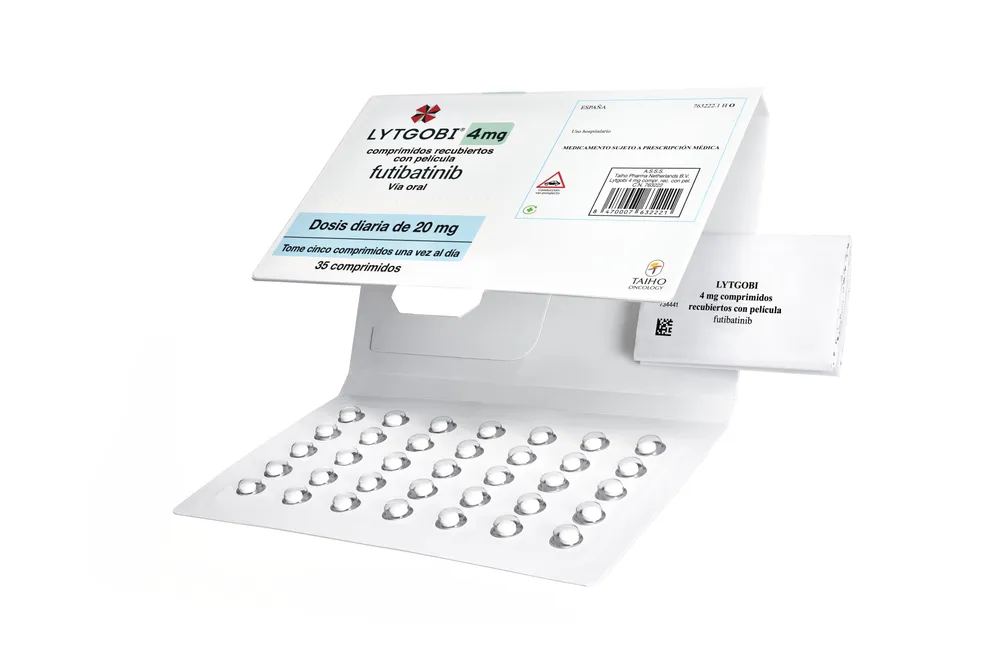
Table of Contents
Package leaflet: Information for the user
Introduction
Package leaflet: information for the patient
Lytgobi 4 mg film-coated tablets
futibatinib
This medicinal product is subject to additional monitoring, which will allow for rapid identification of new safety information. You can help by reporting any adverse reactions you may experience. Information on how to report adverse reactions is included at the end of section 4.
Read the entire leaflet carefully before starting to take this medicine, as it contains important information for you.
- Keep this leaflet, as you may need to read it again.
- If you have any questions, consult your doctor or pharmacist.
- This medicine has been prescribed for you only and must not be given to other people, even if they have the same symptoms as you, as it may harm them.
- If you experience any adverse reactions, consult your doctor or pharmacist, even if they are adverse reactions not listed in this leaflet. See section 4.
Leaflet contents
- What Lytgobi is and what it is used for
- What you need to know before taking Lytgobi
- How to take Lytgobi
- Possible adverse reactions
- How to store Lytgobi
- Contents of the pack and other information
1. What Lytgobi is and what it is used for
Lytgobi contains the active substance futibatinib, which belongs to a group of anticancer medicines called tyrosine kinase inhibitors. It blocks the action of a cellular protein called fibroblast growth factor receptor (FGFR), which helps regulate cell growth. Cancer cells may have an abnormal form of this protein.
By blocking FGFR, futibatinib may prevent the growth of cancer cells.
Lytgobi is used alone (as monotherapy) to treat adults with bile duct cancer (also known as cholangiocarcinoma) that has spread or cannot be removed by surgery, in patients who have already received prior treatment, and whose tumour has a specific type of abnormal "FGFR".
2. What you need to know before taking Lytgobi
Do not take Lytgobi if you are allergic to futibatinib or to any of the other ingredients of this medicine (listed in section 6).
Warnings and precautions
Talk to your doctor or pharmacist before starting treatment with Lytgobi if:
- you have been told you have high levels of phosphate in your blood (a condition known as hyperphosphatemia), based on a blood test result
- you have eye problems or visual disturbances, such as retinal issues (layers of light-sensitive nerve tissue located at the back of the eye)
Ophthalmologic examinations are recommended:
- before starting treatment with Lytgobi
- 6 weeks after starting treatment, or at any time if visual or eye problems occur.
Lytgobi may cause serous retinal detachment (the retina shifts from its normal position). Symptoms include blurred vision, flashes of light in the visual field (photopsia), and small dark floating shapes moving across the visual field (floaters). Inform your doctor immediately if you experience any vision problems.
Lytgobi may cause high levels of phosphate in the blood and lead to mineral accumulation, such as calcium, in various tissues of the body. Your doctor may recommend dietary changes, phosphate-lowering treatment, or modification or discontinuation of Lytgobi if necessary. Inform your doctor immediately if you experience painful skin lesions, muscle cramps, numbness or tingling around the mouth, or an abnormal heartbeat.
Lytgobi may harm an unborn baby. If you are a woman of childbearing potential or if your partner can become pregnant, you must use effective contraception during treatment and for at least 1 week after the last dose of Lytgobi. It is unknown whether Lytgobi reduces the effectiveness of contraceptive medications; therefore, barrier methods should be used in addition to contraceptive medications to prevent pregnancy.
Children and adolescents
Lytgobi must not be given to children or adolescents under 18 years of age. It is not known whether it is safe and effective in this age group.
Other medicines and Lytgobi
Inform your doctor or pharmacist if you are taking, have recently taken, or might need to take any other medicines.
In particular, inform your doctor if you are taking any of the following medicines, so they can decide whether your treatment needs to be adjusted:
- itraconazole: a medicine used to treat fungal infections.
- clarithromycin: a medicine used to treat certain infections.
- rifampicin: a medicine used to treat tuberculosis and other infections.
- carbamazepine, phenytoin, phenobarbital: medicines used to treat epilepsy.
- efavirenz: a medicine used to treat HIV infection.
- theophylline: a medicine used to treat breathing problems.
- olanzapine: a medicine used to manage symptoms of mental disorders.
Pregnancy and breastfeeding
If you are pregnant or breastfeeding, think you might be pregnant, or are planning to become pregnant, consult your doctor or pharmacist before using this medicine.
- Pregnancy/Contraception – information for women
You must not become pregnant during treatment with Lytgobi, as this medicine could harm the unborn baby. A pregnancy test should be performed before starting treatment. Women who can become pregnant must use effective contraceptive methods during treatment and for at least 1 week after the last dose of Lytgobi. Barrier methods should be used as a second form of contraception to prevent pregnancy. Talk to your doctor about the most suitable contraceptive method for you.
- Contraception – information for men
You must not father a child during treatment with Lytgobi, as this medicine may harm the baby. You must use effective contraception during treatment and for at least 1 week after the last dose of Lytgobi.
- Breastfeeding
Do not breastfeed during treatment with Lytgobi and for at least 1 week after the last dose. This is because it is unknown whether Lytgobi passes into breast milk and could therefore harm the baby.
Driving and use of machines
Lytgobi may cause side effects such as fatigue or visual disturbances. Do not drive or operate machinery if this occurs.
Lytgobi contains lactose and sodium
This medicine contains lactose (a sugar found in milk and dairy products). If your doctor has informed you that you have an intolerance to certain sugars, consult with them before taking this medicine.
This medicine contains less than 1 mmol of sodium (23 mg) per tablet, i.e., essentially “sodium-free”.
3. How to take Lytgobi
Treatment with Lytgobi should be initiated by a physician experienced in the diagnosis and treatment of biliary tract cancer. Follow exactly the administration instructions for this medicine provided by your doctor or pharmacist. If in doubt, consult your doctor or pharmacist again.
Recommended dose
5 tablets of Lytgobi 4 mg (20 mg of futibatinib in total) taken orally once daily. Your doctor will adjust the dose or interrupt treatment if necessary.
Method of administration
Swallow the tablet whole with a glass of water at the same time each day. Lytgobi may be taken with food or between meals. Tablets must be swallowed whole to ensure the complete dose is administered.
Duration of treatment
Take Lytgobi for the duration indicated by your doctor.
If you take more Lytgobi than you should
Inform your doctor immediately if you have taken more Lytgobi than prescribed.
If you forget to take Lytgobi
- If you miss a dose of Lytgobi by 12 hours or less, take the missed dose as soon as you remember.
- If you miss a dose of Lytgobi for more than 12 hours, skip the missed dose. Take the next dose at the usual time.
- Do not take a double dose of Lytgobi if you vomit. Take the next dose at the scheduled time.
- Do not take a double dose to make up for missed doses.
If you stop taking Lytgobi
Do not stop taking Lytgobi without consulting your doctor, as interruption could reduce the effectiveness of treatment.
If you have any further questions about the use of this medicine, ask your doctor, pharmacist, or nurse.
4. Possible adverse effects
Like all medicines, this medicine can cause adverse effects, although not everyone experiences them.
Contact your doctor immediately if you experience any of the following serious adverse effects. The adverse effects listed below are common (may affect up to 1 in 10 people):
- Migraine
- Intestinal obstruction
Other adverse effects
Consult your doctor if you experience any other adverse effects. These may occur with the following frequencies:
Very common (may affect more than 1 in 10 people)
- High or low phosphate levels observed in blood tests
- Low sodium levels observed in blood tests
- Nail separation from the nail bed, poor nail formation, change in nail color
- Constipation
- Diarrhea
- Dry mouth
- Vomiting
- Abdominal pain
- Hair loss (alopecia)
- Feeling of tiredness or weakness
- Dry skin
- High levels of liver enzymes observed in blood tests
- Nausea
- Inflammation of the lining of the mouth (stomatitis)
- Decreased appetite
- Dry eye
- Redness, swelling, peeling, or tenderness, mainly in the hands or feet (hand-foot syndrome)
- Taste disturbances
- Muscle pain
- Joint pain
Common (may affect up to 1 in 10 people)
- Eye problems, such as inflammation of the eyes or cornea (front part of the eye), blurred vision, sudden appearance of small dark spots that move across the field of vision (floaters), and flashes of light in the visual field (photopsia).
Reporting of adverse effects
If you experience any type of adverse effect, talk to your doctor, pharmacist, or nurse, even if it is a possible adverse effect not listed in this leaflet. You can also report them directly through the national reporting system included in Appendix V. By reporting adverse effects, you can help provide more information on the safety of this medicine.
5. Storage of Lytgobi
Keep this medicine out of the sight and reach of children.
Do not use this medicine after the expiry date stated on the carton and blister after “CAD” or “EXP”. The expiry date refers to the last day of the month indicated.
No special storage conditions are required.
Medicines should not be disposed of via wastewater or household waste. Ask your pharmacist how to dispose of medicines and packaging you no longer need. This will help protect the environment.
6. Package contents and other information
Composition of Lytgobi
- The active substance is futibatinib.
Each film-coated tablet contains 4 mg of futibatinib.
- The other components are:
- Tablet core: corn starch, crospovidone, hydroxypropylcellulose, lactose monohydrate, magnesium stearate, mannitol, microcrystalline cellulose, and sodium lauryl sulfate (see section 2, “Lytgobi contains lactose and sodium”)
- Film coating: hypromellose, macrogol, and titanium dioxide
- Binder: magnesium stearate
Appearance of Lytgobi and contents of the pack
Lytgobi 4 mg is presented as film-coated tablets, round, white in colour, embossed with "4MG" on one side and "FBN" on the other side.
Lytgobi tablets are supplied in blisters within a sealed carton containing a 7-day supply, as follows:
- Daily dose of 20 mg: each carton contains 35 tablets (5 tablets once daily).
- Daily dose of 16 mg: each carton contains 28 tablets (4 tablets once daily).
- Daily dose of 12 mg: each carton contains 21 tablets (3 tablets once daily).
Marketing Authorisation Holder
Taiho Pharma Netherlands B.V.
Barbara Strozzilaan 201
1083 HN Amsterdam
The Netherlands
Manufacturer
PCI Pharma Services (Millmount Healthcare Limited)
Block 7, City North Business Campus
Stamullen, Co. Meath, K32 YD60
Ireland
Date of the most recent review of this leaflet: {MM/YYYY}
This medicinal product has been authorised under a “conditional approval” scheme.
This means that further information on this medicinal product is expected. The European Medicines Agency will review the new information annually and this patient information leaflet will be updated as necessary.
Other sources of information
Detailed information on this medicinal product is available on the website of the European Medicines Agency: http://www.ema.europa.eu.
This patient information leaflet can be found on the website of the European Medicines Agency in all languages of the European Union/European Economic Area.