Lysodren 500 mg tablets
Spain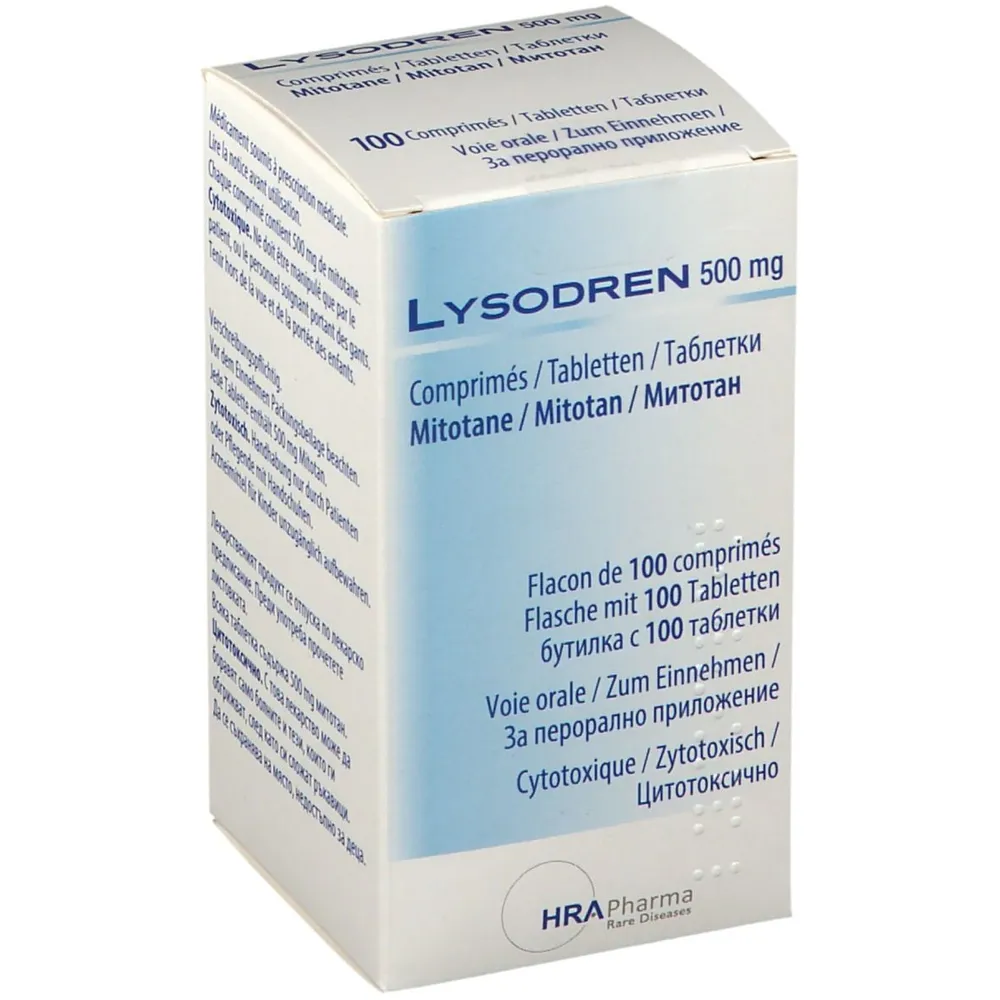
Table of Contents
Patient Information Leaflet
Introduction
Patient Information Leaflet
Lysodren 500 mg tablets
mitotane
Read the entire leaflet carefully before you start taking this medicine, as it contains important information for you.
-
Keep this leaflet, as you may need to read it again.
-
If you have any questions, consult your doctor or pharmacist.
-
This medicine has been prescribed for you only and must not be given to other people, even if they have the same symptoms as you, because it could harm them.
-
If you experience any adverse effects, consult your doctor or pharmacist, even if these are not listed in this leaflet. See section 4.
Always carry the Lysodren Patient Card attached at the end of this leaflet.
Leaflet Contents
-
What Lysodren is and what it is used for
-
What you need to know before taking Lysodren
-
How to take Lysodren
-
Possible side effects
-
How to store Lysodren
-
Contents of the pack and other information
1. What Lysodren is and what it is used for
Lysodren is a cancer treatment medicine that contains the active substance mitotane.
This medicine is used for the symptomatic treatment of advanced, inoperable, recurrent or metastatic malignant tumors of the adrenal glands.
2. What you need to know before starting Lysodren
Do not take Lysodren
- if you are allergic to mitotane or any of the other ingredients of this medicine (listed in section 6).
- if you are breastfeeding. You must not breastfeed while taking Lysodren.
- if you are taking medications containing spironolactone (see “Taking Lysodren with other medicines”).
Warnings and precautions
Talk to your doctor or pharmacist before starting to take Lysodren.
You must inform your doctor if you are in any of the following situations:
- if you experience any injury (shock, severe trauma), have an infection, or develop any illness while taking Lysodren. Inform your doctor immediately, as they may recommend temporarily stopping treatment.
- if you have liver problems: Inform your doctor if you develop any of the following signs and symptoms of liver problems during treatment with Lysodren: itching, yellowing of the skin or eyes, dark-colored urine, or pain or discomfort in the upper right part of the stomach. Your doctor should perform blood tests to check your liver function before starting treatment, during treatment with Lysodren, and whenever clinically indicated. Your doctor may decide to interrupt treatment with Lysodren.
- if you have severe kidney disorders.
- if you are taking any of the medicines listed below (see “Other medicines and Lysodren”).
- if you have gynecological problems such as vaginal bleeding, menstrual disorders, and/or pelvic pain.
This medicine must not be handled by anyone other than the patient and those caring for the patient, and especially must not be handled by pregnant women. Caregivers should wear disposable gloves when handling the tablets.
During treatment with Lysodren
Lysodren may temporarily reduce the amount of hormones produced by your adrenal gland (cortisol), but your doctor will correct this by using appropriate hormone medication (steroids).
Lysodren may cause bleeding that lasts longer than usual. If you need to undergo surgery or dental procedures during treatment with Lysodren, your healthcare provider will perform blood tests to assess the risk of prolonged bleeding.
Always carry the Lysodren Patient Card included at the end of this leaflet.
Other medicines and Lysodren
Tell your doctor or pharmacist if you are using or have recently used any other medicines, including those obtained without a prescription.
You must not take Lysodren together with medicines containing spironolactone, a medicine frequently used as a diuretic to treat heart, liver, or kidney diseases.
Lysodren may also interfere with other medicines. Therefore, if you are taking any medicine containing any of the following active substances, you must inform your doctor:
- warfarin or other anticoagulants (blood thinners) used to prevent blood clots. The dose of the anticoagulant may need to be adjusted.
- antiepileptic medicines
- rifabutin or rifampicin used in the treatment of tuberculosis.
- griseofulvin used in the treatment of fungal infections.
- herbal preparations containing St. John’s wort (Hypericum perforatum).
- sunitinib, etoposide: used to treat cancer.
- midazolam, used as a sedative.
Taking Lysodren with food and drink
Lysodren should preferably be taken during meals, with fatty foods such as milk, chocolate, or oil.
Pregnancy, breastfeeding, and fertility
Lysodren may harm the unborn baby. If you are pregnant, think you might be pregnant, or plan to become pregnant, inform your doctor as soon as possible to determine whether you should stop or continue treatment with Lysodren.
Women of childbearing age must use an effective method of contraception during treatment with Lysodren, including after stopping treatment. Please consult your doctor.
Due to the potential for serious adverse reactions in your baby, you must not breastfeed while taking Lysodren, even after stopping treatment. Consult your doctor.
Driving and using machines
Lysodren may have a significant influence on the ability to drive and use machines. Consult your doctor.
3. How to take Lysodren
Follow exactly the instructions for using this medicine given by your doctor. If in doubt, consult your doctor or pharmacist again.
Dosage and administration
The usual starting dose at the beginning of treatment is 2 to 3 g (4 to 6 tablets) per day.
Your doctor may start treatment with higher doses, such as 4 to 6 g (8 to 12 tablets).
In order to select the optimal dose for treating your disease, your doctor will regularly monitor the amount of Lysodren in your blood. Your doctor may decide to temporarily interrupt treatment with Lysodren or reduce the dose if you experience certain adverse effects.
Use in children and adolescents
The starting daily dose of Lysodren is 1.5 to 3.5 g/m2 of body surface area (your doctor will calculate this based on the child's weight and height). Experience in patients of this age group is very limited.
Method of administration
You should swallow the tablets with a glass of water, during meals containing fatty foods. The total daily dose can be administered in two or three divided doses.
If you take more Lysodren than you should
Contact your doctor immediately if you accidentally take more Lysodren than you should, or if a child accidentally ingests any tablets.
If you forget to take Lysodren
If you accidentally miss a dose, take the next dose as scheduled. Do not take a double dose to make up for the missed dose.
If you have any further questions about the use of this medicine, ask your doctor or pharmacist.
4. Possible adverse effects
Like all medicines, this medicine may cause adverse effects, although not everyone gets them.
Tell your doctor immediately if you experience any of the following adverse effects:
- Adrenal insufficiency: fatigue, abdominal pain, nausea, vomiting, diarrhoea, confusion
- Anaemia: pallor, tendency to muscle fatigue, difficulty breathing, dizziness especially upon standing
- Liver disorders: yellowing of the skin and eyes (jaundice), itching, nausea, diarrhoea, fatigue, dark-coloured urine
- Neurological disorders: movement and coordination problems, unusual sensations such as tingling or cramps, memory loss, difficulty concentrating, difficulty walking, dizziness
These symptoms may indicate complications for which specific treatment may be appropriate.
These adverse effects may occur with certain frequencies defined as follows:
- very common: may affect more than 1 in 10 people
- common: may affect up to 1 in 10 people
- frequency not known: cannot be estimated from available data
Very common adverse effects
- vomiting, nausea (feeling dizzy), diarrhoea, stomach pain
- loss of appetite
- unusual sensations such as tingling or cramps
- movement and coordination disorders, dizziness, confusion
- drowsiness, fatigue, muscle fatigue (muscle tiredness during exertion)
- inflammation (swelling, heat, pain) of mucous membranes, skin irritations
- circulatory disorders (increased bleeding time)
- increased cholesterol, triglycerides (fats), and liver enzymes (in blood tests)
- decreased white blood cell count
- breast development in men
- adrenal insufficiency (may cause fatigue, abdominal pain, nausea, vomiting,
- diarrhoea, confusion)
Common adverse effects
- dizziness, headache
- peripheral nervous system disorders (a group of sensory disorders, muscle weakness and atrophy, reduced reflexes, and vasomotor symptoms such as flushing, sweating, and sleep disturbances)
- cognitive impairment (such as memory loss and difficulty concentrating)
- motor disorders
- decreased red blood cell count (anaemia, with symptoms such as pallor and fatigue), decreased platelet count (may increase tendency to bruising and bleeding)
- hepatitis (autoimmune) (may cause yellowing of the skin and eyes, dark-coloured urine)
- difficulty coordinating muscles
Frequency not known
- fever
- generalized pain
- flushing, high or low blood pressure, dizziness/vertigo upon rapid standing, increased salivation
- eye disorders: impaired vision, blurred vision, double vision, distorted images, glare
- opportunistic infection
- liver damage (may cause yellowing of the skin or eyes, dark-coloured urine)
- decreased uric acid in blood tests
- bladder inflammation with bleeding
- presence of blood in urine, presence of protein in urine
- balance disorders
- distortion of taste sensation
- indigestion
- ovarian macrocysts (with or without symptoms such as pelvic pain, vaginal bleeding, menstrual disorders)
- decreased androstenedione (sex hormone precursor) in blood tests in women
- decreased testosterone (sex hormone) in blood tests in women
- increased sex hormone-binding globulin (a protein that binds sex hormones) in blood tests
- increased corticosteroid-binding globulin in blood tests
- increased thyroxine-binding globulin in blood tests
- decreased free testosterone (sex hormone) in blood tests in men
- hypogonadism in men (with symptoms such as excessive breast development, decreased libido, erectile dysfunction, fertility disorders)
- allergic reactions, itching
In children and adolescents, thyroid problems, neuropsychological disorders, growth retardation, and one case of encephalopathy have been observed. In addition, some signs of hormonal changes have been observed (such as excessive breast development in males and vaginal bleeding and/or early breast development in females).
Reporting of adverse effects
If you experience any adverse effect, consult your doctor or pharmacist, even if it is a possible adverse effect not listed in this leaflet. You can also report them directly through the national reporting system listed in Annex V. By reporting adverse effects, you can help provide more information on the safety of this medicine.
5. Storage of Lysodren
Keep this medicine out of the sight and reach of children.
Store in the original packaging. After first opening: 1 year.
Do not use this medicine after the expiry date stated on the carton and on the vial after EXP.
Disposal of unused medicine and of all materials that have come into contact with it must be carried out in accordance with local regulations for cytotoxic medicines.
Medicines must not be disposed of via wastewater drains or household waste. Ask your pharmacist how to dispose of medicines you no longer require. This will help protect the environment.
6. Package contents and other information
Composition of Lysodren
- The active substance is mitotane. Each tablet contains 500 mg of mitotane.
- The other components are corn starch, microcrystalline cellulose (E460), macrogol 3350 and anhydrous colloidal silicon dioxide.
Appearance of the product and contents of the container
Lysodren tablets are white, biconvex, round and scored.
Lysodren is available in plastic bottles containing 100 tablets.
Marketing Authorization Holder:
Esteve Pharmaceuticals, S.A.
Passeig de la Zona Franca 109, 4th floor
08038 Barcelona
Spain
+34 93 446 60 00
Manufacturer responsible for manufacturing:
Latina Pharma S.p.A.
Via Murillo, 7
04013 Sermoneta (LT)
Italy
or
Centre Specialites Pharmaceutiques
76-78, avenue du Midi
63800 Cournon d’Auvergne
France
Date of the most recent review of this package leaflet:
Other sources of information
Detailed information on this medicinal product is available on the website of the European Medicines Agency: http://www.ema.europa.eu. There are also links to other websites about rare diseases and orphan medicinal products.
This package leaflet is available on the European Medicines Agency website in all languages of the European Union/European Economic Area.
LYSODREN: PATIENT CARD
I am being treated with Lysodren (mitotane) I am prone to acute adrenal insufficiency If I required urgent medical care, appropriate precautions should be taken | My doctor's name is: ……………………………………….. Telephone: ………………………………. For further product information, please contact: Esteve Pharmaceuticals, S.A. Tel.: + 34 93 446 60 00 |