Luveris 75 IU, powder and solvent for solution for injection
Spain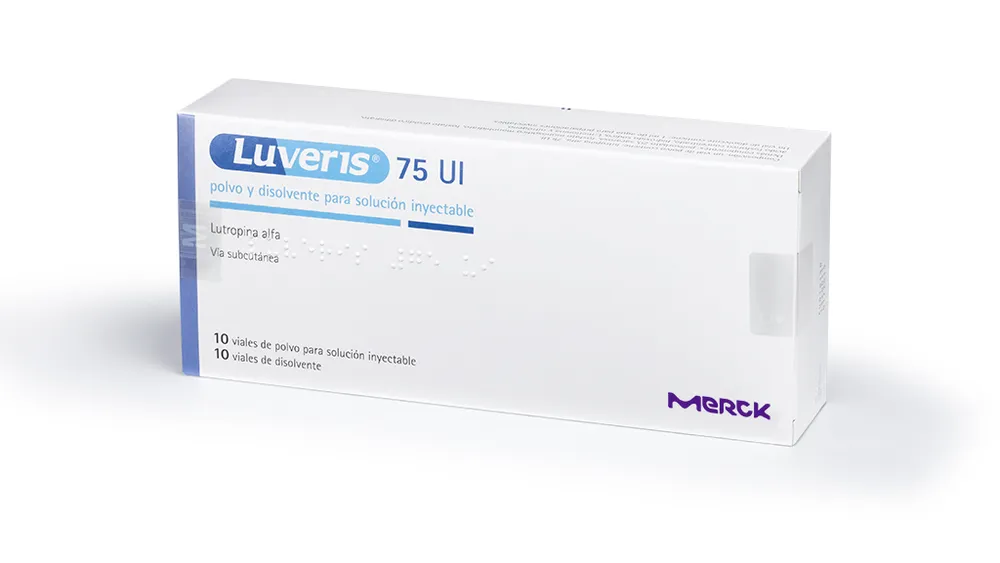
Table of Contents
Package leaflet: Information for the user
Introduction
Package leaflet: information for the user
Solvent in vials
Luveris 75 IU powder and solvent for solution for injection
lutropin alfa
Read all of this leaflet carefully before you start using this medicine because it contains important information for you.
- Keep this leaflet. You may need to read it again.
- If you have any questions, ask your doctor, pharmacist, or nurse.
- This medicine has been prescribed for you only. Do not pass it on to other people, even if they have the same symptoms as you, because it may harm them.
- If you experience any adverse effects, consult your doctor, pharmacist, or nurse, even if they are effects not listed in this leaflet. See section 4.
Contents of the leaflet
- What Luveris is and what it is used for
- What you need to know before using Luveris
- How to use Luveris
- Possible adverse effects
- How to store Luveris
- Contents of the pack and other information
1. What Luveris is and what it is used for
What Luveris is
Luveris is a medicine containing lutropin alfa, a recombinant Luteinizing Hormone (LH), which is essentially similar to the hormone naturally found in humans, but produced using biotechnology. It belongs to a family of hormones called gonadotropins, which are involved in the normal regulation of reproduction.
What Luveris is used for
Luveris is recommended for the treatment of adult women who produce very low levels of certain hormones involved in the natural reproductive cycle. The medicine is used in combination with another hormone called follicle-stimulating hormone (FSH) to stimulate the development of follicles, which are structures in the ovary where eggs (ova) mature. This treatment is followed by administration of a single dose of human Chorionic Gonadotropin (hCG), which triggers the release of an egg from the follicle (ovulation).
2. What you need to know before using Luveris
Do not use Luveris
- if you are allergic to gonadotropins (such as luteinizing hormone, follicle-stimulating hormone, or human chorionic gonadotropin) or to any of the other ingredients of this medicine (listed in section 6).
- if you have ovarian, uterine, or breast cancer.
- if you have been diagnosed with a brain tumor.
- if you have an unexplained enlargement of the ovaries or fluid-filled sacs in the ovaries (ovarian cysts) of unknown origin.
- if you have unexplained vaginal bleeding.
Do not use Luveris if any of the above conditions apply to you. If you are unsure, speak with your doctor or pharmacist before using this medicine.
Warnings and precautions
Talk to your doctor, pharmacist, or nurse before starting to use Luveris.
Before starting treatment, both your fertility and that of your partner should be assessed.
It is advisable not to use Luveris if you have a medical condition that would prevent a normal pregnancy, such as when the ovaries do not function properly due to a condition called primary ovarian insufficiency, or if you have malformations of the reproductive organs.
Porphyria
Before starting treatment, inform your doctor if you or a family member has porphyria (a disorder in breaking down porphyrins that can be inherited from parents to children).
Ovarian hyperstimulation syndrome (OHSS)
This medicine stimulates the ovaries. This increases the risk of developing ovarian hyperstimulation syndrome (OHSS). This condition occurs when your follicles develop excessively and turn into large cysts. If you experience abdominal pain, rapid weight gain, nausea or vomiting, or have difficulty breathing, contact your doctor immediately. Your doctor may instruct you to stop using this medicine (see section 4 under “Serious side effects”).
If you are not ovulating and the recommended dosage and administration guidelines are followed, the risk of OHSS is lower. Treatment with Luveris rarely leads to severe OHSS. The risk is higher if you also receive the medication used to trigger final follicular maturation (which contains human chorionic gonadotropin, hCG). See section 3 under “How much to use” for further information. If OHSS develops, your doctor may decide not to administer hCG during this treatment cycle and may advise you to abstain from sexual intercourse or to use barrier contraception for at least four days.
Your doctor will carefully monitor your ovarian response using ultrasound scans and blood tests, both before and during treatment.
Multiple pregnancy
When using Luveris, there is an increased risk of conceiving more than one baby at a time (“multiple pregnancy”, mostly twins) compared to natural conception. A multiple pregnancy may lead to medical complications for you and your babies. You can reduce the risk of multiple pregnancy by using the correct dose of Luveris at the recommended times. When undergoing assisted reproductive techniques, the risk of multiple pregnancy is associated with your age, the quality and number of fertilized eggs or embryos implanted.
Spontaneous abortion
When undergoing assisted reproductive techniques or ovarian stimulation to produce eggs, the likelihood of spontaneous abortion is higher than in the general population of women.
Ectopic pregnancy
Women with a history of fallopian tube disease are at risk of ectopic pregnancy (a pregnancy in which the embryo implants outside the uterus), regardless of whether the pregnancy occurs spontaneously or through fertility treatments.
Blood clotting problems (thromboembolic events)
Talk to your doctor before starting Luveris if you or a family member have ever had blood clots in the leg or lung, or a heart attack or stroke. You may have an increased risk of developing serious blood clots or worsening of existing clots while receiving treatment with Luveris.
Tumors of the reproductive organs
Benign and malignant tumors of the ovaries and other reproductive organs have been reported in women who have received various pharmacological treatments for infertility.
Congenital malformations
Congenital malformations following assisted reproductive techniques may be slightly more frequent than after spontaneous pregnancies. This may be due to factors related to the parents, such as maternal age and genetic background, procedures involved in assisted reproductive techniques, and multiple pregnancies.
Children and adolescents
Luveris is not indicated for use in children and adolescents under 18 years of age.
Other medicines and Luveris
Inform your doctor or pharmacist if you are taking, have recently taken, or might need to take any other medicines.
Do not mix Luveris with other medicines in the same injection, except with follitropin alfa, if prescribed by your doctor.
Pregnancy and breastfeeding
Do not use Luveris if you are pregnant or breastfeeding.
Consult your doctor or pharmacist before using any medicine.
Driving and using machines
The influence of Luveris on the ability to drive and use machines is negligible or none.
Luveris contains sodium
Luveris contains less than 1 mmol of sodium (23 mg) per dose; i.e., essentially “sodium-free”.
3. How to use Luveris
Follow exactly the administration instructions for this medicine given by your doctor. If in doubt, consult your doctor again.
Use of this medicine
Your doctor will decide the most appropriate dose and regimen for you throughout the treatment.
What dose to use
Luveris is usually used daily for up to three weeks, simultaneously with FSH injections.
- The usual initial dose is 75 IU (1 vial) of Luveris together with 75 IU or 150 IU of FSH.
- Depending on the response, your doctor may increase the FSH dose, preferably by increments of 37.5 to 75 IU every 7–14 days.
Your doctor may decide to extend the treatment up to 5 weeks.
When the desired response has been achieved, a single injection of hCG should be given 24 to 48 hours after the last injection of Luveris and FSH. You are advised to have intercourse on the day of hCG administration and also the following day. Alternatively, intrauterine insemination or another medically assisted reproductive procedure may be performed, at your doctor’s discretion.
If an excessive response occurs, treatment must be stopped and hCG must not be administered (see section 4 under “Ovarian hyperstimulation syndrome (OHSS)”). For the next cycle, your doctor will prescribe a lower FSH dose than that used in the previous cycle.
Method of administration
Luveris must be administered subcutaneously, i.e., by injecting just under the skin. Each vial is for single use only.
If you are self-administering Luveris, carefully read the following instructions:
-
Wash your hands. It is important that your hands and materials used are as clean as possible.
-
Gather everything you will need. Find a clean place and prepare all the following items:
-
one vial of Luveris,
-
one vial of solvent,
-
two alcohol-impregnated cotton swabs,
-
one syringe,
-
one reconstitution needle for dissolving the powder with the solvent,
-
one fine needle for subcutaneous injection,
-
a sharps container for the safe disposal of glass containers and needles.
-
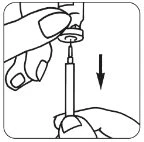
Remove the protective closure cap from the solvent vial: Insert the reconstitution needle
| into the syringe and introduce some air into the syringe by pulling back the plunger to approximately the 1 ml mark. Then insert the needle into the vial, push the plunger to expel the air, turn the vial upside down, and gently withdraw all of the solvent. Place the syringe carefully on the table, taking care not to touch the needle. |
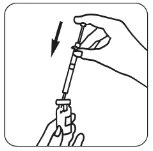
- Prepare the injection solution: Remove the protective closure cap from the vial containing
| the Luveris powder, take your syringe and slowly inject the solvent into the Luveris vial. Gently swirl without removing the syringe. Do not shake. |
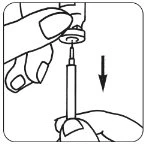
- Once the powder has dissolved (which usually happens immediately), check that the
| The resulting solution is clear and does not contain any particles. Invert the vial and gently withdraw the solution into the syringe. |
You may also mix Luveris and follitropin alfa, as an alternative to injecting each product separately. After dissolving the Luveris powder, draw the solution into the syringe and then re-inject it into the vial containing the follitropin alfa powder. Once the powder has dissolved, withdraw the solution into the syringe. Check for particles as indicated above, and do not use the solution if it is not clear.
Up to 3 vials of powder can be dissolved in 1 mL of solvent.
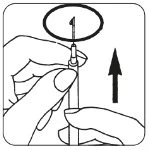
- Change the needle by attaching the fine needle, and remove any air bubbles: if present,
| air bubble in the syringe, hold it with the needle pointing upward and tap the syringe gently until the air collects at the top. Gently push the plunger until the air bubbles disappear. |
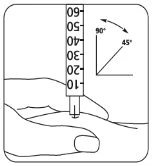
- Inject the solution immediately: Your doctor or nurse will have instructed you where to
| inject the dose (e.g., abdomen, front of the thigh). Clean the selected area with an alcohol-soaked cotton ball. Firmly pinch the skin and insert the needle at an angle of 45° to 90°, using a dart-like motion. Inject under the skin, following the provided instructions. Do not inject directly into a vein. Administer the solution by gently pushing the plunger. Take as much time as needed to inject the full dose. Immediately remove the needle and clean the skin with an alcohol-soaked cotton ball using a circular motion. |
- Dispose of all used materials: After completing the injection, immediately discard all needles and empty glass containers into the sharps container provided. Any unused portion of the solution must also be discarded.
If you use more Luveris than you should
The effects of an overdose of Luveris are unknown; however, there is a possibility that ovarian hyperstimulation syndrome may occur (see section 4). However, this will only happen if hCG is administered (see section 2 under “Warnings and precautions”).
If you forget to use Luveris
Do not use a double dose to make up for missed doses. Contact your doctor.
If you have any further questions about the use of this medicine, ask your doctor, pharmacist, or nurse.
4. Possible adverse effects
Like all medicines, this medicine can cause adverse effects, although not everyone will experience them.
Serious adverse effects
Contact your doctor immediately if you notice any of the adverse effects listed below. Your doctor may instruct you to stop using Luveris.
Allergic reaction
Allergic reactions such as skin rash, redness of the skin, blisters, and swelling of the face with difficulty breathing can be serious in some cases. This adverse effect is very rare (may affect up to 1 in 10,000 people).
Ovarian hyperstimulation syndrome (OHSS)
- Pain in the lower abdomen accompanied by nausea or vomiting may be symptoms of ovarian hyperstimulation syndrome (OHSS). The ovaries may have over-responded to treatment and may have formed large fluid-filled sacs or cysts (see section 2 under “Ovarian hyperstimulation syndrome (OHSS)”). This adverse effect is common (may affect up to 1 in 10 people). If this occurs, your doctor will need to examine you as soon as possible.
- In very rare cases, serious blood clotting complications (thromboembolic episodes), usually associated with severe OHSS, may occur. This can cause chest pain, shortness of breath, stroke, or heart attack (see section 2 under “Problems with blood clotting”).
Other common side effects
- Headache
- Nausea, vomiting, diarrhoea, abdominal discomfort or abdominal pain
- Fluid-filled sacs in the ovaries (ovarian cysts), chest pain, and pelvic pain
- Local reactions at the injection site, such as pain, itching, bruising, swelling, or irritation
No cases of ovarian torsion or intra-abdominal bleeding have been reported after treatment with Luveris; however, rare cases have been reported after treatment with human menopausal gonadotropin (hMG), a medicine derived from urine, which also contains LH.
Ectopic pregnancy (implantation of the embryo outside the uterus) may occur, particularly in women with a history of tubal disease.
Reporting of adverse effects
If you experience any type of adverse effect, talk to your doctor, pharmacist, or nurse, even if it is a possible adverse effect not listed in this leaflet. You can also report them directly via the Spanish Pharmacovigilance System for Human Medicines: www.notificaRAM.es. By reporting adverse effects, you can help provide more information on the safety of this medicine.
5. Storage of Luveris
Keep this medicine out of the sight and reach of children.
Do not use this medicine after the expiry date stated on the carton and on the vials after EXP. The expiry date refers to the last day of the month indicated.
Do not store above 25 °C. Keep in the original packaging to protect from light.
Do not use this medicine if there are any visible signs of deterioration, such as discoloration of the powder or damage to the container.
The medicine should be administered immediately after reconstitution of the powder.
The solution must not be administered if it contains particles or is not clear.
Medicines should not be disposed of via wastewater or household waste. Ask your pharmacist how to dispose of medicines and containers you no longer need. This will help protect the environment.
6. Contents of the pack and other information
Composition of Luveris
- The active substance is lutropin alfa. One vial of injectable powder contains 75 IU (International Units).
- Lutropin alfa is recombinant human luteinizing hormone, r-hLH, produced by recombinant DNA technology.
- The other components of the powder are polysorbate 20, sucrose, monosodium phosphate monohydrate, disodium phosphate dihydrate, concentrated phosphoric acid, sodium hydroxide, L-methionine, and nitrogen.
- The solvent is water for injections.
Appearance of the product and contents of the pack
- Luveris is presented as a powder and solvent for solution for injection.
- Each vial of powder contains 75 IU of lutropin alfa and each vial of solvent contains 1 ml of water for injections.
- Luveris is available in cartons containing 1, 3 or 10 vials of powder with the same number of solvent vials.
Marketing Authorization Holder
Merck Europe B.V.
Gustav Mahlerplein 102
1082 MA Amsterdam
The Netherlands
Manufacturer
Merck Serono S.p.A.
Via delle Magnolie 15
70026 Modugno (Bari)
Italy
Date of the most recent revision of this leaflet: 06/2022
Detailed information on this medicine is available on the European Medicines Agency website: http://www.ema.europa.eu.