Lizipaina chlorhexidine 5 mg/benzocaine 2.5 mg lozenges for sucking
Spain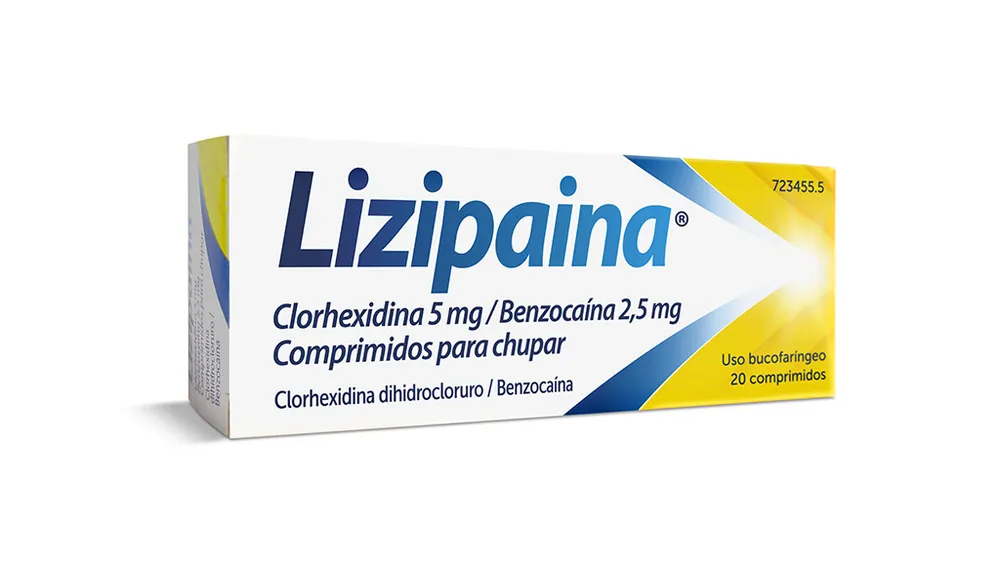
Table of Contents
- Package leaflet: Information for the user
- Introduction
- 1. What Lizipaina is and what it is used for
- 2. What you need to know before starting to take Lizipaina.
- 3. How to take Lizipaina
- 4. Possible adverse effects
- 5. Storage of Lizipaina
- 6. Contents of the container and additional information.
- **Composition of Lizipaina**
Package leaflet: Information for the user
Introduction
Package leaflet: information for the user
Lizipaina Chlorhexidine 5 mg / Benzocaine 2.5 mg, oral tablets
Chlorhexidine dihydrochloride / Benzocaine
Read all of this leaflet carefully before you start using this medicine, because it contains important information for you.
Always follow exactly the instructions for taking this medicine as described in this leaflet or as directed by your doctor or pharmacist.
- Keep this leaflet, as you may need to read it again.
- If you need advice or more information, consult your pharmacist.
- If you experience any adverse effects, consult your doctor or pharmacist, even if they are effects not listed in this leaflet. See section 4.
- You should consult a doctor if your condition worsens or does not improve after 2 days of treatment.
Contents of the leaflet
- What Lizipaina is and what it is used for
- What you need to know before taking Lizipaina
- How to take Lizipaina
- Possible adverse effects
- How to store Lizipaina
- Contents of the pack and other information
1. What Lizipaina is and what it is used for
The active ingredients in this medicine combine the antiseptic and disinfectant action of chlorhexidine with the local anesthetic effect of benzocaine.
This medicine is used for the temporary local symptomatic relief of mild mouth and throat infections accompanied by pain but without fever, such as sore throat, hoarseness, and minor mouth ulcers, in adults, adolescents, and children aged 6 years and older.
You should consult a doctor if symptoms worsen or do not improve after 2 days.
2. What you need to know before starting to take Lizipaina.
Do not take Lizipaina
- if you are allergic to the active substances or to any of the other components of this medicine (listed in section 6).
Warnings and precautions
Talk to your doctor or pharmacist before taking Lizipaina:
- if you are intolerant to other local anesthetics such as para-aminobenzoic acid (PABA), parabens, or paraphenylenediamine (a component of hair dye)
- if you have a severe or extensive injury in the mouth
- if you suffer from periodontitis (gum disease), as chlorhexidine may increase supragingival calculus formation
- if you have dental fillings in your incisor teeth and the filling surface or its margins are rough, as they may develop permanent staining with chlorhexidine.
Anaphylactic reactions
Rare but serious allergic reactions, including fatal anaphylaxis, have been reported with topical and oral use of chlorhexidine.
Lizipaina chlorhexidine 5 mg / benzocaine 2.5 mg should not be used if there has been previous hypersensitivity reactions to chlorhexidine (including allergic reactions after using mouthwashes, during insertion of chlorhexidine-coated urinary or venous catheters, or with pre-surgical skin washes or preparatory showers).
If symptoms of allergic reactions occur during use of Lizipaina chlorhexidine 5 mg / benzocaine 2.5 mg, treatment must be immediately discontinued and the patient should seek medical attention.
Stop taking this medicine and go immediately to your doctor if you or a child under your care develop pale, gray or bluish skin, lips or nail beds, headache, dizziness, difficulty breathing, fatigue, or tachycardia (rapid heartbeat).
Do not take this medicine if you develop sores or ulcerations in the mouth and throat.
Do not exceed the recommended dose indicated in section 3 (How to take Lizipaina).
It is recommended to maintain adequate oral hygiene to reduce tartar buildup and possible tooth discoloration that may be caused by chlorhexidine.
Due to the local anesthetic effect of benzocaine, avoid eating or drinking immediately after taking a tablet.
Use under adult supervision in young children and in individuals with swallowing or aspiration difficulties, as the tablets pose a potential choking hazard.
If symptoms persist or worsen, or if new symptoms appear, stop using this medicine and consult your doctor.
Children
This medicine should not be given to children under 6 years of age without first consulting a doctor.
Children may be more sensitive to benzocaine, as may elderly individuals and debilitated patients.
Special populations
Elderly individuals and debilitated patients may be more sensitive to benzocaine.
Other medicines and Lizipaina
Inform your doctor or pharmacist if you are taking, have recently taken, or might need to take any other medicines.
Although no interactions have been reported under the recommended conditions of use, Lizipaina should not be used at the same time as other medicines applied in the mouth without consulting your doctor or pharmacist. This is especially important with antiseptics used in the mouth or throat, sulfonamides (medicines used to treat certain infections), and cholinesterase inhibitor medicines (such as those used for Alzheimer's disease).
Anionic compounds and suspending agents, common ingredients in toothpastes, reduce the effectiveness of chlorhexidine; therefore, the mouth should be thoroughly rinsed after using toothpaste.
Use of Lizipaina with food and drinks
Avoid eating or drinking immediately after taking this medicine.
Pregnancy and breastfeeding
If you are pregnant or breastfeeding, think you may be pregnant, or are planning to become pregnant, consult your doctor or pharmacist before using this medicine.
Taking medicines during pregnancy may be harmful to the embryo, fetus, or nursing infant and should be monitored by your doctor.
If you are pregnant or breastfeeding, consult your doctor before using this medicine.
Driving and using machines
It is unknown whether the combination of benzocaine and chlorhexidine affects the ability to drive or operate machinery.
Interference with diagnostic tests
If you are scheduled to undergo any diagnostic tests (including blood or urine tests, skin tests using allergens, etc.), inform your doctor that you are using this medicine, as it may alter test results. This medicine may interact with pancreatic function tests that use bentiromide. Do not use this medicine at least 3 days before the test and inform your doctor.
Lizipaina contains sodium
This medicine contains less than 1 mmol of sodium (23 mg) per tablet; therefore, it is essentially "sodium-free".
3. How to take Lizipaina
Follow exactly the instructions for use provided in this leaflet or those given by your doctor or pharmacist. If in doubt, consult your doctor or pharmacist.
The recommended dose is:
Adults, adolescents, and children aged 6 years and older: 1 lozenge every 2 or 3 hours, slowly dissolving it in the mouth.
Do not take more than 8 lozenges per day.
The lozenges should be slowly dissolved in the mouth, without chewing or swallowing them, as their action is local and only occurs when the product is in direct contact with the affected area. The lozenges must not be chewed or swallowed.
Always use the lowest effective dose.
If you notice that symptoms worsen or persist for more than 2 days after starting treatment, or if fever, headache, nausea, or vomiting occur, you should consult your doctor as soon as possible.
If you take more Lizipaina than you should
In case of overdose or accidental ingestion, consult your doctor or pharmacist immediately or call the Toxicology Information Service at telephone number: 91 562 04 20, indicating the medicine and the amount ingested.
Signs of overdose may include: slurred speech, drowsiness, unsteady gait, blurred or double vision, dizziness, excitement or seizures, tinnitus, increased sweating, decreased oxygen levels in the blood (pale, grayish, or bluish skin, lips, and nail beds, difficulty breathing, fatigue, confusion, headache, feeling of dizziness, rapid heartbeat, and death in the most severe cases). A decrease in blood pressure may also occur.
4. Possible adverse effects
Like all medicines, this medicine can cause adverse effects, although not everyone will experience them.
The following adverse effects have been observed; their frequency cannot be estimated from the available data.
Irritation in the mouth or at the tip of the tongue or numbness of the tongue, which are usually temporary; loss of sensation in the mouth; stomatitis (inflammation of the oral mucosa); desquamation of the mucosa; burning sensation in the mucosa; altered taste perception; discoloration of teeth, tongue, fillings, and dentures; increased tartar buildup; anaphylactic shock and anaphylactic reactions (for example, urticaria, angioedema, and rash).
Parotid gland inflammation has also been reported.
Tooth discoloration may occur especially in individuals with tartar deposits on the teeth. This tooth discoloration is not permanent and can be removed by professional dental cleaning. Discoloration of dental fillings may be permanent. Discoloration of the tongue resolves spontaneously and is not dangerous.
Altered taste perception may occur.
There have been cases of methemoglobinemia caused by benzocaine, a serious condition that must be treated immediately because it reduces the amount of oxygen in the blood. This can occur even if you have used this product before. Stop using the product and seek immediate medical attention if you or a child under your care experiences: difficulty breathing, cyanosis (bluish discoloration of the skin and mucous membranes), altered mental state, headache, fatigue, difficulty exercising, rapid heartbeat, dizziness, or loss of consciousness.
Reporting of adverse effects
If you experience any type of adverse effect, consult your doctor or pharmacist, even if it is a possible adverse effect not listed in this leaflet. You may also report them directly via the Spanish Pharmacovigilance System for Human Medicines. Website: www.notificaram.es. By reporting adverse effects, you can help provide more information on the safety of this medicine.
5. Storage of Lizipaina
Keep this medicine out of the sight and reach of children.
Do not store this medicine above 30°C.
Do not use this medicine after the expiry date stated on the packaging after EXP. The expiry date refers to the last day of the month indicated.
Medicines must not be disposed of via wastewater drains or household waste. Dispose of unused medicines and their containers at the SIGRE Point at your pharmacy. If you are unsure, ask your pharmacist how to properly dispose of unused medicines and their packaging. This will help protect the environment.
6. Contents of the container and additional information.
Composition of Lizipaina
- The active substances are chlorhexidine dihydrochloride and benzocaine.
- The other components are mannitol (E-421), microcrystalline cellulose, povidone, magnesium stearate, sodium cyclamate (E-952), sodium saccharin (E-954), menthol flavour.
Appearance of the medicinal product and contents of the container
White, round, flat, bevelled lozenges.
Presented in a container with 20 lozenges in a polypropylene tube with a low-density polyethylene cap.
Marketing Authorisation Holder and Manufacturer
Marketing Authorisation Holder:
Opella Healthcare Spain, S.L.
C/ Rosselló i Porcel, 21
08016 Barcelona,
Spain
Manufacturer:
Laboratorios Alcalá-Farma, S.L.
Avenida de Madrid, 82
28802 Alcalá de Henares (Madrid)
Spain
or
Temmler Pharma GmbH
Temmlerstraße 2
35039 Marburg, Germany
Date of the most recent review of this package leaflet: November 2025.
You can access detailed and up-to-date information about this medicine by scanning with your mobile phone (smartphone) the QR code included in the package leaflet and outer packaging.
You may also access this information at the following internet address:
https://cima.aemps.es/cima/dochtml/p/12055/P_12055.html
Detailed and up-to-date information on this medicine is available on the website of the Spanish Agency of Medicines and Health Products (AEMPS): http://www.aemps.gob.es