Lisinopril Normon 20 mg tablets EFG
Spain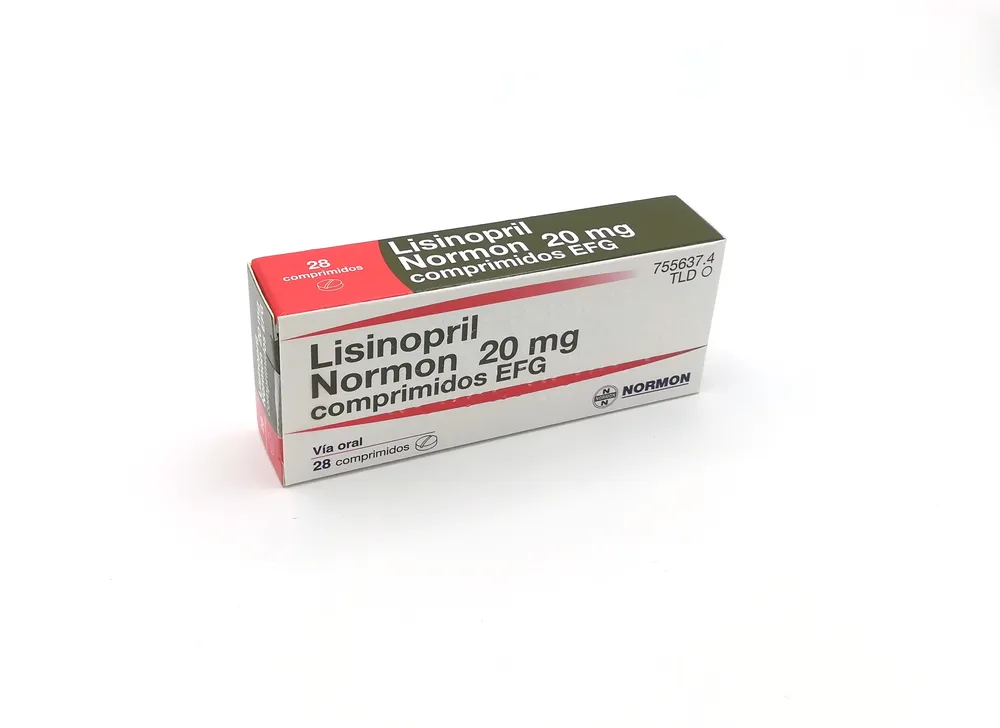
Table of Contents
- Package leaflet: Information for the user
- Introduction
- 1. What Lisinopril Normon is and what it is used for
- 2. What you need to know before starting Lisinopril Normon
- 3. How to take Lisinopril Normon
- 4. Possible adverse effects
- 5. Storage of Lisinopril Normon
- 6. Contents of the pack and other information
Package leaflet: Information for the user
Introduction
Package leaflet: information for the patient
Lisinopril Normon 20 mg tablets EFG
Read the entire leaflet carefully before you start taking this medicine because it contains important information for you.
- Keep this leaflet as you may need to read it again.
- If you have any questions, ask your doctor or pharmacist.
- This medicine has been prescribed for you only, and you should not give it to other people, even if they have the same symptoms as you, because it could harm them.
- If you experience any adverse reactions, consult your doctor or pharmacist, even if they are adverse reactions not listed in this leaflet. See section 4.
Leaflet contents:
- What Lisinopril Normon is and what it is used for
- What you need to know before taking Lisinopril Normon
- How to take Lisinopril Normon
- Possible side effects
- How to store Lisinopril Normon
- Contents of the pack and other information
1. What Lisinopril Normon is and what it is used for
Lisinopril Normon belongs to a group of medicines called angiotensin-converting enzyme (ACE) inhibitors.
Lisinopril Normon can be used in the following cases:
- For the treatment of high blood pressure (hypertension).
- For the treatment of heart failure.
- If you have recently had a heart attack (myocardial infarction).
- For the treatment of kidney disorders in type II diabetes in hypertensive patients.
Lisinopril works by dilating your blood vessels. This helps lower your blood pressure. It also makes it easier for your heart to pump blood to all parts of your body.
2. What you need to know before starting Lisinopril Normon
Do not take Lisinopril Normon
- if you are allergic to lisinopril or to any of the other components of this medicine (listed in section 6).
- if you have ever had an allergic reaction to any other ACE inhibitor medicine. The allergic reaction may have caused swelling of the hands, feet, ankles, face, lips, tongue, or throat. It may also have caused difficulty swallowing or breathing (angioedema).
- if you are currently taking or have recently taken sacubitril/valsartan, a medicine used to treat a type of long-term (chronic) heart failure in adults, as the risk of angioedema (rapid swelling under the skin, for example in the throat) is high.
- if any member of your family has had a severe allergic reaction (angioedema) to an ACE inhibitor, or if you have had a severe allergic reaction (angioedema) for unknown reasons.
- if you are more than 3 months pregnant. It is also advisable to avoid Lisinopril Normon early in pregnancy (see section “Pregnancy and breastfeeding”).
- if you have diabetes or kidney failure and are being treated with a blood pressure-lowering medicine containing aliskiren.
If you are unsure whether any of these situations apply to you, consult your doctor or pharmacist before taking Lisinopril Normon.
If you develop a persistent dry cough after starting treatment with Lisinopril Normon, consult your doctor.
Warnings and precautions
Consult your doctor or pharmacist before starting Lisinopril Normon
- If you have narrowing (stenosis) of the aorta (one of the arteries in the heart) or narrowing of the heart valves (mitral valve).
- If you have narrowing (stenosis) of the renal artery.
- If you have thickening of the heart muscle (known as hypertrophic cardiomyopathy).
- If you have a blood vessel disease (collagen vascular disease).
- If you have impaired kidney function or are on dialysis.
- If you have liver problems.
- If you have diabetes.
- If you are taking any of the following medicines, the risk of angioedema (rapid swelling under the skin, for example in the throat) may increase:
- temsirolimus, sirolimus, everolimus, and other medicines belonging to the class of mTOR inhibitors (used to prevent rejection of transplanted organs and for cancer).
- racecadotril, a medicine used to treat diarrhoea.
- vildagliptin, a medicine used to treat diabetes.
- If you are taking any of the following medicines used to treat high blood pressure (hypertension):
- an angiotensin II receptor antagonist (ARA) (also known as “sartans”, e.g., valsartan, telmisartan, irbesartan), particularly if you have kidney problems related to diabetes.
- aliskiren.
Your doctor may monitor your kidney function, blood pressure, and blood electrolyte levels (e.g., potassium) at regular intervals.
See also the information under the heading “Do not take Lisinopril Normon”.
- If your doctor has advised you to control the amount of salt in your diet.
- If you have recently experienced vomiting or diarrhoea.
- If you have high cholesterol levels and are undergoing a treatment called "LDL apheresis".
- If you have low blood pressure. You may experience this as dizziness or lightheadedness, especially when standing up.
- You should inform your doctor if you are (or plan to become) pregnant. Use of Lisinopril Normon is not recommended early in pregnancy, and it must not be taken if you are more than 3 months pregnant, as it may cause serious harm to the baby if used during this period (see section “Pregnancy and breastfeeding”).
- If you are of black origin, as Lisinopril Normon may be less effective. You are also more likely to develop the adverse effect “angioedema” (a severe allergic reaction).
If you are unsure whether any of these situations apply to you, consult your doctor or pharmacist before taking Lisinopril Normon.
Treatment of allergies such as insect stings
Inform your doctor if you are receiving or are about to receive treatment to reduce the effects of an allergy, such as to insect stings (desensitisation treatment). Taking Lisinopril Normon during this treatment could cause you to have a severe allergic reaction.
Surgery
If you are undergoing surgery (including dental surgery), inform your doctor or dentist that you are taking Lisinopril Normon. This is because you may experience low blood pressure (hypotension) if certain local or general anaesthetics are administered while you are taking Lisinopril Normon.
Children and adolescents
Lisinopril Normon has been studied in children. For further information, consult your doctor. Lisinopril Normon is not recommended for children under 6 years of age or for children with severe kidney problems.
Taking Lisinopril Normon with other medicines
Tell your doctor or pharmacist if you are taking, have recently taken, or might need to take any other medicines. This is because Lisinopril Normon may affect how some medicines work, and some medicines may affect Lisinopril Normon. Your doctor may need to adjust your dose and/or take other precautions.
In particular, inform your doctor or pharmacist if you are taking any of the following medicines:
- Other medicines that help lower blood pressure.
- If you are taking an angiotensin II receptor antagonist (ARA) or aliskiren (see also information under the headings “Do not take Lisinopril Normon” and “Warnings and precautions”).
- Medicines used to increase urine elimination (diuretics).
- Beta-blockers such as atenolol and propranolol.
- Nitrate derivatives (for heart problems).
- Potassium supplements (including salt substitutes), potassium-sparing diuretics, and other medicines that may increase potassium levels in the blood (e.g., trimethoprim and cotrimoxazole for bacterial infections; cyclosporine, an immunosuppressant used to prevent organ transplant rejection; and heparin, a medicine used to thin the blood and prevent clots).
- Medicines for depression and mental disorders, including lithium.
- Non-steroidal anti-inflammatory drugs (NSAIDs) used to treat arthritis or pain.
- Aspirin (acetylsalicylic acid), if you are taking more than 3 grams per day.
- Medicines for depression and mental disorders, including lithium.
- Medicines for the treatment of asthma.
- Medicines for nasal or sinus congestion or other cold remedies (including those available over the counter).
- Medicines that suppress the body’s immune response (immunosuppressants).
- Allopurinol (for gout).
- Procainamide (for heart rhythm disorders).
- Medicines containing gold salts, such as sodium aurothiomalate, administered by injection.
- Insulin or oral antidiabetic medicines.
- The following medicines may increase the risk of angioedema (symptoms of angioedema include swelling of the face, lips, tongue, and/or throat, with difficulty swallowing or breathing):
- Medicines used to dissolve blood clots (tissue plasminogen activator), usually administered in hospital.
- Medicines administered to prevent rejection of transplanted organs (temsirolimus, sirolimus, everolimus, and other medicines belonging to the class of mTOR inhibitors). See section 2 “Warnings and precautions”.
- Racecadotril, used to treat diarrhoea.
- Vildagliptin, a medicine used to treat diabetes.
Pregnancy and breastfeeding:
Pregnancy
Inform your doctor if you think you are (or are planning to become) pregnant. Your doctor will usually advise you to stop taking Lisinopril Normon before becoming pregnant or as soon as you know you are pregnant, and will recommend an alternative medicine. Lisinopril Normon is not recommended early in pregnancy, and must not be taken if you are more than 3 months pregnant, as it may cause serious harm to the baby if used after the third month of pregnancy.
Breastfeeding
Inform your doctor if you are breastfeeding or planning to breastfeed. Lisinopril Normon is not recommended for nursing mothers, and your doctor may choose an alternative treatment if you wish to start breastfeeding, especially if your baby is a newborn or was premature.
Driving and using machines:
Some people may feel dizzy or tired while taking this medicine. If this occurs, do not drive or operate any tools or machinery.
You should wait to see how the medicine affects you before attempting these activities.
3. How to take Lisinopril Normon
Follow exactly the instructions for use of this medicine given by your doctor. If in doubt, consult your doctor or pharmacist again.
Once you start taking lisinril, your doctor may carry out blood tests. Afterwards, your doctor may adjust the dose so that you take the appropriate amount of medicine.
How to take the medicine
- Swallow the tablet with water.
- Try to take your tablets at the same time every day. It does not matter whether you take lisinopril before or after meals.
- Continue taking lisinopril for as long as your doctor tells you, as it is a long-term treatment. It is important that you continue taking this medicine every day.
Taking the first dose
- Take special care when taking the first dose of lisinopril or if your dose is increased. It may cause a greater decrease in blood pressure than subsequent doses.
- This effect may make you feel dizzy or lightheaded. If this occurs, lying down may help. If you are concerned, consult your doctor as soon as possible.
The tablet can be divided into equal doses.
Adults
Your dose depends on your condition and whether you are taking any other medication. Your doctor will tell you how many tablets you should take each day. If you are unsure, consult your doctor or pharmacist.
For high blood pressure
The recommended initial dose is 10 mg once daily.
The usual long-term dose is 20 mg once daily.
For heart failure
The recommended initial dose is 2.5 mg once daily.
The usual long-term dose is 5 mg to 35 mg once daily.
After a myocardial infarction
The recommended initial dose is 5 mg within the first 24 hours after the infarction, and 5 mg one day later.
The usual long-term dose is 10 mg once daily.
Kidney problems caused by diabetes
The recommended dose is 10 mg or 20 mg once daily.
If you are elderly, have kidney problems, or are taking diuretic medicines, your doctor may prescribe a lower dose than the usual dose.
Use in children and adolescents (6 to 16 years of age) with high blood pressure
- Lisinopril is not recommended in children under 6 years of age or in children with severe kidney problems.
- The doctor will calculate the correct dose for the child. The dose depends on the child's body weight.
- For children weighing between 20 kg and 50 kg, the recommended starting dose is 2.5 mg once daily.
- For children weighing more than 50 kg, the recommended starting dose is 5 mg once daily.
If you take more Lisinopril Normon than you should
If you take more lisinopril than you should, consult your doctor or go to a hospital immediately. The most common symptoms are: palpitations and/or dizziness.
In case of overdose or accidental ingestion, contact the Toxicology Information Service. Telephone 91 562 04 20.
If you forget to take Lisinopril Normon
If you forget to take a dose, take it as soon as you remember. However, if it is almost time for your next dose, skip the missed dose.
Do not take a double dose to make up for forgotten doses.
If you stop taking Lisinopril Normon
Do not stop taking your tablets, even if you feel well, unless your doctor tells you to.
If you have any other questions about the use of this medicine, ask your doctor or pharmacist.
4. Possible adverse effects
Like all medicines, this medicine can cause adverse effects, although not everyone will experience them.
If you experience any of the following reactions, stop taking Lisinopril Normon and contact your doctor immediately.
-
Severe allergic reactions (rare, occurring in 1 to 10 out of 10,000 patients). Signs may include sudden onset of:
-
Swelling of the face, lips, tongue, or throat. This may make swallowing difficult.
-
Severe or sudden swelling of the hands, feet, or ankles.
-
Difficulty breathing.
-
Severe skin itching (with hives).
- Serious skin disorders, such as unexpected and sudden rash, skin redness, or peeling (very rare, occurring in fewer than 1 in 10,000 patients).
- An infection with symptoms such as fever and a severe deterioration in your general condition, or fever with signs of a localized infection such as sore throat/pharynx/mouth or urinary disturbances (very rare, occurring in fewer than 1 in 10,000 patients).
Other possible adverse effects:
Frequent (between 1 and 10 in 100 patients)
Headache.
Dizziness or lightheadedness, especially when standing up quickly.
Diarrhea.
Persistent dry cough.
Vomiting.
Kidney disorders (detected by blood tests).
Uncommon (between 1 and 10 in 1,000 patients)
Mood changes.
Change in color of fingers or toes (pale blue followed by redness), or numbness or tingling in fingers or toes.
Changes in taste.
Somnolence.
Dizziness.
Difficulty sleeping.
Stroke.
Fast heartbeat.
Rhinorrhea (runny nose).
Nausea.
Stomach pain or indigestion.
Skin rash or itching.
Inability to achieve an erection (impotence).
Feeling of tiredness or weakness (lack of strength).
A significant drop in blood pressure that may occur in patients with: coronary artery disease, narrowing of the aorta (a heart artery), renal arteries, or heart valves; or thickening of the heart muscle. If this occurs, you may feel dizzy or lightheaded, especially when standing up quickly.
Changes in blood tests used to monitor proper liver and kidney function.
Myocardial infarction.
Visual and/or auditory hallucinations.
Rare (between 1 and 10 in 10,000 patients)
Confusion.
Hives (urticaria).
Dry mouth.
Hair loss.
Psoriasis (a skin condition).
Change in the sense of smell.
Development of breast tissue in men.
Changes in certain blood cells or other blood components. Your doctor may take blood samples from time to time to check whether Lisinopril Normon is affecting your blood. Signs may include fatigue, pale skin, sore throat, fever, joint and muscle pain, joint or gland swelling, or sensitivity to sunlight.
Low sodium levels in the blood (which may cause symptoms such as fatigue, headache, nausea, vomiting).
Sudden kidney failure.
Very rare (fewer than 1 in 10,000 patients)
Sinusitis (feeling of pain and pressure behind the cheeks and eyes).
Wheezing.
Low blood glucose levels (hypoglycemia). Signs may include feeling hungry or weak, sweating, and rapid heartbeat.
Lung inflammation. Signs include cough, shortness of breath, and high fever.
Yellowing of the skin or whites of the eyes (jaundice).
Liver inflammation. This may cause loss of appetite, yellowing of the skin and eyes, and dark-colored urine.
Pancreatitis. This causes moderate to severe stomach pain.
Serious skin disorders. Symptoms include redness, blistering, and peeling.
Sweating.
Reduced urine output or inability to urinate.
Liver failure.
Hives.
Intestinal inflammation.
Frequency not known (cannot be estimated from available data)
Symptoms of depression.
Fainting.
Adverse effects in children appear to be comparable to those observed in adults.
Reporting of adverse effects
If you experience any adverse effect, talk to your doctor, pharmacist, or nurse, even if it is a possible adverse effect not listed in this leaflet. You can also report them directly via the Spanish Pharmacovigilance System for Human Medicines: https://www.notificaram.es. By reporting adverse effects, you can help provide more information on the safety of this medicine.
5. Storage of Lisinopril Normon
No special storage conditions are required.
Keep this medicine out of the sight and reach of children.
Do not use this medicine after the expiry date stated on the packaging after EXP. The expiry date is the last day of the month indicated.
Medicines should not be disposed of via wastewater or household waste. Dispose of containers and unused medicines at the SIGRE collection point at your pharmacy. If you have any doubts, ask your pharmacist how to dispose of containers and medicines you no longer need. This will help protect the environment.
6. Contents of the pack and other information
Composition of Lisinopril Normon
- Each tablet contains 20 mg of lisinopril as the active substance in the form of lisinopril dihydrate.
- The other components are: mannitol (E-421), calcium hydrogen phosphate dihydrate, colloidal silica, corn starch, pregelatinized corn starch, and magnesium stearate.
Appearance of the product and contents of the pack
Lisinopril Normon 20 mg is presented as white or almost white, round, biconvex tablets, with a break line and engraved "L20" on one side and blank on the other, in packs of 28 tablets in PVC/aluminum blisters, with a package leaflet.
Marketing Authorization Holder and Manufacturer
LABORATORIOS NORMON, S.A.
Ronda de Valdecarrizo, 6 – 28760 Tres Cantos – Madrid (SPAIN).
Date of the most recent revision of this leaflet: March 2024
Other sources of information
Detailed information on this medicinal product is available on the website of the Spanish Agency of Medicines and Health Products (AEMPS) https://www.aemps.gob.es/.