Lidocaine/epinephrine Normon 20 mg/ml + 0.0125 mg/ml solution for injection EFG
Spain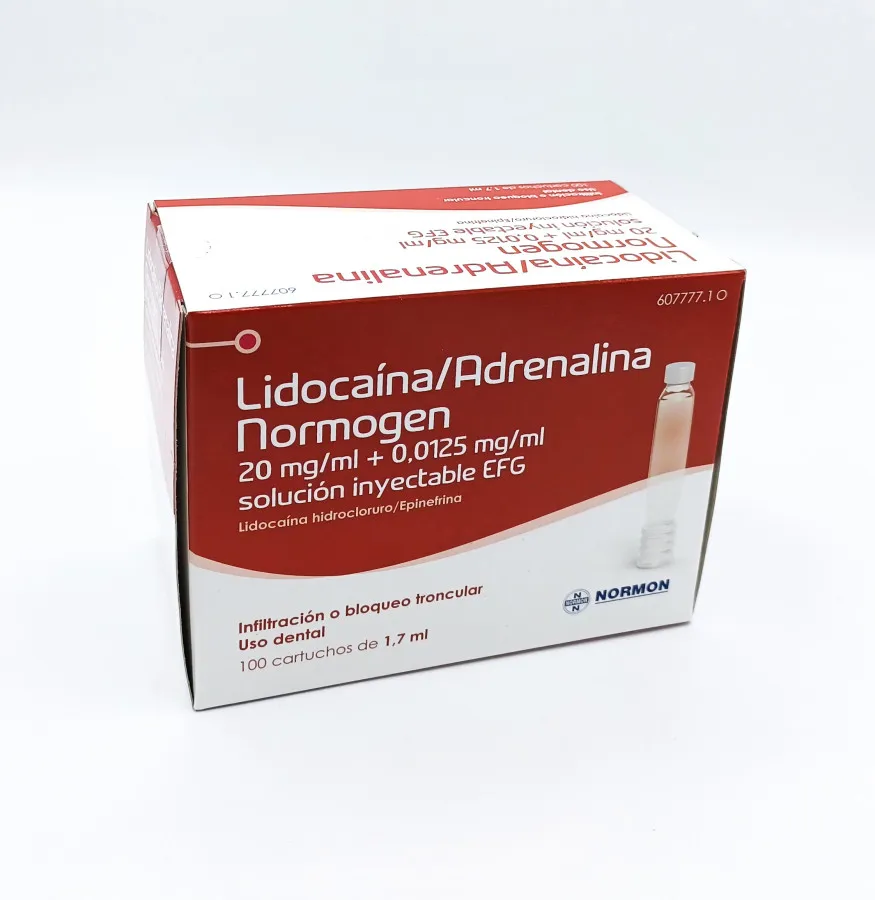
Table of Contents
- Package leaflet: Information for the user
- Introduction
- 1. What Lidocaína/Epinefrina Normon 20 mg/ml + 0.0125 mg/ml solution for injection EFG is and what it is used for
- 2. What you need to know before using Lidocaine/Epinephrine Normon 20 mg/ml + 0.0125 mg/ml injectable solution EFG
- 3. How to use Lidocaine/Epinephrine Normon 20 mg/ml + 0.0125 mg/ml injectable solution EFG
- 4. Possible adverse effects
- 5. Storage of Lidocaine/Epinephrine Normon 20 mg/ml + 0.0125 mg/ml solution for injection EFG
- 6. Contents of the container and other information
Package leaflet: Information for the user
Introduction
PACKAGE LEAFLET: INFORMATION FOR THE USER
Lidocaine/Epinephrine Normon 20 mg/ml + 0.0125 mg/ml solution for injection EFG
Lidocaine hydrochloride monohydrate/Epinephrine (bitartrate)
Read the entire leaflet carefully before you start using this medicine, because it contains important information for you.
- Keep this leaflet as you may need to read it again.
- If you have any questions, ask your doctor, pharmacist, or nurse.
- If you experience any adverse reactions, consult your doctor, pharmacist, or nurse, even if they are adverse reactions not listed in this leaflet. See section 4.
Leaflet contents:
- What Lidocaine/Epinephrine Normon 20 mg/ml + 0.0125 mg/ml solution for injection EFG is and what it is used for
- What you need to know before using Lidocaine/Epinephrine Normon 20 mg/ml + 0.0125 mg/ml solution for injection EFG
- How to use Lidocaine/Epinephrine Normon 20 mg/ml + 0.0125 mg/ml solution for injection EFG
- Possible side effects
- How to store Lidocaine/Epinephrine Normon 20 mg/ml + 0.0125 mg/ml solution for injection EFG
- Contents of the pack and other information
1. What Lidocaína/Epinefrina Normon 20 mg/ml + 0.0125 mg/ml solution for injection EFG is and what it is used for
Lidocaína/Epinefrina Normon 20 mg/ml + 0.0125 mg/ml is indicated for local dental anesthesia by infiltration or troncular block.
2. What you need to know before using Lidocaine/Epinephrine Normon 20 mg/ml + 0.0125 mg/ml injectable solution EFG
? Do not use Lidocaine/Epinephrine Normon:
- If you are allergic to lidocaine, epinephrine, amide-type local anesthetics, or any of the other components of this formulation.
- If you have closed-angle glaucoma (increased intraocular pressure), paroxysmal tachycardia (rapid pulse), or complete high-frequency arrhythmia (abnormal heart rhythm).
? Warnings and precautions
-
If you have any liver disorder. Special caution is required if the disorder is severe, as toxic levels of lidocaine may be reached.
-
If you have kidney disease, as the anesthetic or its metabolites may accumulate.
-
If you are being treated with monoamine oxidase inhibitors (MAO inhibitors), tricyclic antidepressants, phenothiazines, or non-cardioselective beta-blockers.
-
If you have heart dysfunction, as cardiac depressant effects may be increased.
-
If you have hypersensitivity to drugs, especially anesthetics or other chemically related substances.
Avoid injection into inflamed or infected areas.
Consult your doctor, even if any of the above conditions occurred in the past.
- Other medicines and Lidocaine/Epinephrine Normon:
Inform your doctor or pharmacist if you are taking or have recently taken any other medicines, including those obtained without a prescription. Some medicines may affect the action of others.
Administration of Lidocaine/Epinephrine Normon is not recommended with the following medicines:
- Tricyclic antidepressants or MAO inhibitors (monoamine oxidase inhibitors): may increase the vasodepressor effect of epinephrine.
- Phenothiazines and butyrophenones: may reduce or reverse the vasodepressor effect of epinephrine.
- Non-cardioselective beta-blockers (e.g., propranolol).
- Central nervous system depressants: may lead to additive depressant effects.
- Disinfectant solutions containing heavy metal ions: lidocaine may release ions from these solutions, causing significant local irritation and swelling.
- Neuromuscular blocking agents: the anesthetic may prolong or potentiate the action of these drugs.
Intramuscular injection of lidocaine may cause increased levels of phosphokinase.
- Use of Lidocaine/Epinephrine Normon with food, beverages, and alcohol
After administration of Lidocaine/Epinephrine Normon, do not ingest food until sensation has returned.
- Pregnancy and breastfeeding:
Consult your doctor or pharmacist before using any medicine. Special caution should be exercised when prescribing to pregnant women.
Lidocaine is excreted in small amounts in breast milk. No problems have been reported during breastfeeding.
? Driving and use of machines: Although effects on the ability to drive are not expected, the dentist will decide when you are fit to drive or operate machinery.
- Lidocaine/Epinephrine Normon contains sodium metabisulfite and sodium:
This medicine may cause severe allergic reactions and bronchospasm (sudden sensation of suffocation) because it contains sodium metabisulfite (E-223).
For doses below 3.91 ml, this medicine contains less than 23 mg of sodium per dose; this is essentially "sodium-free".
For doses equal to or greater than 3.91 ml, this medicine contains 23 mg or more of sodium (main component of table/cooking salt) per dose, equivalent to 1.1–7.3% of the maximum daily recommended sodium intake for an adult.
Athletes are advised that this medicine contains a component that may lead to a positive result in doping control tests.
3. How to use Lidocaine/Epinephrine Normon 20 mg/ml + 0.0125 mg/ml injectable solution EFG
Your dentist will determine the dose and method of administration of Lidocaine/Epinephrine Normon.
If you feel that the effect of this medicine is too strong or too weak, inform your doctor or pharmacist.
For infiltration or terminal anaesthesia, administration of 1 ml of Lidocaine/Epinephrine Normon is generally sufficient. For nerve block anaesthesia, the dose is 1.5 to 2 ml. The maximum dose within 24 hours is 500 mg of lidocaine, and must in no case exceed 7 mg/kg of body weight in adults.
Do not eat food until sensation has returned.
Paediatric population and special populations
In children, elderly patients, debilitated patients, and patients with cardiac and/or hepatic diseases, doses should be reduced according to age and physical condition.
Method of administration
Administration must be performed slowly.
Do not administer by intravenous route.
- If you receive more Lidocaine/Epinephrine Normon than you should
In case of overdose or accidental ingestion, contact your doctor or pharmacist immediately or call the Toxicology Information Service at telephone number 91-562 04 20, indicating the medicine and the amount used.
Respiratory, circulatory complications, and seizures may occur. If these occur, administration must be discontinued and appropriate treatment initiated.
If you have any further questions about the use of this product, ask your doctor or pharmacist.
4. Possible adverse effects
Like all medicines, Lidocaine/Epinephrine Normon may have adverse effects, although not everyone experiences them.
The frequencies of adverse reactions are defined as follows: very common (may affect more than 1 in 10 people), common (may affect up to 1 in 10 people), uncommon (may affect up to 1 in 100 people), rare (may affect up to 1 in 1,000 people), very rare (may affect up to 1 in 10,000 people), and frequency not known (cannot be estimated from the available data).
Very common (at least 1 in 10 patients): excitation, agitation, dizziness, tinnitus (ringing in the ears), blurred vision, nausea, vomiting, tremors, and convulsions. Following excitation, respiratory depression and coma may occur, even with myocardial depression (reduced activity of the heart muscles), hypotension (low blood pressure), bradycardia (slow heart rate), arrhythmia (abnormal heart rhythm and rate), and cardiac arrest.
Very rare (less than 1 in 10,000 patients): allergic reactions.
Other adverse reactions: Epinephrine may cause tachycardia (increased heart rate), cardiac rhythm disturbances, and increased blood pressure, although this is extremely rare.
If you consider any of the adverse effects you experience to be severe, or if you notice any adverse effects not listed in this leaflet, inform your doctor or pharmacist.
Reporting of adverse effects
If you experience any type of adverse effect, consult your doctor, pharmacist, or nurse, even if it is a possible adverse effect not listed in this leaflet.
You may also report them directly through the Spanish Pharmacovigilance System for Human Medicines: https://www.notificaram.es. By reporting adverse effects, you can help provide more information on the safety of this medicine.
5. Storage of Lidocaine/Epinephrine Normon 20 mg/ml + 0.0125 mg/ml solution for injection EFG
Keep out of the sight and reach of children.
Do not store above 30°C and keep in the original packaging to protect from light. Do not freeze.
Expiry: Do not use Lidocaine/Epinephrine Normon after the expiry date stated on the container, following "exp.". The expiry date refers to the last day of the month indicated.
Medicines should not be disposed of via wastewater or household waste. Ask your pharmacist how to dispose of medicines and packaging you no longer need. This will help protect the environment.
6. Contents of the container and other information
Composition of Lidocaine/Epinephrine Normon 20 mg/ml + 0.0125 mg/ml solution for injection EFG
The active substances are lidocaine hydrochloride monohydrate and epinephrine (bitartrate). Each ml of solution contains: lidocaine hydrochloride monohydrate and epinephrine (bitartrate).
The other components are: sodium metabisulfite (E-223), sodium chloride, water for injections.
Appearance of the product and contents of the container
Lidocaine/Epinephrine Normon 20 mg/ml + 0.0125 mg/ml: a clear, colourless or slightly yellowish solution.
Lidocaine/Epinephrine Normon 20 mg/ml + 0.0125 mg/ml is an injectable solution. It is supplied in cartridges, in packages containing 1 cartridge of 1.7 ml and a package leaflet.
Marketing Authorization Holder
LABORATORIOS NORMON, S.A.
Ronda de Valdecarrizo, 6 – 28760 Tres Cantos – Madrid (SPAIN)
Manufacturer
LABORATORIOS NORMON, S.A.
Ronda de Valdecarrizo, 6 – 28760 Tres Cantos – Madrid (SPAIN)
or
LABORATORIOS NORMON, S.A.
Avenida de los Artesanos, 28 – 28760 Tres Cantos – Madrid (SPAIN)
The latest revision of this leaflet was in February 2020
Other sources of information
Detailed and up-to-date information on this medicinal product is available on the website of the Spanish Agency of Medicines and Medical Devices (AEMPS) http://www.aemps.gob.es/
This information is intended for healthcare professionals only
For injection into the oral mucosa.
FOR DENTAL ANAESTHESIA ONLY.
To avoid intravenous injection, aspiration must always be performed prior to injection.
The use of an appropriate injection syringe for infiltration anaesthesia ensures optimal performance and maximum safety against cartridge breakage. Only the contents of intact cartridges should be injected.
To prevent any risk of infection (e.g. prevention of transmission of hepatitis), it is essential to use freshly sterilized syringes and needles. The remaining contents of partially used cartridges must not be administered to other patients.
For external disinfection of cartridges, isopropyl alcohol 91% or 70% ethyl alcohol without denaturants is recommended. Solutions containing heavy metals are not recommended, as they release ions (mercury, zinc, copper, etc.) which may cause oedema in dental local anaesthetic injections.
When any local anaesthetic is used, oxygen, resuscitation equipment and medications should be readily available.
Like other local anaesthetics, symptoms of toxicity in the form of respiratory, circulatory complications and seizures may occur due to excessive dosage, rapid absorption or inadvertent intravascular injection.
In such cases, for respiratory disturbances, ensure and maintain an open airway, administer oxygen and initiate controlled or assisted ventilation if necessary. In some patients, endotracheal intubation may be required.
For circulatory depression, a vasoconstrictor (preferably ephedrine) and intravenous fluids are recommended.
For convulsive seizures, if seizures do not respond to assisted ventilation, a benzodiazepine such as diazepam (in increments of 2.5 mg) or an ultra-short-acting barbiturate such as thiopental or thiamylal (in increments of 50 to 100 mg) is recommended, administered intravenously every 2 or 3 minutes. It should be borne in mind that under these circumstances, especially barbiturates, may cause circulatory depression when administered intravenously. A neuromuscular blocker is also recommended to reduce the muscular manifestations of persistent seizures. When these drugs are administered, artificial ventilation is mandatory.
Injection into an inflamed area must be avoided.