Lidocaine/adrenaline Normogen 20 mg/ml + 0.0125 mg/ml solution for injection EFG
Spain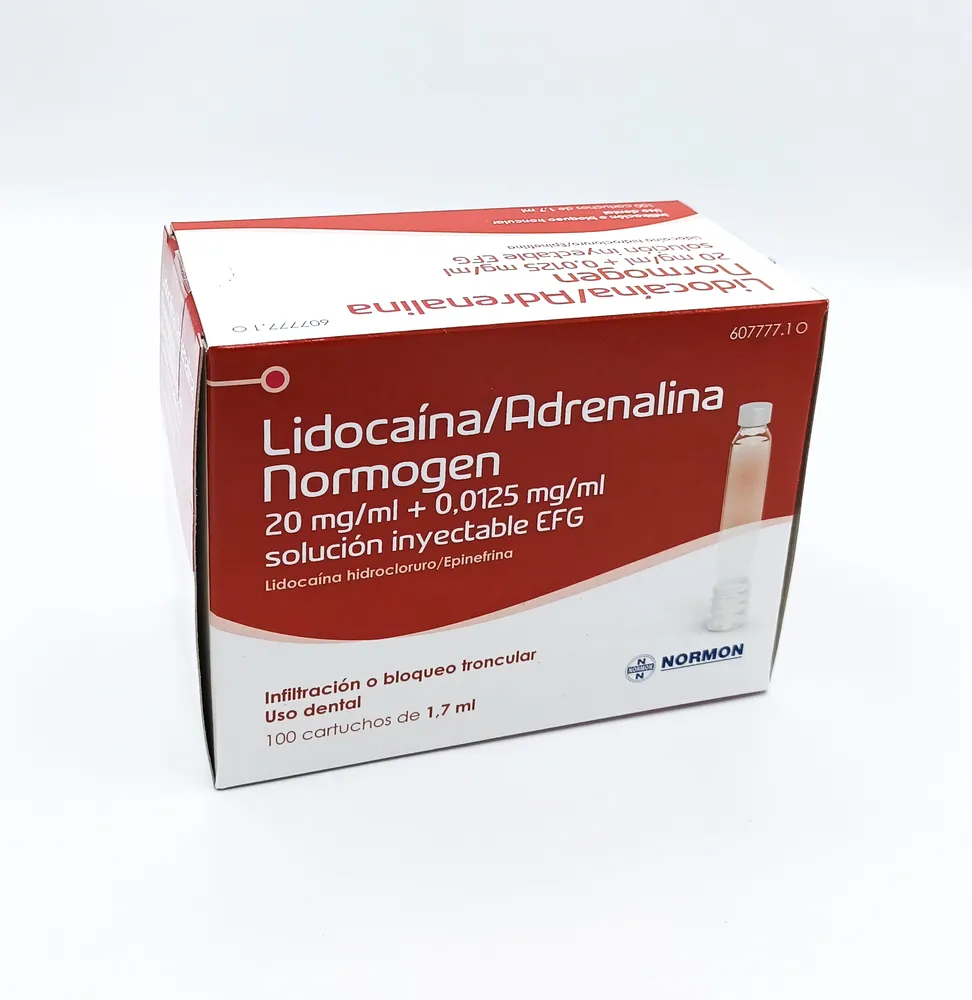
Table of Contents
- Package leaflet: Information for the user
- Introduction
- 1. What Lidocaína/Adrenalina Normogen is and what it is used for
- 2. What you need to know before using Lidocaine/Adrenaline Normogen
- 3. How to use Lidocaine/Adrenaline Normogen
- 4. Possible adverse effects
- 5. Storage of Lidocaine/Adrenaline Normogen
- 6. Contents of the pack and other information
Package leaflet: Information for the user
Introduction
Package leaflet: information for the user
Lidocaíne/Adrenaline Normogen 20 mg/ml + 0.0125 mg/ml solution for injection EFG
lidocaine hydrochloride/epinephrine
Read all of this leaflet carefully before you start using this medicine, because it contains important information for you.
- Keep this leaflet, as you may need to read it again.
- If you have any questions, consult your dentist or pharmacist.
- This medicine has been prescribed for you only, and you should not give it to others, even if they have the same symptoms as you, because it could harm them.
- If you experience any adverse effects, consult your dentist or pharmacist, even if they are adverse effects not listed in this leaflet. See section 4.
Contents of the leaflet
- What Lidocaïne/Adrenaline Normogen is and what it is used for
- What you need to know before using Lidocaïne/Adrenaline Normogen
- How to use Lidocaïne/Adrenaline Normogen
- Possible side effects
- How to store Lidocaïne/Adrenaline Normogen
- Contents of the pack and other information
1. What Lidocaína/Adrenalina Normogen is and what it is used for
Lidocaína/Adrenalina Normogen is an injectable solution indicated for local dental anesthesia, by infiltration or perineural route.
All surgical and non-surgical procedures in dentistry. Lidocaína/Adrenalina Normogen 20 mg/ml + 0.0125 mg/ml injectable solution is indicated when it is necessary to prolong the duration of anesthesia or when a reduction in local blood flow is required.
2. What you need to know before using Lidocaine/Adrenaline Normogen
Do not use Lidocaine/Adrenaline Normogen
- if you are allergic to lidocaine, adrenaline, amide-type local anaesthetics, or any of the other ingredients of this medicine (listed in section 6).
- if you have uncontrolled epilepsy with treatment.
- if you suffer from severe heart disease, serious arterial disorders or hypertension, ischemia, serious cardiac arrhythmias, migraine, hyperthyroidism, diabetes, benign prostatic hyperplasia, acute angle-closure glaucoma, or kidney disease, as this medicine contains a vasoconstrictor.
Warnings and precautions
Consult your dentist or pharmacist before starting to use lidocaine/adrenaline.
- if you have high blood pressure or heart problems.
- if you have liver or kidney problems.
- if you have diabetes.
- if you have thyroid problems.
If you are unsure whether any of the above conditions apply to you, consult your dentist or nurse before being administered lidocaine/adrenaline.
Other medicines and Lidocaine/Adrenaline Normogen
Inform your dentist or pharmacist if you are taking, have recently taken, or might need to take any other medicines, including medicines you have purchased without a prescription or herbal medicines. This is because lidocaine/adrenaline may affect how some medicines work, and conversely, some medicines may affect lidocaine/adrenaline.
In particular, inform your dentist if you are taking or using any of the following medicines:
- Beta-blockers such as propranolol.
- Butyrophenones for vomiting, such as domperidone.
- Other butyrophenones used to treat mental disorders, such as haloperidol.
- Phenothiazines used to treat mental disorders, such as chlorpromazine.
- Medicines for depression, such as monoamine oxidase inhibitors (MAOIs) and tricyclic antidepressants.
- Cimetidine
Lidocaine/Adrenaline Normogen with food, drinks and alcohol
After administration of lidocaine/adrenaline, do not eat food until sensation has returned.
Pregnancy and breastfeeding
If you are pregnant or breastfeeding, think you may be pregnant, or are planning to become pregnant, consult your dentist or pharmacist before using this medicine.
Driving and use of machines
Lidocaine may temporarily affect your motor skills, attention, and coordination. Your doctor will advise you whether you can drive or operate machinery.
Use in athletes
This medicine contains adrenaline, which may lead to a positive result in doping control tests (see references in section 4.4 of the Summary of Product Characteristics).
Lidocaine/Adrenaline Normogen contains sodium metabisulfite
Rarely, it may cause severe hypersensitivity reactions and bronchospasm.
Lidocaine/Adrenaline Normogen contains sodium
This medicine contains less than 1 mmol of sodium (23 mg) per cartridge; hence, it is essentially “sodium-free”.
3. How to use Lidocaine/Adrenaline Normogen
Your dentist will administer lidocaine/adrenaline by injection. Your dentist knows the correct way to give you this medicine.
The dose your dentist gives you will depend on the type of pain relief you need. It will also depend on your body size, age, and physical condition, as well as on the part of the body where the medicine will be injected. The lowest possible dose producing the required effect will be administered.
Lidocaine/adrenaline prevents nerves from transmitting pain signals to the brain. It stops you from feeling pain. It will start working within a few minutes after the injection, and its effect will gradually wear off once the medical procedure is completed.
Use in children and special populations
In children, doses will be reduced according to weight and age.
If you have been given more Lidocaine/Adrenaline Normogen than you should have
Serious side effects from receiving too much lidocaine/adrenaline require special treatment. Your dentist is trained to manage such situations. The first signs of having received too much lidocaine/adrenaline usually include:
- Feeling dizzy or slightly lightheaded.
- Numbness of the lips and around the mouth.
- Numbness of the tongue.
- Hearing problems.
- Vision problems.
Your dentist will stop administering lidocaine/adrenaline as soon as these signs appear, to reduce the risk of serious adverse effects. This means that if you experience any of these symptoms, or think you have received too much lidocaine/adrenaline, you must inform your dentist immediately.
Other more serious adverse effects from receiving excessive amounts of lidocaine/adrenaline include, among others, speech difficulties, irrational behavior, muscle spasms, seizures, effects on the heart and blood vessels, loss of consciousness, coma, and temporary interruption of breathing (apnea).
In case of overdose or accidental ingestion, consult your doctor or pharmacist immediately or call the Toxicology Information Service at telephone 91 562 04 20, indicating the medicine and the amount used.
4. Possible adverse effects
Like all medicines, this medicine can cause adverse effects, although not everyone will experience them.
Rare (may affect up to 1 in 1,000 people):
Low blood pressure, altered heart rhythm (arrhythmias), cardiac arrest, metallic taste, tinnitus (ringing in the ears), dizziness, anxiety, tremors, nystagmus (involuntary eye movements), headache, increased respiratory rate, paresthesia of the lips and tongue (loss of sensation accompanied by a burning sensation). Loss of consciousness and seizures, coma, and respiratory arrest (in case of overdose). Nausea, vomiting, and increased respiratory rate followed by respiratory depression, which may lead to respiratory arrest.
Due to the presence of adrenaline as a vasoconstrictor, the following rare adverse reactions may also occur: high blood pressure, chest pain, altered heart rhythm (arrhythmias), cardiovascular arrest, sensation of warmth, sweating, headaches, thyroid gland enlargement.
Very rare (may affect up to 1 in 10,000 people):
Skin rash, erythema (redness), pruritus (itching), edema (swelling) of the tongue, lips or mouth, allergic reactions or anaphylactic shock.
Due to the presence of sodium metabisulfite as an excipient, the following very rare adverse reactions may also occur: in individuals with bronchial asthma, allergic reactions may arise, presenting with vomiting, diarrhea, wheezing, acute asthma attack, decreased level of consciousness, or anaphylactic shock.
Reporting of adverse effects
If you experience any adverse effects, consult your dentist, pharmacist, or nurse, even if they are adverse effects not listed in this leaflet. You may also report them directly via the Spanish Pharmacovigilance System for Human Medicinal Products at www.notificaRAM.es. By reporting adverse effects, you can help provide more information on the safety of this medicine.
5. Storage of Lidocaine/Adrenaline Normogen
Keep this medicine out of the sight and reach of children.
Do not use this medicine after the expiry date stated on the packaging and cartridge after EXP. The expiry date refers to the last day of the month indicated.
Do not store above 25°C.
Do not refrigerate or freeze.
Keep in the original packaging to protect from light.
Do not use this medicine if you see any particles or if the solution is not clear.
Cartridges are for single use only. Use immediately after opening the cartridge. Discard any unused solution.
Medicines must not be disposed of via wastewater or household waste. Return unused medicines and their containers to the SIGRE point at your pharmacy. If in doubt, ask your pharmacist how to dispose of medicines and containers you no longer need. This will help protect the environment.
6. Contents of the pack and other information
Composition of Lidocaine/Adrenaline Normogen
-
The active substances are lidocaine hydrochloride and epinephrine (adrenaline) as bitartrate. Each ml of injectable solution contains lidocaine hydrochloride monohydrate, equivalent to 20 mg of anhydrous lidocaine hydrochloride (34 mg per 1.7 ml cartridge) and 12.5 micrograms of epinephrine (adrenaline) (as epinephrine bitartrate) (21.3 micrograms per 1.7 ml cartridge).
-
The other components are sodium metabisulfite (E-223), sodium chloride, and water for injections.
Appearance of Lidocaine/Adrenaline Normogen and pack contents
Lidocaine/Adrenaline Normogen is a transparent, colourless or slightly yellowish solution.
It is packaged in single-use glass cartridges, sealed at the base with a movable rubber plunger and at the top with a rubber seal held in place by an aluminium cap.
Pack containing 50 cartridges of 1.7 ml.
Pack containing 100 cartridges of 1.7 ml (clinical pack).
Only certain pack sizes may be marketed.
Marketing Authorisation Holder and Manufacturer
Laboratorios Normon, S.A.
Ronda de Valdecarrizo, 6
28760 Tres Cantos – Madrid
Spain
This medicinal product is authorised in the European Economic Area member states under the following names:
Bulgaria: Dilocain
France: Lidocaine Normon 20 mg/ml Adrenaline 0.0125 mg/ml, solution injectable
Iceland: Lident
Portugal: Lidocaine + Adrenaline Normogen
Romania: Lident 20 mg/ml + 0.0125 mg/ml solutie injectabila în cartus
Spain: Lidocaine/Adrenaline Normogen 20 mg/ml + 0.0125 mg/ml solution for injection EFG
Date of latest revision of this leaflet: August 2024
This information is intended for healthcare professionals only:
To avoid intravenous injection, aspiration must always be performed prior to injection. Using the appropriate injection syringe designed for local anaesthetic infiltration ensures optimal performance and maximum safety against cartridge breakage. Only the contents of intact cartridges should be injected.
To avoid any risk of infection (e.g. prevention of hepatitis transmission), it is essential to use newly sterilized syringes and needles. The remaining contents of partially used cartridges must not be administered to other patients.
For external disinfection of the cartridges, 91% isopropyl alcohol or 70% ethyl alcohol without denaturants is recommended. Solutions containing heavy metals are not recommended, as they release ions (mercury, zinc, copper, etc.) that may cause oedema during dental local anaesthetic injection.
When any local anaesthetic is used, oxygen, resuscitation equipment, and emergency medications must be readily available.
Injection into inflamed areas should be avoided.
Prior to use, the solution should be inspected visually; only clear solutions without particles should be used.
Cartridges are for single use only. If only part of a cartridge is used, the remaining contents must be discarded.
Use immediately after opening the cartridge.
Disposal of unused medicine and of all materials that have come into contact with it must be carried out in accordance with local regulations.